 From the Peace Dividend to the Power Dividend
For much of the late twentieth century, economic interdependence was presented as an insurance policy against conflict. The argument appeared convincing: countries that traded together, invested in one another and depended upon the same financial and technological systems would have too much to lose from confrontation. Factories crossed borders, companies built global supply chains, and nations specialised in what they could produce most efficiently. Economic connection was expected to discipline political aggression.
History, however, offered a warning that was too easily ignored. Before the First World War, Europe was already deeply connected through trade, finance and investment. Those links did not prevent conflict. During the oil shocks of the 1970s, control over energy became a source of geopolitical influence. In later decades, access to financial markets, strategic technologies and critical commodities repeatedly shaped international behaviour.
The mistake was not in believing that interdependence could create prosperity. It clearly did. The mistake was in assuming that dependence would always remain commercially neutral. A network that carries goods, money, data or technology can also be used to interrupt them. The infrastructure of cooperation can quietly become the infrastructure of coercion.
The New Geography of Economic Power
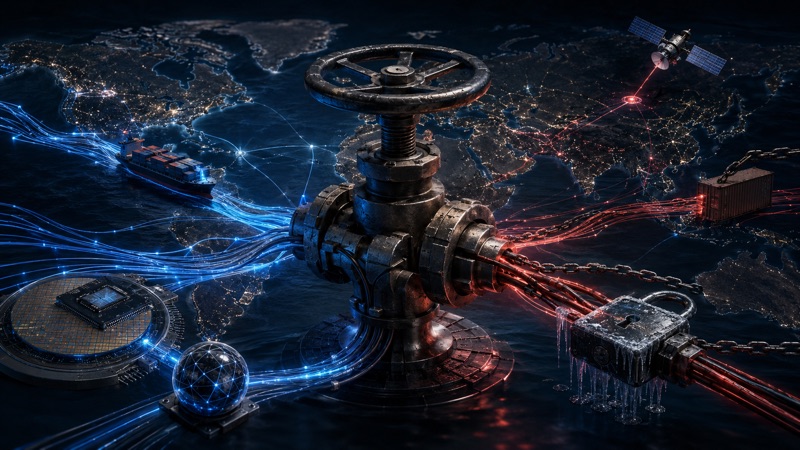
Traditional power was visible. It consisted of armies, territory, weapons and military alliances. The emerging form of power is less visible but can be equally disruptive. It lies inside payment systems, semiconductor supply chains, cloud platforms, undersea cables, shipping routes, insurance markets, logistics software, digital standards and control over critical minerals.
A country does not need to occupy another country to impose serious economic pain. It may restrict access to advanced chips, freeze overseas assets, block financial transactions, withdraw technology licences, prohibit investment, deny shipping insurance or place strategic companies on restricted lists. A port, payment network or digital platform can become a geopolitical checkpoint almost overnight.
This is the weaponisation of interdependence: the conversion of economic connection into political leverage.
The strongest position no longer belongs only to the country producing the largest quantity of a product. It may belong to the country controlling the most difficult point to replace. A small component, specialised machine, software update, certification system or financial clearing mechanism can carry more strategic importance than an entire factory. Economic power increasingly sits at the bottlenecks of global networks.
This changes how national strength must be measured. Gross domestic product alone cannot reveal who controls the switches, standards and chokepoints on which other economies depend.
Efficiency Created the Chokepoints
Globalisation rewarded concentration. Firms reduced inventories, relied on single suppliers, outsourced non-core functions and placed production where costs were lowest. This system produced cheaper goods and higher corporate margins, but it also removed redundancy. The more efficient the network became, the more dependent it became on uninterrupted movement.
Just-in-time production worked brilliantly in normal conditions. Under pandemics, wars, sanctions, cyberattacks, tariff shocks or shipping disruptions, it could become just-too-late production.
The vulnerability was not accidental. It was created by the economic logic of the previous era. Companies were rewarded for reducing spare capacity, while governments treated strategic resilience as an unnecessary expense. Competition policy examined prices but rarely examined national dependence. Procurement systems selected the lowest bidder without asking whether the supplier, technology, logistics route or payment channel could remain available during a geopolitical crisis.
The world therefore built networks that were commercially efficient but strategically fragile. The cheapest supply chain was often the one carrying the largest hidden risk.
Sanctions Are Becoming Industrial Policy
Economic restrictions are usually described as temporary responses to political disputes. Their effects, however, can reshape industrial geography for decades.
Export controls encourage targeted countries to develop domestic alternatives. Financial restrictions create incentives for new payment arrangements. Asset freezes alter how governments view the safety of foreign reserves. Technology bans divide research, investment and production ecosystems. Shipping controls redirect trade through longer and more expensive routes. Even countries not directly targeted begin to reconsider their exposure.
This creates a paradox. Pressure may weaken an opponent in the short term while accelerating its economic separation in the long term. A sanction can punish dependence, but it can also teach the sanctioned country that dependence is dangerous. Once that lesson enters national strategy, restoring the earlier relationship becomes difficult.
Sanctions and export controls are therefore no longer peripheral foreign-policy tools. They increasingly function as instruments of industrial policy. They influence where factories are built, which technologies receive subsidies, where minerals are processed and which countries are treated as trusted production partners.
The global economy is not simply fragmenting into geographical blocs. It is being reorganised into different layers of trust.
The Costly Return of Strategic Redundancy
Countries will now reduce selected dependencies even when doing so appears economically inefficient. Production will be duplicated. Strategic inventories will grow. Domestic industries will receive protection and subsidies. Firms will qualify alternative suppliers in multiple countries. Governments will invest in backup energy systems, secure digital infrastructure and national reserves of critical materials.
This will raise costs. Consumers may pay more, companies may carry larger inventories and governments may support facilities that cannot compete on price alone. But the calculation has changed. The relevant question is no longer only how much a product costs in normal times. It is also how much its absence would cost during a crisis.
Redundancy, once dismissed as waste, is becoming a strategic asset.
Yet complete self-sufficiency is neither realistic nor desirable. Modern products combine knowledge, components and materials from many economies. Attempting to nationalise every stage of production would reduce innovation and impose enormous costs. The real challenge is not to eliminate interdependence but to distinguish manageable dependence from dangerous dependence.
That requires identifying where substitution is slow, concentration is extreme, infrastructure is politically exposed or disruption could paralyse essential sectors. Resilience must be selective and evidence-based. Otherwise, national security may become an excuse for permanent protectionism, inefficient subsidies and politically connected domestic monopolies.
The Developing-Country Dilemma
The weaponisation of economic networks creates a particularly difficult environment for developing economies. Many lack the fiscal capacity to subsidise entire industries or duplicate sophisticated supply chains. They may depend on one country for technology, another for energy, another for export demand and a small number of global institutions for finance.
Pressure to choose sides could narrow their development options. Compliance with one bloc’s rules may restrict access to another bloc’s markets. Technology ecosystems may become incompatible. Financial and data standards may divide. Smaller countries could find themselves connected to several networks but trusted fully by none.
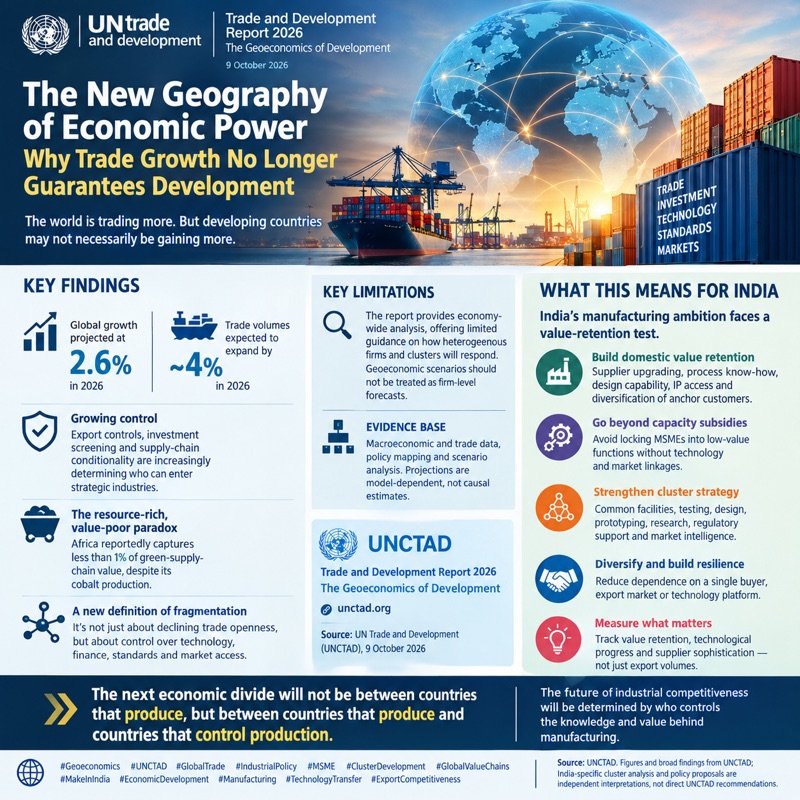
For India, the opportunity is significant but not automatic. Companies seeking to diversify production may view India as an alternative manufacturing base. But geopolitical alignment alone cannot replace industrial capability. Reliable electricity, efficient logistics, skilled labour, quality infrastructure, predictable regulation and competitive suppliers will remain essential.
India must avoid confusing geopolitical interest with guaranteed investment. A country becomes strategically valuable not merely because others want to reduce dependence on a rival, but because it can deliver consistently at scale.
Indian MSMEs face an even sharper transition. International buyers will increasingly examine cyber resilience, ownership structures, traceability, carbon intensity, data protection and continuity planning alongside price and quality. Small firms that remain invisible beyond the first-tier supplier may lose opportunities even if their products are competitive. Cluster-level testing centres, shared traceability platforms, secure digital systems and collective risk intelligence will therefore become essential economic infrastructure.
The Future Is Not Deglobalisation but Guarded Globalisation
The world is unlikely to abandon globalisation. It will instead construct a more guarded version of it. Trade will continue, but political trust will influence its direction. Investment will continue, but strategic screening will expand. Technology will spread, but within increasingly controlled ecosystems. Supply chains will remain international, but they will be designed with escape routes.
Companies will need to map not only suppliers but dependencies hidden several layers below them. Governments will need to understand that infrastructure ownership, software standards and financial plumbing can carry geopolitical consequences. Procurement will increasingly measure the price of interruption, not merely the price of purchase.
The central struggle of the coming decade will be over who controls the networks and who merely participates in them.
Interdependence is not disappearing. Its innocence is.
The old global economy treated connection as an economic good. The emerging order treats every connection as both an opportunity and a potential vulnerability. Nations that understand this distinction will build resilience without retreating into isolation. Those that do not may discover that the systems designed to connect them to global prosperity can also be switched off against them.
The future will not belong to the least connected country. Nor will it necessarily belong to the most connected. It will belong to those capable of remaining connected without becoming controllable.
#GlobalEconomy #Geopolitics #SupplyChains #TradePolicy #EconomicSecurity #MSME #India #Globalisation




No comments:
Post a Comment