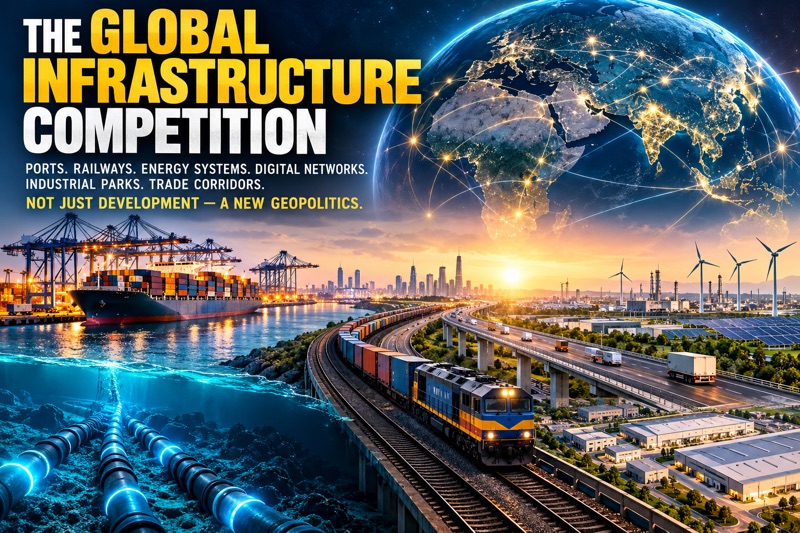
 For much of modern economic history, infrastructure was treated as the plumbing of development. Governments built roads, ports, power stations and railways so that factories could produce, farmers could reach markets and cities could grow. That description is becoming dangerously incomplete. Infrastructure is no longer simply supporting the economy. It is increasingly determining who controls the geography of the future economy. A port can influence trade routes. A railway can redirect mineral flows. A power grid can create industrial dependence. A data cable can determine digital connectivity. An industrial park can anchor an entire manufacturing ecosystem. The emerging global competition is therefore not only about who produces the cheapest product. It is increasingly about who builds, finances, operates and connects the systems through which products, energy, information and capital must travel.
Infrastructure Has Always Been Political
History provides an uncomfortable reminder that infrastructure and power have rarely been separate. The Roman road network moved commerce, but it also moved armies and administration. European railway construction during the colonial period connected markets, but frequently connected them according to the requirements of imperial trade. Canals such as Suez and Panama transformed transportation economics while simultaneously becoming strategic assets. After the Second World War, highways, electricity systems, ports and development finance became central to reconstruction and industrialisation.
The twentieth-century development model therefore had a relatively simple sequence: build infrastructure, reduce transaction costs, attract investment and generate growth.
The twenty-first century is adding another layer: build infrastructure, shape connectivity, influence supply chains and acquire strategic leverage.
That difference is fundamental.
The New Geography of Power Is Being Built
Globalisation once encouraged the belief that geography was becoming less important. Containerisation, cheap shipping, telecommunications and open trade reduced the economic penalty of distance. Companies could separate design, production, assembly and distribution across continents.
But recent disruptions have exposed the limits of that model. Pandemic-era shortages, geopolitical tensions, shipping disruptions, energy insecurity and competition over critical minerals have reminded governments that a supply chain is ultimately a physical chain.
Factories need electricity. Electricity needs grids. Grids need equipment and minerals. Minerals need mines, railways and ports. Digital economies need data centres, submarine cables and reliable energy. Semiconductor plants need water, power, logistics and specialised industrial ecosystems.
The supposedly weightless global economy has rediscovered concrete, steel, electricity and geography.
This is why ports, railways, logistics parks, pipelines, transmission systems, semiconductor ecosystems and digital networks are acquiring significance far beyond their immediate commercial returns.
The Competition Is Moving from Products to Systems
Traditional industrial competition asked a straightforward question: which country can manufacture a product most efficiently?
The emerging competition asks something much larger: which country or coalition can organise the entire economic system around production?
Consider an industrial corridor. Its value does not come from a highway alone. It emerges when transport infrastructure connects with industrial nodes, ports, electricity, warehousing, customs systems, finance, skills, housing and digital networks.
The same principle applies internationally.
A port without efficient hinterland connectivity may remain an expensive piece of concrete. A railway without sufficient cargo becomes a fiscal burden. An industrial park without suppliers becomes real estate. A digital network without affordable electricity cannot create a competitive data economy.
The real strategic asset is therefore not infrastructure itself. It is connected infrastructure.
This is where global infrastructure competition becomes more sophisticated. Major economies and development institutions are increasingly interested not merely in individual projects but in corridors and ecosystems capable of reorganising trade and investment geography.
Finance Will Become the Invisible Battlefield
The most important infrastructure competition may occur before construction begins.
Infrastructure requires enormous amounts of long-term capital. Developing economies simultaneously need transport systems, renewable energy, electricity grids, urban infrastructure, water systems and digital connectivity. Their fiscal capacity is often insufficient to finance everything domestically.
This creates a strategic question: who finances the infrastructure?
The lender or investor may influence technology standards, procurement, contractors, operating structures, debt terms and sometimes the future commercial orientation of the asset.
Infrastructure finance therefore carries something ordinary trade finance rarely does: decades of institutional relationships.
A consumer product can change suppliers next year. A railway gauge, electricity architecture, port concession, telecommunications system or industrial corridor may shape economic relationships for several decades.
This is why competition among national governments, multilateral development banks, sovereign funds, private investors and development-finance institutions will intensify.
But the danger is equally important. Developing countries can easily confuse available finance with good infrastructure.
Money can build an asset. It cannot guarantee that the asset creates productivity.
The Coming Problem of Infrastructure Without Economics
The next decade may produce an extraordinary paradox: countries could simultaneously suffer from infrastructure shortages and infrastructure excess.
There may be too little infrastructure where businesses genuinely need it and too much politically attractive infrastructure where economic demand remains weak.
This distinction matters enormously.
A spectacular port with insufficient cargo is not transformation. An industrial park without firms is not industrialisation. A railway without freight economics is not connectivity. A data centre without reliable electricity is not digital sovereignty.
The obsession with project size can therefore become misleading.
The better measurement is not kilometres constructed, megawatts installed or investment announced. It is economic activity generated per unit of infrastructure investment.
That requires governments to move from construction thinking to ecosystem thinking.
Digital Infrastructure Changes the Meaning of Sovereignty
The infrastructure contest is also moving underground and into cyberspace.
Submarine cables, fibre networks, cloud infrastructure, satellite systems, data centres and telecommunications equipment are becoming the roads and ports of the digital economy.
This creates a new kind of strategic geography.
A country may possess excellent physical ports but remain digitally dependent. It may generate enormous amounts of data while relying heavily on foreign technological infrastructure to process or transmit it.
Future economic sovereignty will therefore involve at least three overlapping networks: physical connectivity, energy connectivity and digital connectivity.
Countries capable of integrating all three could become disproportionately important economic nodes.
India Cannot Win by Building Isolated Projects
This changing landscape presents India with an unusually large opportunity, but also a major policy challenge.
India sits between important economic regions: East and Southeast Asia, the Indian Ocean, the Gulf, Africa and Europe. Its domestic market, manufacturing ambitions and maritime position create the possibility of becoming a major node in emerging trade and production networks.
But geography creates opportunity only when infrastructure converts location into economic advantage.
India therefore needs to think beyond individual highways, ports and industrial parks. The more important question is whether these assets form functioning production corridors.
A port must connect efficiently with manufacturing clusters. Manufacturing clusters must connect with suppliers. Suppliers need skills, technology and finance. Logistics systems need predictable customs procedures. Exporters need certification and market intelligence. Electricity must be reliable and increasingly competitive in carbon intensity.
The corridor must become an economic organism rather than a collection of construction projects.
For MSMEs this distinction is especially important. Large corporations can sometimes build private logistics, warehousing, energy and compliance systems. Smaller enterprises cannot.
Well-designed common infrastructure can therefore reduce the structural disadvantage faced by MSMEs. Poorly designed infrastructure may simply raise nearby land prices while leaving enterprise productivity largely unchanged.
Industrial Clusters May Become the Missing Link
The future infrastructure debate should consequently move closer to cluster economics.
Imagine a transport corridor passing through ten industrial clusters. Traditional infrastructure planning may measure traffic volumes and travel times. A more advanced approach would ask what prevents firms in those clusters from entering larger value chains.
Perhaps the problem is testing facilities. Perhaps cold storage. Perhaps design capability. Perhaps worker accommodation. Perhaps digital logistics. Perhaps certification laboratories or common effluent treatment.
The next generation of infrastructure policy should connect hard infrastructure with productive capability infrastructure.
That could become particularly important for India because thousands of smaller manufacturing enterprises already exist. The challenge is not always to create economic activity from zero. It is frequently to connect existing productive capacity with better technology, logistics and markets.
The World Could Split into Competing Connectivity Systems
The more difficult future scenario is fragmentation.
If geopolitical competition intensifies, infrastructure networks themselves could begin reflecting competing economic blocs. Countries may increasingly prefer trusted telecommunications suppliers, secure energy systems, alternative payment networks, diversified shipping routes and politically reliable logistics corridors.
Globalisation would not necessarily disappear.
It could instead become multi-network globalisation.
Several partially overlapping trade, technology, energy and financial systems could coexist.
For developing countries this would create difficult choices. Joining only one infrastructure ecosystem could create dependency. Trying to participate in every ecosystem could generate incompatible standards and political pressure.
Strategic flexibility may therefore become an economic asset.
From Infrastructure Competition to Connectivity Competition
The biggest mistake would be to interpret the emerging infrastructure race simply as another construction boom.
The deeper competition concerns connectivity.
Countries will compete to become places through which goods move, electricity flows, data travels, capital circulates and production networks connect.
Some countries will build infrastructure.
Others will build economic gravity.
That distinction may define the next phase of global development.
The winning infrastructure of the future will not necessarily be the biggest port, longest railway or largest industrial park. It will be the network that creates the strongest relationships between production, technology, energy, logistics, finance and markets.
The twentieth century taught countries to build roads to development.
The twenty-first century may demand something much harder: build networks that others find economically valuable to join.
And that is why the Global Infrastructure Competition is ultimately not a competition over concrete.
It is a competition over the architecture of the future global economy.
#Infrastructure #EconomicCorridors #Geopolitics #GlobalTrade #IndustrialPolicy #India #MSME #IndustrialClusters #SupplyChains #DigitalInfrastructure #Logistics #EconomicDevelopment




No comments:
Post a Comment