
1. A historical sweep: How productivity soared — and now stalls
For much of the 20th century and into the early 21st, global agriculture rode a wave of spectacular productivity gains: the Green Revolution, widespread mechanisation, improved fertilisers, seed breeding, irrigation expansion, and global trade networks that allowed surpluses and specialisation.
To illustrate the trend with numbers: over the long period from 1961–2021, world agricultural output increased at about 2.3 % annually. Total factor productivity (TFP) — a measure of output produced per unit of input — grew at about 1.1 % per year over that span.
However the last decade shows a much less impressive story: between 2011–2020, output grew around 1.93 % per year, compared with 2.72 % in the 2001–2010 decade. More strikingly, TFP growth fell to just about 1.14 % annually in 2011–2021 from 1.93 % in 2001–2010.
Why is this slowdown so worrying? Because agriculture is a fundamental enabling sector: it supplies food (and increasingly bio-inputs), stabilises incomes in many countries, supports economic development, and underpins food security. When productivity slows, it means either inputs must rise (land, water, fertiliser, labour) or production growth must fall (with attendant implications for food prices, trade imbalances, rural employment, biodiversity and environment).
Several key drivers of the slowdown have been identified:
Climate change and extreme weather events are reducing yield potentials and increasing risks. One study estimates that anthropogenic climate change has reduced global agricultural TFP by about 21 % since 1961, equivalent to losing roughly nine years of productivity growth.
Research & development, extension of innovations, and adoption of technologies are lagging. In regions where the “easy” gains (irrigation expansion, high-yield varieties) have already been captured, incremental improvements are harder to come by. In the U.S., research shows agriculture is facing its first productivity slowdown in decades, partly from weak R&D investment.
Soil degradation, diminishing returns on input intensification, ecological constraints (water, land, nutrients) impose harder limits.
The “low-hanging fruit” of productivity have largely been picked; future gains will likely require more radical changes (digital agriculture, precision farming, biology-based seeds) which are more complex, costly, and risk-laden.
A golden era of productivity acceleration has given way to a more challenging plateau — and perhaps a deceleration — just when global demand (driven by population growth, diets, rising incomes) still aims upward.
2. Trade shifts & self-sufficiency: The changing map of global agriculture
While productivity dynamics are internal to the farming and production system, the external dimension of global trade is shifting dramatically — with major implications for how countries organise agriculture and how global markets work.
China as a case study
One of the most consequential actors is China, whose agricultural and trade policies are helping reshape global flows. Consider these pieces of evidence:
China has set an ambitious self-sufficiency agenda: the country has declared a “red line” for arable land and emphasised “zero tolerance” for falling below it, aiming to bolster domestic production and reduce import dependence.
Historically, China’s agricultural trade shifted markedly. After its accession to the World Trade Organization in 2001, China moved from being a modest exporter of agricultural products to a major net importer. For example, exports grew ~8 % annually over two decades, but imports grew ~15 % annually.
The sectoral composition of trade is changing: for instance in one recent study raw agricultural imports still account for more than 60 % of China’s total agri-imports, while the share of raw products in exports dropped below 40 % by 2023.
Underlying this are structural constraints: China’s arable land declined by over 12 million ha between 2009–2021, while intensification (fertiliser use, chemical inputs) has created soil, water and environmental stress.
The upshot: China’s push for self-sufficiency (especially in staple grains) and its changed import/export posture are tilting the global agricultural map.
Global implications
Countries that previously relied on export-oriented agriculture catering to China’s import demands must now reassess: if China shrinks its import growth, this will reverberate through global commodity markets.
Supply chains will see increasing regionalisation or re-orientation: e.g., producers may shift toward other emerging demand centres, or rethink which crops make sense to export versus produce domestically.
Strategic geopolitics enters: food security is increasingly intertwined with national security. Self-sufficiency, domestic buffers, and control of value-chains matter.
Smaller or open-economy agricultural exporters may face risk of demand shocks if major importers shift their strategies.
Trade policy, tariffs, subsidies, and bilateral/multilateral agreements will matter more: production may become more localised or constrained by strategic considerations rather than purely comparative advantage.
3. A future-critical outlook: Where agriculture is headed (and what must change)
Putting together the productivity slowdown and the trade re-shaping, we enter a crucial inflection point for global agriculture. The decisions made (and the innovations adopted) now will shape outcomes for food security, sustainability and geopolitical stability. Here are some of the key elements and what to watch for — with a critical lens.
3.1 Productivity renaissance or stagnation?
Scenario A: Renaissance: If agricultural systems invest heavily in the next wave of technology — precision/robotic farming, gene-edited crops, vertical/controlled-environment agriculture, digital data analytics, AI + remote sensing (what some call “Agriculture 4.0”) — then we might re-accelerate productivity growth. Indeed studies suggest this is feasible but only with concerted investment.
Scenario B: Stagnation / decline: If investment remains low, R&D lags, climate effects worsen, and socio-economic barriers (adoption, infrastructure) persist — then we may see productivity growth fall further, perhaps to under 1 % annually. That would severely constrain output growth in the face of rising demand.
Criticality: The difference between these scenarios is not trivial. A sustained productivity growth of ~2 % annually might allow supply to keep pace with moderate demand growth without huge expansions of land or inputs. But growth at <1 % means either demand must moderate (hard politically) or supply will struggle, pushing up food prices, intensifying land conversion, increasing environmental degradation and contributing to social unrest.
3.2 Demand–supply mismatch & environmental trade-offs
With a global population projected to reach ~9–10 billion this century and rising per capita demands, agriculture will need to deliver more with less (land, water, ecological impact).
If productivity fails to keep up, the only recourse may be intensification (more inputs per hectare) or expansion (bringing more land into production) — both of which come with environmental costs (soil degradation, deforestation, biodiversity loss, water stress). For example, one model shows supply-side improvements alone trigger compensatory land expansion that undermines ecological gains.
Therefore, demand-side change (diet shifts, food waste reduction, more plant-based diets) becomes a critical lever. Without it, the ecological burden of agriculture will balloon.
3.3 Trade re-wiring and strategic agriculture
As major players like China orbit toward self-sufficiency in certain crops and try to de-risk imports, global supply-chains will re-wire. Countries will be forced to ask: Which crops am I going to export, which will I produce domestically? Where are my competitive advantages?
Some regions may transition away from bulk commodity crop production (if their customers change), toward higher-value crops, services (ag-tech), or diverse systems. Others may double down on staple production to serve export markets still open.
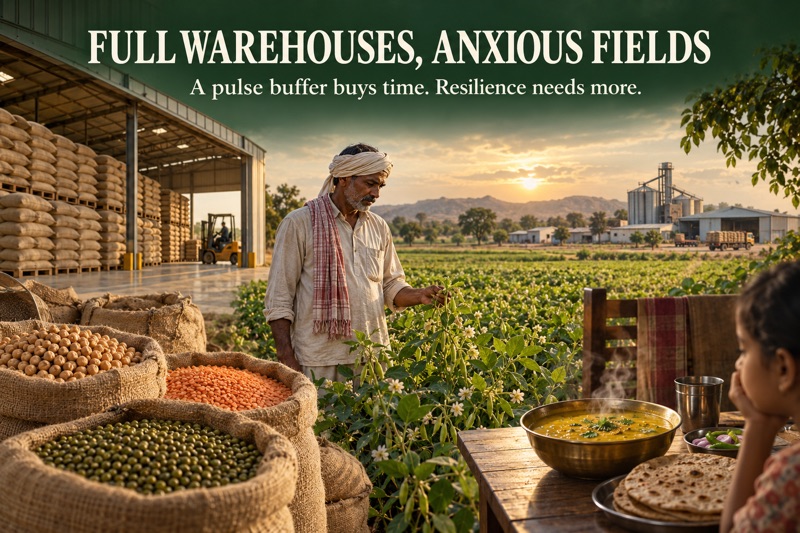
Strategic backup and resilience will matter: nations may maintain buffer stocks, diversify geographic sourcing, and invest in domestic capacity for staples (even if not fully competitive).
Trade alliances and agricultural diplomacy will become more prominent — agriculture will more explicitly be part of geopolitical strategy (not just commercial trade).
3.4 Sustainability, agriculture as climate actor
Agriculture will be simultaneously part of the solution and part of the problem: it must feed billions, but also reduce greenhouse-gas emissions, protect soils, restore landscapes and manage water. The global agrifood system is already under scrutiny for its environmental footprint.
Productivity gains alone are insufficient if they degrade ecological capital (soil, biodiversity, water). The future must integrate regenerative agriculture, agro-ecological practices, and closed-loop systems.
From a risk standpoint: if agricultural productivity lags and environmental degradation accelerates, the outcome could be a vicious cycle — degraded soils lower yields, yield drops drive expansion, that expansion degrades more land, etc.
3.5 What must change — policy, investment, mindset
Massive investment in agricultural R&D, extension services, infrastructure (rural roads, digital connectivity) and adoption mechanisms. Without bridging the “innovation-to-practice” gap, productivity will stall.
Adoption of smart farming: IoT sensors, drones, robotics, gene technologies, precision irrigation — these must move from niche to standard, globally, including in lower-income countries.
Re-orientation of trade policies: Governments must recognise that self-sufficiency goals may conflict with comparative advantage and global efficiency — trade diversification, regional cooperation and strategic reserves become more critical.
Demand-side strategies: Encourage dietary shifts, reduce food waste, promote more sustainable consumption. This eases the pressure on supply systems.
Environmental integration: Reward systems and policies must value soil health, water sustainability, biodiversity. Agriculture must earn the right to expand or intensify by safeguarding the ecosystem.
Resilience mindset: Climate shocks, supply-chain disruptions, trade wars will continue — systems need built-in buffers, flexibility and redundancy. The era of “just-in-time” global food may be more brittle than recognised.
4. A visionary scenario to 2050 and beyond
Imagine the global agricultural landscape in 2050 under two divergent pathways:
Pathway 1: “Stagnation & Stress”
Global agricultural productivity grows at ~0.5–1.0 % annually.
Staple crop output barely keeps pace with demand; food prices steadily climb; pressure on marginal lands intensifies.
Major importers like China reduce dependence, forcing export-oriented producers to scramble for new markets or shift crops.
Environmental degradation accelerates — soil loss, water scarcity, biodiversity erosion become limiting factors.
Food insecurity hotspots increase; trade disruptions (due to climate, geopolitics) become more frequent.
Agriculture becomes a significant risk vector for instability (migration, conflict over resources, price shocks).
Pathway 2: “Transform & Thrive”
Productivity rebounds to ~1.5–2.0 % annually via widespread adoption of advanced technologies and regenerative practices.
Smart farming, biological innovations, precision inputs, AI-driven crop management become mainstream globally.
Agriculture is decoupled from heavy land/chemical expansion: more yield per hectare, less environmental damage.
Trade flows stabilise but shift: self-sufficient nations still trade high-value speciality crops, services and technologies, while staple chains become regionalised and resilient.
Demand-side moderation (plant-rich diets, lower waste) ensures supply stress is manageable.
Agriculture becomes part of the climate solution: sequestering carbon, restoring soils, integrating agro-forestry, supporting biodiversity.
Food systems are more robust: better buffers, diversified sourcing, resilient to shocks.
Which path unfolds depends critically on decisions taken now. The stakes are high. In agriculture, a half-percent difference in productivity growth adds up to massive output shortfalls by mid-century.
5. Final reflections
The era of sweeping productivity gains in agriculture is waning; the next decade is likely to bring slower growth, higher risks unless we act.
Global trade in agriculture is being re-calibrated — countries like China are shifting toward self-sufficiency, altering demand landscapes and forcing realignment of supply chains.
Agriculture now sits at the conjunction of food security, climate change, trade geopolitics, technological disruption and environmental sustainability.
The imperative is not just produce more — but produce better, smarter, more sustainably, and integrate demand-side moderation.
For policymakers, businesses and farmers alike, the coming years will require strategic foresight, investment in innovation, agility in trade and commitment to ecological health. Without this, we risk a world where agricultural growth stalls, food becomes more expensive and fragile, and the ecological cost becomes unbearable.
Agriculture is not just facing another incremental phase of growth — it is entering a period of transition. The choices we make now will determine whether that transition leads to renewed vitality or systemic strain.
#agriculturalproductivity
#foodsecurity
#globaltrade
#climatechange
#selfsufficiency
#sustainablefarming
#agricultureinnovation
#chinaagriculturepolicy
#regenerativeagriculture
#futureoffood




No comments:
Post a Comment