Showing posts with label market access. Show all posts

Saturday, October 28, 2023

Government Initiatives and Opportunities for Self-Help Groups (SHGs) in India: Empowering Women and Alleviating Poverty


Self-help groups (SHGs) have become a crucial tool for poverty alleviation and women's empowerment in India. The government has taken several initiatives to support and promote the growth of SHGs in the country. The National Rural Livelihoods Mission (NRLM) is one of the flagship programs that aims to reduce poverty by mobilizing rural women into SHGs and building community institutions of the poor. It has played a significant role in the spread of SHGs since 2011.

In August 2021, under the Atmanirbhar Bharat program, the government announced financial support of Rs 1,625 crore to over 0.4 million SHGs. This funding was specifically aimed at providing assistance to SHGs during the challenging times of the COVID-19 pandemic[2]. Additionally, the government has been focusing on promoting financial inclusion for SHGs, enabling them to access formal credit and banking services. This has been instrumental in supporting the growth and sustainability of SHGs.

Market linkages and skill development opportunities have been provided to SHGs to help them access new markets and increase their earning potential. The government has recognized the power of SHGs in women's empowerment and has implemented various programs and initiatives to support women's participation in SHGs. These initiatives aim to enhance the socio-economic status of women and promote their active involvement in decision-making processes.

However, SHGs in India still face challenges that need to be addressed. Access to credit remains a significant challenge for many SHGs due to the lack of collateral and credit history. Market access is another hurdle as SHGs often struggle to reach markets for their products, limiting their earning potential. The digital divide is also a concern, as many SHGs lack access to digital technology, hindering their participation in e-commerce and other digital platforms.

Looking forward to 2024, SHGs have opportunities that can be capitalized on. The government's continued support and recognition of SHGs as a tool for poverty alleviation and women's empowerment present a positive outlook. The growing demand for sustainable and locally sourced products provides avenues for SHGs to access new markets and increase their earning potential. The push for digital transformation by the government can also help SHGs overcome the digital divide and participate in e-commerce platforms.

In conclusion, self-help groups in India have made significant progress in poverty alleviation and women's empowerment. The government has played a crucial role in supporting the growth of SHGs through various initiatives. However, challenges such as access to credit, market access, and the digital divide need to be addressed. With the right support and opportunities, SHGs can continue to contribute to India's economic development and make a positive difference in the lives of women.

References:
[1] Key to BJP plans in the run-up to 2024 LS polls: Self-Help Groups, in maps and numbers https://indianexpress.com/article/political-pulse/bjp-plans-2024-lok-sabha-polls-self-help-groups-8898020/
[2] Self Help Groups - Drishti IAS https://www.drishtiias.com/daily-updates/daily-news-analysis/self-help-groups-4
[3] This MoU will be a landmark in empowering women SHGs and rural poor youth - PIB https://pib.gov.in/PressReleasePage.aspx?PRID=1907742
[4] (PDF) Self-Help Groups and COVID-19: Effects on and Challenges for the National Rural Livelihoods Mission in India - ResearchGate https://www.researchgate.net/publication/358667235_Self-Help_Groups_and_COVID-19_Effects_on_and_Challenges_for_the_National_Rural_Livelihoods_Mission_in_India
[5] The power of the collective empowers women: Evidence from self-help groups in India - PMC - NCBI https://www.ncbi.nlm.nih.gov/pmc/articles/PMC8350313/
[6] The Economic Potential Of Women Self-help Groups - Forbes India https://www.forbesindia.com/article/special/the-economic-potential-of-women-selfhelp-groups/61329/1
[7] Self Help Groups - PIB https://pib.gov.in/newsite/PrintRelease.aspx?relid=191635
[8] Women self-help groups: Funding alone does not work; the government needs to listen in https://www.downtoearth.org.in/blog/governance/women-self-help-groups-funding-alone-does-not-work-the-government-needs-to-listen-in-78995
[9] Self Help Groups - Drishti IAS https://www.drishtiias.com/daily-updates/daily-news-analysis/self-help-groups-4
[10] Self-help groups as platforms for development: The role of social capital - PMC - NCBI https://www.ncbi.nlm.nih.gov/pmc/articles/PMC8350316/
[11] Social networks, mobility, and political participation: The potential for women's self-help groups to improve access and use of public entitlement schemes in India | IFPRI https://www.ifpri.org/publication/social-networks-mobility-and-political-participation-potential-womens-self-help-groups
[12] In India, Women's Self-Help Groups combat the COVID-19 (Coronavirus) pandemic https://www.worldbank.org/en/news/feature/2020/04/11/women-self-help-groups-combat-covid19-coronavirus-pandemic-india

Thursday, October 26, 2023

Transforming Indian Agriculture: Unleashing the Potential of Farmers Producer Organizations (FPOs)

Introduction

Farmers Producer Organizations (FPOs) have emerged as a promising model for empowering small and marginal farmers in India. By offering various services such as input procurement, marketing, processing, and credit, FPOs aim to address the challenges faced by farmers and improve their income and livelihood. This article critically reviews the successes, challenges, and level of success achieved by FPOs in India, and presents recommendations for their growth and sustainability.

Successes of FPOs in India

FPOs in India have demonstrated several successes, marking a positive impact on the agricultural sector:

Increased farm income: Studies have consistently shown that farmers who are members of FPOs can yield 20-30% higher earnings compared to non-members. By collectively bargaining with buyers, reducing input costs, and accessing value-added markets, FPOs provide farmers with better price realization for their produce.

Improved access to inputs and credit: FPOs play a crucial role in facilitating the procurement of high-quality inputs at competitive prices for their members. Additionally, they assist farmers in obtaining credit from formal financial institutions, ensuring the availability of capital for enhancing productivity and profitability.

Reduced risk: FPOs mitigate farmers' risks by providing access to insurance and other risk management mechanisms. This empowers farmers to protect themselves from unforeseen challenges such as crop failure and price volatility, fostering stability and resilience in the agricultural sector.

Empowerment: By giving farmers a voice in the market and equipping them with the necessary skills and knowledge, FPOs empower small and marginal farmers to manage their businesses more effectively. This shift in power dynamics can lead to the socio-economic upliftment of farming communities.

Challenges Faced by FPOs

Despite their successes, FPOs face various challenges that hinder their growth and sustainability:

Lack of awareness: Many farmers are still unaware of FPOs and the potential benefits they offer. Efforts need to be made to raise awareness and educate farmers about the advantages of joining FPOs.

Weak capacity: FPOs often lack the technical and managerial skills required to operate efficiently. Support in capacity building and skill enhancement must be provided to strengthen the organizational structure and functioning of FPOs.

Inadequate financing: Access to sufficient finance remains a significant challenge for FPOs, limiting their ability to expand their operations and reach a larger membership base. Strategies should be devised to facilitate easier access to finance and credit for FPOs from banks and other financial institutions.

Unfavorable market environment: FPOs operate in a market environment that often favors larger players and disadvantages small and marginal farmers. Addressing this issue would require policy interventions aimed at creating a more equitable and supportive market system.

Level of Success Achieved by FPOs in India

The level of success attained by FPOs in India is characterized by considerable variation. While some FPOs have flourished, transforming the lives of their members, others have encountered significant challenges and even failed.

A study conducted by the Indian Council of Agricultural Research in 2022 revealed that only around 20% of FPOs in India can be classified as fully operational and profitable. The remaining 80% struggle to survive. This disparity in success depends on factors such as the quality of management, member commitment, and support from the government and other stakeholders.


FPOs have the potential to act as catalysts in the transformation of Indian agriculture. To harness this potential, robust support from the government and other stakeholders is vital. By addressing the challenges faced by FPOs and implementing the recommendations provided, FPOs can overcome barriers and contribute significantly to the empowerment and development of small and marginal farmers.

Recommendations for Supporting FPOs

To support the growth and sustainability of FPOs, the government and other stakeholders should consider the following recommendations:

1. Raising awareness: Launch awareness campaigns to educate farmers about the benefits and functioning of FPOs, and encourage them to join.

2. Training and capacity building: Provide comprehensive training programs to FPOs, focusing on technical and managerial skills, financial management, and market linkages.

3. Facilitating access to finance: Establish easier access to finance and credit through tailored financial products and simplified lending procedures for FPOs.

4. Creating favorable market environment: Introduce policy reforms that level the playing field for small and marginal farmers, ensuring fair prices, transparent market information, and simplified marketing processes.

By adopting these recommendations, the government and other stakeholders can foster an enabling environment for FPOs, unlock their full potential, and contribute to the sustainable development of Indian agriculture.

In conclusion, FPOs have shown promise in uplifting small and marginal farmers in India. By effectively addressing the challenges they face and leveraging the successes achieved, FPOs can be instrumental in transforming the socio-economic landscape of Indian agriculture. With collaborative efforts from all stakeholders, FPOs can chart a path towards a more inclusive and prosperous agricultural sector for the betterment of farmers and the nation as a whole.

The citations

1. Indian Council of Agricultural Research (2022). Study on the Status of Farmers' Producer Organizations in India.
2. National Bank for Agriculture and Rural Development (NABARD). Farmer Producers' Organizations (FPOs). https://www.nabard.org/auth/writereaddata/CareerNotices/2309195308National%20Paper%20on%20FPOs%20-%20Status%20&%20Issues.pdf
3. Backpacker (2023). Farmer Producers' Organizations in India: A Critical Review. https://books.google.co.in/books?id=1-EDAAAAMBAJ&pg=PA15&lpg=PA15&dq=FPO+in+India:+A+Critical+Review+of+Successes,+Challenges,+and+Recommendations&source=bl&ots=r3oo-dqJqi&sig=ACfU3U3lAJGs80iIKF4RDK5MqkaO7t9mkg&hl=en

Thursday, September 21, 2023

Leveraging E-commerce for the Growth of MSMEs by ICRIER

Introduction

The Annual Survey of Micro, Small, and Medium Enterprises (MSMEs) in India aims to explore the potential of e-commerce platforms in enhancing market access and enabling the growth of MSMEs. It is widely believed that e-commerce platforms can provide new sales channels for MSMEs, allowing them to reach customers in a wider geographical market. However, limited evidence is available on the engagement of MSMEs with e-commerce platforms in India, as this information is often proprietary and not accessible to researchers. This report fills this knowledge gap by conducting a comprehensive primary survey of MSMEs, combining data from integrated and non-integrated enterprises to understand the potential of e-commerce in India.

The survey was conducted between 4 November 2022 and 20 January 2023, covering 2,007 MSMEs across different size categories. The majority of the firms in the sample were micro-sized (65%), followed by small-sized (19%) and medium-sized enterprises (16%). Out of the total sample, 50% of the enterprises were integrated with e-commerce platforms, while the remaining 50% were not. The survey spanned six product categories, including sports goods, toys, processed and preserved food products, apparel, furniture, and handicraft products. It covered several cities in India, such as Ahmedabad, Bhubaneshwar, Delhi, Jaipur, Lucknow, Ludhiana, Jalandhar, Agra, Meerut, Saharanpur, and Chennai. All the enterprises included in the sample were registered on the Udyam portal, a government facility that provides firms with a permanent registration and basic identification number.

The survey questionnaire aimed to gather information on key performance indicators of the firms, including sales, employment, and profitability. It also captured important characteristics of the businesses, such as export orientation and demographic factors of the owners. This allows for a comparative assessment of MSMEs engaged in e-commerce platforms and those that are not. The survey design also takes into account the heterogeneities within the MSME sector, recognizing that factors influencing e-commerce integration and performance may differ across micro, small, and medium enterprises.

Survey Findings

The survey findings shed light on the characteristics and performance of integrated and non-integrated MSMEs in India. The results indicate that firms with younger and more educated owners are more likely to integrate with e-commerce platforms. The survey also revealed that women-owned MSMEs are not far behind male-owned firms in terms of e-commerce integration, despite women's underrepresentation in the overall MSME landscape. Export-oriented firms were found to have a higher propensity for e-commerce integration, suggesting a positive relationship between export orientation and digitalization.

Integrated firms generally exhibited better performance compared to non-integrated firms. They reported higher turnovers, profitability, and a higher share of permanent employees in their workforce. Integration with e-commerce platforms brought several benefits, with a significant percentage of integrated enterprises reporting an increase in total sales and profit margins. Many firms also invested in employee training, new equipment, machinery, and software upon joining e-commerce platforms. Integration was associated with improvements in product design, adoption of new business practices, and organizational methods, indicating investment and innovation at the firm level.

While integrated firms saw several positive outcomes, the survey also identified challenges faced by non-integrated MSMEs. Lack of knowledge and information about digital technologies and e-commerce platforms emerged as key barriers to integration. Policymakers and stakeholders must take into account the potential inequities that may arise between integrated and non-integrated firms and work towards bridging the divide. Investments in technology, digital skills, infrastructure services, financial services, managerial and business skills, and enterprise support and training are crucial in enhancing the capabilities and productivity of MSMEs.

Key Challenges and Policy Recommendations

Based on the survey findings, the report highlights key challenges faced by MSMEs in India and provides policy recommendations to address these challenges. One of the main challenges is the lack of knowledge and information about e-commerce platforms, which hinders the integration of MSMEs. To overcome this barrier, the report suggests the need for awareness programs, capacity-building initiatives, and training programs to enhance digital literacy and provide information on the benefits and process of e-commerce integration.

Access to finance is another challenge for MSMEs, both integrated and non-integrated. The report recommends the development of innovative financing mechanisms, such as linking e-commerce platform sales to loan accounts or leveraging fintech companies and non-banking financial corporations for easier access to loans. It also emphasizes the importance of improving credit assessment processes and expanding the availability of formal finance to MSMEs, especially those without a presence on e-commerce platforms.

Infrastructure development is crucial for the growth of MSMEs and their integration with e-commerce platforms. The report suggests the provision of reliable and affordable internet connectivity, enhanced logistics and transportation networks, and access to electricity and other utilities. Improving physical infrastructure will facilitate smoother online transactions, reduce costs, and enhance the overall competitiveness of MSMEs.

The report also highlights the need for collaborative efforts between government bodies, industry associations, e-commerce companies, and other stakeholders. Policy coordination and dialogue are essential to create an enabling environment for MSMEs to integrate with e-commerce platforms. Cooperation between different stakeholders can lead to the development of supportive regulations, policies, and initiatives that promote MSME growth and facilitate e-commerce integration.

Conclusions

The Annual Survey of MSMEs in India sheds light on the potential of e-commerce platforms in enhancing market access and enabling the growth of MSMEs. The survey findings indicate that integration with e-commerce platforms brings significant benefits to MSMEs, including improved market access, increased sales and profit margins, investment in technology and innovation, and access to formal finance. However, challenges remain, particularly for non-integrated MSMEs, who face barriers such as lack of knowledge and information. Bridging the gap between integrated and non-integrated firms requires investments in digital skills, infrastructure development, and enterprise support. Policy coordination and collaboration among various stakeholders are crucial in creating an enabling environment for MSMEs to leverage e-commerce platforms for their growth.

The report concludes by emphasizing the importance of leveraging the potential of e-commerce platforms to foster inclusive and sustainable growth for MSMEs in India. E-commerce integration can help overcome the limitations of local markets and enable MSMEs to reach a wider customer base, both domestically and internationally. By addressing the challenges and implementing the recommended policy measures, India can unlock the full potential of its MSME sector, contributing to economic development, job creation, and poverty alleviation.
https://drive.google.com/file/d/1QCFrrbBPhf0O4X1asGwC2bxzqX69GWw4/view?usp=drivesdk

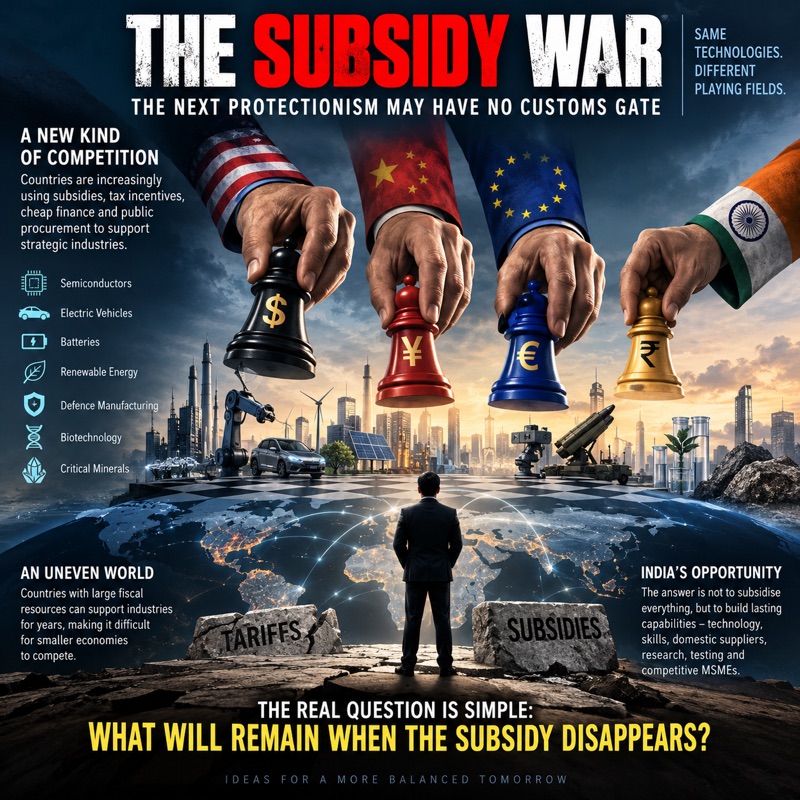
The Subsidy War: When Governments Become Competitors

For much of the last three decades, the visible face of protectionism was the tariff. Governments raised duties, imposed quotas or restricte...