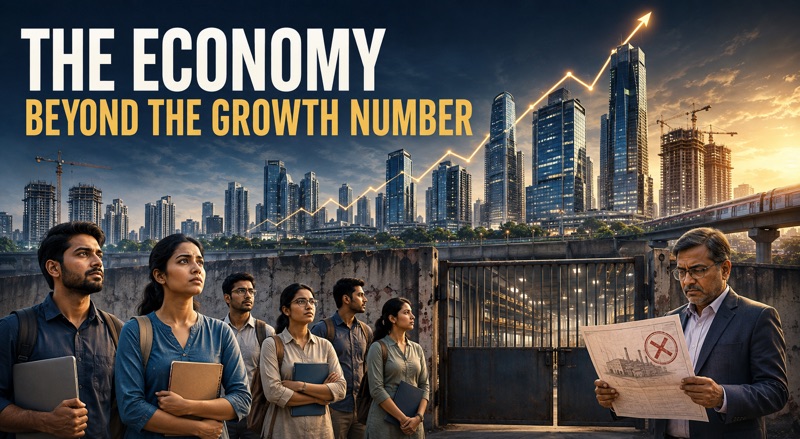
 When Growth Becomes a Distraction
An economy can grow impressively on paper and still leave millions of people waiting for a decent livelihood. This is the uncomfortable contradiction at the centre of the Indian growth story. The debate usually gets trapped in one question: Is the official growth number accurate? Economists examine base years, deflators, surveys, tax data and statistical methods. These questions are important, particularly when different indicators appear to tell different stories. But they can also distract attention from a much larger problem.
Even if every growth number is accepted as correct, the real test remains unanswered. Is the economy producing enough secure, productive and reasonably paid jobs? Are businesses investing in new factories, technologies and capabilities? Are global companies bringing long-term capital, knowledge and supply chains? Are young people becoming more productive, or are they merely moving between unemployment, examination preparation and insecure work?
A growth rate cannot answer these questions by itself.
The Jobless Celebration
Economic growth was once expected to create a visible chain of progress. Investment created factories. Factories created employment. Employment generated incomes. Rising incomes expanded demand, encouraging further investment. This relationship was never perfect, but it gave growth a social meaning.
That chain is now weakening. Production can increase without a similar rise in employment. Automation allows companies to expand output with fewer workers. Digital platforms can increase transactions without building stable careers. Construction can absorb workers temporarily but rarely provides lasting skill development. Much of the services economy creates either highly paid jobs for a small group or insecure work for a much larger group.
This produces a strange economy in which output rises, corporate profits improve and financial markets celebrate, while educated young people compete for a limited number of government posts or accept work far below their qualifications. The issue is not simply unemployment. It is the shortage of good employment.
A delivery worker may be counted as employed, but that does not mean the economy is using human potential well. A graduate doing irregular work without social security is technically part of economic activity, but this is not the demographic dividend that India was promised.
Why Is Private Investment Still Hesitant?
If future demand were unquestionably strong, industrial investment should be expanding rapidly across sectors. Companies should be building capacity, hiring workers and taking long-term risks. Yet many businesses remain cautious. Large firms often prefer financial investments, acquisitions, debt reduction or expansion in selected capital-intensive sectors. Smaller firms struggle with finance, delayed payments, uncertain demand, regulatory complexity and expensive compliance.
This reluctance contains an important message. Businesspeople invest when they expect consumers to buy, policies to remain predictable and institutions to function. Announcements and incentives can encourage investment, but they cannot replace confidence.
Public infrastructure investment can support growth, but the state cannot permanently substitute for private risk-taking. Roads, ports, airports and industrial corridors become economically meaningful only when firms use them to create productive activity. Otherwise, infrastructure may improve while the employment engine remains weak.
The Foreign Investment Puzzle
India has a large market, a young population, engineering capability and a strategic position in a world seeking alternatives to concentrated supply chains. These advantages should attract much larger and more diverse flows of foreign direct investment.
But capital does not arrive merely because a country is large. Investors also examine policy stability, contract enforcement, customs procedures, taxation, logistics, skill quality, regulatory consistency and the ability to move from approval to production. They compare India not only with its own past but with Vietnam, Indonesia, Mexico, Poland and other competing locations.
There is also a difference between foreign investment that creates factories and investment that purchases existing assets. Both may appear in headline figures, but their economic effects are not the same. A new manufacturing plant can create suppliers, skills, exports and employment. The acquisition of an existing company may change ownership without creating comparable productive capacity.
The deeper question is therefore not how much foreign capital entered, but what kind of economy that capital helped to build.
The Demographic Dividend Has an Expiry Date
India often speaks of its young population as if youth automatically guarantees prosperity. It does not. A large working-age population becomes a dividend only when people are healthy, educated, skilled and productively employed. Without these conditions, the same population can become a source of economic frustration and social instability.
The opportunity is temporary. Young people do not remain young forever. Every year spent in unemployment, repetitive examination preparation or low-productivity work reduces lifetime earnings and weakens confidence. Skills also become outdated. A person who enters the labour market without a productive opportunity may carry that disadvantage for decades.
The greatest economic loss may therefore be invisible. It is the factory that was never established, the skill that was never developed, the enterprise that never received finance and the young person whose productive years were never fully used.
Stop Worshipping One Number
Gross domestic product is useful, but it was never designed to measure the complete health of society. It does not tell us whether employment is secure, whether household incomes are rising broadly, whether women can participate in the workforce, whether small firms are becoming more productive or whether growth is concentrated among a few sectors and regions.
The country needs a wider economic dashboard. Employment quality, real wages, household consumption, private investment, new business formation, manufacturing depth, female workforce participation, export complexity and productivity growth should receive the same public attention as GDP.
This would change the nature of economic debate. Instead of asking whether India is the fastest-growing major economy, the country would ask whether growth is building productive citizens, competitive firms and resilient institutions.
Growth Must Be Felt Before It Is Celebrated
The future contest will not be won by the country with the most impressive presentation. It will be won by the country that converts technology, capital and human ability into widespread productive employment. Artificial intelligence, advanced manufacturing, clean energy, biotechnology and digital services will create new opportunities, but they may also concentrate wealth and eliminate routine work. India cannot enter this future with an education system separated from industry, industrial policy separated from employment and growth policy separated from household reality.
The real economic crisis may not be that the growth number is wrong. It may be that the number is broadly right but the structure beneath it is weak.
An economy is not truly successful when statistics rise. It is successful when a young person can find useful work, a small entrepreneur can invest without fear, an industrialist can plan beyond the next policy change and a household can see a believable path towards a better life.
India does not need to abandon growth. It needs to stop treating growth as the final answer. Growth is only a means. Jobs, capabilities, dignity and economic security are the real destination.
#IndianEconomy #Employment #DemographicDividend #EconomicGrowth #Manufacturing #Investment #YouthEmployment #EconomicPolicy




No comments:
Post a Comment