 The uncertainty hidden inside an extension
India’s textile and apparel exporters have heard an encouraging number: five years. On 16 September 2026, it was reported that the Commerce Ministry had sought a five-year extension of the Remission of Duties and Taxes on Exported Products scheme, or RoDTEP. The proposal has gone to the Expenditure Finance Committee and is being discussed with the Finance Ministry. But the most important fact is also the simplest: a proposal is not an approval. The present arrangement expires on 30 September. Until a formal decision is notified, no exporter can safely convert political intention into a commercial price.
This distinction may appear procedural in Delhi, but it is financial inside a factory. An export quotation must be made today for production, shipment and payment that may occur months later. Fabric may have to be purchased, workers retained, capacity blocked and credit arranged before the buyer confirms an order. If remission is assumed and later delayed, reduced or withdrawn, the exporter absorbs the gap. If it is excluded from the price, the quotation may become uncompetitive. The uncertainty therefore behaves like an invisible tax even before any scheme actually ends.
From incentives to correction of hidden taxes
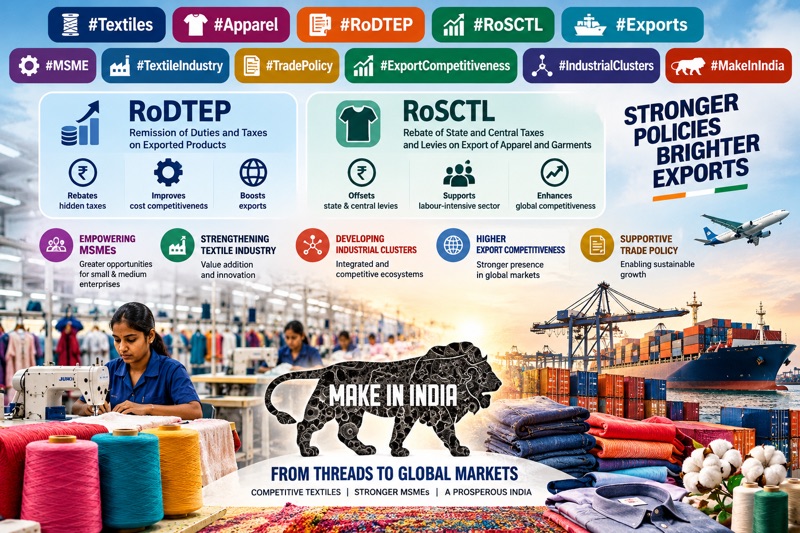
India’s export-support history has repeatedly moved between short extensions, altered rates and changing scheme designs. Earlier mechanisms were often described as export incentives. RoDTEP was introduced from 2021 with a different logic: to refund embedded central, state and local taxes and levies that are not reimbursed elsewhere. That is not a reward for exporting. It is an attempt to prevent domestic taxes from travelling abroad inside the price of an Indian product.
This historical shift matters. If remission is treated as a temporary favour, it can be extended at the last moment and changed frequently. If it is understood as part of tax neutrality, predictability becomes essential. A government would not normally ask a manufacturer to guess next month’s GST treatment while quoting a long-term supply contract. Yet exporters are often expected to make a similar guess about embedded-tax remission. The result is a policy that may provide reimbursement but still impose uncertainty costs.
The textile value chain also needs precision because it does not sit under one scheme. Apparel, garments and made-ups are covered by RoSCTL, while textile products outside that coverage use RoDTEP. The reported five-year request concerns RoDTEP. It should not be casually presented as a confirmed five-year settlement for the whole textile and apparel sector. As of the latest verified position, no post-deadline decision for RoSCTL had been confirmed either. A headline about one proposal can therefore create false comfort across several different product categories.
Policy risk is unequal
Large exporters can model several scenarios, hold reserves, negotiate with buyers and spread the risk across markets. A small exporter usually cannot. A remission of even a few percentage points may determine whether an order generates a margin or a loss. Working capital is already tied up in raw material, wages, testing, logistics and delayed buyer payments. When policy becomes uncertain, the firm with the weakest balance sheet carries the largest burden.
This creates a quiet structural bias. The formal scheme may apply equally, but uncertainty does not. It rewards companies able to finance ambiguity and penalises those that must know the exact landed price before accepting an order. In labour-intensive textiles and apparel, this is not merely a question of company profitability. Lost or postponed orders move quickly into shorter workdays, delayed wages and pressure on household incomes in production clusters.
The deeper danger is behavioural. Repeated short extensions teach exporters and buyers not to trust the stated horizon. Even when support continues, firms may add an uncertainty premium, avoid longer contracts or reduce investment. Buyers may shift orders toward suppliers in countries where the policy environment is easier to price. A late extension can prevent an immediate loss of benefit while failing to restore the confidence that the delay has already damaged.
A cluster must become a risk-management institution
Industry associations should not remain waiting rooms for government notifications. They can convert policy uncertainty into manageable commercial choices. Every textile and apparel cluster should circulate product-specific costing sheets showing two clear positions: price with remission and price without remission. The sheets should distinguish RoDTEP products from RoSCTL products rather than treating the sector as one uniform category.
Associations should also provide model clauses for quotations and contracts. These can allow prices to be adjusted if the applicable remission rate changes, expires or is notified after shipment. Such clauses will not eliminate buyer resistance, but they will make the risk visible and negotiable instead of leaving the exporter to absorb it silently.
The same institutional platform should link remission documentation with proof of origin, traceability and sustainability records. Future competitiveness will not depend on one rebate alone. Buyers and regulators are increasingly asking where materials came from, how products were made and whether environmental and labour claims can be verified. A cluster that organises these records together can turn compliance from duplicated paperwork into commercial evidence. The future association will not merely lobby for a scheme; it will provide shared intelligence, standard documents and real-time risk support.
Two possible futures after 30 September
If a properly funded five-year extension is approved before expiry, exporters will gain more than remission. They will gain a planning horizon. Firms can quote with greater confidence, negotiate longer contracts and make investments whose returns require several seasons. Yet even a five-year notification must be judged by its rates, coverage, budget and administrative reliability. Duration without adequate reimbursement or timely processing can become stability only on paper.
If the decision arrives late, or if another short extension is issued, support may technically survive while the uncertainty premium remains. Orders negotiated before notification will already have carried risk. Firms may continue to assume that every deadline is provisional. The government would then be financing remission without receiving its full economic return because predictability, the most productive part of the policy, would still be missing.
The strongest future approach is not a permanent subsidy culture. It is a transparent, rules-based system for neutralising verified embedded taxes, with periodic evidence-based rate reviews announced well before commercial deadlines. The distinction is important. Competitive firms should not depend indefinitely on discretionary support, but neither should Indian exports carry domestic taxes that foreign buyers will not pay.
Predictability is productive infrastructure
Roads, ports and power systems are recognised as infrastructure because firms build decisions around them. Stable trade policy performs the same function. It allows prices, contracts, credit and investment to connect across time. When a scheme reaches its expiry date before its successor is certain, the missing infrastructure is not money alone. It is confidence.
A five-year proposal signals that the government understands the value of a longer horizon. But the textile and apparel sector cannot ship a signal, finance an intention or price an expectation. It can work only with a notified rule. The immediate requirement is a timely and clear decision for both RoDTEP and RoSCTL. The larger reform is to end the habit of governing long production cycles through last-minute certainty. In the export economy of the future, predictability will not be an administrative courtesy. It will be a measurable source of competitiveness.
#Textiles #Apparel #RoDTEP #RoSCTL #Exports #MSME #TextileIndustry #TradePolicy #ExportCompetitiveness #IndustrialClusters #MakeInIndia




No comments:
Post a Comment