The American Paradox: A Rich Economy Living on Future Income
For much of the twentieth century, the United States built an extraordinary economic system around a simple principle: expanding production would create employment, rising incomes would generate consumption, and consumption would encourage further investment. This relationship helped transform America into the world's largest consumer market and a central engine of international economic growth.
But the American economy of the twenty-first century is becoming increasingly complicated. Consumption remains its greatest economic strength, yet maintaining that consumption increasingly depends on household borrowing, accumulated financial wealth, housing values, government expenditure, and confidence in future income.
The central contradiction is becoming difficult to ignore. An economy can continue expanding its consumption even when the financial foundations supporting that consumption become increasingly unequal and fragile.
The United States is not necessarily approaching an immediate economic crisis. Its productivity, technological leadership, deep capital markets, innovative enterprises, and international financial influence provide substantial resilience. Nevertheless, a deeper structural question deserves attention: how long can consumption remain the principal engine of growth when housing, healthcare, education, borrowing, and public debt servicing absorb growing portions of economic resources?
This is not simply an American question. It is a question about the future stability of international demand.
From Industrial Prosperity to Financially Supported Consumption
The historical transformation of American capitalism provides an important explanation.
During the decades following the Second World War, the American economic model was supported by industrial employment, expanding manufacturing capacity, relatively strong wage growth, affordable housing in many regions, and a rapidly growing middle class. Productivity improvements helped increase purchasing power, while domestic manufacturing supplied a significant share of consumer demand.
Beginning in the 1980s, the structure gradually changed. Globalisation encouraged companies to relocate labour-intensive production abroad. Financial markets became more influential. Household credit expanded, and rising property and equity prices became increasingly important sources of perceived wealth.
The United States progressively moved towards an economic structure in which it consumed an enormous volume of goods produced through international supply chains while concentrating substantial domestic value creation in technology, finance, intellectual property, professional services, and other high-value activities.
This arrangement created important global benefits. China, Mexico, Vietnam, Germany, South Korea, India, and numerous other economies developed commercial relationships with American consumers and businesses.
However, the arrangement also produced a fundamental imbalance.
American consumption increasingly supported production and employment beyond American borders, while many American households became more exposed to housing costs, education expenses, healthcare expenditure, and financial-market fluctuations.
The result was an economic model capable of generating impressive aggregate wealth without distributing financial security equally.
The Household Debt Question: When Purchasing Power Becomes Borrowing Power
Household consumption is not determined by income alone. It is also influenced by access to credit, accumulated savings, interest rates, expected employment stability, and asset ownership.
Credit cards, automobile loans, mortgages, and education loans allow households to distribute expenditure over time. In a growing economy, borrowing can be productive because future incomes help finance present consumption and investment.
The problem arises when debt obligations grow faster than the capacity to service them.
Higher interest rates increase the cost of new borrowing and variable-rate debt. Credit card balances become more expensive to maintain. Automobile financing becomes less affordable. Housing purchases are postponed, and households begin reducing discretionary spending.
The consequences are not evenly distributed.
Affluent American households may continue consuming because they possess substantial financial assets, retirement savings, property wealth, and stable incomes. Lower- and middle-income households are more dependent on wages and credit availability.
This creates a particularly important economic possibility: aggregate American consumption can remain strong even while financial stress intensifies among substantial sections of the population.
It is therefore insufficient to examine retail sales or household consumption growth alone. The more revealing indicators are debt-servicing burdens, delinquency rates, real disposable income, savings capacity, and expenditure patterns across income groups.
A consumer economy becomes structurally vulnerable when its spending resilience depends increasingly on those households that are already financially secure.
Housing: The Silent Tax on American Consumption
Housing has emerged as one of the most important structural constraints on household purchasing power.
For homeowners who purchased properties when mortgage rates were low, housing wealth may provide financial stability. For younger households, renters, and first-time buyers, however, high property prices, mortgage rates, insurance premiums, property taxes, and rental costs can substantially restrict disposable income.
This produces a contradiction within the same economy.
Rising property values strengthen the balance sheets of existing homeowners, but they can weaken the purchasing power of those trying to enter the housing market.
The consequences extend beyond real estate.
When households spend a larger proportion of their incomes on accommodation, less remains for furniture, clothing, restaurants, travel, automobiles, consumer electronics, and other products.
Housing affordability therefore influences the global trading system.
A sustained housing-cost burden in the United States could eventually reduce demand for manufactured consumer goods across Asian production networks, affecting exporters and their smaller suppliers.
The American housing problem is consequently not merely a domestic social issue. It is potentially an international demand issue.
The Wealth Effect: Can Stock Markets Replace Wage Growth?
One of the distinctive characteristics of contemporary American consumption is its relationship with financial wealth.
When equity markets rise, households possessing substantial investments may feel wealthier and increase spending. Retirement accounts, investment portfolios, and property holdings can strengthen confidence even when wage growth is moderate.
This wealth effect helps explain why American consumption can sometimes remain resilient despite high interest rates and pessimistic consumer sentiment.
However, financial wealth is unevenly distributed.
The benefits of rising asset prices accrue disproportionately to households with larger investment holdings. Households without significant financial assets do not experience comparable improvements in purchasing power.
An economy can therefore display strong consumer spending alongside rising inequality in financial resilience.
This distinction becomes particularly important when equity valuations depend heavily on expectations about artificial intelligence, technology-sector profitability, and future productivity.
If financial-market gains are sustained by genuine productivity improvements, they can support long-term prosperity. If valuations move substantially ahead of earnings, consumption linked to financial wealth becomes vulnerable to market corrections.
The deeper issue is whether American consumption is being sustained by broadly rising productive income or increasingly concentrated asset appreciation.
These are economically different foundations for growth.
Government Debt: The Second Pillar of the Contradiction
Household debt represents only one dimension of the American economic challenge. Federal borrowing introduces another.
Government deficits can support aggregate demand during downturns, finance infrastructure, strengthen national security, and sustain essential public services. Borrowing is not inherently economically damaging, particularly when it supports productive investment.
However, persistent fiscal deficits create difficult choices when interest costs rise.
A growing share of government revenue may be required to service outstanding debt, potentially limiting the resources available for infrastructure, education, research, social protection, and other public priorities.
The United States possesses an exceptional advantage: the dollar remains the principal international reserve currency, and US Treasury securities occupy a central position in global financial markets.
This gives the American government greater financing flexibility than most countries enjoy.
Nevertheless, reserve-currency status does not eliminate the economic cost of borrowing. It changes the nature and timing of the constraints.
The American fiscal challenge is therefore not simply whether the government can borrow. It is whether additional borrowing will generate sufficient future productivity, income, and fiscal capacity to justify its cost.
A country that finances current consumption without strengthening future productive capacity gradually narrows its policy choices.
At the same time, excessive or poorly timed fiscal consolidation could weaken demand and reduce growth. The challenge is to distinguish productive public investment from expenditure that provides temporary support without durable economic returns.
The Interest Rate Trap: When Inflation Control Weakens Demand
American monetary policy faces a recurring dilemma.
Higher interest rates can reduce inflationary pressure by moderating credit expansion and spending. But the same rates also increase borrowing costs for households, businesses, and governments.
Lower interest rates may support investment and consumption, yet they can also encourage renewed borrowing, financial speculation, and asset-price inflation if economic conditions are unsuitable.
This creates a difficult balancing problem.
If inflation remains persistent, monetary policy may need to stay restrictive for longer than households and businesses expect. If consumer demand weakens sharply, restrictive financial conditions could intensify the slowdown.
The complication is that monetary policy operates through an economy with highly unequal balance sheets.
A wealthy household with substantial savings may benefit from higher interest income, while a financially constrained household faces more expensive credit.
Similarly, large corporations may finance investment through retained earnings or capital markets, while smaller businesses depend more heavily on bank lending.
Consequently, a single interest-rate policy can produce very different economic outcomes across households and enterprises.
The central issue is no longer simply the level of interest rates. It is how financial conditions redistribute purchasing power, investment capacity, and economic risk.
The Global Transmission: When the American Consumer Slows Down
The United States is not merely a large national market. It is a major destination for goods and services produced across the world.
American demand supports international production networks in electronics, textiles, automobiles, machinery, pharmaceuticals, furniture, food products, and digital services.
A sustained weakening of consumption would therefore transmit economic pressure through several channels.
Asian exporters could experience declining orders for consumer electronics, apparel, furniture, and household products. European producers could face weaker demand for automobiles, machinery, luxury goods, and specialised industrial products. Latin American economies could experience reduced demand for selected manufactured goods, agricultural commodities, and intermediate inputs.
The consequences would extend beyond direct exports.
A reduction in American retail demand can cause multinational buyers to reduce inventory, postpone orders, renegotiate prices, and transfer financial pressure to overseas suppliers.
Smaller firms are particularly vulnerable because they often possess limited working capital and weak bargaining power.
This creates an important asymmetry in international trade.
A relatively modest decline in final consumer demand can produce a much larger disruption in orders, production schedules, and cash flows among smaller suppliers.
Inventory adjustments and changes in sourcing decisions can amplify demand fluctuations throughout global value chains.
The transmission would not be uniform. Exporters serving essential consumption, healthcare, infrastructure, or rapidly growing industries may remain resilient. Countries with diversified markets and stronger domestic demand would be better positioned to absorb the shock.
The Dollar Contradiction: Global Safety Can Create Global Instability
The international role of the dollar introduces another dimension.
During periods of global financial uncertainty, investors frequently seek dollar-denominated assets because of their liquidity and perceived safety.
This can strengthen the dollar even when uncertainty originates partly within the American economy.
A stronger dollar may reduce the local-currency cost of imported goods for American consumers, but it can also increase the burden of dollar-denominated debt for foreign borrowers and create exchange-rate pressures in emerging economies.
Conversely, a weaker dollar may improve American export competitiveness while altering inflation and financial conditions elsewhere.
The world therefore faces an unusual structural dependency.
The United States supplies a large share of global final demand while also supplying the dominant currency used in international finance and trade.
Its domestic monetary and fiscal decisions consequently influence economies that have little direct control over those decisions.
The contradiction is not that the dollar system is necessarily approaching collapse. Rather, global economic stability remains heavily dependent on the financial conditions of a single national economy.
Artificial Intelligence: A New Productivity Solution or Another Wealth Divide?
Technological change could alter the American consumption–debt relationship.
Artificial intelligence, automation, advanced manufacturing, biotechnology, and digital infrastructure offer opportunities for substantial productivity improvements.
If these technologies increase output per worker, reduce production costs, create new industries, and support higher real incomes, they could strengthen the economic foundations of consumption.
However, productivity gains do not automatically translate into broadly distributed purchasing power.
If the principal benefits accrue to technology owners, investors, and a narrow group of highly skilled workers, aggregate wealth may increase without comparable improvements in the financial position of the wider population.
The result could be an economy that becomes technologically more productive while remaining socially and financially unequal.
The decisive question is therefore not whether artificial intelligence will create wealth. It is whether the distribution of that wealth will generate sufficiently broad household purchasing power to sustain consumption.
Technology can expand an economy's productive frontier, but it cannot by itself guarantee an inclusive consumer market.
Three Possible Economic Pathways Towards 2035
The Productivity-Led Renewal
In the more favourable scenario, technological innovation raises productivity, real wages strengthen, housing supply improves, and debt burdens become more manageable relative to income. Consumption remains resilient because purchasing power increasingly reflects productive economic gains rather than additional borrowing.
This would support American growth and provide a relatively stable market for international exporters.
The Unequal Consumption Economy
In a second scenario, the American economy continues expanding, but consumption growth becomes increasingly concentrated among higher-income households. Financial assets perform well, technology companies generate substantial profits, and affluent consumers remain active.
Meanwhile, housing costs, debt servicing, and limited savings constrain a substantial share of households.
Aggregate economic indicators could remain respectable, while mass-market consumer industries experience weaker and more uneven demand.
This scenario would create significant changes in international trade, favouring premium products, essential goods, and highly competitive low-cost suppliers while squeezing middle-market producers.
The Debt-Constrained Adjustment
In a more adverse scenario, persistent borrowing costs, weaker employment growth, housing affordability pressures, and reduced fiscal flexibility combine to weaken household spending.
Businesses respond by cutting investment, reducing inventories, and delaying recruitment. Exporters experience declining orders, and financial-market volatility further undermines confidence.
Such an adjustment need not resemble the global financial crisis of 2008. It could instead emerge as a prolonged period of weak consumption growth, uneven investment, and repeated financial stress.
The most important distinction between these scenarios is not the absolute size of American debt. It is the relationship between debt obligations, income growth, productivity, asset valuations, and the distribution of purchasing power.
What India and Other Exporting Economies Must Understand
For India, the American consumption–debt contradiction has direct strategic implications.
The United States is an important market for Indian pharmaceuticals, engineering goods, textiles, apparel, electronics, gems and jewellery, and technology-enabled services.
However, export strategies cannot assume that American consumer demand will expand indefinitely at historical rates.
Indian exporters must distinguish between sectors driven by discretionary household expenditure and those supported by essential consumption, business investment, healthcare, or long-term technological change.
A decline in American discretionary spending could affect apparel, jewellery, home furnishings, and selected consumer products earlier than some essential healthcare categories.
For Indian MSME clusters, the challenge is especially serious.
Small exporters frequently lack access to detailed information about American household demand, retail inventories, credit conditions, and buyer financial health. They often discover weakening demand only when purchase orders are postponed or payments are delayed.
India therefore needs a more sophisticated export-demand intelligence system.
Such a system should monitor American real disposable income, consumer credit stress, housing affordability, retail inventories, import demand, and sector-specific purchasing patterns.
Export promotion institutions should also encourage market diversification, stronger working-capital management, product upgrading, and deeper relationships with reliable international buyers.
The objective should not be to withdraw from the American market. It should be to reduce dependence on a single source of demand while improving the capacity to respond to changes within that market.
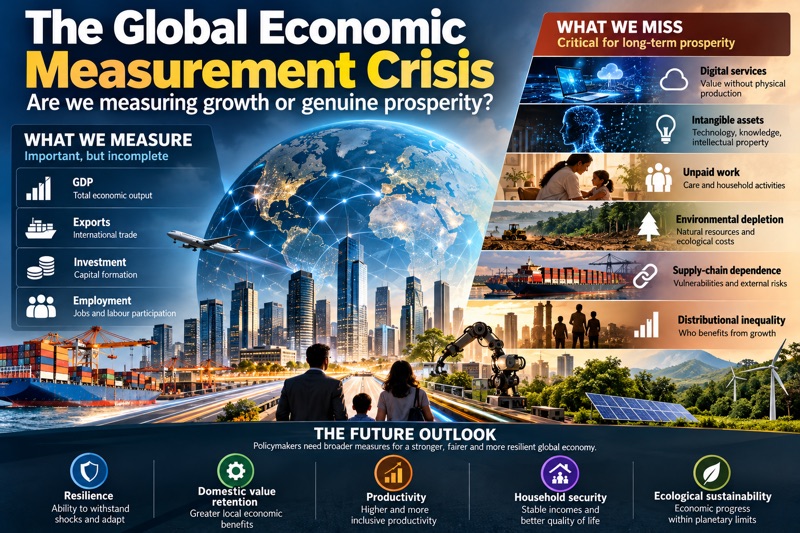
Beyond GDP: Measuring the Real Strength of American Consumption
The conventional indicators used to evaluate the American economy are increasingly insufficient when considered in isolation.
GDP growth may remain positive while household financial stress increases. Employment numbers may appear strong while housing affordability deteriorates. Equity markets may reach new highs even as financially constrained consumers reduce expenditure.
A more meaningful assessment requires a combination of indicators.
Real disposable income reveals the purchasing power available after inflation and taxes. Household debt-service ratios indicate the pressure of financial obligations. Delinquency rates provide signals of credit stress. Housing-cost burdens reveal the resources absorbed by accommodation. Savings patterns and consumption across income groups help identify whether spending growth is broad-based or concentrated.
Fiscal interest expenditure, business investment, productivity growth, and the composition of imports provide additional evidence about the sustainability of demand.
No single indicator can establish whether the American consumption model is becoming unsustainable.
The analytical challenge is to understand how these indicators interact.
A debt burden that appears manageable during strong employment growth can become more difficult if incomes stagnate. High asset valuations may support spending temporarily, but they do not guarantee permanent purchasing power. Fiscal borrowing may stimulate demand today, but its long-term benefits depend partly on how the resources are used.
The quality of economic growth therefore matters as much as its quantity.
Can the World Depend on a Consumer Who Must Keep Borrowing?
The American economy remains one of the most innovative, productive, and financially sophisticated economies in the world. Its strengths should not be underestimated, and high debt levels alone do not establish that an economic crisis is inevitable.
Yet its consumption-led structure raises an increasingly important question about the relationship between prosperity and financial sustainability.
For decades, the global economy has benefited from the willingness and ability of American households to consume goods and services produced around the world.
International production networks expanded around this demand. Export-oriented economies invested in factories, ports, logistics systems, and industrial capabilities partly because the American market offered substantial purchasing power.
But an international economic system cannot safely assume that household consumption will remain resilient under every combination of debt obligations, housing costs, asset-price fluctuations, and fiscal constraints.
The future of American capitalism may therefore depend less on whether consumers can continue borrowing and more on whether productivity, real incomes, housing affordability, and financial security can provide a stronger foundation for consumption.
For the rest of the world, the challenge is equally profound.
Export-led growth strategies must become less dependent on the uninterrupted expansion of American demand and more capable of generating domestic value, diversified markets, and resilient production systems.
The defining economic question of the coming decade may not be whether the United States can continue consuming more. It may be whether the world can build a more balanced economic system in which growth depends less on expanding debt and more on expanding productive purchasing power.
And that may be one of the most consequential structural questions facing the international economy between now and 2035.
Analytical note: This is a structural economic assessment and scenario analysis, not a prediction of an imminent US recession. The arguments distinguish potential vulnerabilities from established outcomes. Current numerical estimates have deliberately been omitted rather than presented without verification.
#USEconomy #GlobalEconomy #ConsumerDebt #FiscalDeficit #HouseholdConsumption #InternationalTrade #EconomicOutlook #GlobalValueChains #MSME #ExportCompetitiveness