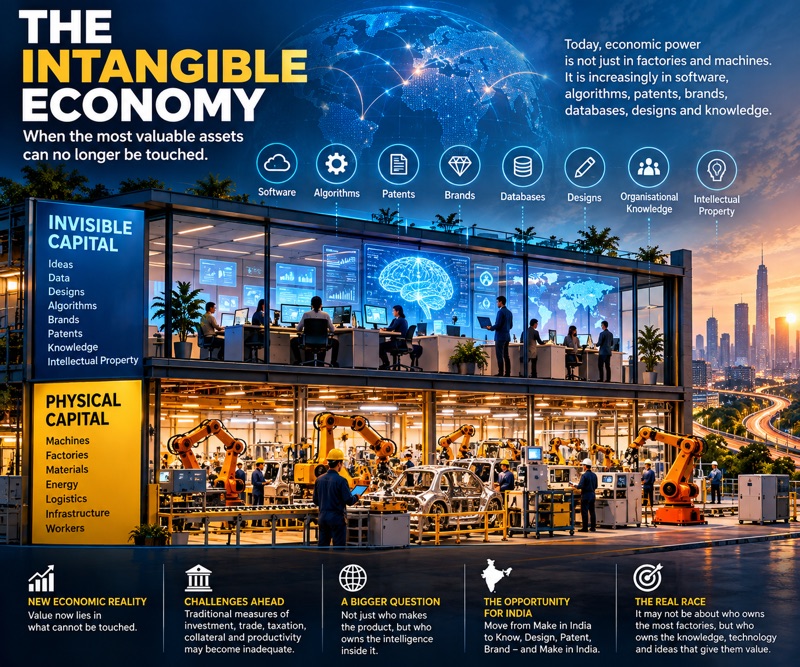
 The Factory Is Still There, but Value Has Moved Somewhere Else
For most of economic history, wealth was reassuringly visible. Agricultural power could be measured in land and harvests. Industrial power appeared as coal mines, steel plants, machines, warehouses, railways and factories. A company’s strength could almost be photographed. The balance sheet reflected this physical world: land had a price, machinery had a replacement cost, inventories could be counted and buildings could be offered to a bank as collateral.
The twenty-first-century economy is quietly breaking this relationship between what can be seen and what creates value.
Increasingly, the valuable part of a business may not be its factory, office or inventory. It may be software controlling production, an algorithm predicting customer behaviour, a database accumulated over years, a patented process, a trusted brand, a product design, a distribution system or simply the organisational knowledge that allows thousands of people to work together efficiently.
We are moving from an economy of owning things to an economy of knowing things.
From Land to Machines to Knowledge
Every major economic transformation has changed the meaning of capital. In an agrarian economy, land was the decisive asset. The Industrial Revolution shifted power toward machinery, factories and infrastructure. The twentieth century added mass production, managerial systems and global brands.
The digital age is producing another transition.
A modern company can become enormously valuable without owning proportionately enormous physical assets. Software can be reproduced millions of times at negligible additional cost. A successful design can travel internationally without a container ship. An algorithm developed in one location can influence transactions across dozens of countries almost instantly. A brand can command a premium even when competing products emerge from remarkably similar manufacturing systems.
This creates an unusual economic paradox: the economy is becoming more valuable while parts of its productive capital are becoming less visible.
And that invisibility is not merely an accounting curiosity. It challenges some of the basic institutions through which capitalism has traditionally operated.
The Balance Sheet May Be Looking at Yesterday’s Economy
Industrial accounting was designed for an industrial world.
Buy a machine and accountants recognise an asset. Construct a factory and investment appears clearly. Spend heavily building organisational capability, training employees, developing proprietary databases, experimenting with software or strengthening a brand, and significant portions of that expenditure may be treated differently.
This distinction becomes increasingly problematic when competitive advantage itself moves toward intangible capability.
Two companies may possess factories of roughly comparable physical quality yet produce dramatically different economic results because one possesses better software, stronger design capability, deeper supplier knowledge, superior data and a more trusted brand.
The machines may look similar.
The productive intelligence surrounding the machines is not.
Therefore, future industrial policy cannot simply ask: How much manufacturing capacity has been created?
It must increasingly ask: How much knowledge has been embedded inside that capacity?
The New Geography of Trade May Be Invisible
Traditional international trade statistics were built around goods crossing borders. A container carrying garments from India to the United States is relatively easy to record. Its origin, destination and declared value can be identified.
But imagine a product designed in Italy, engineered through software developed in India, manufactured in Vietnam, marketed through an American digital platform, supported by cloud infrastructure elsewhere and sold under intellectual property registered in another jurisdiction.
Where exactly was the value created?
The physical product crosses one border. Its economic intelligence may have crossed several.
This could become one of the defining problems of international economics. Countries that dominate manufacturing volumes may not necessarily capture the largest share of value. Countries controlling design, technology, standards, software, brands, platforms and intellectual property can potentially capture substantial margins without undertaking the majority of physical production.
The old debate was about who manufactures the product.
The emerging debate will be about who owns the intelligence inside the product.
Data Is Becoming Capital—but Strange Capital
Data illustrates why conventional economic categories are becoming uncomfortable.
A machine deteriorates when used. Data can become more useful when repeatedly analysed and combined with other information. A warehouse occupies a specific geographical location. A database can be accessed simultaneously across borders. A physical asset can normally be sold to another owner. The commercial value of data often depends heavily on context, scale, permissions and the analytical systems surrounding it.
Algorithms create similar complications.
Their economic value may not lie in the lines of code themselves but in accumulated learning, proprietary datasets, continuous experimentation and integration into business processes.
This means the future corporation may increasingly resemble an institutional memory system rather than simply a collection of physical assets.
Banking Could Face an Intangible Collateral Problem
There is another consequence that deserves far more attention.
Banks understand buildings, land and machinery because these assets can usually be valued and pledged as collateral. But what happens when the most productive assets of a small enterprise are software, designs, customer relationships, technical knowledge or intellectual property?
A technologically sophisticated company can therefore become economically valuable but financially difficult to understand through conventional lending models.
This could produce a strange financing divide.
Asset-heavy businesses may continue receiving traditional credit because lenders can see their collateral, while knowledge-intensive businesses depend increasingly on equity, venture finance, specialised lenders or cash flows.
The financial system could therefore underestimate precisely the enterprises that represent the emerging economy.
For MSMEs, this question becomes particularly important. The next generation of cluster development cannot stop at common facilities, industrial estates and machinery upgrading. Clusters will increasingly require shared design intelligence, testing knowledge, digital systems, databases, branding capability, intellectual-property support and mechanisms for converting knowledge into finance.
The future cluster may contain fewer common machines and more common intelligence.
Taxation Will Chase Value That Has Become Mobile
Factories are difficult to move overnight. Intellectual property is considerably more mobile.
As corporate value becomes increasingly intangible, governments face a fundamental taxation challenge: economic activity can occur in one country, customers can reside in another, intellectual property can be located elsewhere and profits can potentially be attributed through complex corporate structures.
The international tax debate is therefore not merely about tax rates. It reflects a deeper problem: the geographical location of economic value itself is becoming harder to define.
The industrial economy tied companies to places.
The intangible economy partially separates value from geography.
Governments will spend the coming decades trying to reconnect the two.
Productivity May Also Be Misread
There is an even more uncomfortable possibility: parts of the productivity puzzle may reflect measurement systems struggling to capture organisational transformation.
Installing an expensive machine is visible investment. Redesigning an entire production system around data, artificial intelligence, worker knowledge and supply-chain coordination can be much harder to quantify.
Yet the second transformation may eventually matter more.
Artificial intelligence could accelerate this problem dramatically. AI will increasingly become embedded not only in products but in organisational decision-making—procurement, quality control, forecasting, design, maintenance, logistics, marketing and management.
A factory may therefore become significantly more productive without looking radically different from outside.
The intelligence layer will change before the concrete layer does.
The Great Divide May Become Tangible versus Intangible
The most important future inequality may not simply be between manufacturing and services or between developed and developing economies.
It may emerge between economies that produce physical goods and economies that own the knowledge governing those goods.
A country can manufacture millions of products and still capture limited margins if foreign companies control the technology, product architecture, branding, standards, distribution platforms and customer relationships.
This is particularly important for emerging economies.
Industrialisation remains essential because physical production creates employment, supplier networks, engineering capabilities and technological learning. But manufacturing without intangible accumulation can become a trap. Countries may build factories while remaining permanently dependent on somebody else’s technology, brands and market access.
The next stage of development therefore cannot simply be Make in India—or its equivalent elsewhere.
It must increasingly become Know in India, Design in India, Patent in India, Brand from India and Make in India.
The Future Factory Will Have Two Floors
One floor will remain physical: machines, workers, materials, energy and logistics.
The other will be invisible: software, algorithms, designs, patents, databases, standards, brands, organisational routines and accumulated knowledge.
The competitiveness of the first floor will increasingly depend upon the sophistication of the second.
This changes the meaning of industrial strategy. Governments have historically competed through infrastructure, industrial land, electricity, tax incentives and capital subsidies. These will remain important. But future competitiveness will depend increasingly on research ecosystems, universities, technical talent, intellectual-property institutions, digital infrastructure, design capabilities, standards, data governance and the ability of firms to convert knowledge into commercially scalable assets.
Countries building factories without simultaneously building intangible capital may discover that they have constructed the hardware of industrialisation while importing its operating system.
The Invisible Economy Will Require New Economic Eyes
The central problem of the intangible economy is therefore not that economic value is disappearing.
It is that value is becoming harder to see.
Our statistics still largely observe yesterday’s economy. Banks often lend against yesterday’s definition of assets. Trade systems were designed around yesterday’s borders. Tax systems search for yesterday’s geographical connection between production and profit. Industrial policies frequently subsidise yesterday’s forms of capital.
But tomorrow’s competitive advantage may increasingly sit inside code, designs, databases, organisational routines and human knowledge.
The great economic race of the coming decades may consequently not be about who owns the largest number of factories.
It may be about who owns the invisible architecture that tells those factories what to produce, how to produce it, how to improve it—and who ultimately captures the value.
That is the real arrival of the intangible economy.
#IntangibleEconomy #FutureOfBusiness #KnowledgeEconomy #ArtificialIntelligence #Innovation #IntellectualProperty #Manufacturing #MSME #DigitalEconomy #India


No comments:
Post a Comment