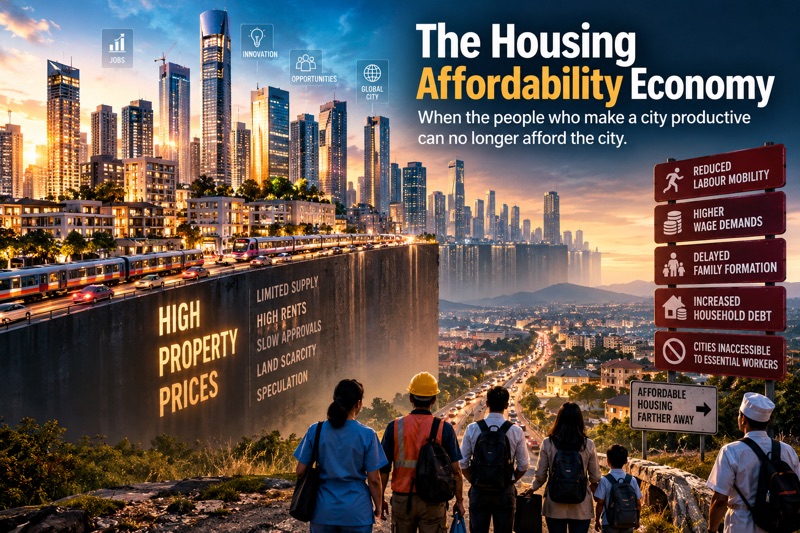
 Housing was once treated largely as a social question: where people live, how much space they have, whether they own or rent, and whether governments should support affordable homes. That interpretation is becoming dangerously outdated. Housing is increasingly part of the productive infrastructure of an economy. When workers cannot afford to live near jobs, housing stops being merely a household problem and becomes a labour-market problem, a productivity problem, a competitiveness problem and eventually a growth constraint.
From Shelter to Asset to Economic Barrier
The economic history of housing has travelled through three broad stages. During industrialisation, housing was primarily about shelter close to factories and employment. During the great expansion of the twentieth-century middle class, home ownership increasingly became a mechanism for household security and wealth creation. In the financialised economy of recent decades, housing has increasingly become an investment asset whose price can move far beyond the growth of local wages.
That transformation matters because a house performs two functions that can eventually conflict. It is somewhere to live, but it is also an asset whose owner benefits when its value rises. What appears as wealth creation for an existing homeowner can simultaneously become an affordability barrier for the next buyer.
This creates an unusual economic contradiction: societies celebrate rising property values while worrying about housing affordability. Yet these are often two sides of the same balance sheet.
The Labour Market Cannot Function Efficiently if Workers Cannot Move
Modern economies talk endlessly about labour flexibility, skills, entrepreneurship and productivity. But labour cannot be flexible if housing is geographically inflexible.
Imagine a worker receiving a better employment opportunity in a highly productive city. Economically, that worker should move. But if the additional salary is absorbed by rent, mortgage payments, commuting and childcare, the opportunity may become irrational.
Housing therefore begins to behave like an invisible tax on economic mobility.
This can create a strange situation in which companies report labour shortages while potential workers exist elsewhere. The missing link is not necessarily skills or willingness to work. It may simply be the cost of entering the geography where those jobs exist.
The future labour shortage may therefore sometimes be a housing shortage wearing a different name.
When Successful Cities Become Victims of Their Own Success
The world’s most economically successful cities attract companies, capital, universities, technology, culture and highly skilled workers. But success generates land demand. Land supply is inherently limited, while planning restrictions, infrastructure bottlenecks, construction costs and slow approvals can further restrict usable housing supply.
Prices then rise.
At first, this appears to confirm the city’s attractiveness. Eventually, however, the mechanism can reverse.
Teachers, nurses, technicians, hospitality workers, drivers, retail employees, young researchers and many other workers essential to the functioning of the city can find themselves pushed increasingly far from their workplaces.
The wealthy can purchase proximity. Everyone else purchases commuting time.
And commuting time is itself an economic cost. Two hours spent travelling every day does not appear prominently in GDP accounts, but it consumes human energy, family time and productive capacity.
A globally competitive city that cannot house the people required to operate it is not fully competitive. It is living on inherited advantages while gradually increasing its own operating costs.
Housing Inflation Eventually Enters the Factory and Office
Employers cannot remain insulated from housing costs forever.
If workers must spend increasingly large shares of income on accommodation, wage expectations eventually rise. Businesses then experience higher labour costs without necessarily receiving higher productivity in return.
This is especially important for manufacturing and labour-intensive services.
A factory may receive incentives to locate in an industrial region, but workers also need affordable housing, transport, schools, healthcare and everyday services. Industrial policy that builds factories without building functioning settlements around them solves only half the problem.
The industrial cluster of the future therefore cannot be merely an aggregation of factories. It must increasingly become a live-work ecosystem.
Countries competing for manufacturing investment may eventually discover that affordable housing is as important to industrial competitiveness as electricity tariffs, logistics costs and corporate taxation.
The Generational Divide Is Becoming a Property Divide
Housing also changes the distribution of wealth between generations.
When property prices rise substantially faster than incomes, the economic starting point of young households increasingly depends on whether their families already own appreciating assets.
Two people with similar education, skills and salaries may therefore experience completely different economic trajectories. One receives family assistance for a deposit or inherits property. The other spends decades transferring a large proportion of income to landlords or servicing debt.
Merit has not disappeared, but inherited geography and inherited property begin to influence the returns to merit.
This could become one of the defining inequality mechanisms of the twenty-first century.
The old class divide was often between capital and labour. A new divide increasingly runs between those who entered the property economy early and those attempting to enter it after asset prices have detached from ordinary incomes.
The Hidden Demographic Cost
Housing affordability also reaches deeply into demographic behaviour.
Young adults facing expensive housing may remain with parents longer, postpone independent households, delay marriage or partnership decisions, and reconsider having children.
The paradox is striking. Governments in ageing societies may spend heavily encouraging families to have more children while allowing the basic cost of establishing a household to become increasingly prohibitive.
Demographic policy therefore cannot be separated indefinitely from housing economics.
A society cannot simultaneously make family formation structurally expensive and expect financial incentives alone to reverse declining fertility.
Debt Can Preserve Affordability—Until It Cannot
For decades, financial systems partially solved the affordability problem by expanding credit. Longer mortgage periods, lower interest rates and innovative lending enabled households to purchase increasingly expensive properties.
But credit does not necessarily make housing cheaper. Sometimes it simply increases the amount buyers can bid.
This distinction is fundamental.
If additional purchasing power enters a market where housing supply remains constrained, finance can become capitalised into land prices. The household obtains a larger mortgage, but the underlying shortage remains.
The affordability problem has merely been converted into a debt problem.
Future housing systems therefore face a difficult question: how much household leverage can compensate for insufficient supply before financial vulnerability becomes greater than the original affordability problem?
Artificial Intelligence Cannot Digitise Land
The coming technological economy makes the housing problem even more interesting.
AI can reduce the cost of information. Automation can increase productivity. Digital platforms can reorganise work. But technology cannot manufacture unlimited land in productive locations.
Remote work appeared briefly to offer an escape from expensive cities by separating employment from geography. It will remain important, but many economic activities still depend on physical ecosystems—laboratories, hospitals, factories, universities, logistics centres, entertainment districts and dense networks of specialised suppliers.
The future economy may therefore produce an unusual scarcity: digital abundance surrounded by physical scarcity.
Software can scale almost infinitely. Urban land cannot.
This means some of the largest economic rents of the future may emerge not from producing new technologies but from controlling scarce physical locations around the ecosystems where those technologies are created.
The Next Infrastructure Revolution May Be Housing
Governments traditionally classify roads, ports, power grids, airports and digital networks as infrastructure while treating housing as a separate social sector.
That distinction may become increasingly artificial.
If affordable housing determines whether workers can access productive employment, then housing is effectively labour-market infrastructure.
This requires a different policy imagination. Building more units is important, but numbers alone are insufficient. Housing must connect with mass transit, employment centres, industrial corridors, schools, healthcare and urban services. Land-use regulation, approval times, rental markets, construction productivity and transport planning become part of the same economic system.
For India, this question will become particularly important as industrial corridors, manufacturing clusters, logistics hubs and rapidly expanding urban regions attract millions of workers. Industrialisation without affordable urbanisation can simply transfer rural underemployment into urban precarity.
The City of 2040 Will Compete on Affordability
For much of recent history, cities competed for investment through infrastructure, talent, taxation, connectivity and quality of life. The next competition may increasingly include something much simpler:
Can ordinary skilled people actually afford to live there?
This may become an underestimated competitive advantage.
Cities that combine employment opportunities with affordable housing, efficient public transport and reasonable commuting times could attract both workers and employers away from prestigious but prohibitively expensive metropolitan centres.
The geography of economic opportunity could consequently decentralise. Secondary cities connected through high-quality transport and digital infrastructure may become increasingly attractive because they offer something megacities are losing: economic accessibility.
The Real Housing Crisis Is Not About Houses
The deepest mistake is to measure the housing crisis only through property prices.
The real cost appears elsewhere—in delayed families, excessive debt, longer commuting, labour shortages, higher wages without corresponding productivity, weaker entrepreneurship, intergenerational inequality and declining accessibility of productive cities.
Housing therefore sits quietly underneath many economic problems that governments currently treat separately.
The twenty-first-century economy may eventually discover that the affordability of a modest home near economic opportunity is not merely a social aspiration. It is part of the operating system of capitalism itself.
A city can survive expensive housing for a surprisingly long time because accumulated wealth, infrastructure and reputation continue attracting capital.
But there is a threshold beyond which success begins consuming its own foundations.
When the people who make a city productive can no longer afford the city, housing has stopped reflecting prosperity. It has started taxing it.
#HousingAffordability #UrbanEconomy #FutureOfCities #EconomicGrowth #LabourMobility #HousingCrisis #UrbanPlanning #Infrastructure #FutureOfWork #EconomicInequality