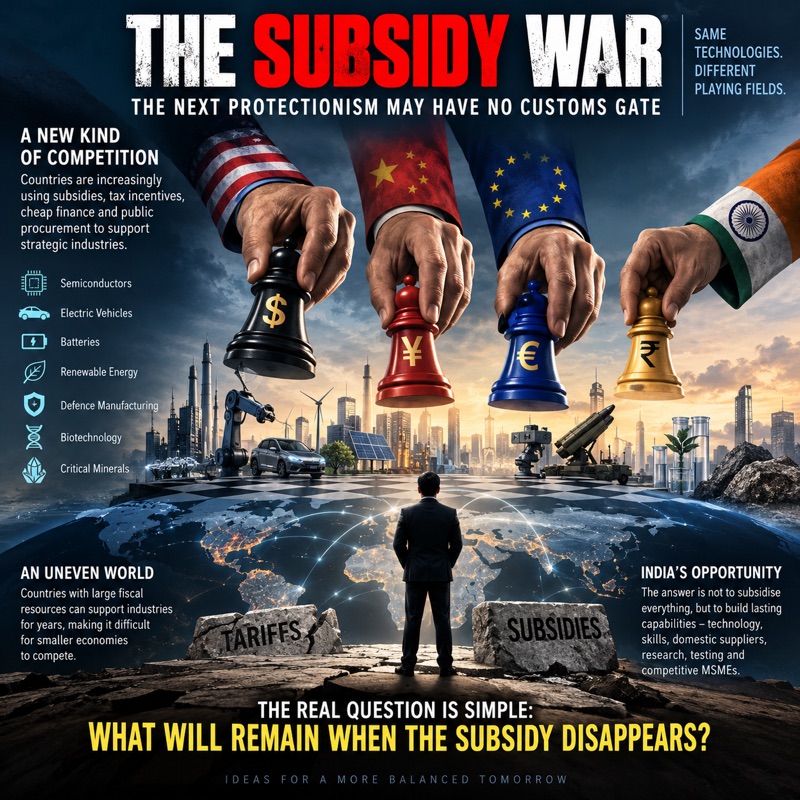
 For much of the last three decades, the visible face of protectionism was the tariff. Governments raised duties, imposed quotas or restricted imports. The next phase may be much harder to see at the border. Competition is increasingly moving inside the factory gate, into tax systems, concessional finance, public procurement, research grants, cheap land, energy support and government-backed investment. The emerging global economy may therefore be shaped not simply by which company produces most efficiently, but by which country can afford to make strategic production economically possible.
From tariff walls to subsidy ecosystems. This is not entirely new. Industrialisation has rarely been a purely market-driven process. Britain protected and supported emerging capabilities during its industrial rise. The United States used public procurement, defence research and infrastructure to develop technologies that later became commercial industries. Japan, South Korea and other East Asian economies combined finance, technology acquisition, exports and industrial coordination. China subsequently demonstrated the enormous scale at which state policy, infrastructure, finance and manufacturing could be brought together. What is different today is that industrial policy is returning simultaneously across competing economic powers, and it is concentrating on many of the same technologies.
Semiconductors, batteries, electric vehicles, renewable-energy equipment, critical minerals, advanced computing and other strategic industries now sit at the intersection of economics, climate policy and national security. OECD data released in June 2026 estimated industrial subsidies covered by its MAGIC database at about $108 billion in 2024, their highest level since the global financial crisis. Solar equipment, semiconductors and heavy industries were among the most subsidised sectors over 2005–24. The important change is therefore not simply that subsidies exist. It is that governments increasingly regard productive capacity itself as a strategic asset.
The market price may no longer tell the whole story. Imagine two factories producing broadly similar batteries. One pays normal commercial interest rates, purchases electricity at market prices, finances its own research and carries the full risk of expanding capacity. The other receives tax credits, concessional finance, infrastructure support, research assistance and guaranteed public demand. Both products eventually arrive in the international market with a price attached to them. But those prices emerge from very different economic ecosystems. The apparent competition between two companies can therefore conceal competition between two national industrial systems.
This changes the old idea of comparative advantage. Countries traditionally specialised according to resources, labour, skills, capital and accumulated capabilities. Increasingly, comparative advantage can also be deliberately financed. A government with deep fiscal resources can reduce the private cost of developing an industry for years while firms acquire technology, scale and supplier networks. Once these capabilities become embedded, temporary support can produce a much more permanent industrial geography.
The dangerous inequality is becoming fiscal. This is where the subsidy war becomes particularly uncomfortable for developing economies. UNCTAD reported in July 2026 that strategic sectors accounted for 44 per cent of global greenfield investment in 2025, compared with 16 per cent in 2020. Announced project values in these sectors increased from $109 billion to $576 billion over five years. Yet low- and lower-middle-income economies captured only around 10 per cent of strategic-sector greenfield investment during 2020–25.
The future industrial divide could therefore be determined partly by the size of government balance sheets. Richer economies can subsidise semiconductor fabrication, battery factories, hydrogen, biotechnology laboratories and advanced defence manufacturing while still financing infrastructure and research. Many poorer countries face a completely different arithmetic. UNCTAD reported in 2026 that government interest payments in developing countries increased 102 per cent between 2014 and 2024 while government revenues increased only 39 per cent; it estimates that 73 per cent of developing countries lost fiscal space between 2018 and 2024. Asking such economies simply to match the subsidies of much richer competitors is unrealistic.
The subsidy race can become a development trap. A dangerous cycle can emerge. Strategic industries move towards countries offering large incentives. Those investments create specialised suppliers, engineers, laboratories, patents and infrastructure. These capabilities then attract the next generation of investment. Countries unable to finance the first round may therefore lose not merely today’s factory but tomorrow’s industrial ecosystem.
This is why the subsidy war is potentially more consequential than a tariff war. A tariff can change the price of an imported product. A sufficiently large and sustained industrial programme can change where technology, skills, suppliers and innovation are located for decades.
There is another danger. Subsidies can easily become politically attractive but economically lazy. Governments may announce enormous incentive packages because expenditure is visible while capability is difficult to measure. A subsidised factory is not necessarily a competitive industry. If local suppliers remain weak, technology remains imported, research capability does not develop and production survives only while incentives continue, the country has purchased capacity without acquiring capability. The World Bank’s recent work on industrial policy similarly stresses that fiscal space, market size and the government’s capacity to implement policy constrain what countries can effectively do.
India cannot win by writing the largest cheque. For India, this distinction is crucial. Attempting to reproduce every subsidy offered by the United States, China, Europe, Japan or South Korea across every strategic industry would spread public resources too thinly. The more durable strategy is to use public support to remove specific capability gaps: testing facilities, specialised skills, industrial research, standards, component ecosystems, patient finance, reliable power, logistics and supplier development.
The question for every incentive programme should therefore be brutally simple: what capability will remain when the subsidy ends?
If the answer is only additional production capacity, the policy may have purchased output. If the answer includes domestic engineering knowledge, qualified suppliers, intellectual property, skilled workers, export relationships and continuously improving productivity, public expenditure may have helped build an industry.
MSMEs could become the missing layer. The subsidy debate is usually dominated by enormous semiconductor fabs, battery gigafactories and multinational investments. But industrial depth comes from hundreds or thousands of smaller specialised firms surrounding them. Precision components, tooling, sensors, chemicals, electronics, testing, maintenance, software, packaging and engineering services determine whether a strategic factory becomes an isolated plant or the centre of an industrial ecosystem.
This should change the architecture of industrial policy. Instead of measuring success primarily through investment commitments and installed capacity, governments should also track how many domestic suppliers enter the value chain, how their productivity changes, whether technology moves into smaller firms and whether those firms subsequently obtain independent customers and export markets.
The next protectionism may have no customs gate. Future trade disputes will still involve tariffs, but increasingly they will concern the conditions under which products were created: subsidies, local-content incentives, carbon support, public procurement, technology restrictions, concessional finance and strategic investment rules. UNCTAD reported that governments introduced a record 229 investment-policy measures in 2025, with incentives accounting for half of favourable measures and increasingly targeting advanced manufacturing, digital infrastructure, energy-transition technologies and critical minerals.
The world may consequently be moving from globalisation organised primarily around efficiency towards globalisation organised around strategic capability. Capital will still cross borders, but governments will increasingly try to determine what kind of capital arrives, what it produces and which domestic capabilities remain behind.
The real subsidy war will be fought after the subsidy. The countries that spend the most money will not automatically build the strongest industries. The decisive question will be whether public money creates private capability. Countries that convert temporary support into technology, suppliers, skills, productivity and innovation can eventually reduce dependence on support. Countries that merely subsidise production may discover that they have created industries permanently dependent on the state.
For smaller and fiscally constrained economies, this offers an important alternative to an unwinnable spending contest. They do not need to subsidise everything. They need to identify narrow positions in emerging value chains where capabilities can realistically become globally competitive, cooperate regionally where scale is insufficient, and concentrate scarce public resources on knowledge and infrastructure that many firms can use. UNCTAD itself argues that developing economies should identify practical entry points into strategic value chains rather than simply attempting to match the massive subsidy programmes of major powers.
The twentieth-century industrial question was often what can a country manufacture? The early twenty-first century increasingly asks what can a country subsidise? But the more important question for the decades ahead will be different:
What can a country learn to produce competitively after the subsidy disappears?
That may ultimately separate industrial policy from industrial dependency.
#IndustrialPolicy #Subsidies #Manufacturing #India #MSME #GlobalTrade #Semiconductors #EV #CriticalMinerals #EconomicDevelopment




No comments:
Post a Comment