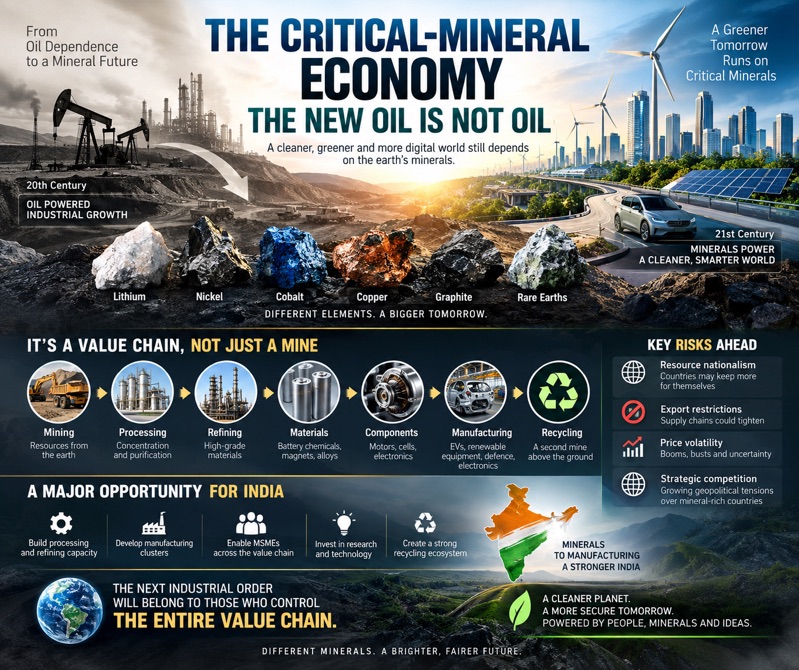
For more than a century, the geography of economic power was heavily influenced by oil. Countries worried about oil wells, shipping lanes, pipelines, refineries and strategic petroleum reserves. Wars were shaped by energy security. Foreign policies were built around oil-producing regions. Industrial economies became vulnerable whenever petroleum supplies were interrupted. The world is now trying to escape this dependence through electric vehicles, renewable energy, batteries and cleaner technologies. But an uncomfortable paradox is emerging. The energy transition may reduce dependence on petroleum while creating a new dependence on minerals. The names are changing from oil and gas to lithium, nickel, cobalt, copper, graphite and rare earths. The politics of dependence may not disappear.
From the Oil Economy to the Mineral Economy — The industrial revolution was powered first by coal and later increasingly by petroleum. The emerging clean-energy economy is much more material-intensive. An electric vehicle needs batteries, motors, electronics and sophisticated power systems. Solar plants require metals, specialised materials and electrical equipment. Wind turbines require large quantities of steel, copper and, in some technologies, rare-earth permanent magnets. Electricity grids require enormous amounts of copper and aluminium. Data centres, semiconductors, defence equipment and advanced electronics add another layer of mineral demand. The future economy may therefore be digital on the surface but increasingly physical underneath.
The Great Mistake Is to Look Only at the Mine — Having minerals underground does not automatically create industrial power. This is perhaps the most important lesson for mineral-rich developing countries. The real value chain begins with exploration and mining but continues through concentration, processing, refining, chemical conversion, materials engineering, component manufacturing, final products, recovery and recycling. A country can export mineral ore worth relatively little and later import batteries, magnets, electronics or advanced components containing the same material at many times the value. This is an old development problem appearing in a new technological form. For decades, many developing economies exported commodities while advanced industrial economies captured value through technology, brands and manufacturing. The critical-mineral transition could reproduce exactly the same structure unless mineral-rich countries build processing and manufacturing capabilities.
The New Oil Refinery May Be the Mineral Processing Plant — During the petroleum era, controlling an oil field was important, but refining capacity, petrochemicals, shipping, finance and distribution determined much of the economic power surrounding oil. Critical minerals may follow a similar pattern. Mining attracts attention because it is visible. Processing is less visible but strategically more important. Whoever can convert raw minerals reliably into battery-grade chemicals, cathode and anode materials, permanent magnets and specialised industrial inputs can influence entire downstream industries. The strategic contest is therefore moving from ownership of natural resources towards ownership of industrial ecosystems.
China Understood the Value Chain Earlier — One of the defining characteristics of the emerging mineral economy is the importance of processing capacity and downstream manufacturing. China developed powerful positions not simply by controlling domestic mineral deposits but by investing across processing, refining, materials and manufacturing supply chains. This created an industrial ecosystem that is difficult to reproduce quickly elsewhere. Other economies are now attempting to diversify their supply chains, but building a mine is very different from building an integrated mineral-to-manufacturing ecosystem. Technology, environmental approvals, infrastructure, skills, finance and assured demand all have to move together.
The Green Transition Could Produce a New Resource Nationalism — Countries rich in critical minerals are beginning to understand that simply exporting raw materials may sacrifice the largest part of future value creation. Governments may increasingly demand domestic processing, local manufacturing, technology transfer, employment creation or greater national participation before allowing resources to leave their borders. Export restrictions and local-processing requirements could therefore become more common. What appears economically rational for one mineral-producing country can collectively make global supply chains less predictable. The world may gradually move from petroleum nationalism towards mineral nationalism.
The Next Trade War May Begin Underground — Trade policy is already becoming intertwined with economic security. Critical minerals sit directly at the intersection of energy, defence, electronics, automobiles and advanced manufacturing. This makes them very different from ordinary commodities. Governments may increasingly treat mineral supply chains as strategic infrastructure. Export controls, investment screening, strategic reserves, bilateral mineral partnerships and long-term supply agreements could become normal instruments of industrial policy. The cheapest supplier may no longer automatically win. The politically reliable supplier may become more valuable than the lowest-cost supplier.
Price Volatility Could Become the Hidden Enemy of the Energy Transition — There is another contradiction. Expectations of huge future mineral demand can stimulate massive investment. New capacity can then push prices sharply downward, discouraging further investment. Several years later, insufficient new capacity can produce shortages and another price spike. Such cycles are familiar in commodity markets. But when minerals become essential inputs for batteries, grids and clean technologies, commodity cycles can directly affect the speed and cost of decarbonisation. The energy transition therefore needs not merely more minerals but more stable mineral supply systems.
Recycling Will Slowly Become a Strategic Mine Above the Ground — The first phase of the mineral economy will inevitably depend heavily on extraction. The second phase could increasingly depend on circularity. Every battery, motor, electronic device and piece of industrial equipment eventually becomes a potential secondary mineral resource. Countries without large geological reserves can still develop positions in collection, dismantling, material recovery, refining and recycling technology. Tomorrow’s strategically important mine may therefore not always be underground. It may be inside cities, factories, vehicles and discarded electronics.
India Must Avoid Becoming a Buyer at the End of the Chain — India’s challenge is particularly important. Rapid expansion of renewable power, electric mobility, electronics, defence manufacturing and grid infrastructure will increase demand for strategic materials. Merely securing overseas mines or discovering domestic reserves will not be enough. India needs capabilities connecting mineral security with refining, materials science, battery chemistry, permanent magnets, power electronics, recycling, equipment manufacturing and research. Otherwise, dependence on imported petroleum could gradually be replaced by dependence on imported mineral-based components.
The Opportunity for MSMEs Is Larger Than Mining — Critical minerals are often discussed as if they belong only to giant mining companies. That misses much of the industrial opportunity. Thousands of smaller firms can participate around mineral testing, exploration equipment, mining machinery, specialised chemicals, precision engineering, furnaces, material handling, recycling equipment, waste recovery, environmental technologies, battery components, electronics and industrial services. This is where cluster development becomes relevant. India does not need only critical-mineral mines. It needs critical-mineral manufacturing clusters connecting research institutions, processors, component manufacturers, recyclers, testing laboratories, equipment suppliers and downstream industries.
The Future Industrial Map May Follow Energy and Minerals Together — During the twentieth century, factories frequently moved towards markets, ports, labour and fossil-energy systems. The twenty-first-century industrial map could increasingly follow a different combination: renewable electricity, critical minerals, processing capacity, water, logistics, technology and geopolitical reliability. Countries possessing minerals but lacking infrastructure may remain commodity exporters. Countries without major mineral deposits but possessing processing technology and manufacturing ecosystems may capture far greater value.
The Final Paradox — The world describes the coming transition as moving from a resource-intensive economy towards a clean and digital economy. In reality, the digital and green economy is enormously dependent on physical materials. Artificial intelligence needs data centres. Data centres need electricity. Electricity networks need copper and aluminium. Electric vehicles need batteries. Batteries need processed minerals. Wind turbines, electronics, defence systems and automation all return us eventually to materials.
So the future may not be about escaping natural resources at all. It may be about changing which resources matter.
The petroleum age taught countries to think about energy security.
The critical-mineral age will force them to think about entire value-chain security.
And that is a much more difficult challenge.
The countries that simply possess minerals may earn royalties. The countries that process them may build industries. The countries that convert them into technologies may capture markets. But the countries that combine minerals, clean energy, processing, manufacturing, recycling, technology and strategic alliances could shape the next industrial order.
The new oil is not lithium, cobalt, copper or rare earths individually.
The new oil is control over the value chain.
#CriticalMinerals #Manufacturing #India #MSME #EnergyTransition #SupplyChains #IndustrialPolicy #ElectricVehicles #RenewableEnergy #ClusterDevelopment




No comments:
Post a Comment