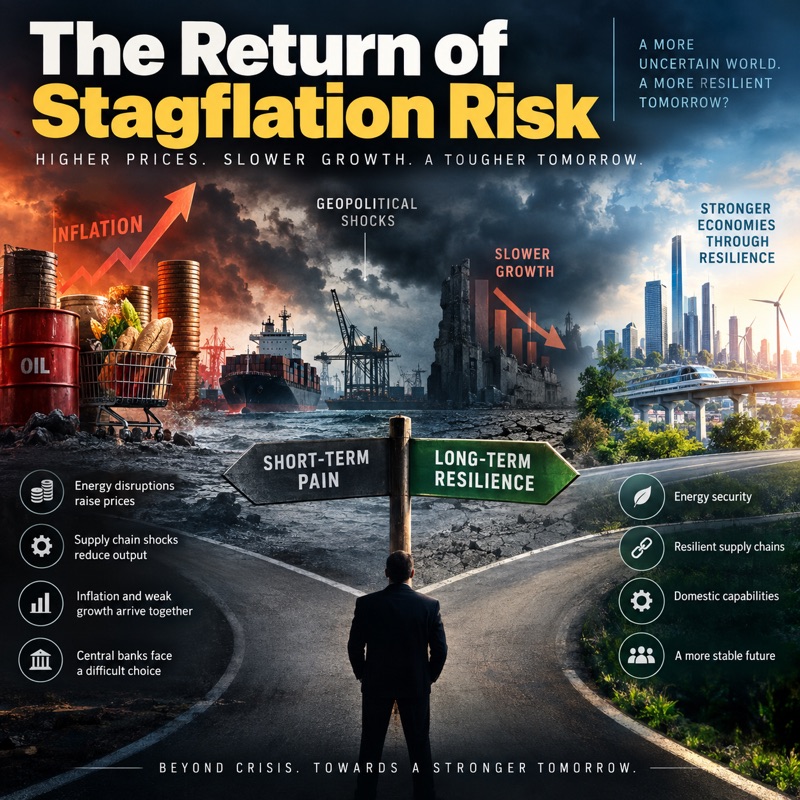
 For much of the past forty years, economic policymaking became relatively comfortable. When growth weakened, central banks could reduce interest rates. When inflation increased, they could raise them. The problems appeared different and the medicines appeared reasonably clear. The world entering the late 2020s is becoming much less convenient. Inflation and weak growth can now arrive together, and geopolitics can produce both.
The ghost of the 1970s is returning in a different form. The word stagflation became part of economic vocabulary during the 1970s, when oil shocks demonstrated something uncomfortable. An economy could experience rising prices without experiencing strong demand or prosperity. Expensive energy raised the cost of transport, manufacturing, food and almost everything else while simultaneously reducing household purchasing power and industrial activity. Traditional demand-management policies struggled because reducing inflation could deepen the slowdown, while stimulating growth could intensify inflation.
The following decades gradually changed that environment. Globalisation expanded manufacturing capacity. China and other Asian economies supplied cheaper manufactured goods. International supply chains lowered production costs. Energy markets became more diversified. Independent central banks gained credibility. Inflation declined across much of the world.
The global economy began to believe that persistent stagflation belonged to economic history.
That assumption now looks increasingly fragile.
The new stagflation may begin outside the economy. The important change is the source of inflation. When inflation comes mainly from excessive domestic demand, interest rates can reduce spending and cool prices. But when inflation originates from disrupted oil supplies, expensive shipping, geopolitical conflict, trade restrictions, critical-mineral shortages or fragmented supply chains, monetary policy becomes a much weaker instrument.
A central bank can increase interest rates. It cannot produce oil.
It can reduce credit. It cannot reopen a shipping route.
It can suppress consumer demand. It cannot manufacture semiconductors, fertilizers, copper or rare earths.
This distinction may become one of the defining economic problems of the coming decade.
The IMF’s July 2026 outlook illustrates the tension. Global growth is projected at only 3.0 percent in 2026, below the 3.5 percent average recorded during 2024–25. At the same time, global headline inflation is projected to rise from 4.1 percent in 2025 to 4.7 percent in 2026. The IMF describes the earlier global disinflation process as having stalled, with higher energy and food prices playing an important role. (IMF eLibrary)
This is not necessarily a repeat of 1970s stagflation. But the combination deserves attention because the transmission mechanism is becoming familiar: an external supply shock raises prices while weakening real incomes and production.
Energy is no longer merely another commodity. It is becoming a macroeconomic transmission system. When energy prices rise sharply, the effect moves through almost every value chain. Fertilizer becomes more expensive. Food production costs increase. Transport becomes costlier. Chemicals, metals, plastics and textiles face higher processing costs. Electricity-intensive manufacturing loses competitiveness. Households spend more on fuel and utilities and therefore have less money for other consumption.
Inflation rises while demand can simultaneously weaken.
That is the stagflation mechanism.
The IMF’s July assessment also shows how uneven this process can be. Energy exporters outside conflict zones may benefit from better terms of trade, while energy-importing economies with limited participation in the technology boom can face considerably greater pressure. Meanwhile, countries strongly connected to the AI and technology investment cycle can receive an offsetting growth impulse. (IMF eLibrary)
This means the next stagflationary episode, if it develops, may not be globally uniform. It could produce a deeply divided world economy.
There may be three economies inside one global economy. Technology-intensive economies could continue investing rapidly in AI, semiconductors, data centres and advanced manufacturing. Energy-exporting countries could benefit from higher commodity revenues. But energy-dependent developing economies outside major technology value chains could face the worst combination: expensive imports, weaker currencies, high financing costs and slower growth.
The future development divide may therefore be determined not simply by income per capita but by three forms of strategic capacity: access to affordable energy, access to technology and the ability to finance shocks.
Countries weak in all three could become particularly vulnerable.
The central-bank dilemma is becoming structural. If inflation remains high, central banks may maintain or increase interest rates. But expensive money reduces housing demand, business investment and consumer spending. MSMEs are often hit particularly hard because they borrow at higher rates and possess smaller financial buffers.
If central banks instead reduce rates to protect growth, currencies may weaken and imported inflation may increase.
Neither choice attacks the original supply constraint.
This creates an uncomfortable possibility: monetary authorities may increasingly be asked to solve problems that monetary policy did not create and cannot directly repair.
The deeper solution therefore moves beyond interest rates.
Economic resilience may become the new inflation policy. Countries may need larger strategic energy reserves, diversified import sources, stronger electricity systems, renewable capacity, domestic food security, efficient logistics and alternative shipping arrangements. Firms may hold larger inventories, diversify suppliers and build redundancy into supply chains.
For decades, economics rewarded efficiency through minimum inventories, concentrated production and just-in-time supply systems. The emerging world may increasingly reward something different: the ability to continue operating when the cheapest supply route suddenly disappears.
That resilience will carry a cost. Redundant suppliers, inventories and domestic capacity can initially look inefficient. But the definition of efficiency changes when disruptions become frequent.
A factory supplied by the cheapest producer in the world is not necessarily competitive if geopolitical disruption repeatedly stops its production.
The future inflation battle may therefore be fought inside factories, ports and power systems as much as inside central banks. Energy productivity, renewable electricity, logistics efficiency, domestic supplier development, recycling, material substitution and technological upgrading could become instruments of macroeconomic stability.
This is especially important for developing economies. Countries that remain dependent on imported energy, imported technology and imported intermediate goods may repeatedly import inflation whenever geopolitics becomes unstable.
Industrial policy and inflation policy could therefore begin to overlap.
The larger danger is normalising expensive instability. One shock can be treated as temporary. Repeated shocks create a new economic structure. Wars, sanctions, shipping disruptions, tariff conflicts, climate events, mineral restrictions and supply-chain fragmentation can gradually raise the normal cost of doing business.
Then inflation does not require an overheated economy.
It can emerge from an overheated geopolitical system.
The world may consequently be entering an era in which policymakers cannot simply choose between fighting inflation and supporting growth. They may have to build economies capable of doing both simultaneously.
The defining economic question of the next decade may therefore not be whether stagflation returns in exactly the form experienced fifty years ago.
It may be whether our institutions are still designed for a world that no longer exists.
The old policy framework assumed that markets would remain globally connected, energy would remain accessible, supply chains would remain open and geopolitics would remain largely outside everyday economic management.
That assumption is disappearing.
The future may belong to economies that understand a simple but uncomfortable reality: price stability will increasingly depend on strategic resilience, and growth will increasingly depend on the capacity to survive disruption.
#Stagflation #GlobalEconomy #Inflation #Geopolitics #EnergySecurity #SupplyChains #EconomicPolicy




No comments:
Post a Comment