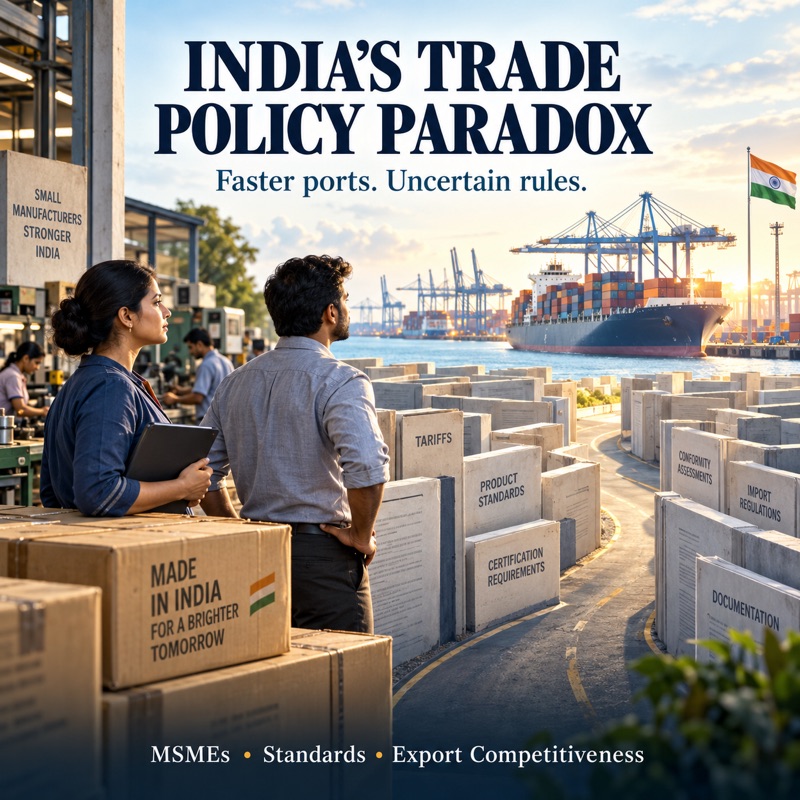
 A factory can become more efficient and still become less competitive. Its workers may produce more, its machines may waste less, and its shipments may reach the port faster. Yet a change in input duties, a delayed certification or an unexpected restriction can wipe out those gains. For India, this is an uncomfortable possibility: public investment can accelerate the movement of goods while policy uncertainty slows the movement of business.
India’s eighth WTO Trade Policy Review, held on 21 and 23 July 2026, provides an opportunity to examine this tension. The exercise combines an independent Secretariat report, a government report and scrutiny by WTO members. It offers a detailed account of policy, but does not establish that a particular intervention caused productivity to rise or fall. The distinction matters when translating institutional findings into industrial strategy. (wto.org)
From building industry to building reliability. After independence, India used protection and public investment to develop an industrial base in an economy short of capital and technological capacity. The reforms of 1991 widened the space for competition and international exchange. The next stage requires a harder achievement: making Indian enterprises dependable participants in production systems that cross borders repeatedly.
A manufacturer buying an imported component may be preparing an Indian export. A tariff that supports the component producer can raise costs for the enterprise using it. Both businesses belong to the domestic economy. Policy becomes misleading when it counts the gains of the protected industry without examining the losses of its customers.
The useful question is therefore how protection changes the capabilities of the entire production chain. Does it create better suppliers, stronger technology and competitive prices over time? Or does it allow one segment to charge more while another struggles to sell abroad?
Progress at the border, friction inside the system. The WTO reports that average import release times fell between 2023 and 2025 by approximately six hours at seaports and 18 hours at integrated check posts. It also places India’s average applied most-favoured-nation tariff at 15.7% in FY2025–26, including specified additional import levies. Participation in global value chains remains below the ASEAN average. These indicators show progress alongside continuing constraints; they do not establish a single cause for India’s competitiveness gap. (wto.org)
For a small enterprise, however, the interaction is easy to understand. A faster port helps only after the business has identified the correct classification, confirmed the applicable requirements, arranged testing and secured its inputs. A smooth final stage cannot recover every delay accumulated earlier.
Consider a hypothetical exporter that agrees to a fixed price and delivery date. If an input requirement changes after the order is accepted, the firm may have to find another supplier, repeat testing or absorb additional costs. The overseas buyer experiences a broken promise, regardless of which institution caused the difficulty.
Predictability therefore has economic value. It allows firms to quote confidently, carry smaller precautionary inventories and commit money to expansion.
Quality must come with the capacity to comply. India’s government told the review that Quality Control Orders serve legitimate public policy objectives. Consumer safety and product reliability deserve serious protection. The question is how to achieve these objectives while enabling smaller producers to meet them. (pib.gov.in)
A standard can raise quality when firms have access to suitable laboratories, technical advice, affordable testing and realistic transition periods. Where those conditions are missing, the same requirement can become a barrier that favours businesses with larger compliance departments.
This creates a difficult policy risk. A measure intended to improve products may also concentrate the market. That possibility requires investigation through evidence on testing costs, waiting times, supplier availability and business exits. Neither the announcement of a standard nor complaints against it settle the issue.
Before implementing major requirements, government should examine readiness in the clusters that must comply. Laboratory numbers alone are insufficient. What matters is whether the right test is available, recognised and affordable within the time a business can survive.
An incentive is a starting point, not a productivity result. Production-linked support should be judged by what enterprises can sustain after assistance ends. Additional output is useful, but the deeper questions concern domestic supplier development, worker skills, technological learning and competitiveness without continuing subsidy.
These outcomes require firm-level evidence. Supported enterprises may already have been positioned to expand. Demand may have risen independently. A credible assessment should distinguish production associated with a programme from production caused by it.
The same discipline should apply to import substitution. Replacing an imported product creates greater economic value when the domestic alternative becomes reliable and competitive. Counting the reduction in imports alone leaves the cost to downstream industries unanswered.
The next cluster institution must help firms understand the rules. Marketing assistance remains useful, but securing a buyer creates obligations that a cluster must be equipped to fulfil. Associations and common facility centres should develop shared services that explain regulatory changes, map product requirements, coordinate testing and identify risks to essential supplies.
Their value should be measured in practical outcomes: fewer rejected consignments, shorter certification delays, lower compliance costs and more repeat orders. A circular forwarded to hundreds of firms is not the same as a problem solved.
Major tariff and QCO changes should also undergo cluster-level impact assessments. These should examine which producers benefit, which input users bear costs, whether substitutes exist and how existing contracts will be affected. Emergency interventions may sometimes be necessary, but clear triggers and review dates can reduce avoidable uncertainty.
The future advantage is the ability to keep a promise. India’s industrial ambitions will depend on how well infrastructure, standards, trade rules and enterprise support work together. Each measure can appear reasonable on its own while their combined effect makes production harder.
The strongest trade policy will make it easier for a small manufacturer to improve quality, obtain inputs and deliver consistently. That is where national ambition meets everyday economic reality.
India can build more ports, factories and export platforms. Its next competitive advantage must also be built into the confidence with which an enterprise accepts an order—and keeps its promise.
#MSMEs #TradePolicy #ClusterDevelopment




No comments:
Post a Comment