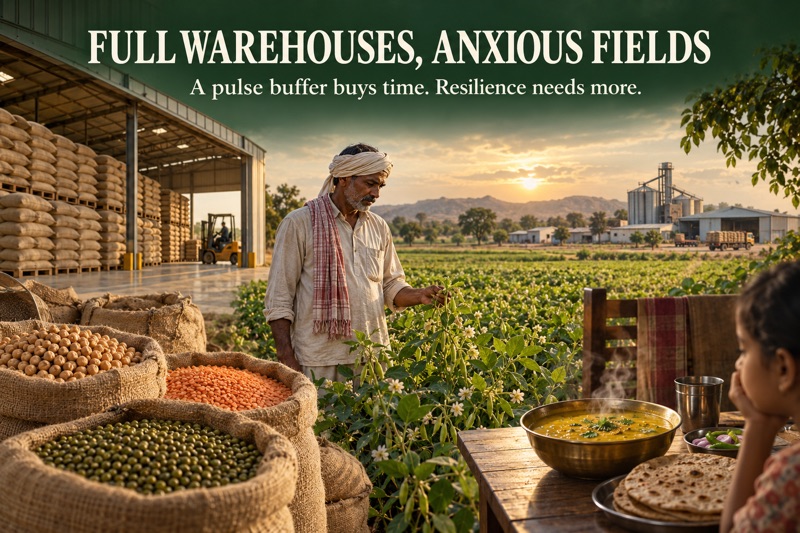
 A family buying dal and a farmer deciding whether to sow pulses are looking at the same food system from opposite ends. The family needs an affordable price today. The farmer needs a worthwhile return months later. A policy that satisfies one while repeatedly disappointing the other can produce temporary relief and permanent instability. This is the uncomfortable question behind the celebration of a record pulse buffer.
Government pulse stocks reportedly stand at 4.5 million tonnes against a norm of 3.5 million tonnes. The buffer report places kharif pulse acreage at 11.84 million hectares on 18 September 2026, down 1.42% from a year earlier. A separate report describes the same percentage as an increase, so the direction needs confirmation from the official sowing series. Neither acreage figure establishes harvested output.
The additional one million tonnes provides room to respond. It does not establish how long that room will last. That depends on the size and timing of shortages, the types of pulses available, their condition and how quickly they can reach consumers. A national stock total is useful information, but an incomplete measure of security.
The old success can become the new blind spot. India’s historical struggle against food scarcity made procurement, public storage and distribution central to agricultural policy. That approach helped build protection against shortages, particularly around rice and wheat. Its institutional legacy still shapes how success is discussed: more procurement, larger stocks and fuller warehouses.
Pulses demand a wider understanding of success. Food security must include the ability to obtain a varied and affordable diet. A system can be comfortable in its cereal balance and uncomfortable in its protein supply. The next agricultural transition must therefore ask whether farmers can reliably supply what households need to eat, at prices that allow both sides to manage their budgets.
The danger is that a well-stocked warehouse makes reform appear less urgent. Procurement is visible. Better seed availability, dependable extension, fair quality assessment and timely payments attract less attention. Yet these quieter services influence whether the next season produces a dependable crop.
Cheap dal today must leave room for tomorrow’s farmer. Buffer releases can soften sudden price increases. Their timing, however, matters. Heavy releases alongside fresh arrivals could weaken farm prices precisely when growers need to recover their costs. Waiting too long could leave households paying more and small processors struggling to purchase raw material.
This is a coordination problem with real human consequences. A farmer who repeatedly receives a poor return will reconsider the crop. A household facing expensive dal may reduce purchases. Protecting consumption while undermining the incentive to produce would merely postpone the shortage.
Policy should therefore make intervention more predictable. Farmers, millers and traders need a clearer understanding of the conditions that could trigger releases and how fresh harvest arrivals will be considered. Predictability cannot remove weather risk, but it can prevent government decisions from becoming an additional source of uncertainty.
An inflation forecast cannot stand in for a harvest. Reuters reported food inflation of roughly 6% in August and the Chief Economic Adviser’s expectation that pressure would ease towards year-end. That remains an outlook. A national inflation number also cannot explain the conditions facing every pulse grower or every household.
The same caution applies to rainfall averages. Crop outcomes depend on where rain falls, when it arrives and what happens during sensitive growth stages. Sown hectares measure planting, not the quantity or quality eventually harvested. Reasonable optimism should guide preparation alongside contingency planning.
Imports provide another source of supply: recent reporting estimates that they meet about 18–20% of annual pulse consumption. The strategic concern is how reliably imports can arrive when needed. Domestic production, diversified overseas sourcing and usable reserves should support one another. Treating any single source as sufficient would create avoidable exposure.
The missing institution is a working pulse cluster. A useful cluster would connect growers with seed suppliers, agronomic advice, aggregation, drying, moisture testing, grading, storage, finance and dal milling. Its value would lie in dependable services available through the season.
Consider the farmer who must sell immediately because storage is unavailable and a loan repayment is due. A warehouse alone will not change that decision. Access to finance against stored produce, transparent quality testing and credible buyers must work together. Otherwise, infrastructure may exist while distress selling continues outside its gate.
For a small dal mill, dependable raw material quality can matter as much as installed capacity. Uneven moisture, mixed lots and irregular deliveries complicate processing and purchasing. Cluster investment should be judged by better farmer realisations, lower losses, reliable throughput and timely payments. Counting buildings and machines says little about these outcomes.
Nutrition programmes could provide more predictable demand through transparent purchasing schedules and appropriate quality requirements. Farmer organisations and local processors would need fair opportunities to participate, manageable contract sizes and payment discipline. A public contract that pays late can transfer the financing burden to the smallest supplier.
The future buffer must be measured in usable supply. Associations and public agencies should publish understandable information on stock age, pulse variety, quality, location, crop conditions, imports and market arrivals. Such information would help distinguish a large reserve on paper from supplies that can actually be delivered.
Digital dashboards could support this work, but their credibility would depend on physical verification. A sophisticated screen cannot compensate for outdated stock records or unreliable quality checks. Technology becomes useful when it improves decisions and accountability.
Two broad paths remain possible. Good rabi production, dependable imports and measured releases could ease pressure while preserving reserves. A weaker crop combined with early depletion could leave processors facing tighter supply later. These are scenarios, not predictions; preparation should remain flexible enough for both.
The record buffer creates a window for action. Its deepest value will be realised if that window is used to improve farm productivity, strengthen local processing and make commercial relationships more dependable. If it becomes a reason to delay those changes, the next shortage will arrive with familiar explanations.
The strongest evidence of food security will be a farmer willing to sow pulses again, a processor able to plan production and a household able to afford dal without cutting something else from its plate.
#FoodSecurity #Agriculture #Pulses #MSMEs #ClusterDevelopment





No comments:
Post a Comment