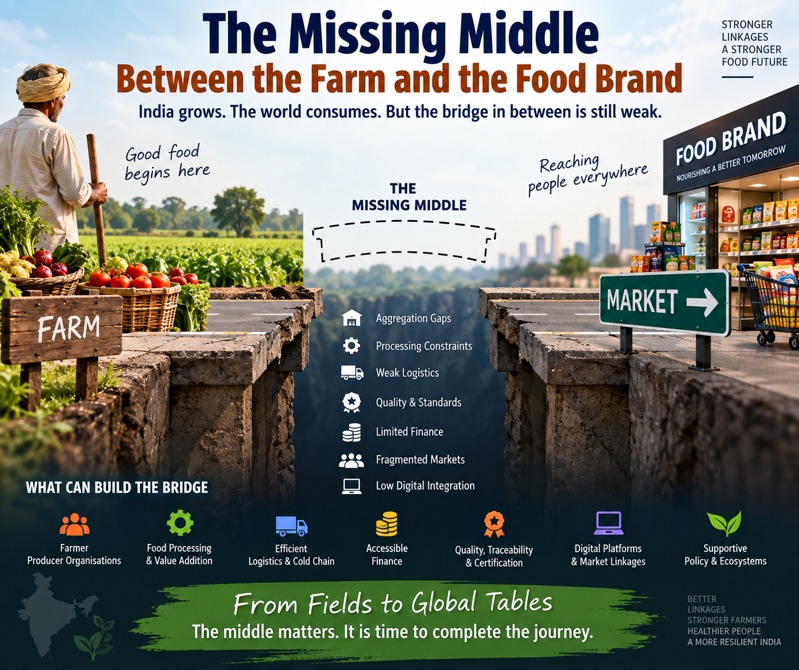
 India can grow a crop, build a food factory and launch a brand, yet still struggle to connect the three profitably. The weakest point may be the ordinary journey between them. A small processor needs raw material of predictable quality, delivered at the right time, supported by working capital and a buyer who pays. When that chain breaks, a machine purchased with public support can become an expensive waiting room.
The shift beyond production. The historical success of raising agricultural output made availability a central policy concern. Processing adds a different challenge: turning seasonal and variable produce into a consistent product. A food enterprise competes through taste and price, but also through shelf life, packaging, delivery and trust. Abundant crops do not automatically produce dependable industrial inputs.
An April 2026 government backgrounder reported that processed food had increased its share of agricultural exports from 13.7 per cent in 2014–15 to 20.4 per cent in 2024–25. It also reported 34 lakh tonnes of additional annual processing and preservation capacity under the food-processing PLI scheme as of February 2026. These are dated indicators of a deeper processing economy. They do not establish how evenly the gains reached small processors or farmers. [Source 1]
The strategic interpretation is that the contest is moving towards organisation around the product. Large businesses can combine procurement, quality systems, brand recognition and distribution. A village enterprise cannot reproduce that entire structure on its own. Its disadvantage may have less to do with entrepreneurial effort than with the cost of buying each supporting service separately.
Build the connection before enlarging the factory. Consider a proposed fruit-processing cluster. Before expanding machinery, its institutions should establish whether growers can supply the required varieties and grades, whether collection is commercially viable, and whether buyers want the intended product. A shared laboratory is useful only if its results arrive in time and are accepted by customers. A cold store adds value only when the product, storage conditions and buyer schedule justify its operating cost.
For MSMEs, the practical priority is a small set of dependable services: aggregation, grading, appropriate storage, packaging support and buyer-linked production planning. Farmer organisations, processors and logistics providers need explicit responsibilities. Shared infrastructure without clear service standards risks transferring coordination problems into a new building.
The financial test should follow a batch from procurement to payment. How much is rejected? How long does inventory remain unsold? What proportion of deliveries leads to repeat orders? Do farmers receive a better net realisation after grading and transport costs? These questions reveal competitiveness more clearly than installed capacity alone.
The next food advantage. Digital records and better process control could help smaller firms qualify for demanding buyers. However, technology cannot repair an arrangement in which nobody accepts responsibility for quality failures or delayed payment. The durable opportunity lies in combining local agricultural knowledge with professional commercial services. A temporary price increase may attract investment; reliable supply and repeat demand must sustain it.
India’s food future will depend partly on who owns brands and factories. It will also depend on whether the enterprises between the farm and the final market can earn enough to keep the chain working.
good product. What connects them? Grading, storage, packaging, transp




No comments:
Post a Comment