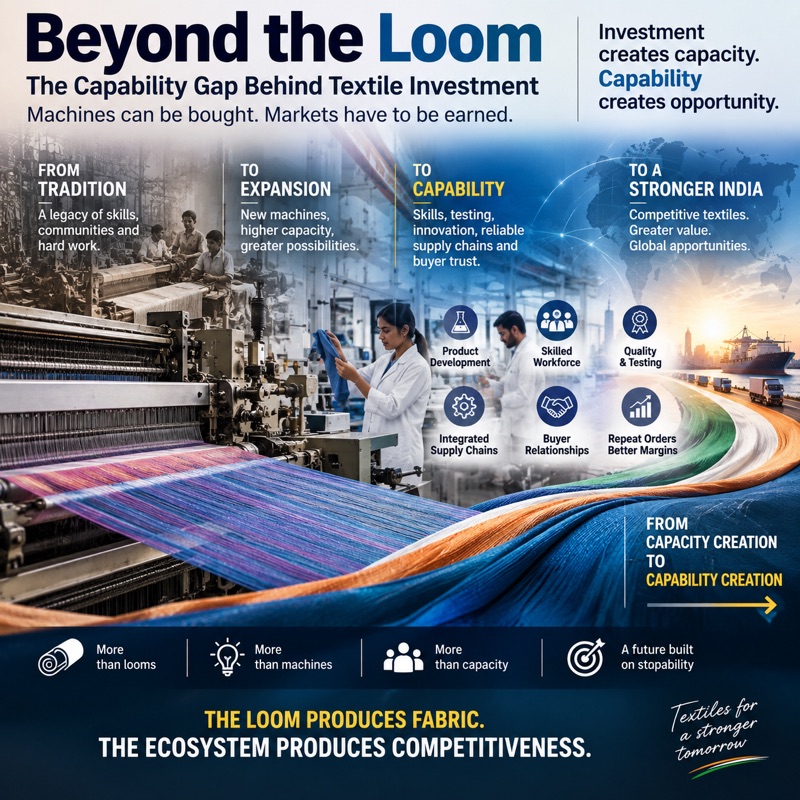
 India may be entering a new phase of textile investment. New machines are being installed, new capacities are being planned and public incentives are encouraging firms to move into man-made fibres, technical textiles and higher-value products. But there is a danger in confusing investment with competitiveness. A textile machine can be purchased in a few months. The capability to satisfy a demanding international buyer may take years to build.
The history of textiles is really a history of accumulated capability. Successful textile centres were rarely created simply by putting factories in one location. Tirupur became important because knitting, dyeing, processing, garmenting, accessories, logistics, labour skills, exporters and buyers gradually grew around one another. Ludhiana developed its own ecosystem around hosiery, woollens, knitwear, machinery, traders and specialised skills. What appears today as manufacturing capacity is actually the result of decades of learning, relationships, experimentation and commercial trust.
This distinction matters because the next textile competition will be very different from the previous one. India is no longer competing only on the number of looms, spindles, knitting machines or sewing machines it possesses. It is increasingly competing on how quickly a firm can develop a new fabric, meet a performance specification, document compliance, reproduce quality consistently and deliver thousands of pieces exactly when promised.
Investment is becoming easier, but capability is still difficult. The Textile PLI programme illustrates this transition. By July 2026, 170 companies had been approved under the scheme. The October 2025 amendments reduced the minimum investment thresholds by 50 per cent, from ₹300 crore to ₹150 crore in one category and from ₹100 crore to ₹50 crore in the other, while also lowering the incremental turnover requirement and expanding eligible products. The government subsequently reported that 65 of the 96 applications received under Round 3 were from MSMEs. (Press Information Bureau)
This is important. It means the investment door has become wider.
But walking through the door is not the same as reaching the market.
An approved investment tells us that a company intends to create capacity. It does not tell us whether an international sportswear company will approve its fabric, whether a technical textile will pass the required tests, whether colour consistency will survive repeated production runs, whether rejection rates will remain commercially acceptable or whether the buyer will return with another order.
That is the capability gap.
The factory is no longer the real competitive unit. The network is. A garment exporter may perform perfectly and still lose an order because the dyeing unit is inconsistent. A fabric producer may develop an excellent material but fail because testing takes too long. A technical textile manufacturer may install sophisticated equipment but struggle because specialised technicians are unavailable. An exporter may meet the price but lose the customer because an accessory supplier misses the delivery schedule.
This changes the economics of cluster development.
The old question was how much common infrastructure a cluster needed. The more useful question now is what market opportunity firms are unable to capture because a specific capability is missing.
That difference is fundamental.
A cluster does not necessarily need another building, laboratory or common facility centre. It may need faster access to an existing laboratory. It may need five highly trained technicians. It may need a product-development specialist who can work with twenty firms. It may need shared sampling capability. It may need certification support, digital traceability, chemical-management expertise or a mechanism connecting manufacturers with specialised international buyers.
Shared facilities should therefore begin with a buyer problem, not a construction plan. Before establishing a new facility in Tirupur, Ludhiana or another textile cluster, institutions should identify a product or buyer segment that local firms are repeatedly unable to enter. Then ask why.
Is the problem testing? Finishing? Product design? Certification? Small trial quantities? Skills? Machinery settings? Raw-material consistency? Buyer qualification?
Only after identifying the bottleneck should infrastructure be considered.
Every proposed shared facility should therefore have expected users, estimated trial volumes, trained technical staff, a realistic service price and a clear commercial problem that it solves. Where competent private capacity already exists, subsidising access, upgrading quality or building connections may produce better results than creating another institution.
The next industrial policy challenge is not capacity creation but capability creation. This distinction will become even more important as textiles move towards performance fabrics, recycled materials, smart textiles, medical applications, protective clothing, sportswear and increasingly traceable supply chains. Machines in these industries will become more sophisticated, but machines will also become globally available. Knowledge, organisational discipline, supplier coordination and trusted customer relationships will remain much harder to purchase.
This is where India’s textile policy may need its next evolution.
PLI has helped address the economics of investment and scale. The next layer should address the economics of experimentation. Small firms often hesitate to enter unfamiliar markets because the first experiment is expensive. Developing samples, testing materials, changing production settings, obtaining certification and approaching buyers all involve costs before there is any certainty of an order.
Clusters can reduce this risk collectively.
Shared product-development centres, specialised testing, demonstration production, technical mentoring, buyer-linked innovation programmes and pooled training can reduce the cost of experimentation without forcing firms to surrender their customers or confidential designs.
And this requires a different way of measuring success. Approved investment is easy to count. Installed machinery is visible. Buildings can be photographed. Capability is harder to measure.
But capability has its own evidence.
How many new samples were accepted by buyers? How many firms entered a higher-value product category? Did rejection rates fall? Did testing time decline? Did firms receive repeat orders? Did export margins improve? Did delivery become more reliable? Did MSMEs move from subcontracting towards direct customer relationships?
These indicators may tell us far more about competitiveness than the value of machinery installed.
The future textile race may ultimately be about who keeps the machines intelligently occupied. Countries can subsidise factories. Companies can import technology. Investors can finance production capacity. But markets cannot be ordered from a catalogue.
Demand has to be earned.
India therefore needs to look beyond the loom. The deeper textile infrastructure of the future will consist of skills, testing, product development, standards, information, specialised suppliers, logistics, buyer knowledge and commercial trust.
The loom produces fabric.
The ecosystem produces competitiveness.
And in the textile economy of the future, the countries and clusters that understand this difference may capture far more value than those that simply install more machines.
One particularly strong idea here is the shift from capacity creation to capability creation. Official figures show ₹8,117.64 crore of actual investment and 33,427 new jobs under the PLI scheme as of 31 March 2026, while the scheme’s 170 approved applicants collectively envisage much larger future investment, turnover and employment. That makes the distinction between approved/committed investment and demonstrated market capability especially
#IndianTextiles #MSME #TextileIndustry #Exports #ClusterDevelopment




No comments:
Post a Comment