Friday, July 31, 2026

Before the World Learns to Produce More, It Must Learn to Deliver Power Better

The Forgotten Half of the Electricity Story

For decades, countries believed that producing more electricity was the biggest challenge. Governments invested in coal plants, hydroelectric projects, gas stations, nuclear energy, and now massive renewable energy parks. The belief was simple. More generation would automatically mean better development. History has proved otherwise. Electricity does not create prosperity when it remains trapped in transmission lines, lost in outdated networks, or sold through financially weak distribution systems. The real challenge of the future is not producing electricity. It is delivering affordable, reliable, and financially sustainable power to every factory, business, farm, and household.

Why Distribution Has Become the Weakest Link

Electricity distribution rarely receives the same attention as power generation because it is less visible. Power plants make headlines while distribution networks quietly determine whether industries can operate without interruption. In India, distribution companies sit at the centre of the entire power economy. They collect payments, maintain local networks, purchase electricity, connect renewable energy, and ensure that consumers receive uninterrupted supply. When these institutions become financially weak, the entire energy system begins to lose efficiency. Technical losses, electricity theft, delayed payments, ageing infrastructure, and uneven pricing slowly weaken their financial health, creating a cycle that becomes increasingly difficult to break.

The Hidden Cost Paid by Industry

Many businesses believe they are paying only for the electricity they consume. In reality, productive industries often pay for much more. Cross-subsidization has become a defining feature of the power system. Higher industrial tariffs are frequently used to support lower tariffs for other consumer categories. While social protection remains important, excessive dependence on industrial consumers increases production costs, weakens export competitiveness, discourages manufacturing investment, and reduces the attractiveness of India as a global production hub. The electricity bill of a factory increasingly reflects policy distortions as much as the actual cost of power.

Renewable Energy Cannot Succeed Without Strong Distribution

India has made remarkable progress in expanding solar and wind energy. Yet renewable energy depends on a distribution system capable of managing fluctuating supply, balancing demand, integrating battery storage, and modernizing local grids. Building thousands of megawatts of renewable capacity alone will not guarantee a successful energy transition. Weak distribution infrastructure can prevent clean energy from reaching consumers efficiently. The future of green energy therefore depends as much on intelligent distribution networks as on renewable power generation itself.

The Financial Burden That Quietly Expands

Financially stressed distribution companies create costs that eventually spread throughout the economy. Governments provide financial assistance, banks carry growing exposure, investment decisions become cautious, and infrastructure upgrades are delayed. These pressures do not disappear. They are transferred through public finances, higher tariffs, delayed maintenance, or reduced investment in modernization. What appears to be a power-sector problem gradually becomes a national economic challenge affecting inflation, industrial productivity, fiscal stability, and long-term competitiveness.

The Digital Grid Will Define the Next Industrial Revolution

The coming decades will transform electricity from a one-way service into an intelligent digital ecosystem. Electric vehicles, smart factories, artificial intelligence, automated manufacturing, distributed solar systems, battery storage, and smart homes will all demand real-time communication between consumers and the grid. Distribution companies will no longer simply deliver electricity. They will manage millions of connected devices that continuously generate and consume power. Countries that modernize their distribution networks will gain a decisive economic advantage. Those that fail may possess abundant electricity but remain unable to use it efficiently.

India Stands at a Strategic Crossroads

India is entering an era where manufacturing expansion, semiconductor production, electronics, electric mobility, green hydrogen, and digital infrastructure all require dependable electricity. Every production-linked incentive, every industrial corridor, and every smart city ultimately depends on reliable power distribution. If the last mile of electricity remains weak, even the strongest industrial policies will struggle to achieve their full potential. Distribution reform is therefore not merely an energy-sector agenda. It has become an industrial strategy, an investment strategy, and a national competitiveness strategy.

The Future Will Judge the Strength of the Grid, Not the Size of the Power Plants

The coming decades will not distinguish nations by how much electricity they generate but by how effectively they deliver it. The strongest economies will be those where electricity reaches every enterprise with reliability, transparency, financial sustainability, and digital intelligence. The real power crisis of the future will not be a shortage of electricity. It will be the inability to distribute it efficiently. Nations that continue celebrating generation while neglecting distribution may discover that they built impressive power plants but failed to build a truly powerful economy.

For social media, this theme can be distilled into a compelling LinkedIn and Facebook post, and it also lends itself well to a futuristic infographic or editorial-style illustration.

#PowerDistribution #EnergyTransition #India #MSME #Manufacturing #IndustrialCompetitiveness #RenewableEnergy #SmartGrid #EconomicDevelopment #FutureEconomy


Thursday, July 30, 2026

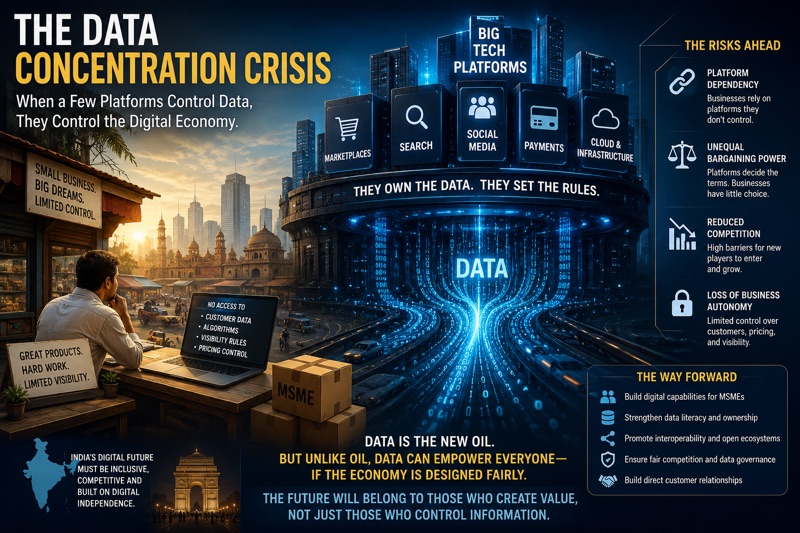
The New Empire Is Built on Data


Every major economic revolution has been driven by control over a valuable resource. During the agricultural age it was fertile land. The industrial era belonged to those who owned factories, machines, and raw materials. The digital economy has introduced a new strategic resource that is even more powerful than oil or steel. That resource is data.
Every online search, digital payment, product review, social media interaction, delivery order, and customer preference creates information. Individually these pieces of information appear insignificant, but together they form an economic asset that can shape consumer behaviour, influence markets, predict demand, and determine which businesses succeed and which quietly disappear.

The Invisible Shift in Economic Power

The concentration of data is changing the balance of economic power without attracting the attention that financial crises or stock market crashes receive. Instead of competing only through better products or lower prices, businesses increasingly compete through access to consumer information. The companies that collect the largest amount of data gain a significant advantage because they understand customers before customers even make purchasing decisions.

This silent shift creates a market where information becomes more valuable than production itself. Manufacturers may produce quality goods, retailers may provide excellent service, and entrepreneurs may introduce innovative ideas, but without access to customer data they often struggle to reach buyers on equal terms.

India’s Growing Digital Dependence

India has become one of the world’s fastest-growing digital economies. Millions of consumers now shop online, make digital payments, discover products through search engines, and rely on social media before making purchasing decisions. This digital transformation has opened enormous opportunities for businesses of every size.

However, it has also created a growing dependence. Many small businesses now rely on digital marketplaces to sell products, online platforms to attract customers, payment systems to receive money, and social media to remain visible. While these platforms have expanded market access, the businesses using them rarely control the customer information, pricing algorithms, search rankings, or visibility rules that determine their success.

As a result, many enterprises have become participants in digital markets without becoming owners of their own digital future.

When Small Businesses Lose Control

For decades, local businesses built relationships directly with customers. They understood buying habits, seasonal demand, and community preferences through personal interaction. Today, much of that valuable relationship is increasingly mediated by digital platforms.

A business may receive thousands of online orders yet know very little about the people making those purchases. The platform owns much of the customer relationship, controls communication channels, and can alter visibility or commercial terms at any time. This gradually reduces the independence of enterprises and increases their reliance on systems they neither manage nor influence.

The greatest danger is not the use of technology itself but the gradual erosion of business autonomy.

Competition Without Equal Access

Healthy markets depend on fair competition. When only a small number of organisations possess detailed consumer information, advanced analytics, and digital visibility, new competitors face higher barriers to entry. Smaller firms may produce better products but remain invisible because they lack access to the same level of information and digital reach.

Over time, market concentration can reduce innovation, weaken entrepreneurial confidence, and limit consumer choice. Economic growth becomes increasingly influenced by those who control digital infrastructure rather than those who create value through production, design, or service.

The Next Economic Divide

The coming decade may not simply divide economies into developed and developing nations. It may divide businesses into those that own data and those that merely generate it for others.

Artificial intelligence will deepen this divide. The quality of AI systems depends heavily on access to vast amounts of reliable data. Organisations controlling this information will improve their technology faster, strengthen customer relationships, and increase productivity at a pace that smaller competitors may struggle to match. The gap between digital leaders and digital followers could become one of the defining economic challenges of the next generation.

Building Digital Independence

The solution is not to slow digitalisation or discourage innovation. The challenge is to build a digital economy where opportunity is more widely shared. India needs stronger digital capabilities for MSMEs, greater awareness about data ownership, interoperable digital ecosystems, fair competition policies, secure data governance, and institutional support that enables enterprises to build direct relationships with customers.

Small businesses should be encouraged to invest in their own digital assets, customer databases, analytics, and online capabilities instead of relying entirely on external platforms. Industry associations, technology institutions, and policymakers must work together to ensure that digital growth strengthens enterprise independence rather than creating permanent dependence.

The Choice Before the Digital Economy

The Data Concentration Crisis is ultimately a question of economic sovereignty in the digital age. If information remains concentrated in the hands of a few powerful platforms, the economy may become more efficient but also less competitive, less innovative, and less inclusive.

History reminds us that every era of concentrated economic power eventually demanded new institutions, new rules, and new models of competition. The digital age will be no different. The countries that recognise data as a shared strategic resource, while protecting innovation and enterprise freedom, will build stronger and more resilient economies. Those that ignore this challenge may discover too late that they no longer control the engines of their own economic future.

#DataEconomy #DigitalIndia #MSME #ArtificialIntelligence #DigitalTransformation #Innovation #Competition #BusinessStrategy #EconomicPolicy #FutureOfBusiness


Wednesday, July 29, 2026

The Biggest Shock Is Not Job Loss but Human Adjustment

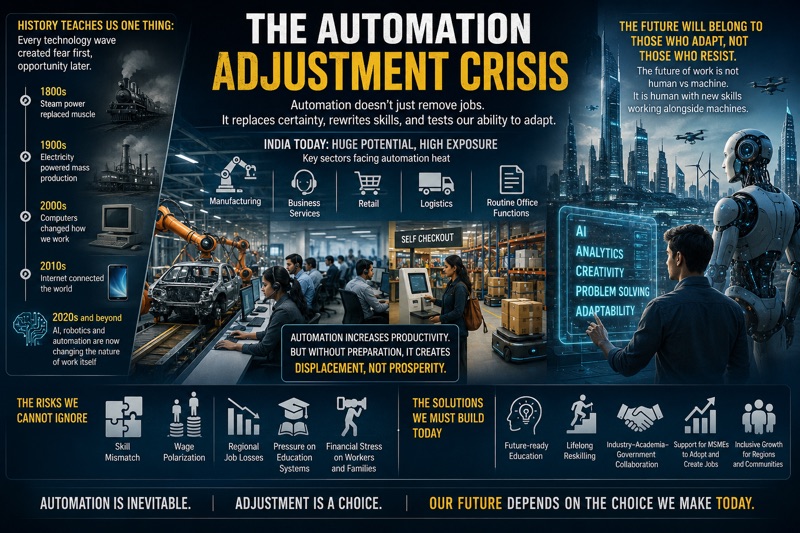
History shows that every industrial revolution created fear before it created prosperity. The steam engine reduced manual labour, electricity transformed factories, computers changed offices, and the internet reshaped entire industries. Every wave of technology eventually created new opportunities, but only after millions of people endured years of uncertainty. The coming age of artificial intelligence, robotics, automation, and intelligent machines is different because it is moving much faster than any previous transformation. This is no longer just about replacing physical work. It is beginning to replace routine thinking, repetitive decisions, and predictable office tasks. The real crisis is therefore not automation itself. The crisis is whether societies can prepare people quickly enough for a world where yesterday’s skills lose value almost overnight.
India Is Standing at a Dangerous Crossroads

India has built one of the world’s largest workforces, but a significant share of employment still depends on repetitive and standardized work. Manufacturing plants are introducing robotics to improve quality and reduce production costs. Warehouses are becoming automated with smart sorting systems. Retail businesses increasingly rely on self-service technologies and digital platforms. Business process outsourcing is integrating artificial intelligence into customer support, accounting, and data processing. Logistics companies are adopting autonomous planning systems that require fewer routine administrative roles. Every sector is becoming more productive, but not necessarily more labour-intensive. The challenge is that productivity is growing faster than the ability of workers to acquire new skills.

Productivity Can Rise While Opportunity Shrinks

Economic success is often measured through higher output, greater efficiency, and rising corporate profits. Yet these numbers can hide a silent social crisis. A company may double its production while employing fewer workers than before. Another may increase profits through automation without creating additional employment. From an economic perspective, both outcomes appear positive. From a social perspective, they create uncertainty for families that depend on stable jobs. Growth without broad participation gradually weakens purchasing power, increases inequality, and reduces confidence in economic institutions. The economy may become richer while many citizens feel poorer.

The Next Divide Will Be Between Skills, Not Income

The future will no longer separate workers by education alone. It will separate those who continuously learn from those whose skills remain unchanged. Workers capable of managing machines, analysing data, solving complex problems, designing systems, and working alongside artificial intelligence will command higher wages. Those performing repetitive tasks will face increasing competition from software and robotics. This creates wage polarization where highly skilled professionals earn substantially more while routine occupations experience stagnant incomes or disappear altogether. The divide will not be between rich and poor countries. It will increasingly exist within the same city, the same industry, and even the same workplace.

Education Is Becoming the Weakest Link

Many education systems continue to prepare students for occupations that are already changing rapidly. Memorising information has limited value when intelligent systems can retrieve knowledge within seconds. The future demands creativity, adaptability, critical thinking, communication, digital literacy, and continuous learning. Unfortunately, most retraining still begins only after workers lose their jobs instead of preparing them before disruption occurs. This reactive approach increases unemployment, weakens confidence, and places greater pressure on governments and employers to manage the consequences.

Regional Economies Could Face Unequal Futures

Automation will not affect every region equally. Industrial districts dependent on routine manufacturing, repetitive assembly, or standardized services may experience significant employment adjustments. Regions that invest in advanced manufacturing, digital infrastructure, innovation ecosystems, research institutions, and lifelong learning will continue attracting investment and creating higher-value employment. Those that fail to modernize risk losing industries, skilled workers, and future investment. The next economic map of India may be shaped less by geography and more by the ability of regions to continuously upgrade their workforce.

The Real Competition Is Between Adaptable Nations and Static Economies

The countries that will lead the coming decades will not necessarily be those with the largest populations or the cheapest labour. They will be those that build the fastest systems for reskilling workers, supporting innovation, modernising education, and helping businesses adopt technology without leaving people behind. Automation is not the enemy of employment. Poor preparation is. Machines will continue to become smarter because innovation never waits for permission. The real question is whether institutions, businesses, and governments can become equally intelligent in preparing people for that future. The nations that succeed will transform automation into prosperity. Those that hesitate may discover that the greatest crisis was never the machine. It was the failure to prepare humans for the world the machine created.


#Automation #ArtificialIntelligence #FutureOfWork #Manufacturing #MSME #Industry40 #SkillDevelopment #DigitalTransformation #IndianEconomy #EconomicPolicy


Tuesday, July 28, 2026

When Industrial Clusters Stop Innovating, Economies Stop Growing

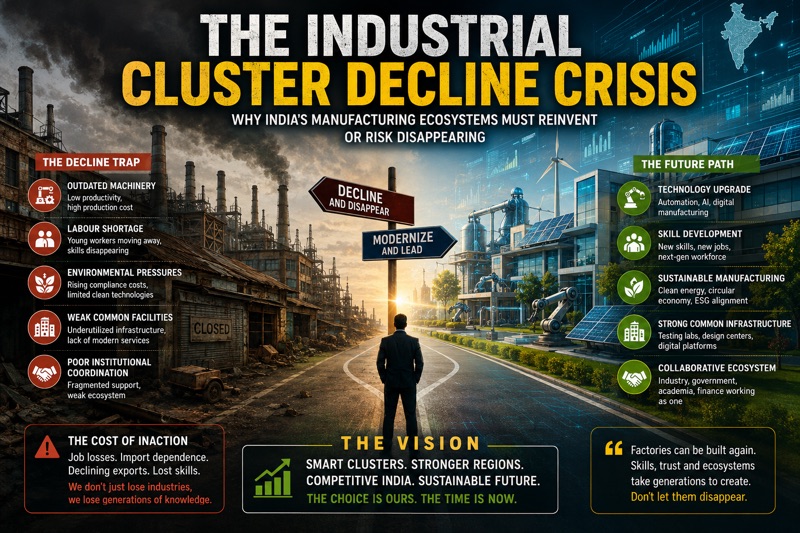
Before the world built global value chains, industrial clusters built local economies. Small workshops located close to one another created products that reached national and international markets long before the internet connected buyers and sellers. These clusters were never just groups of factories. They were living ecosystems where entrepreneurs, skilled workers, suppliers, transporters, repair shops, designers, and traders learned from one another every day. Their greatest strength was not machinery. It was collective knowledge built over generations. Today, many of these ecosystems are quietly weakening, and the consequences could be far greater than the closure of a few factories.

The Slow Collapse That Few People Notice

Industrial decline rarely begins with a dramatic factory shutdown. It starts with machines that are not replaced, skilled workers who retire without successors, young people choosing different careers, rising production costs, and institutions that gradually lose their ability to solve common problems. Production continues, but competitiveness slowly fades. Markets shift towards higher quality, faster delivery, digital manufacturing, and sustainable production while many traditional clusters continue operating with business models designed decades ago. The crisis is therefore not sudden. It is gradual, making it even more dangerous because it often escapes public attention until recovery becomes extremely difficult.

India’s Manufacturing Strength Cannot Depend on Yesterday’s Success

India has built hundreds of industrial clusters across sectors such as textiles, garments, leather, engineering goods, handicrafts, food processing, sports goods, auto components, ceramics, electronics, brassware, and furniture. These clusters have generated millions of jobs and contributed significantly to exports and regional development. However, many of them now face a common set of structural challenges. Outdated machinery reduces productivity. Labour shortages are increasing as younger workers seek more stable and better-paying employment. Environmental regulations demand cleaner production technologies that many small enterprises cannot afford individually. Common Facility Centres often remain underutilized or technologically outdated. At the same time, institutional coordination among industry associations, government agencies, financial institutions, research organisations, and training providers remains weak. As a result, clusters that once competed globally are increasingly struggling to compete even in domestic markets.

Technology Is Changing Faster Than Industrial Ecosystems

The next industrial revolution will not reward businesses simply because they have experience. It will reward those that combine experience with automation, artificial intelligence, digital quality systems, advanced materials, robotics, data analytics, and sustainable manufacturing. Large corporations can often invest in these technologies independently. Small enterprises within clusters usually cannot. Their competitive advantage has always depended on collective action. If collective institutions fail to modernize, the entire ecosystem risks falling behind together. This creates a widening technology gap where global competitors become more productive while traditional clusters become increasingly dependent on low-cost production, a strategy that is becoming unsustainable.

The Disappearance of Skills Is Harder to Reverse Than the Loss of Factories

When a factory closes, another investor may eventually reopen production. When specialised skills disappear, rebuilding them may take decades. Traditional craftsmanship, precision manufacturing techniques, specialised engineering knowledge, and production experience are accumulated over generations. Once experienced workers leave the industry and young people stop entering it, these capabilities vanish quietly. Countries that lose specialised industrial skills often become dependent on imports even for products they once produced efficiently. The real crisis is therefore not merely industrial decline. It is the erosion of productive knowledge that cannot be easily recreated through policy announcements alone.

Regional Economies Face the Greatest Risk

Industrial clusters are often the economic backbone of entire districts. They create employment not only within factories but also across logistics, transport, packaging, maintenance, hospitality, education, financial services, and local retail. When a cluster weakens, the impact spreads across the regional economy. Young workers migrate to larger cities, local businesses lose customers, property markets stagnate, and public infrastructure becomes underutilized. Regional inequality widens as investment increasingly concentrates in a few large metropolitan centres while traditional manufacturing towns struggle to attract new opportunities.

The Future Will Belong to Smart Clusters, Not Cheap Clusters

Competing only on lower labour costs is no longer a sustainable strategy. Future competitiveness will depend on innovation, design capabilities, digital integration, sustainability, quality certification, skilled human resources, collaborative research, and strong business support institutions. Industrial clusters must evolve into intelligent manufacturing ecosystems where enterprises share technology, testing facilities, common services, market intelligence, digital platforms, export support, and research partnerships. Universities, technical institutions, startups, financial institutions, and industry associations must become active participants in cluster development rather than operating in isolation.

A National Competitiveness Challenge

The decline of industrial clusters is not simply an MSME issue. It is a national competitiveness issue. Strong manufacturing ecosystems determine export performance, employment generation, innovation capacity, regional development, and economic resilience. Countries that successfully modernize their industrial clusters will strengthen their position in global supply chains. Those that neglect them may gradually lose productive capacity despite having large domestic markets. The coming decade will therefore not be defined by which country has the largest number of factories, but by which country successfully transforms its traditional industrial clusters into modern centres of innovation, technology, sustainability, and global competitiveness. If India succeeds in this transformation, its clusters can become engines of the next manufacturing revolution. If not, the country risks losing not only industries but also the skills, entrepreneurship, and regional prosperity that have powered its manufacturing story for generations.


#IndustrialClusters #MSME #Manufacturing #MakeInIndia #Industry40 #ClusterDevelopment #EconomicDevelopment #Exports #Innovation #RegionalDevelopment


The Village Is Not Running Out of People. It Is Running Out of Opportunities


For decades, agriculture has been the backbone of rural India. It has fed the country, supported millions of families, and shaped the social and cultural life of villages. But history also teaches us that no nation has become prosperous by depending only on farming. Every developed economy gradually moved workers from agriculture into manufacturing, processing, services, transport, tourism, digital businesses, and thousands of small local enterprises. That transformation created better incomes, stronger local markets, and a growing middle class. India now stands at the same turning point.
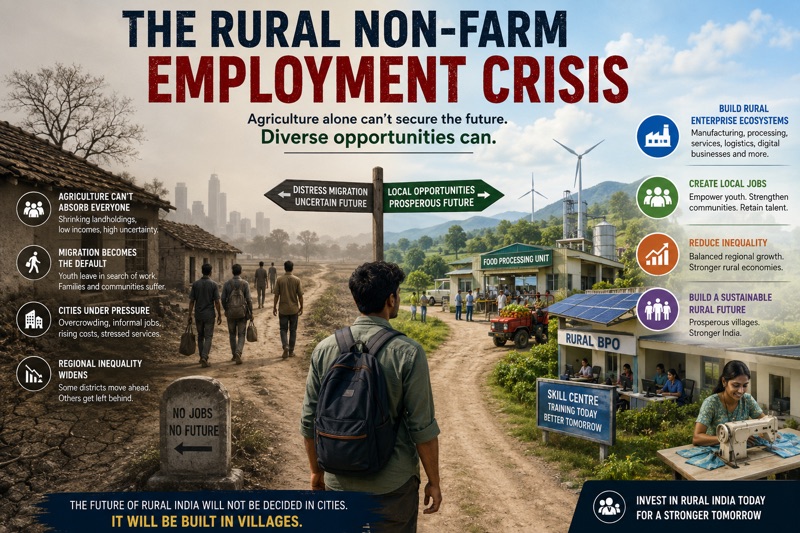
The biggest challenge is not that agriculture is failing. The real challenge is that agriculture alone cannot provide sustainable livelihoods for an expanding rural population. Land holdings continue to shrink, farming incomes remain uncertain because of weather and market fluctuations, and mechanization has reduced the demand for manual labour. Yet millions of young people still depend directly or indirectly on agriculture because there are too few alternatives close to home.

Migration Is Becoming a Survival Strategy Instead of a Choice

Across India, countless villages are losing their young workforce. Every year, young men and women leave their homes to search for work in cities. Many do not migrate because they dream of urban life. They migrate because they see no future where they were born.

This silent movement has become one of India’s biggest structural economic shifts. Families are separated, elderly parents remain in villages, children often grow up without one or both parents, and social networks weaken. At the same time, cities struggle with overcrowding, rising housing costs, traffic congestion, informal settlements, and increasing pressure on public services. Rural unemployment therefore does not remain a rural problem. It eventually becomes an urban crisis as well.

Empty Industrial Maps Create Empty Economic Futures

Many districts still lack strong manufacturing clusters, food processing industries, logistics hubs, repair services, tourism enterprises, digital service centers, or modern rural businesses. As a result, economic activity remains narrow and seasonal. Even educated rural youth often find themselves without jobs that match their aspirations or skills.

This is not simply a shortage of factories. It is a shortage of complete local economic ecosystems. Enterprises need finance, skilled workers, transport, digital connectivity, reliable electricity, market access, technology, and supportive institutions. When these pieces are missing, entrepreneurship struggles to survive, investments remain limited, and employment opportunities disappear before they are even created.

Rural Prosperity Will Be Built by Enterprise, Not Agriculture Alone

The future of rural India depends on creating thousands of small engines of local growth rather than waiting for a few large industries to arrive. Food processing units, textile clusters, handicrafts, renewable energy services, rural tourism, warehousing, cold chains, digital business centers, healthcare services, repair workshops, logistics, and local startups can together generate millions of jobs.

Technology is opening entirely new possibilities. High-speed internet allows professionals to work remotely from villages. Artificial intelligence, digital commerce, online education, telemedicine, and platform-based businesses are reducing the importance of physical location. If supported by the right infrastructure and skills, villages can become centers of innovation rather than suppliers of migrant labour.

The Next Economic Divide May Be Between Connected Villages and Forgotten Villages

The coming decade may not divide India between rural and urban areas. It may divide rural India itself. Districts that build strong local enterprise ecosystems will attract investment, retain talent, and create rising incomes. Districts that fail to diversify beyond agriculture may experience continuous migration, declining local demand, and growing inequality.

This emerging divide will shape education, healthcare, social stability, and even political confidence. Communities that lose their youth lose more than workers. They lose entrepreneurs, innovators, future leaders, and the energy needed to build stronger local economies.

The Real Crisis Is Not Rural Poverty. It Is Rural Potential Going Unused

India possesses one of the world’s largest rural populations, a young workforce, rich natural resources, traditional skills, and expanding digital infrastructure. Yet much of this potential remains underutilized because employment opportunities have not kept pace with changing aspirations.

The greatest economic loss is not visible in government statistics. It is measured in unrealized dreams, businesses that were never started, skills that remain unused, and villages that slowly lose their confidence in the future.

A Different Future Is Still Possible

History shows that countries become prosperous when economic opportunity reaches every region instead of remaining concentrated in a few metropolitan centers. India’s next development story should not be about moving millions more people into cities. It should be about bringing industries, services, innovation, finance, and entrepreneurship closer to where people already live.

The future of rural India will not be secured by asking agriculture to carry an impossible burden. It will be secured by building vibrant non-farm economies that allow people to stay, work, innovate, and prosper within their own communities. If India succeeds in creating strong rural enterprise ecosystems, villages will become engines of national growth. If it fails, migration will continue to replace opportunity, and the cost will be borne not only by rural India but by the entire nation.


#RuralEmployment #MSME #Manufacturing #LocalEnterprise #DistressMigration #RuralDevelopment #EconomicTransformation #RegionalInequality #SkillDevelopment #InclusiveGrowth


Monday, July 27, 2026

The Youth Aspiration Crisis: When Dreams Grow Faster Than Opportunities


A Generation That Dreamed Bigger Than the Economy Could Deliver
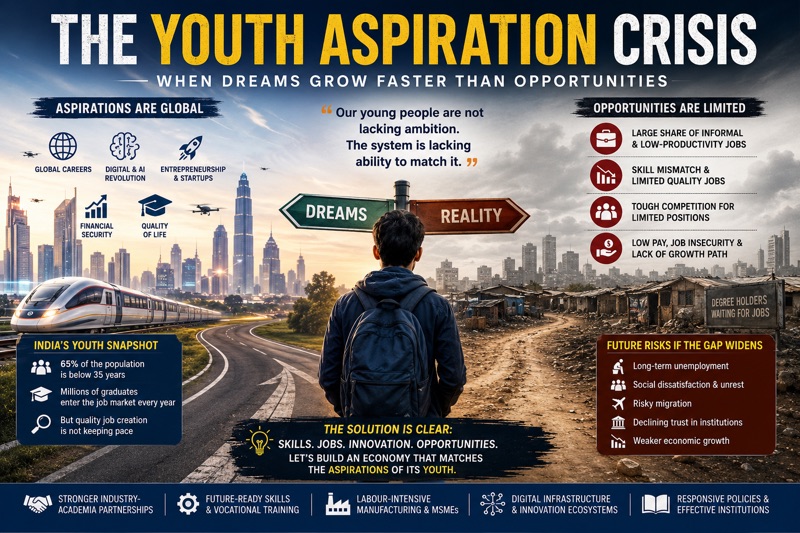
Every generation dreams of a better future than the one before it. That has always been the foundation of economic progress. But today, something unusual is happening. The speed at which aspirations are rising has far exceeded the speed at which economies are creating meaningful opportunities. The Youth Aspiration Crisis is not simply about unemployment. It is about the widening gap between what young people believe is possible and what the economy is actually able to provide. This silent mismatch is becoming one of the defining economic and social challenges of the twenty-first century.

For centuries, aspirations grew slowly because information travelled slowly. A village youth compared life with neighbouring villages. Today, a young person in a small town compares opportunities with professionals in Bengaluru, Dubai, London, Singapore, and Silicon Valley every single day. Social media, digital education, artificial intelligence, global entertainment, and instant communication have expanded ambitions faster than economic systems have expanded productive employment. Expectations have become global, but opportunities remain largely local.

India’s Demographic Dividend Can Become Its Greatest Test

India possesses one of the youngest populations in the world. This has long been described as the country’s demographic dividend. But a demographic dividend is not guaranteed. It delivers growth only when education, skills, industries, infrastructure, and institutions grow together. If millions of educated young people enter a labour market that cannot absorb their ambitions, the dividend gradually turns into a demographic challenge.

Across the country, young graduates increasingly seek professional careers, digital jobs, entrepreneurship, research, creative industries, and financially secure employment. Yet a significant share of available work remains informal, low-productivity, poorly paid, or without long-term career progression. Many graduates prepare for years for a limited number of government vacancies while private industry continues to report shortages of job-ready skills. The problem is no longer only the number of jobs. It is the growing mismatch between the nature of available jobs and the aspirations of an increasingly educated generation.

When Expectations Rise Faster Than Economic Transformation

History shows that societies remain stable when opportunities grow alongside aspirations. Trouble begins when expectations continue to rise while economic mobility slows. Young people do not become frustrated simply because they are unemployed. They become frustrated when they feel that hard work, education, and talent no longer guarantee progress.

This creates a deeper economic challenge. Families invest heavily in education with the belief that qualifications will improve their lives. When those expectations remain unfulfilled, confidence in education, institutions, and public systems gradually weakens. The cost is not measured only in income. It is measured in declining optimism, delayed family decisions, mental stress, reduced entrepreneurship, and a growing feeling that success depends more on luck than capability.

The Hidden Economic Cost of Unfulfilled Ambitions

The Youth Aspiration Crisis is often discussed as a social issue, but its economic consequences are equally serious. A young person who remains unemployed or underemployed for several years gradually loses valuable skills, confidence, and productivity. Businesses lose potential innovators. The economy loses future taxpayers, entrepreneurs, researchers, and consumers. Migration pressures increase as young people search for opportunities elsewhere, sometimes through risky or illegal channels. At the same time, domestic consumption weakens because uncertain incomes delay spending, housing purchases, investment, and family formation.

The longer this gap persists, the more difficult it becomes to restore trust between citizens and institutions. Economic growth alone cannot solve this problem if growth does not create productive, rewarding, and future-ready employment.

The Future Will Reward Countries That Create Opportunity, Not Just Growth

The next phase of global competition will not be won simply by countries that produce more goods or report higher GDP growth. It will be won by those that continuously convert the aspirations of their young population into innovation, entrepreneurship, skilled employment, and productive enterprises. Artificial intelligence, green manufacturing, advanced services, digital industries, biotechnology, creative economies, and knowledge-intensive manufacturing will reshape employment in the coming decades. Countries that prepare their youth for these transformations will strengthen both economic resilience and social stability.

India still has a remarkable opportunity. Its youthful population can become the world’s greatest source of innovation, productivity, and entrepreneurship. But that opportunity cannot be taken for granted. The future will depend on stronger industry-academia partnerships, faster skill development, labour-intensive manufacturing, thriving MSMEs, digital infrastructure, research ecosystems, and institutions that respond quickly to changing economic realities.

The Youth Aspiration Crisis is ultimately not a crisis of ambition. It is a crisis of opportunity. Young people have already shown that they are ready to compete with the world. The real question is whether the economy can evolve quickly enough to match their energy, talent, and dreams. Nations that succeed in closing this gap will shape the global economy of tomorrow. Those that fail may discover that disappointed aspirations can become far more expensive than unemployment itself.

#YouthAspirationCrisis #IndiaEconomy #DemographicDividend #FutureOfWork #Employment #MSMEs #SkillDevelopment #Innovation #EconomicGrowth #YouthEmpowerment


India’s New MSME Law: A Payment Reform or the Beginning of a Different Small-Business Economy?

India has spent decades telling small businesses to become competitive. Perhaps it is finally beginning to ask a more uncomfortable question...