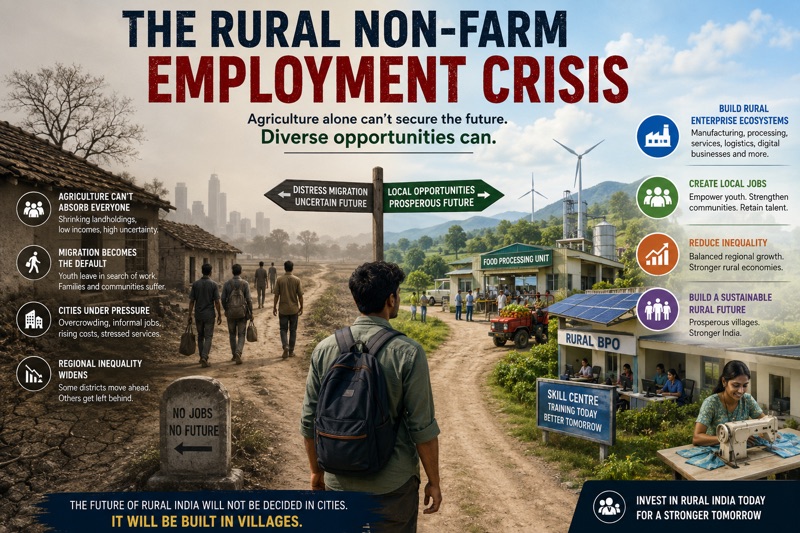
 For decades, agriculture has been the backbone of rural India. It has fed the country, supported millions of families, and shaped the social and cultural life of villages. But history also teaches us that no nation has become prosperous by depending only on farming. Every developed economy gradually moved workers from agriculture into manufacturing, processing, services, transport, tourism, digital businesses, and thousands of small local enterprises. That transformation created better incomes, stronger local markets, and a growing middle class. India now stands at the same turning point.
The biggest challenge is not that agriculture is failing. The real challenge is that agriculture alone cannot provide sustainable livelihoods for an expanding rural population. Land holdings continue to shrink, farming incomes remain uncertain because of weather and market fluctuations, and mechanization has reduced the demand for manual labour. Yet millions of young people still depend directly or indirectly on agriculture because there are too few alternatives close to home.
Migration Is Becoming a Survival Strategy Instead of a Choice
Across India, countless villages are losing their young workforce. Every year, young men and women leave their homes to search for work in cities. Many do not migrate because they dream of urban life. They migrate because they see no future where they were born.
This silent movement has become one of India’s biggest structural economic shifts. Families are separated, elderly parents remain in villages, children often grow up without one or both parents, and social networks weaken. At the same time, cities struggle with overcrowding, rising housing costs, traffic congestion, informal settlements, and increasing pressure on public services. Rural unemployment therefore does not remain a rural problem. It eventually becomes an urban crisis as well.
Empty Industrial Maps Create Empty Economic Futures
Many districts still lack strong manufacturing clusters, food processing industries, logistics hubs, repair services, tourism enterprises, digital service centers, or modern rural businesses. As a result, economic activity remains narrow and seasonal. Even educated rural youth often find themselves without jobs that match their aspirations or skills.
This is not simply a shortage of factories. It is a shortage of complete local economic ecosystems. Enterprises need finance, skilled workers, transport, digital connectivity, reliable electricity, market access, technology, and supportive institutions. When these pieces are missing, entrepreneurship struggles to survive, investments remain limited, and employment opportunities disappear before they are even created.
Rural Prosperity Will Be Built by Enterprise, Not Agriculture Alone
The future of rural India depends on creating thousands of small engines of local growth rather than waiting for a few large industries to arrive. Food processing units, textile clusters, handicrafts, renewable energy services, rural tourism, warehousing, cold chains, digital business centers, healthcare services, repair workshops, logistics, and local startups can together generate millions of jobs.
Technology is opening entirely new possibilities. High-speed internet allows professionals to work remotely from villages. Artificial intelligence, digital commerce, online education, telemedicine, and platform-based businesses are reducing the importance of physical location. If supported by the right infrastructure and skills, villages can become centers of innovation rather than suppliers of migrant labour.
The Next Economic Divide May Be Between Connected Villages and Forgotten Villages
The coming decade may not divide India between rural and urban areas. It may divide rural India itself. Districts that build strong local enterprise ecosystems will attract investment, retain talent, and create rising incomes. Districts that fail to diversify beyond agriculture may experience continuous migration, declining local demand, and growing inequality.
This emerging divide will shape education, healthcare, social stability, and even political confidence. Communities that lose their youth lose more than workers. They lose entrepreneurs, innovators, future leaders, and the energy needed to build stronger local economies.
The Real Crisis Is Not Rural Poverty. It Is Rural Potential Going Unused
India possesses one of the world’s largest rural populations, a young workforce, rich natural resources, traditional skills, and expanding digital infrastructure. Yet much of this potential remains underutilized because employment opportunities have not kept pace with changing aspirations.
The greatest economic loss is not visible in government statistics. It is measured in unrealized dreams, businesses that were never started, skills that remain unused, and villages that slowly lose their confidence in the future.
A Different Future Is Still Possible
History shows that countries become prosperous when economic opportunity reaches every region instead of remaining concentrated in a few metropolitan centers. India’s next development story should not be about moving millions more people into cities. It should be about bringing industries, services, innovation, finance, and entrepreneurship closer to where people already live.
The future of rural India will not be secured by asking agriculture to carry an impossible burden. It will be secured by building vibrant non-farm economies that allow people to stay, work, innovate, and prosper within their own communities. If India succeeds in creating strong rural enterprise ecosystems, villages will become engines of national growth. If it fails, migration will continue to replace opportunity, and the cost will be borne not only by rural India but by the entire nation.
#RuralEmployment #MSME #Manufacturing #LocalEnterprise #DistressMigration #RuralDevelopment #EconomicTransformation #RegionalInequality #SkillDevelopment #InclusiveGrowth




No comments:
Post a Comment