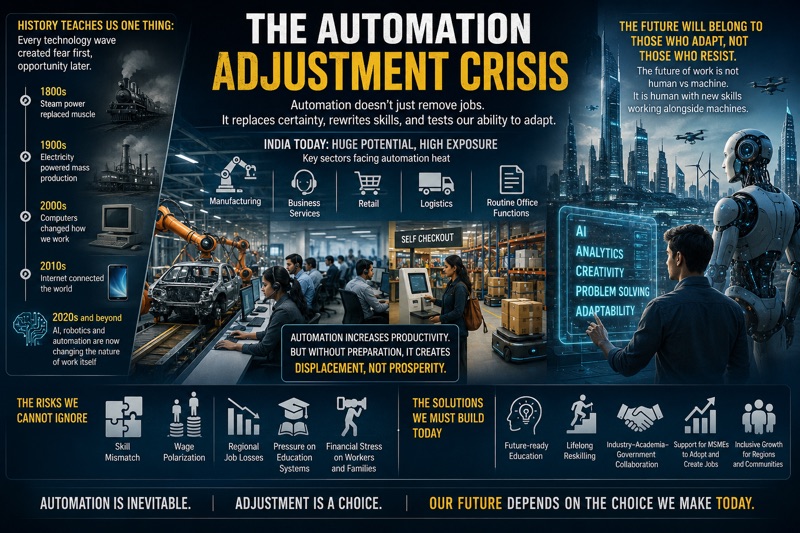
 History shows that every industrial revolution created fear before it created prosperity. The steam engine reduced manual labour, electricity transformed factories, computers changed offices, and the internet reshaped entire industries. Every wave of technology eventually created new opportunities, but only after millions of people endured years of uncertainty. The coming age of artificial intelligence, robotics, automation, and intelligent machines is different because it is moving much faster than any previous transformation. This is no longer just about replacing physical work. It is beginning to replace routine thinking, repetitive decisions, and predictable office tasks. The real crisis is therefore not automation itself. The crisis is whether societies can prepare people quickly enough for a world where yesterday’s skills lose value almost overnight.
India Is Standing at a Dangerous Crossroads
India has built one of the world’s largest workforces, but a significant share of employment still depends on repetitive and standardized work. Manufacturing plants are introducing robotics to improve quality and reduce production costs. Warehouses are becoming automated with smart sorting systems. Retail businesses increasingly rely on self-service technologies and digital platforms. Business process outsourcing is integrating artificial intelligence into customer support, accounting, and data processing. Logistics companies are adopting autonomous planning systems that require fewer routine administrative roles. Every sector is becoming more productive, but not necessarily more labour-intensive. The challenge is that productivity is growing faster than the ability of workers to acquire new skills.
Productivity Can Rise While Opportunity Shrinks
Economic success is often measured through higher output, greater efficiency, and rising corporate profits. Yet these numbers can hide a silent social crisis. A company may double its production while employing fewer workers than before. Another may increase profits through automation without creating additional employment. From an economic perspective, both outcomes appear positive. From a social perspective, they create uncertainty for families that depend on stable jobs. Growth without broad participation gradually weakens purchasing power, increases inequality, and reduces confidence in economic institutions. The economy may become richer while many citizens feel poorer.
The Next Divide Will Be Between Skills, Not Income
The future will no longer separate workers by education alone. It will separate those who continuously learn from those whose skills remain unchanged. Workers capable of managing machines, analysing data, solving complex problems, designing systems, and working alongside artificial intelligence will command higher wages. Those performing repetitive tasks will face increasing competition from software and robotics. This creates wage polarization where highly skilled professionals earn substantially more while routine occupations experience stagnant incomes or disappear altogether. The divide will not be between rich and poor countries. It will increasingly exist within the same city, the same industry, and even the same workplace.
Education Is Becoming the Weakest Link
Many education systems continue to prepare students for occupations that are already changing rapidly. Memorising information has limited value when intelligent systems can retrieve knowledge within seconds. The future demands creativity, adaptability, critical thinking, communication, digital literacy, and continuous learning. Unfortunately, most retraining still begins only after workers lose their jobs instead of preparing them before disruption occurs. This reactive approach increases unemployment, weakens confidence, and places greater pressure on governments and employers to manage the consequences.
Regional Economies Could Face Unequal Futures
Automation will not affect every region equally. Industrial districts dependent on routine manufacturing, repetitive assembly, or standardized services may experience significant employment adjustments. Regions that invest in advanced manufacturing, digital infrastructure, innovation ecosystems, research institutions, and lifelong learning will continue attracting investment and creating higher-value employment. Those that fail to modernize risk losing industries, skilled workers, and future investment. The next economic map of India may be shaped less by geography and more by the ability of regions to continuously upgrade their workforce.
The Real Competition Is Between Adaptable Nations and Static Economies
The countries that will lead the coming decades will not necessarily be those with the largest populations or the cheapest labour. They will be those that build the fastest systems for reskilling workers, supporting innovation, modernising education, and helping businesses adopt technology without leaving people behind. Automation is not the enemy of employment. Poor preparation is. Machines will continue to become smarter because innovation never waits for permission. The real question is whether institutions, businesses, and governments can become equally intelligent in preparing people for that future. The nations that succeed will transform automation into prosperity. Those that hesitate may discover that the greatest crisis was never the machine. It was the failure to prepare humans for the world the machine created.
#Automation #ArtificialIntelligence #FutureOfWork #Manufacturing #MSME #Industry40 #SkillDevelopment #DigitalTransformation #IndianEconomy #EconomicPolicy


No comments:
Post a Comment