 The Economic Storm That Arrives Without a Headline
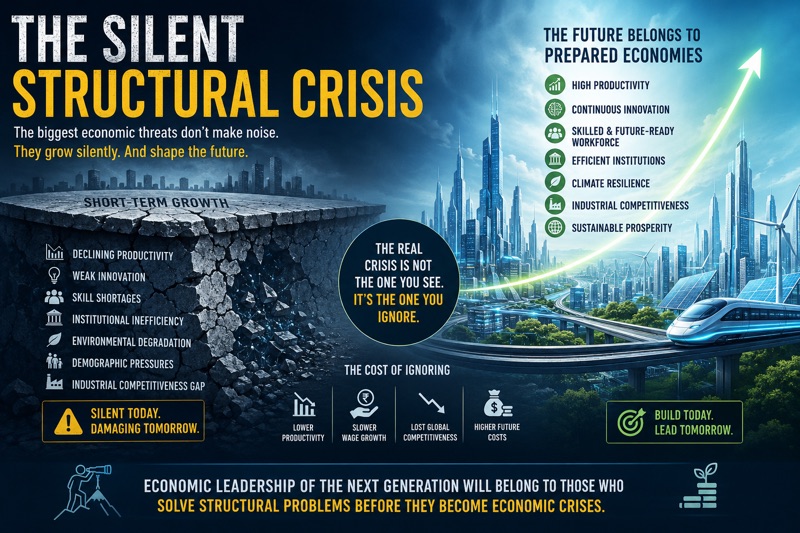
Most people recognize an economic crisis only when stock markets crash, banks fail, inflation surges, or unemployment suddenly rises. Yet history repeatedly shows that the deepest and longest-lasting crises rarely begin with dramatic events. They develop quietly over many years, hidden beneath respectable growth numbers and optimistic economic forecasts. Nations often celebrate rising GDP while overlooking the gradual weakening of productivity, slowing innovation, declining learning outcomes, institutional inefficiency, environmental degradation, and demographic shifts. By the time these invisible cracks become visible, reversing the damage becomes far more difficult and expensive.
Growth Without Strength Is an Illusion
Economic history offers a powerful lesson. Many countries have experienced periods of impressive growth before entering prolonged stagnation because they failed to strengthen the foundations of their economies. Growth driven only by consumption, borrowing, or short-term investment can create the appearance of prosperity, but without improvements in productivity and competitiveness, that prosperity becomes fragile. Every developed economy that has sustained high living standards has continuously invested in knowledge, technology, efficient institutions, and skilled people. The countries that ignored these fundamentals eventually faced slower growth, rising inequality, and declining global influence.
India Stands at a Critical Turning Point
India is one of the world’s fastest-growing major economies and possesses enormous demographic and entrepreneurial potential. However, rapid growth alone cannot guarantee long-term prosperity. Large differences in productivity across states, uneven technology adoption among MSMEs, shortages of advanced skills, infrastructure gaps, delays in institutional decision-making, and increasing environmental pressures remain structural challenges. These issues rarely dominate daily headlines because they do not trigger immediate panic. Yet together they quietly reduce industrial competitiveness, discourage investment, and slow innovation over time. The greatest danger is not today’s slowdown but tomorrow’s inability to compete in an increasingly knowledge-driven global economy.
The Future Will Reward Prepared Economies, Not Fast-Growing Ones
The next global economic race will not be decided simply by cheap labour, abundant natural resources, or even large domestic markets. It will be determined by artificial intelligence, advanced manufacturing, research capability, resilient supply chains, digital governance, climate adaptation, and continuous skill development. Countries that fail to upgrade their institutions and industries may discover that growth becomes increasingly difficult despite large populations and expanding markets. Future investors will increasingly evaluate institutional quality, regulatory predictability, innovation ecosystems, environmental resilience, and workforce capability before committing long-term capital.
The Cost of Ignoring Silent Crises
Unlike financial crises that erupt suddenly, structural crises slowly reduce economic potential year after year. Lower productivity limits wage growth. Weak innovation reduces industrial competitiveness. Skill shortages discourage advanced manufacturing. Institutional inefficiency delays investment decisions. Environmental degradation raises production costs and threatens agricultural security. Demographic pressures strain healthcare, pensions, and public finances. Individually these problems appear manageable, but together they create an economic drag that becomes difficult to reverse. Nations rarely collapse because of a single crisis; they gradually lose momentum by allowing many silent weaknesses to accumulate simultaneously.
Building the Economy Before the Crisis Arrives
The strongest economies of the future will not simply react to crises; they will prevent them. Economic resilience will depend on continuous investment in education, research, technology, efficient public institutions, climate adaptation, industrial modernization, and globally competitive MSMEs. Governments, businesses, universities, and civil society must work together to strengthen the productive capacity of the economy rather than focusing only on short-term growth indicators. Success will increasingly depend on the ability to anticipate structural risks long before they appear in economic statistics.
The Real Test of Economic Leadership
The defining economic question of the coming decades will not be whether countries can avoid the next recession. It will be whether they can identify and solve the silent structural weaknesses that slowly erode national competitiveness. The nations that act early will build resilient, innovative, and prosperous economies capable of withstanding future shocks. Those that wait for visible warning signs may discover that the real crisis had already begun years earlier, unnoticed, while the headlines celebrated growth.
#SilentStructuralCrisis #EconomicTransformation #Productivity #Innovation #HumanCapital #InstitutionalReform #IndustrialCompetitiveness #ClimateResilience #MSMEDevelopment #FutureEconomy




No comments:
Post a Comment