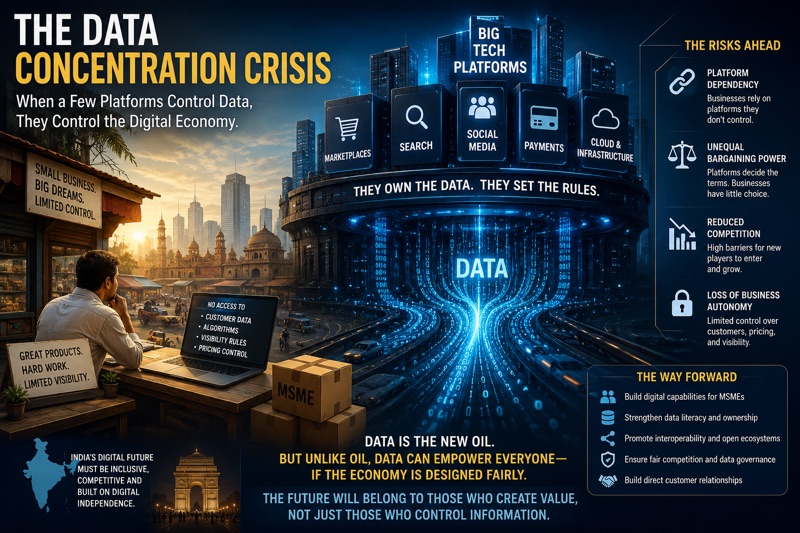
 Every major economic revolution has been driven by control over a valuable resource. During the agricultural age it was fertile land. The industrial era belonged to those who owned factories, machines, and raw materials. The digital economy has introduced a new strategic resource that is even more powerful than oil or steel. That resource is data.
Every online search, digital payment, product review, social media interaction, delivery order, and customer preference creates information. Individually these pieces of information appear insignificant, but together they form an economic asset that can shape consumer behaviour, influence markets, predict demand, and determine which businesses succeed and which quietly disappear.
The Invisible Shift in Economic Power
The concentration of data is changing the balance of economic power without attracting the attention that financial crises or stock market crashes receive. Instead of competing only through better products or lower prices, businesses increasingly compete through access to consumer information. The companies that collect the largest amount of data gain a significant advantage because they understand customers before customers even make purchasing decisions.
This silent shift creates a market where information becomes more valuable than production itself. Manufacturers may produce quality goods, retailers may provide excellent service, and entrepreneurs may introduce innovative ideas, but without access to customer data they often struggle to reach buyers on equal terms.
India’s Growing Digital Dependence
India has become one of the world’s fastest-growing digital economies. Millions of consumers now shop online, make digital payments, discover products through search engines, and rely on social media before making purchasing decisions. This digital transformation has opened enormous opportunities for businesses of every size.
However, it has also created a growing dependence. Many small businesses now rely on digital marketplaces to sell products, online platforms to attract customers, payment systems to receive money, and social media to remain visible. While these platforms have expanded market access, the businesses using them rarely control the customer information, pricing algorithms, search rankings, or visibility rules that determine their success.
As a result, many enterprises have become participants in digital markets without becoming owners of their own digital future.
When Small Businesses Lose Control
For decades, local businesses built relationships directly with customers. They understood buying habits, seasonal demand, and community preferences through personal interaction. Today, much of that valuable relationship is increasingly mediated by digital platforms.
A business may receive thousands of online orders yet know very little about the people making those purchases. The platform owns much of the customer relationship, controls communication channels, and can alter visibility or commercial terms at any time. This gradually reduces the independence of enterprises and increases their reliance on systems they neither manage nor influence.
The greatest danger is not the use of technology itself but the gradual erosion of business autonomy.
Competition Without Equal Access
Healthy markets depend on fair competition. When only a small number of organisations possess detailed consumer information, advanced analytics, and digital visibility, new competitors face higher barriers to entry. Smaller firms may produce better products but remain invisible because they lack access to the same level of information and digital reach.
Over time, market concentration can reduce innovation, weaken entrepreneurial confidence, and limit consumer choice. Economic growth becomes increasingly influenced by those who control digital infrastructure rather than those who create value through production, design, or service.
The Next Economic Divide
The coming decade may not simply divide economies into developed and developing nations. It may divide businesses into those that own data and those that merely generate it for others.
Artificial intelligence will deepen this divide. The quality of AI systems depends heavily on access to vast amounts of reliable data. Organisations controlling this information will improve their technology faster, strengthen customer relationships, and increase productivity at a pace that smaller competitors may struggle to match. The gap between digital leaders and digital followers could become one of the defining economic challenges of the next generation.
Building Digital Independence
The solution is not to slow digitalisation or discourage innovation. The challenge is to build a digital economy where opportunity is more widely shared. India needs stronger digital capabilities for MSMEs, greater awareness about data ownership, interoperable digital ecosystems, fair competition policies, secure data governance, and institutional support that enables enterprises to build direct relationships with customers.
Small businesses should be encouraged to invest in their own digital assets, customer databases, analytics, and online capabilities instead of relying entirely on external platforms. Industry associations, technology institutions, and policymakers must work together to ensure that digital growth strengthens enterprise independence rather than creating permanent dependence.
The Choice Before the Digital Economy
The Data Concentration Crisis is ultimately a question of economic sovereignty in the digital age. If information remains concentrated in the hands of a few powerful platforms, the economy may become more efficient but also less competitive, less innovative, and less inclusive.
History reminds us that every era of concentrated economic power eventually demanded new institutions, new rules, and new models of competition. The digital age will be no different. The countries that recognise data as a shared strategic resource, while protecting innovation and enterprise freedom, will build stronger and more resilient economies. Those that ignore this challenge may discover too late that they no longer control the engines of their own economic future.
#DataEconomy #DigitalIndia #MSME #ArtificialIntelligence #DigitalTransformation #Innovation #Competition #BusinessStrategy #EconomicPolicy #FutureOfBusiness




No comments:
Post a Comment