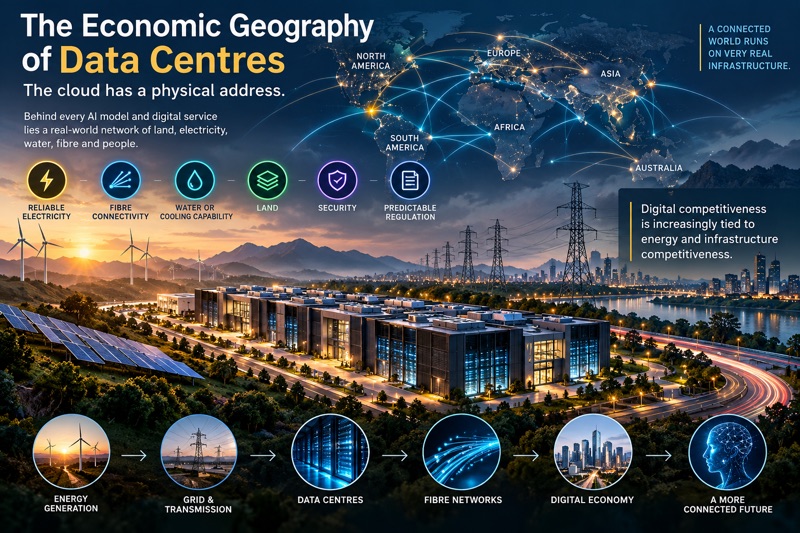
 For almost three decades, the digital economy was described as if it had escaped geography. Information travelled instantly, software crossed borders almost without friction, and businesses moved from offices to websites and then to the cloud. The vocabulary itself reinforced the illusion. We spoke about cyberspace, virtual infrastructure and cloud computing—as though economic activity had somehow detached itself from land, electricity and physical infrastructure. But the next phase of the digital economy is revealing almost the opposite. The more digital the world becomes, the more important physical geography may become. Behind every AI model, streaming service, financial transaction, e-commerce platform and cloud application stands an expanding industrial infrastructure of data centres, electricity networks, fibre cables, cooling systems, land and increasingly sophisticated power-management systems.
From Factory Geography to Computing Geography
The industrial revolution created its own economic map. Textile mills initially gravitated toward water and labour. Heavy industries clustered around coal, ports and railways. Petroleum later reorganised industrial geography around refineries, pipelines and shipping routes. Manufacturing globalisation created another map centred on container ports, industrial clusters, highways and efficient supply chains.
The AI and cloud era is creating yet another map: the geography of computation.
A data centre may appear very different from a steel plant, but economically the location problem is surprisingly familiar. Operators need reliable inputs, infrastructure, connectivity, security and regulatory certainty. The difference is that one of the most important raw materials is electricity and one of the most important transport networks is fibre.
This creates an important contradiction in the idea of a borderless digital economy. Data can cross the world in milliseconds, but the infrastructure processing that data must still exist somewhere.
And where that somewhere is located is becoming economically strategic.
Electricity Is Becoming the Industrial Raw Material of AI
The most important shift may be the convergence between digital competitiveness and energy competitiveness. Earlier generations of policymakers often treated telecommunications, electricity and industrial development as separate policy areas. That distinction is becoming increasingly artificial.
Large-scale cloud computing and particularly AI require enormous computational capacity. Computational capacity requires chips. Chips require servers. Servers require electricity. Electricity generates heat. Heat requires cooling. Cooling requires additional infrastructure and, depending on technology and climate, potentially significant water resources.
The digital value chain therefore eventually reaches something very physical:
AI → Compute → Chips → Data Centres → Electricity → Grid → Energy Infrastructure.
This means countries seeking leadership in artificial intelligence cannot think only about algorithms, startups and semiconductor access. They must think about transformers, transmission lines, generation capacity, storage, substations, fibre networks and land availability.
The next AI bottleneck may therefore emerge not inside a laboratory but inside an electricity grid.
The New Location Economics
Traditional industries often searched for cheap labour. Data-intensive industries increasingly search for something different: cheap, reliable and scalable electrons combined with fast connectivity.
The ideal data-centre location sits at the intersection of several economic systems—abundant power, resilient electricity networks, fibre connectivity, suitable land, manageable cooling conditions, physical security, political stability and predictable regulation.
Few locations possess all these advantages simultaneously.
A location may have cheap renewable electricity but poor international fibre connectivity. Another may possess excellent connectivity but face land constraints. A third may have abundant land but an unreliable electricity system. A fourth may have excellent infrastructure but increasingly restrictive environmental or water regulations.
This creates a new form of location competition.
Governments once competed to attract automobile factories, semiconductor fabs and export-processing zones. Increasingly, they will compete for hyperscale data centres, cloud regions, AI computing clusters and digital infrastructure investment.
But there is a critical difference.
A large manufacturing plant usually creates visible factory employment and supplier ecosystems. A highly automated data centre can involve enormous capital investment without generating comparable direct employment.
Governments therefore need to ask a harder question than simply how much investment is arriving:
How much domestic economic capability is being created around that investment?
Data Centres Are Not Automatically Development Centres
This distinction will become increasingly important for emerging economies.
Celebrating billions of dollars of announced data-centre investment can easily become another version of the old industrial-policy obsession with counting factories rather than measuring linkages.
The real development impact depends on what develops around the facility: domestic cloud services, cybersecurity capabilities, AI businesses, engineering services, renewable-energy systems, cooling technologies, equipment maintenance, fibre infrastructure, digital startups and skilled employment.
Without these linkages, a country risks becoming merely a landlord and electricity supplier to the global digital economy.
The strategic objective should therefore not be simply hosting data centres.
It should be building digital-industrial ecosystems around them.
Water May Become the Hidden Digital Constraint
Energy receives most of the attention, but cooling introduces another dimension to digital geography.
Data centres generate substantial heat. Different cooling technologies have different water requirements, but in water-stressed regions the interaction between digital infrastructure and local resource availability could become politically sensitive.
This creates an uncomfortable future possibility: communities, agriculture, industry and computing infrastructure may increasingly compete indirectly for the same underlying resources.
The location economics of data centres could consequently become partly a climate-economics problem.
Cooler regions, locations with abundant renewable electricity, advanced cooling technologies and strong water-management systems could gain advantages that were barely considered in earlier theories of digital competitiveness.
Climate geography may therefore influence digital geography.
Sovereign Data Will Reinforce the Map
Another force is pushing the digital economy toward physical geography: sovereignty.
Governments increasingly care about where sensitive data are stored, which legal jurisdiction governs them and who controls the infrastructure processing them. Financial data, government records, health systems, defence information and strategically important commercial datasets are unlikely to be treated simply as globally mobile commodities.
This may gradually produce regional or national computing ecosystems.
The global internet will remain interconnected, but the infrastructure beneath it could become increasingly territorial.
The result may resemble energy infrastructure more than the original open-internet ideal: interconnected globally, but organised around national security, regulation, resilience and strategic control.
The Data Centre Could Become the Factory of the Intelligence Economy
The industrial economy converted energy and raw materials into physical goods.
The emerging intelligence economy converts electricity, chips and data into computation.
That makes the data centre something more important than a warehouse filled with servers. It is increasingly becoming the factory floor of the intelligence economy.
This changes how economic geography should be understood.
Regions possessing abundant clean power, strong grids, fibre connectivity, political stability and digital skills could become the industrial centres of the AI age even if they were never major manufacturing centres.
Conversely, some traditional technology centres may discover that talent alone is no longer sufficient if electricity, land and infrastructure cannot expand with computational demand.
The competitive unit may gradually shift from the technology company to the technology-energy ecosystem.
India: From Data-Centre Capacity to Compute Competitiveness
For India, the opportunity is larger than simply attracting global cloud companies. The country has a huge digital population, expanding digital public infrastructure, rapidly growing renewable-energy capacity, a large technology workforce and rising demand for cloud and AI services.
But the strategic challenge is integration.
Data-centre policy cannot remain separated from power-sector reform, renewable generation, storage, grid modernisation, semiconductor strategy, fibre infrastructure, urban planning and skill development.
India should therefore think beyond data-centre parks toward compute corridors—locations where renewable power, transmission infrastructure, fibre networks, cloud infrastructure, AI computing capacity, universities, startups and technology services reinforce one another.
This could create a completely new form of industrial cluster.
Yesterday’s cluster might have contained factories, warehouses and suppliers.
Tomorrow’s cluster could contain data centres, renewable-energy plants, battery systems, AI companies, semiconductor-linked services, cybersecurity firms and research institutions.
The Next Economic Map Will Be Drawn by Electrons and Data
The deepest lesson is that technology has not abolished geography. It has redesigned it.
The nineteenth-century economic map was shaped by coal, rivers and railways. The twentieth century was shaped by oil, highways, electricity grids, airports and container ports. The early twenty-first century appeared to be shaped primarily by digital networks.
The next phase may combine all of them.
Power, fibre, chips, water, land, climate, regulation and data sovereignty will increasingly determine where computational capacity concentrates.
Countries that understand this convergence early may capture much more than data-centre investment. They could capture the infrastructure of the intelligence economy itself.
Countries that treat data centres merely as another real-estate category may discover something much later: the cloud was never really floating above the economy.
It was sitting on land, connected to fibre, consuming electricity—and quietly creating a new geography of global economic power.
#DataCentres #ArtificialIntelligence #DigitalEconomy #EconomicGeography #CloudComputing #Energy #DigitalInfrastructure #AIInfrastructure #India #FutureEconomy





No comments:
Post a Comment