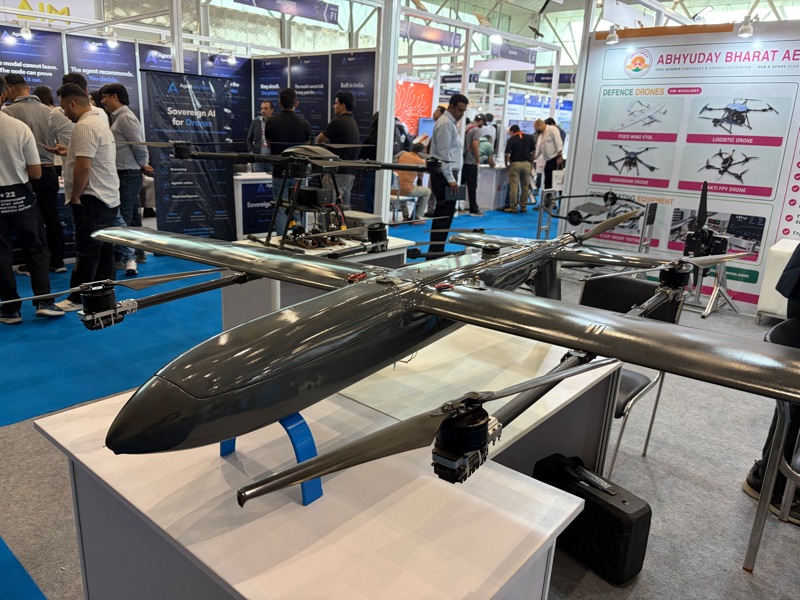
 From Flying Machines to Economic Infrastructure — For most of economic history, the sky was valuable mainly because it connected distant places. Aviation transformed the twentieth century by moving people and goods across countries and continents. The twenty-first century may bring a quieter but equally important transformation. The lower layer of the sky is gradually becoming an economic workspace. Drones are moving from military origins, photography and specialised experimentation into agriculture, construction, mining, logistics, infrastructure maintenance, disaster response, mapping and environmental management. The important question therefore is no longer simply how many drones a country can manufacture. The bigger question is how much economic activity can be built around them.
The Real Revolution Is Not the Drone — A drone by itself is essentially a flying platform carrying sensors, computing capability and communication systems. Its economic value emerges from what it can see, measure, analyse and eventually act upon. A farmer does not fundamentally need a drone. The farmer needs information about crop stress, pests, irrigation and input requirements. A power company does not necessarily need a flying machine; it needs cheaper and faster inspection of thousands of kilometres of transmission infrastructure. A mining company wants accurate volumetric information. A disaster-management authority needs rapid situational awareness. The drone therefore becomes valuable when flight is converted into useful data and data into better decisions.
This distinction could determine where the real profits of the drone economy eventually accumulate. Manufacturing will remain important, particularly because drones combine electronics, batteries, motors, communication systems, navigation technologies, cameras and specialised sensors. But hardware tends to become standardised as industries mature. Competition increases, components become cheaper and margins often decline. The more durable economic value may migrate toward specialised sensors, navigation systems, fleet-management platforms, artificial intelligence, geospatial analytics, maintenance, certification, training and sector-specific services.
Agriculture Could Become the Largest Laboratory — Agriculture demonstrates both the promise and the danger of the drone economy. Drones can support crop mapping, spraying, field surveillance, yield estimation and precision agriculture. For countries with millions of small farmers, however, expecting every farmer to own sophisticated equipment makes little economic sense. The stronger model may be Drone-as-a-Service. Local enterprises, cooperatives, farmer organisations or rural entrepreneurs could operate fleets serving hundreds of farms.
This would represent an important change in rural mechanisation. Earlier agricultural mechanisation largely meant ownership of tractors, pumps and machinery. Future mechanisation may increasingly involve purchasing intelligence and precision as a service. The farmer may pay for hectares surveyed, crops sprayed or problems detected rather than purchasing the technology itself. That could make advanced technology accessible even where individual ownership is uneconomic.
But technology should not automatically be confused with productivity. Spraying a field by drone is useful only when the economics of the crop, farm size, chemical application, regulation and service cost make sense. Subsidising machines without creating viable service markets can easily produce another generation of underutilised equipment.
The Invisible Drone Economy May Become Larger Than the Visible One — The most interesting businesses may eventually be those that hardly describe themselves as drone companies. Consider infrastructure inspection. Roads, bridges, pipelines, railway lines, solar parks, wind turbines, telecommunications towers and electricity networks require continuous monitoring. Traditionally this involves workers, vehicles, scaffolding, helicopters or shutdown periods. Autonomous aerial inspection combined with artificial intelligence could dramatically reduce the cost of observing physical assets.
The same transformation could happen in mining and construction. Instead of periodic manual surveys, companies could continuously generate digital representations of sites. Progress, inventory, excavation volumes, environmental compliance and safety conditions could be measured more frequently. The economic product would no longer be the aerial photograph. It would be continuous intelligence about a physical asset.
This is where drones begin merging with another technological revolution: digital twins. Physical infrastructure could increasingly have continuously updated digital representations generated by drones, satellites, sensors and artificial intelligence. Infrastructure management may gradually shift from periodic inspection to continuous observation and predictive maintenance.
Logistics Will Be Harder Than the Headlines Suggest — Drone delivery attracts enormous attention because it is visually dramatic. Yet the economics are more complicated. Moving a small package through the air must compete with motorcycles, vans, bicycles, automated warehouses and existing delivery networks. Weather, battery range, payload, insurance, noise, landing infrastructure and airspace regulation all matter.
The strongest early economics may therefore appear not in universal urban parcel delivery but in difficult geography and high-value missions: medicines to remote areas, emergency supplies, offshore installations, islands, mountainous regions, mines and locations where conventional transport is slow or expensive.
History repeatedly shows that new technologies first become commercially powerful where they solve expensive problems. The automobile did not immediately replace every horse. Computers did not immediately enter every household. The drone economy will probably develop in the same uneven manner.
The Sky Will Need Its Own Digital Traffic System — Millions of drones cannot simply be added to existing airspace. If drones become general infrastructure, countries will eventually need something resembling digital roads in the sky: designated corridors, identification systems, automated permissions, geofencing, collision avoidance, weather information and real-time traffic management.
This creates another industry beyond manufacturing. Airspace management itself could become a technology platform.
The future drone ecosystem may therefore resemble the internet more than the traditional aircraft industry. Hardware manufacturers will matter, but enormous value could sit in the layers connecting machines, operators, regulators, maps, communication networks, cybersecurity systems and data platforms.
The Security Paradox — The same characteristics that make drones economically attractive also make them strategically sensitive. They are relatively inexpensive, mobile, remotely controlled and capable of carrying cameras, sensors or payloads. Civilian and military technologies increasingly overlap.
Countries therefore face an uncomfortable policy problem. Regulation that is too weak creates risks involving privacy, accidents, smuggling, surveillance and security. Regulation that is too restrictive can prevent an entire domestic industry from developing.
The challenge will be to regulate behaviour and risk without suffocating experimentation. This will become especially important as drones move toward autonomous operation. Once artificial intelligence allows fleets to navigate, coordinate and make limited decisions without continuous human control, the regulatory question changes fundamentally. Governments will no longer regulate only pilots and aircraft. They will increasingly regulate algorithms.
India Should Avoid the Manufacturing Trap — For India, the opportunity is substantial because the country combines agriculture, enormous infrastructure networks, dense cities, difficult terrain, mining regions, long coastlines and a large defence requirement. But a narrow policy focused mainly on domestic drone assembly would underestimate the opportunity.
The stronger industrial strategy would build the complete value chain: components, motors, batteries, communication modules, cameras, specialised sensors, mapping technologies, artificial intelligence, cybersecurity, repair networks, pilot training, certification, insurance, financing and sector-specific applications.
MSMEs could have an especially important role. Thousands of specialised enterprises may emerge around inspection, mapping, agricultural services, repair, training and analytics. Drone clusters may consequently look very different from traditional industrial clusters. Their common infrastructure may not primarily be land and factory sheds. It may consist of testing zones, shared laboratories, simulation facilities, certification centres, data platforms, training facilities and controlled airspace.
From Drone Manufacturing to Drone Intelligence — The largest strategic mistake would be measuring success by the number of drones produced. The better measures would be hectares monitored, infrastructure inspected, accidents prevented, delivery time reduced, crop losses avoided, disaster response improved and maintenance costs saved.
This is the deeper economic transition. Industrial revolutions rarely create their greatest value through the machine alone. Steam engines mattered because they transformed factories and transportation. Electricity mattered because it reorganised production and cities. Computers became revolutionary when software and networks reorganised economic activity.
Drones may follow the same historical path.
The aircraft will become cheaper. Sensors will become better. Artificial intelligence will make interpretation faster. Autonomous navigation will reduce dependence on pilots. Networks may eventually allow thousands of machines to coordinate simultaneously.
At that point, the drone may almost disappear from economic discussion because it will simply become infrastructure.
The Future Is Not About Flying Machines. It Is About Making the Physical World Machine-Readable — This may ultimately be the unconventional way to understand the drone economy. Drones are not merely another transport technology. They are becoming mobile sensors connecting the physical economy with the digital economy.
Factories, farms, forests, mines, roads, power lines, cities and coastlines can increasingly be observed from above, converted into data and analysed continuously. Artificial intelligence can then transform that data into decisions.
The country that manufactures the cheapest drone may gain an industrial market. But the country that learns how to convert millions of drone flights into productive intelligence could capture something much larger.
The real race, therefore, is not for control of drones.
It is for control of the economic intelligence generated between the ground and the sky.
#DroneEconomy #Drones #ArtificialIntelligence #DigitalEconomy #Agriculture #Infrastructure #Logistics #MSME #Innovation #Industry40 #FutureEconomy #India


No comments:
Post a Comment