
But as the discussions unfolded, I realized that the narrative leaned heavily on what could be, rather than how it will actually happen. It was an engaging conversation, yet one that left MSME owners with more questions than answers.
1. From Inspirational Narratives to Practical Pathways
The workshop rightly celebrated the power of AI, the promise of sustainability, and the need for future readiness. However, MSMEs—who form the real backbone of India’s industrial economy—require more than vision statements. They need clear, actionable pathways.
For example:
AI in MSMEs: How can a small leather goods manufacturer in Agra or a textile cluster in Tirupur afford and implement AI-based tools?
Sustainability: What policy instruments exist to help an enterprise switch to green energy or biodegradable packaging without eroding profits?
Skill Upgradation: Which institutions will train entrepreneurs and workers, and how will the cost-sharing work?
Without addressing these ground-level issues, even the best ideas risk becoming abstract.
2. The Missing Policy Bridge
What MSME entrepreneurs truly seek is policy clarity and institutional linkage. Inspiration can motivate, but it’s the structure that enables transformation.
A future-ready MSME ecosystem requires:
Policy Integration: Schemes like the Credit Guarantee Fund Trust for Micro and Small Enterprises (CGTMSE), the Production Linked Incentive (PLI), and Digital MSME initiatives must be aligned to promote sustainability and technology adoption.
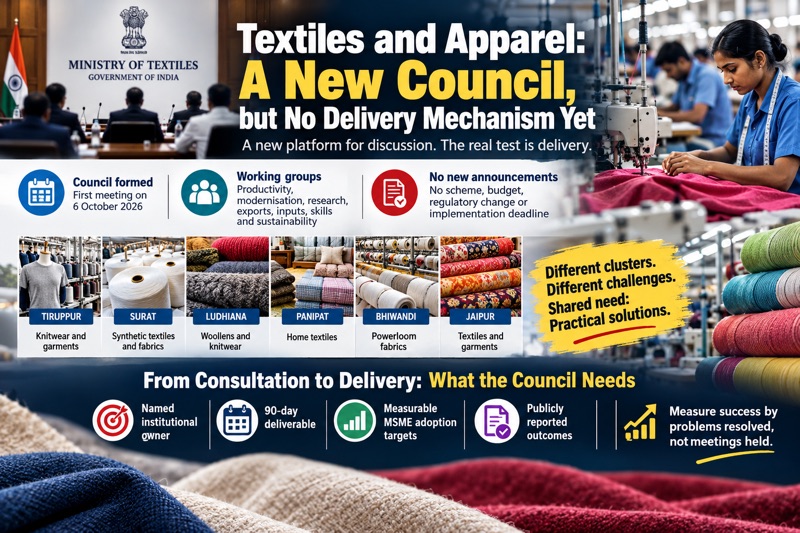
Cluster-Based Approach: Policies should empower industry clusters—textiles, food processing, handicrafts—to develop shared digital facilities and collective branding.
Digital Infrastructure: MSMEs can thrive only when supported by affordable data, logistics, e-commerce access, and cybersecurity frameworks.
Green Transition Incentives: Tax credits for adopting renewable energy, low-interest loans for green certification, and carbon-trading credits could turn sustainability into a profitable strategy.
When these policies are discussed and simplified in workshops, MSMEs walk away not just with inspiration—but with a roadmap.
3. Why Most Workshops Miss the Core Audience
Many such workshops are designed as one-way conversations—policy makers talking to policy implementers, not to entrepreneurs themselves. The result is a widening communication gap. MSME owners often find the discussions too conceptual, detached from their daily operational challenges.
For instance, while AI and sustainability are hot topics, an MSME owner is primarily concerned about:
Late payments and working capital cycles.
Complying with GST, labour, and environmental regulations.
Market access and export documentation.
Skilled manpower and retention.
If workshops integrate live case studies, cluster examples, and handholding models, they can move from awareness sessions to capacity-building platforms.
4. Making Future-Readiness Real: The Way Forward
The next generation of MSME policy events should be outcome-driven, not just agenda-driven. A few ways forward include:
Action Mapping: Every session should end with a clear “To-Do Matrix” — what needs to be done by the government, industry associations, and entrepreneurs respectively.
Sector-Specific Dialogues: Instead of a generic theme, focus on a single sector — e.g., “AI in Food Processing” or “Green Textiles 2030.”
Institutional Partnerships: Tie workshops with institutions like SIDBI, NSIC, NABARD, or Startup India for real-time guidance on finance and compliance.
Capacity-Building as the Central Pillar: Skill, technology, and entrepreneurship training must become the core outcome, not a side note.
This kind of policy-driven engagement will make MSME discussions measurable and meaningful.
5. Toward a New Workshop Culture
If India wants its MSMEs to be genuinely “future-ready,” workshops must evolve into collaborative laboratories of learning and co-creation. The focus should shift:
From “speeches” to “strategies.”
From “awareness” to “implementation.”
From “concepts” to “clusters.”
Entrepreneurs should leave such events with tools, contacts, and confidence—not just a set of PowerPoint slides and motivational quotes.
The New Grammar of MSME Dialogue
India’s MSME ecosystem is standing at a crossroads. With over 63 million enterprises, contributing around 30% of GDP and 48% of exports, they are too important to be left out of the design of economic transformation.
Workshops are powerful convening spaces—but only if they translate ideas into action. The next phase of India’s MSME evolution will depend on how well we connect vision with viability—and policy with practice.
#MSMEs #Sustainability #AIForGrowth #PolicyMatters #DigitalTransformation #Entrepreneurship #InclusiveGrowth #InnovationIndia #ClusterDevelopment #EconomicDevelopment




No comments:
Post a Comment