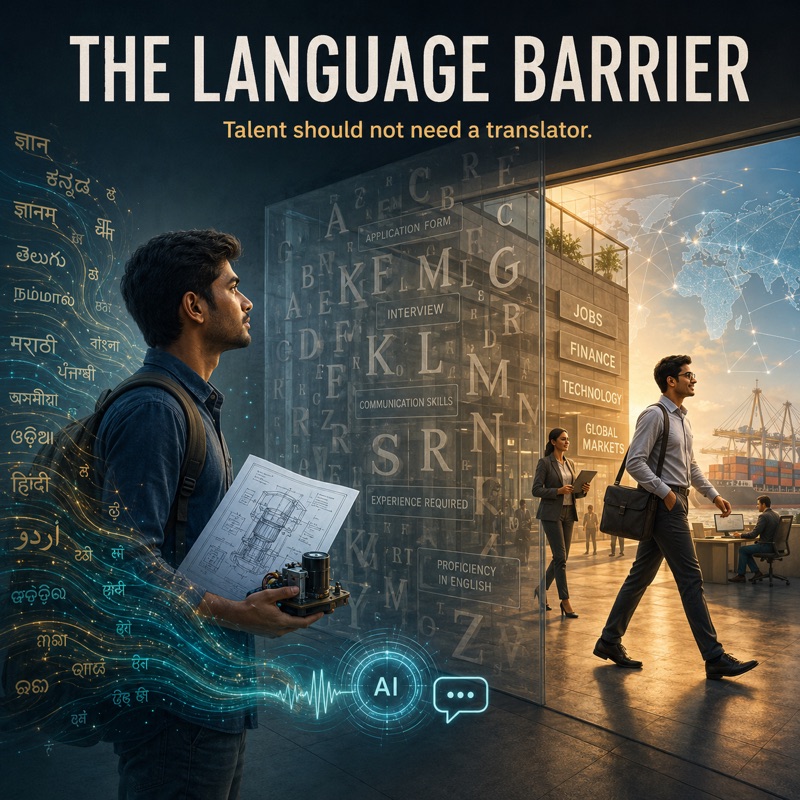
 Language Is Not Merely a Skill; It Is Economic Infrastructure
A road connects a village to a market. Electricity connects a factory to production. The internet connects a business to information. Language performs a similar function: it connects human capability to economic opportunity. Yet language is rarely treated as infrastructure. It is treated as a personal achievement—or, more unfairly, as evidence of intelligence, competence and social refinement.
A capable engineer may understand machines but struggle during an English-language interview. A craft producer may create an internationally marketable product but remain unable to negotiate with overseas buyers. A small entrepreneur may understand the local market better than a corporate consultant but find banking documents, digital platforms and government procedures difficult to navigate. Their economic exclusion does not arise from a lack of talent. It arises because institutions recognise talent only after it is expressed in an approved language.
This is why the language barrier is more dangerous than it appears. It does not openly prohibit participation. It simply increases the distance between ability and opportunity.
From Colonial Administration to the Corporate Economy
India’s language hierarchy has deep historical roots. Under colonial rule, English became the language of higher administration, law and elite education. Independence democratised political citizenship, but it did not fully democratise the languages through which economic power operated. English continued to dominate important parts of higher education, the judiciary, scientific research, corporate management and international commerce.
Economic liberalisation after 1991 further strengthened its market value. Information technology, business-process outsourcing, multinational investment and global services created new opportunities, but these opportunities were disproportionately accessible to people who could communicate confidently in English. A language inherited from colonial administration became a gateway to the global economy.
Research using the 2005 India Human Development Survey found that, after accounting for education, location, social background and other factors, fluent English-speaking men earned about 34 per cent more per hour than comparable men without English skills. Even limited English ability was associated with a 13 per cent premium. The data are now historical and should not be treated as a measure of today’s exact wage difference, but the study demonstrates how language can acquire a measurable economic price. The estimated return to fluency was comparable to completing secondary education. Economic Development and Cultural Change study
The problem is not that English creates opportunities. Its role as a bridge language can help India participate in global science, diplomacy, technology and trade. The problem begins when English shifts from being an enabling skill to becoming a proxy for intelligence. Fluency then becomes confused with competence, accent with confidence and vocabulary with leadership ability.
The Interview Room as a Language Checkpoint
India may conduct education in many languages, but much of its formal economy recruits in one. This creates an invisible checkpoint between learning and earning.
A student can understand physics in Marathi, economics in Hindi, agriculture in Telugu or engineering concepts in Tamil, yet face professional disadvantage if unable to explain that knowledge in polished English. The interview may therefore measure linguistic performance more accurately than occupational ability. The result is a serious allocation failure: institutions select the best communicators available within a narrow language category, not necessarily the most capable workers.
This distortion extends beyond employment. English influences access to professional courses, research material, investment networks, legal assistance, financial products and digital knowledge. It affects who can prepare a convincing business proposal, interpret a complex tender, understand an export standard or communicate with a venture-capital firm. Language thus behaves like an economic multiplier. It increases the value of education, technology, finance and social networks for those who possess it, while reducing their accessibility for those who do not.
The inequality begins much before the job interview. Affluent families can purchase English-medium schooling, private tutoring, digital subscriptions, travel, books and conversational exposure. Many rural and low-income learners encounter English mainly as an examination subject. Two people may possess comparable intelligence, but only one receives years of practice in the language used by powerful institutions. What later appears to be merit may partly be accumulated linguistic privilege.
The Regional Talent Discount
India’s regional economies contain enormous pools of knowledge that formal markets frequently undervalue. Farmers understand soil and climate. Artisans understand materials and design. technicians understand production systems. Small manufacturers understand costs, supplier relationships and customer behaviour. Women running household enterprises understand demand at the neighbourhood level. Yet much of this knowledge remains local because its holders cannot easily package it in the language expected by banks, large buyers, consultants or digital marketplaces.
This creates a regional talent discount. The person’s capability remains the same, but its recognised economic value falls because it cannot travel across language boundaries.
For MSMEs, the consequences can be severe. A small manufacturer may lose a procurement opportunity because the tender is difficult to interpret. An exporter may depend excessively on intermediaries because buyer communication requires English. A promising start-up outside a metropolitan centre may fail to attract investment because its founder cannot perform the familiar language of the pitching ecosystem. Even government schemes designed for inclusion may reproduce exclusion if their portals, instructions, grievance systems and technical vocabulary are not genuinely usable in regional languages.
Translation alone cannot solve this problem. A document may be translated word for word and still remain institutionally incomprehensible. Legal, financial and technological language must be converted into usable knowledge, supported by examples, voice assistance and human guidance.
The English-versus-Indian-Languages Debate Is a False Choice
India does not have to choose between English and its own languages. This binary debate has consumed political energy while avoiding the real economic question: how can every citizen gain access to a bridge language without losing the right to learn, think, innovate and transact in a familiar language?
Removing English from opportunity would isolate people from important international networks. Making English the compulsory gatekeeper would exclude much of India from its own modern economy. The sensible objective is additive multilingualism: strong learning in the mother tongue, practical competence in one or more Indian languages, and functional access to English where it expands opportunity.
The National Education Policy 2020 recognises the educational value of mother-tongue and multilingual learning. The larger challenge is to carry multilingualism beyond the classroom into universities, banks, courts, workplaces, digital platforms and markets. Unless the economic system changes its language behaviour, educational reform alone will have limited effect. Ministry of Education—Bharatiya Bhasha Samiti
Artificial Intelligence: The Great Translator or the New Gatekeeper?
The coming decade could weaken the language barrier more rapidly than any previous reform. Artificial intelligence can translate documents, generate subtitles, convert speech into text, support voice-based banking and help entrepreneurs communicate with buyers across languages. India’s BHASHINI initiative already demonstrates how AI-powered translation can expand access to public services across the country’s 22 scheduled languages. Economic Survey of India
But technology is not automatically democratic. AI systems perform best in languages for which large, clean and commercially valuable datasets exist. Major languages may receive increasingly sophisticated tools, while tribal, minority and low-resource languages remain digitally neglected. Dialects, accents and mixed-language speech may be misunderstood. A person denied an opportunity because of an accent today could be rejected by an automated screening system tomorrow.
The future danger is therefore not simply an English divide. It is a machine-readable language divide. People whose language, accent and expression are well represented in training data will communicate smoothly with digital institutions. Others may become economically invisible to algorithms.
There is another risk. If translation tools are controlled by a few private platforms, linguistic access could become a rented service. India may move from dependence on English-speaking intermediaries to dependence on proprietary digital intermediaries. Open standards, public-language datasets, transparent evaluation and strong privacy protection are therefore essential.
Building a Language-Inclusive Economy
India requires more than language education; it requires language-sensitive economic design. Recruitment should separate communication needs from occupational competence. English proficiency should be tested only where the job genuinely requires it. Skills assessments should be available in multiple languages, while employees can receive workplace language training after recruitment.
Banks and public institutions should provide multilingual applications, voice-based assistance and plain-language explanations rather than literal translations of administrative jargon. Export councils, industry associations and cluster institutions can establish shared translation and business-communication services for MSMEs. Universities should expand high-quality textbooks, lectures and technical terminology in Indian languages without lowering academic standards. Digital platforms should allow sellers to list products, resolve disputes and understand contracts through the language they use in everyday business.
Most importantly, language capability should become common infrastructure at the cluster level. A small enterprise cannot employ translators, export specialists and technical writers for every market. A shared language and international-business facilitation centre can serve hundreds of firms. Such centres could translate catalogues, standards, contracts and buyer communication while helping entrepreneurs gradually acquire functional English and other foreign-language skills.
A Country Cannot Become Economically Advanced by Translating Only Its Elite
The language barrier is ultimately a problem of institutional imagination. India possesses talent in hundreds of linguistic environments, but much of its economic architecture continues to behave as though serious knowledge exists only in a limited vocabulary and accent.
If this continues, English-speaking groups will accumulate not only higher incomes but also stronger professional networks, better access to technology and greater influence over institutions. Language privilege will then be transmitted across generations and mistaken for superior merit. Regional talent will remain underused, smaller towns will lose ambitious young people, and social mobility will become narrower even as the economy grows.
A truly developed India will not be one in which everyone is forced to sound alike. It will be one in which a person can enter the modern economy without first abandoning the language in which they think most clearly. English should remain a bridge to the world, but it must not remain a toll gate within India.
The future belongs neither to English alone nor to linguistic isolation. It belongs to an economy capable of listening to its people in every language—and recognising ability before accent.
#LanguageBarrier #EconomicMobility #InclusiveGrowth #IndianLanguages #EnglishProficiency #ArtificialIntelligence #DigitalInclusion #Employment #MSMEs #FutureOfWork




No comments:
Post a Comment