 Innovation is one of the most celebrated words in the modern economy. Governments want innovative companies. Investors search for disruptive businesses. Universities create innovation centres. Startup programmes reward new ideas. Companies proudly describe themselves as pioneers.
But there is an uncomfortable economic question hidden behind all this enthusiasm.
What happens to the company that arrives too early?
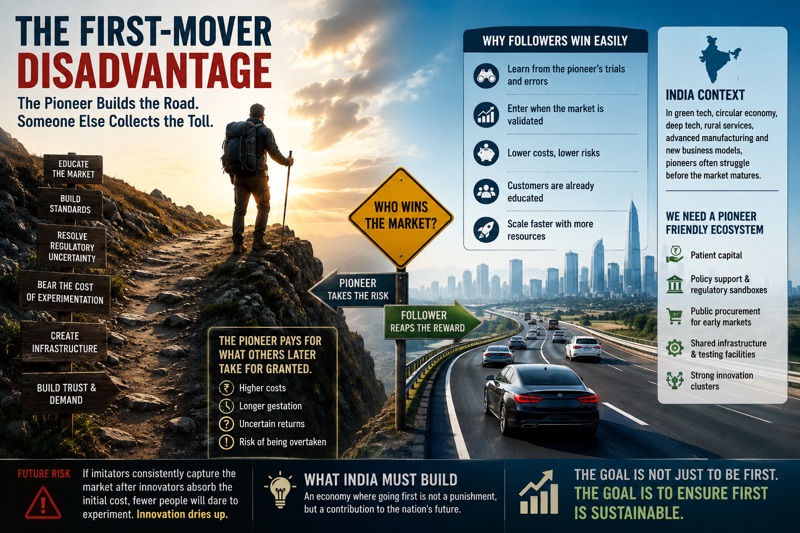
The conventional belief is that the first company entering a new market enjoys a first-mover advantage. It establishes the brand, understands customers before competitors, develops distribution networks and captures market share.
Sometimes this happens.
But history also shows the opposite.
The first mover may actually suffer because it has to build the market before it can sell to the market.
This is the First-Mover Disadvantage.
The Pioneer Pays for the Market
Imagine an entrepreneur introducing a completely new product.
Customers do not understand it. Banks cannot assess it. Regulators are unsure how to classify it. Suppliers are not prepared for it. Skilled workers are unavailable. Standards have not been developed. Investors cannot easily calculate the risk.
The entrepreneur therefore does much more than manufacture a product.
The entrepreneur educates customers, trains employees, develops suppliers, talks to regulators, creates demonstrations, establishes quality benchmarks and sometimes even explains the technology to lenders.
All these activities create knowledge.
But much of this knowledge eventually becomes available to everyone.
The pioneer pays for experimentation while competitors learn almost free of cost.
That changes the economics of innovation.
Suppose the first company spends ₹100 developing technology, understanding customers and establishing distribution. A later competitor may need to spend only ₹50 because the first company has already demonstrated what works and what does not.
The second company can study the pioneer, avoid its mistakes and enter when customers are already familiar with the product.
The innovator creates the market.
The imitator enters the market.
And sometimes the imitator becomes larger than the innovator.
History Has Never Guaranteed Victory to the Inventor
Economic history contains many examples where technological leadership did not automatically become commercial leadership.
Inventors and early companies frequently created technologies that later became enormously valuable, while companies entering at the right stage of market development captured a larger share of the commercial opportunity.
This teaches an important lesson.
Being technologically early and being economically successful are not the same thing.
Industrial revolutions usually develop through waves. First comes experimentation. Then infrastructure develops. Standards emerge. Customers become comfortable. Finance becomes available. Supply chains mature. Finally, mass adoption begins.
The dangerous period is between experimentation and mass adoption.
Someone has to survive that period.
In many industries, the pioneer carries this burden.
India Has a Special Version of This Problem
The First-Mover Disadvantage can become particularly serious in an economy where markets, regulations, finance and supporting institutions develop at different speeds.
Consider an Indian entrepreneur developing a new recycling technology.
The technology may work perfectly.
But where will the raw waste come from?
Who will certify the recycled material?
Will large companies purchase it?
Will banks finance the machinery?
Will municipalities cooperate?
Will government procurement recognise the product?
Will consumers pay more for environmentally responsible production?
The entrepreneur is therefore not simply building a recycling company.
The entrepreneur may effectively be trying to build an entire ecosystem.
This problem can appear across green technology, electric mobility, waste management, circular manufacturing, biotechnology, artificial intelligence applications, rural services, advanced materials, precision manufacturing and deep technology.
India may have entrepreneurs capable of creating new solutions but still lack the institutional architecture required to help those solutions cross the difficult early years.
That is where innovation policy often becomes too simplistic.
We Finance Companies When We Should Sometimes Finance Ecosystems
Most financial systems evaluate firms individually.
Banks examine collateral.
Investors examine revenue.
Government schemes examine eligibility.
But breakthrough innovation often depends on an ecosystem rather than a single company.
A new manufacturing technology may require specialised suppliers, testing laboratories, trained workers, certification institutions, research partnerships and patient capital.
If these supporting institutions do not exist, the pioneering company must indirectly finance their absence.
This creates a hidden innovation tax.
The company spends money not only developing its own product but compensating for weaknesses in the surrounding ecosystem.
Large corporations may survive this.
Small innovators often cannot.
Rural Innovation Faces an Even Harsher Reality
The problem becomes deeper outside major urban markets.
Imagine a company developing an innovative agricultural service for small farmers.
It may need to educate thousands of customers individually.
Distribution costs may be high.
Digital literacy may vary.
Local demonstration may be essential.
Payments may be small and irregular.
The company could spend several years building trust.
Once farmers understand the service and demand becomes visible, larger companies may enter with greater capital, stronger technology and larger marketing budgets.
The pioneer has effectively conducted market research for its future competitors.
This is economically rational for the competitor.
But it can be destructive for the innovation system.
Deep Technology Makes the Problem Bigger
The next generation of Indian entrepreneurship will increasingly involve technologies that require long development periods.
Semiconductors, robotics, advanced materials, biotechnology, clean energy, industrial artificial intelligence, energy storage and sophisticated manufacturing systems cannot always be built through the rapid startup model of launch, scale and exit.
Some technologies may require years before meaningful commercial revenue appears.
During those years, the pioneer is generating something extremely valuable that traditional accounting barely recognises.
Knowledge.
The company discovers which technology works, which customer segment responds, which regulation creates difficulties, which manufacturing process fails and which business model becomes commercially viable.
Even failed experiments generate information.
Competitors entering later inherit part of that information.
This creates a strange economic situation.
The company taking the greatest technological risk may not necessarily receive the greatest economic reward.
Failure Can Actually Become Public Infrastructure
This requires a different way of thinking about failure.
Suppose ten companies experiment with green hydrogen technology and eight fail.
Traditional thinking sees eight unsuccessful companies.
But economically, those eight companies may have generated knowledge about engineering, costs, safety, supply chains, customer behaviour and regulation.
The ninth and tenth companies may succeed partly because the earlier companies discovered what should not be done.
Innovation therefore has a collective learning dimension.
Society benefits from experimentation even when individual firms fail.
Yet society rarely pays the full cost of that experimentation.
The entrepreneur does.
This is one reason markets alone may underinvest in highly uncertain innovation.
The Dangerous Rise of the Fast Follower Economy
There is another possibility India should take seriously.
An economy can become extremely good at imitation without becoming equally good at original experimentation.
This can look efficient for many years.
Companies observe successful technologies, adapt proven business models and enter markets after demand becomes visible.
Capital naturally prefers these opportunities because uncertainty is lower.
Banks prefer them.
Investors understand them.
Customers already recognise them.
But gradually the economy develops a behavioural bias.
Everyone wants to become the second mover.
Few want to become the first.
That is dangerous.
A country of fast followers can grow rapidly when technologies are available elsewhere.
But technological leadership requires somebody to enter markets before certainty exists.
AI Could Intensify the Disadvantage
The coming AI economy may make imitation dramatically faster.
Previously, competitors needed months or years to understand a new business model.
Artificial intelligence can increasingly analyse products, customer responses, patents, pricing structures, marketing strategies and supply chains at extraordinary speed.
The time between innovation and imitation may therefore shrink.
This means the pioneer may have less time to recover the cost of experimentation.
The economics of innovation could consequently become more difficult.
Future competitive advantage may depend less on simply having an idea and more on building combinations that are difficult to copy such as specialised knowledge, manufacturing capability, proprietary data, trusted networks, intellectual property, skilled teams and deeply embedded customer relationships.
India Needs a Pioneer Policy, Not Only a Startup Policy
India has built an increasingly large architecture around startups, incubation, digital infrastructure and entrepreneurship.
The next stage should be more sophisticated.
Policy should distinguish between ordinary business formation and genuine market creation.
A company opening the hundredth business in an established market faces a very different risk from a company trying to create an entirely new industry.
Treating both simply as startups misses the economic difference.
Public procurement could become an important instrument for helping pioneering technologies obtain their first serious customer.
Regulatory sandboxes could allow experimentation before permanent rules are imposed.
Shared testing and certification infrastructure could reduce the cost faced by individual innovators.
Patient capital could support technologies whose commercialisation cycles are longer than conventional venture capital timelines.
Innovation clusters could connect startups with universities, manufacturers, laboratories, investors and large companies.
Most importantly, government should recognise that the first few firms entering a strategic technology are often creating capabilities that extend far beyond their own balance sheets.
The Future Competition Is About Who Can Afford to Experiment
The global economic race of the 2030s may not simply be about who has the cheapest labour, largest factories or biggest consumer market.
It may increasingly be about which countries make experimentation economically survivable.
Countries that reduce the cost of failure will encourage more experiments.
Countries that allow pioneers to retain reasonable rewards from successful experimentation will attract more innovators.
Countries where innovators carry all the risk while imitators capture most of the reward may slowly produce fewer pioneers.
This is why the First-Mover Disadvantage should not be treated as a small business problem.
It is a national competitiveness problem.
India wants to become a major innovation economy. But innovation cannot survive permanently on motivational speeches, startup competitions and celebrations of entrepreneurship.
Someone has to pay for uncertainty.
Someone has to finance experimentation.
Someone has to support the period between invention and commercial scale.
And someone has to ensure that pioneers have enough time and opportunity to benefit from the markets they helped create.
Otherwise we may build an economy with millions of entrepreneurs waiting for somebody else to take the first risk.
The deepest irony of innovation is therefore very simple.
The pioneer discovers the future.
The pioneer explains the future.
The pioneer makes mistakes so that others do not have to.
And just when the market finally becomes ready for the future, the pioneer may discover that everybody else has arrived.
A serious innovation economy must make sure that building the road to the future does not become the fastest route to losing the market.
#Innovation #India #Startups #DeepTech #GreenTechnology #Manufacturing #Entrepreneurship #ArtificialIntelligence #MSME #IndustrialPolicy #StartupIndia #Technology #FutureOfBusiness #EconomicDevelopment




No comments:
Post a Comment