From Industrial Geography to Metropolitan Power
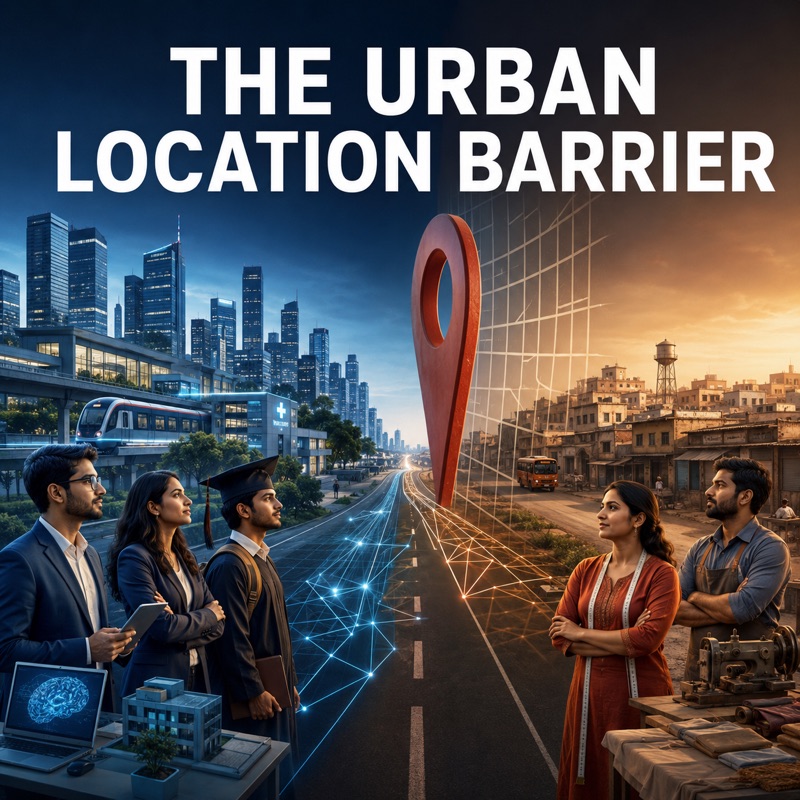 For much of history, economic activity followed geography. Towns grew near rivers, ports, mines, fertile land and trade routes. India’s earliest industrial centres developed in the same way. Mumbai benefited from its port and cotton trade, Kolkata from river access and colonial commerce, Chennai from maritime connections, Ahmedabad from textiles, Jamshedpur from minerals and Kanpur from manufacturing and defence demand. Location mattered because goods and people had to move physically.
The digital age was expected to weaken this relationship. The internet was supposed to allow a business in Ranchi, Madurai, Guwahati or Gwalior to compete with one in Bengaluru, Mumbai or Gurugram. Remote work was expected to separate employment from geography. Online education was supposed to take knowledge everywhere. Digital payments were meant to reduce the advantage of financial centres.
Something quite different has happened. Technology has reduced the cost of communication, but economic power has become even more concentrated. Companies may work online, yet investors, highly skilled workers, specialised hospitals, research institutions, corporate headquarters and influential professional networks continue to gather in a few metropolitan regions. Distance has become less important for sending information but remains extremely important for receiving opportunity.
The urban location barrier begins when a person or enterprise is judged not only by capability but also by where it is located.
The Pin Code Premium
Two entrepreneurs may possess equally promising ideas, but the one operating from Bengaluru, Mumbai, Delhi-NCR or Hyderabad is more likely to meet investors, experienced professionals, technology partners and early customers. The entrepreneur in a smaller city may have lower costs and deeper knowledge of local markets, but must first overcome doubts about talent availability, logistics, scalability and institutional support.
This is the pin code premium. Metropolitan businesses are often considered investable before their actual quality is examined. Businesses from smaller cities are frequently required to prove that their location is not a weakness.
The same divide affects workers. A talented graduate in a district town may formally have access to online vacancies, but access to employment is more than access to information. It includes coaching, language exposure, internships, professional references, interview opportunities, reliable internet, affordable transport and the confidence gained from interacting with employers. These advantages accumulate in large cities.
Location therefore works like invisible capital. It raises the value of some people and businesses without changing their underlying capability.
India Is Urbanising, but Opportunity Is Not Urbanising Evenly
India’s urban future will be enormous. The World Bank projects that Indian towns and cities could house about 600 million people by 2036, or around 40 percent of the population. It also estimates that cities could generate 70 percent of new jobs by 2030. Yet urban expansion does not automatically create geographically balanced development. A country may become more urban while remaining highly metropolitan in its distribution of opportunity. World Bank, World Bank urban resilience report
The distinction is crucial. Urbanisation means that more people live in towns and cities. Balanced urban development means that many different cities become capable of generating productive employment, investment and innovation. India is advancing rapidly in the first direction, but unevenly in the second.
Services already employed nearly 188 million people in 2023–24, according to a NITI Aayog assessment. However, advanced services such as finance, technology, professional consulting and research are much more concentrated than ordinary retail, transport and personal services. A smaller city may record rising service employment while still offering very few high-productivity careers. NITI Aayog
This creates a misleading picture. A town may appear economically active because it has more shops, delivery workers, coaching centres and small construction projects. But activity is not the same as transformation. If its graduates, doctors, engineers, entrepreneurs and capital continue moving outward, the town may consume more without developing a stronger productive base.
The Migration Paradox
Migration has always been part of economic development. It allows people to leave places with limited opportunities and enter more productive labour markets. The problem begins when migration stops being a choice and becomes a compulsory entrance fee for economic participation.
A young person from a smaller town may have to migrate merely to obtain an internship. A woman may reject the same opportunity because living alone in a distant city is unsafe or socially difficult. A small manufacturer may have to open a metropolitan office simply to be taken seriously by buyers. A patient may travel hundreds of kilometres for specialised treatment. A promising startup may relocate because local investors are absent.
These are not simply personal decisions. They are evidence that essential systems are geographically incomplete.
India then faces a double loss. Smaller towns lose ambitious people, while metropolitan regions receive more people than their housing, transport, water and public services can comfortably absorb. One place loses economic energy; the other gains congestion.
The result is not efficient urbanisation. It is forced concentration.
The Small-City Infrastructure Trap
Investors generally prefer locations with dependable roads, electricity, water, digital connectivity, skilled labour and responsive institutions. But these systems are often built most rapidly where investment has already arrived. Smaller cities are then caught in a circular trap: they receive less investment because their infrastructure is weak, and their infrastructure remains weak because they receive less investment.
Municipal finance deepens the problem. Recent World Bank analysis estimates that urban infrastructure investment in India is only about 0.7 percent of GDP, less than half the level required to meet demand. Another assessment estimated that India would need approximately US$840 billion in urban infrastructure investment over 15 years. World Bank, Financing India’s Urban Infrastructure Needs
However, the barrier is not only shortage of money. It is also shortage of municipal capability. Many smaller urban bodies have limited staff for project design, spatial planning, procurement, data management and revenue mobilisation. Even when funding schemes exist, cities with the weakest capacity may be least able to prepare credible projects and obtain them. Public finance can therefore reproduce the same locational inequality it is supposed to correct.
Smart infrastructure placed inside an institution without adequate staff, maintenance budgets or decision-making authority will not make a smart city. It may only create a more expensive form of administrative weakness.
Digital India Cannot Run on Metropolitan Servers Alone
Artificial intelligence, cloud computing, digital platforms and remote services could distribute economic opportunity more widely. But they could also produce a new geography of exclusion.
The next generation of high-value employment will gather around data centres, universities, specialised laboratories, venture capital, advanced manufacturing facilities and dense pools of skilled people. If these assets remain concentrated in a few corridors, AI may widen the urban location barrier. Workers in smaller cities may use digital applications while metropolitan companies own the platforms, data, intellectual property and profits.
This would create a strange economic structure: distributed consumption but concentrated ownership.
Remote work offers only a partial solution. A person can work from anywhere only when anywhere has reliable electricity, high-speed connectivity, suitable housing, social infrastructure and access to continuous learning. Even remote workers need professional communities. Innovation rarely comes from broadband alone; it comes from repeated interaction among people, institutions, capital and ideas.
The future challenge is therefore not merely to provide internet connections. It is to create local knowledge ecosystems capable of producing, adapting and commercialising technology.
Climate Change Will Make the Barrier More Dangerous
Metropolitan concentration is also becoming a climate risk. Many of India’s largest cities already face heat stress, flooding, water scarcity, air pollution and long travel times. Continuing to push people and investment into the same urban regions will increase land prices, infrastructure pressure and environmental vulnerability.
At the same time, smaller cities are not automatically safer. Rapid construction without drainage, resilient housing, public transport or heat planning may reproduce metropolitan problems before these cities acquire metropolitan incomes.
Future urban policy must therefore avoid two bad choices: overcrowded megacities on one side and underprepared small cities on the other. India needs a network of economically capable and climate-resilient cities rather than a few urban giants surrounded by dependent territories.
Building Opportunity Where People Already Live
The solution is not to prevent migration or artificially distribute every industry. Some concentration creates real advantages. Firms benefit from shared suppliers, specialised workers, knowledge exchange and large markets. The objective should not be to eliminate successful metropolitan clusters but to create more locations where such advantages can emerge.
India must move from scheme-based urban development to economic ecosystem development. Smaller cities need more than roads and beautification. They need institutions that connect infrastructure with enterprise growth: applied research centres, industry-linked colleges, testing laboratories, common facilities, business-development services, logistics platforms, export support and professionally managed industrial areas.
Public procurement can give competent local firms their first credible market. Development finance can support city-based enterprise funds and credit guarantees. Universities can become anchors for regional innovation rather than degree-distribution centres. Large companies receiving public incentives can be encouraged to develop suppliers, training networks and service partnerships in nearby smaller cities.
Most importantly, development should build upon the productive identity of each place. Tiruppur did not become important by imitating Bengaluru. Surat did not grow by copying Mumbai. Moradabad, Rajkot, Coimbatore, Ludhiana and many other centres developed through specialised production ecosystems. The future of smaller-city India lies not in becoming miniature metropolitan cities but in becoming stronger versions of themselves.
The Fifteen-Minute Economy Must Also Become a Two-Hour Economy
Urban planners increasingly discuss the fifteen-minute city, where essential daily services can be reached quickly. India also needs a larger regional idea: the two-hour economy.
A smaller town should be able to reach a university, logistics hub, specialised hospital, airport, testing centre or major market within a dependable two-hour journey. High-quality regional rail, buses, freight systems and digital infrastructure can connect groups of smaller cities without forcing every activity into one metropolitan centre.
This would create networks of opportunity instead of isolated urban islands. A worker could access a larger labour market without permanently migrating. A manufacturer could reach testing and logistics facilities without relocating. A student could obtain specialised training while remaining connected to the local economy.
Connectivity should allow places to cooperate, not merely make it easier for talent to leave them.
The Coming Geography of Citizenship
If present trends continue, the most important economic question of the future may not be what a person knows but whether that person can afford to live near the institutions that value that knowledge.
Metropolitan housing costs could become an unofficial tax on opportunity. Children raised in well-connected cities may inherit access to superior education, healthcare, internships and networks. Those born elsewhere may spend their most productive years trying to cross the locational gap. Regional inequality could then become intergenerational inequality.
This is why the urban location barrier is more than an infrastructure issue. It is a question of economic citizenship. A country cannot promise equal opportunity while allowing access to the future to be allocated by pin code.
India does not need to move its population towards opportunity forever. It must begin moving opportunity towards its population. The real test of future urban policy will not be how many megacities become globally competitive. It will be whether a capable person or enterprise in a smaller city can grow without first having to escape from it.
#UrbanLocationBarrier #SmallCities #RegionalInequality #IndianEconomy #UrbanIndia #Employment #MSME #InclusiveDevelopment


No comments:
Post a Comment