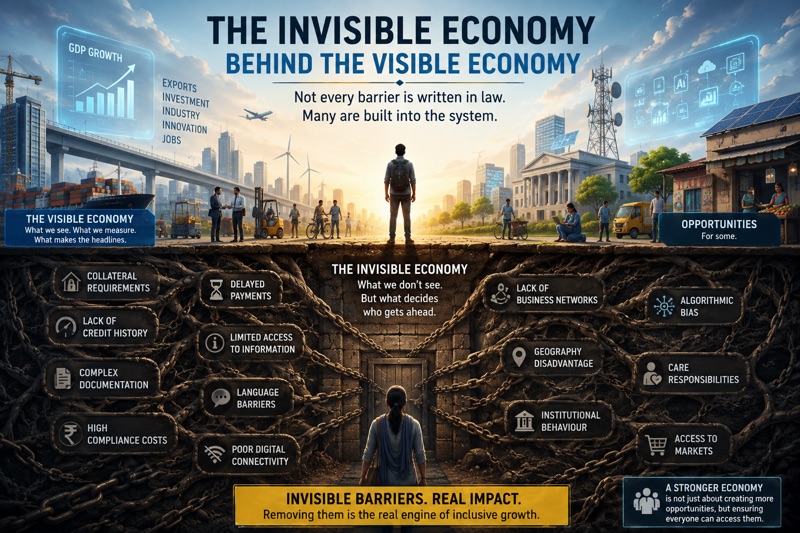
 When economists discuss growth, they often focus on visible indicators such as GDP, exports, industrial output, investment, or stock market performance. These numbers are important because they tell us what has already happened. But beneath every visible economy lies another economy that is rarely measured and almost never discussed. This invisible economy does not produce goods or services. Instead, it quietly decides who gets opportunities and who does not. It shapes who receives credit, who finds customers, who gets reliable information, who builds trusted networks, and who is able to survive difficult times. In many ways, this unseen economy has become more powerful than the formal economy itself.
Invisible Barriers Are More Powerful Than Visible Restrictions
History reminds us that economic barriers were once easy to identify. Governments imposed licensing systems, trade restrictions, quotas, and legal discrimination. As economies opened and regulations became more transparent, many believed that equal opportunity had finally arrived. Yet the nature of exclusion did not disappear. It simply became less visible. Today, there may be no law preventing a young entrepreneur from starting a business, a woman from entering the workforce, an MSME from exporting, or a farmer from reaching national markets. However, hidden obstacles often achieve exactly the same outcome. A lack of collateral blocks access to finance. Complicated documentation discourages formal participation. Delayed payments drain working capital. Poor digital connectivity isolates rural producers. Language barriers limit access to information. Algorithms reward those who are already visible while ignoring those who are not. The result is exclusion without anyone openly admitting that exclusion exists.
Opportunity Is Increasingly Controlled by Invisible Systems
Modern economies are becoming highly dependent on digital platforms, automated decision-making, financial scoring, and institutional processes. These systems promise neutrality because they rely on data rather than human judgement. Yet data itself reflects existing inequalities. Businesses with long financial histories receive easier credit. Companies with established online visibility gain more customers. Individuals with stronger networks hear about opportunities first. Regions with better infrastructure attract more investment. The invisible economy therefore reinforces the advantages of those who are already ahead, while making it increasingly difficult for newcomers to catch up.
The Hidden Cost Paid by MSMEs
For millions of micro, small, and medium enterprises, the biggest challenge is often not competition but access. They struggle to secure affordable finance because they lack sufficient collateral. They lose valuable time dealing with compliance requirements that larger firms manage through specialised departments. Payments are delayed by buyers with stronger bargaining power, creating severe cash-flow pressures. Digital marketplaces promise wider reach but frequently favour businesses with stronger marketing budgets, higher ratings, or greater visibility. Many MSMEs are not defeated by poor products or weak entrepreneurship. They are defeated by invisible systems that silently increase the cost of doing business.
Women Carry an Economic Burden That Rarely Appears in Statistics
One of the most overlooked parts of the invisible economy is unpaid care work. Millions of women contribute enormous economic value by caring for children, elderly family members, and households, yet this work is rarely recognised in national accounts. Time spent on unpaid responsibilities limits opportunities for education, entrepreneurship, formal employment, and skill development. Even where equal employment laws exist, unequal responsibilities continue to produce unequal economic outcomes. The invisible economy therefore influences labour markets as much as education, finance, and technology.
Geography Has Become an Economic Identity
A person’s location increasingly determines economic opportunity. Entrepreneurs operating in metropolitan cities gain easier access to investors, skilled workers, logistics, digital infrastructure, and business networks. Rural producers may have quality products but struggle with transportation, warehousing, branding, certification, and market information. Technology has reduced some geographical barriers, yet many digital services still depend on physical infrastructure, reliable internet, financial access, and institutional support. Economic inclusion remains deeply connected to geography, even in the digital age.
Institutions Can Open Doors or Quietly Close Them
Economic progress depends not only on policies but also on how institutions behave. The same regulation may encourage one entrepreneur while discouraging another, depending on how efficiently it is implemented. Delays in approvals, inconsistent interpretation of rules, excessive paperwork, and fragmented administrative processes increase uncertainty. These hidden transaction costs are rarely visible in official statistics, yet they reduce investment, discourage innovation, and slow economic growth. Institutional behaviour often becomes an invisible tax on productive enterprise.
The Future May Be Driven by Invisible Inequality
The next generation of economic inequality may not be defined primarily by income or wealth. It may be determined by access to trustworthy data, digital identity, artificial intelligence, financial history, professional networks, quality education, and institutional credibility. As AI becomes central to finance, recruitment, healthcare, education, and business decisions, invisible biases embedded in data and algorithms could quietly shape economic destinies. Nations that fail to recognise these hidden barriers may discover that technological progress has made exclusion more efficient rather than less.
Making the Invisible Economy Visible
Economic reform cannot stop at removing formal restrictions. Governments, financial institutions, technology platforms, industry associations, and civil society must identify and reduce the invisible barriers that prevent capable individuals and businesses from participating fully in the economy. Better access to finance, faster payment systems, simpler compliance, stronger digital inclusion, transparent algorithms, affordable childcare, improved logistics, and accountable institutions are no longer social welfare measures. They are economic necessities for sustained growth and national competitiveness.
The greatest economic challenge of the coming decades may not be creating more opportunities. It may be ensuring that opportunities are genuinely accessible. A nation can proudly display impressive growth figures, modern infrastructure, and expanding industries, yet still leave millions standing outside the real gates of prosperity. The visible economy may tell the story of production and wealth, but the invisible economy decides who is allowed to become part of that story. The countries that recognise and dismantle these unseen barriers will build not only faster-growing economies but also stronger, more resilient, and more inclusive societies.
#Economy #InclusiveGrowth #MSME #Entrepreneurship #EconomicDevelopment #PublicPolicy #ArtificialIntelligence #DigitalEconomy #India #Leadership





No comments:
Post a Comment