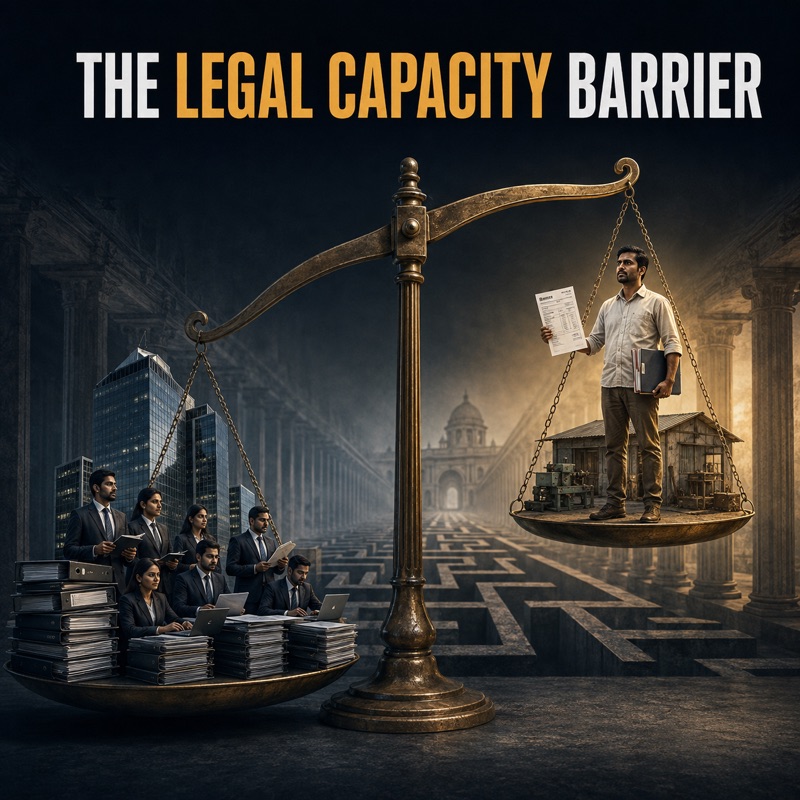
 A Right That Cannot Be Enforced Is Only a Promise
India has created an impressive architecture of commercial laws. Contracts are legally binding, intellectual property can be protected, delayed payments attract penalties, and unfair business practices can be challenged. On paper, a small enterprise and a large corporation stand before the same law. In the marketplace, however, they rarely stand with the same strength.
A large company can maintain an internal legal department, employ specialised lawyers, preserve extensive documentation and continue fighting a dispute for years. A micro or small enterprise may depend on one owner who is simultaneously managing production, customers, workers, banks and government compliance. For such an enterprise, approaching the law is not a routine business function. It is a financial and emotional gamble.
This is the legal capacity barrier: the distance between possessing a legal right and having the money, knowledge, evidence, time and bargaining power required to enforce it.
From Informal Trust to Unequal Contracts
Indian business historically grew through relationships. Traders relied on community networks, family reputation, handwritten accounts and verbal commitments. These arrangements reduced transaction costs when business remained local and the participants knew one another. Social reputation often performed the function that formal contracts were supposed to perform.
Economic liberalisation, national supply chains, e-commerce, outsourcing and digital procurement changed this environment. Small firms began supplying distant buyers, large corporations, government agencies and online platforms. Transactions became more formal, but bargaining power did not become more equal.
The modern purchase order may contain several pages of legal conditions written by the buyer. The supplier normally has only two choices: accept the conditions or lose the order. Clauses concerning payment, rejection, warranties, penalties, jurisdiction, data use and termination are rarely negotiated by a small vendor. The contract may appear voluntary, but economic dependence can turn consent into submission.
India has therefore moved from informal trust to formal contracting without adequately building the legal capacity of its smallest businesses. The result is a dangerous middle ground: small firms carry formal obligations while continuing to depend on informal goodwill for enforcement.
Delayed Payment Is Also a Legal Failure
The delayed-payment crisis illustrates this imbalance. Under the Micro, Small and Medium Enterprises Development Act, payment to a micro or small supplier should ordinarily be made within the agreed period, which cannot exceed 45 days. A buyer who fails to pay can become liable for compound interest at three times the Reserve Bank of India’s bank rate. The statutory protection appears powerful.
Yet the government’s MSME Samadhaan dashboard showed 256,892 applications involving approximately ₹55,244 crore as of 16 August 2026. More than 90,000 applications and cases, involving nearly ₹20,978 crore, were shown as pending. These figures represent claims filed on the portal, not the entire delayed-payment problem. Many enterprises never file because they fear losing the buyer, lack proper documents, do not understand the process or conclude that recovery will consume more resources than the unpaid invoice itself. MSME Samadhaan pending-amount report
The deeper issue is not simply that buyers pay late. It is that some buyers may calculate that a small supplier is unlikely to challenge them. Delay then becomes an informal source of interest-free working capital for the stronger party. The small firm, meanwhile, must borrow to pay wages, purchase materials and meet tax obligations on income it may not yet have received.
In this system, legal weakness is converted directly into financial cost.
The Invisible Price of Seeking Justice
Legal expenses are only the visible part of the barrier. The owner must collect emails, invoices, delivery records, inspection reports, tax documents and payment acknowledgements. Meetings with lawyers take time away from the factory or office. Hearings may require travel. Employees may have to be diverted from productive work. Even after securing a favourable order, actual recovery can require further effort.
A ₹3 lakh dispute may be commercially important to a microenterprise but too small to justify prolonged litigation. The same amount may be insignificant to a large buyer. This asymmetry creates a legal dead zone in which the violation is serious enough to damage the supplier but too small to make formal enforcement economically sensible.
The law consequently works most effectively for disputes large enough to finance the process. Small-value commercial injustice is frequently absorbed, negotiated downward or forgotten. In accounting records it becomes a bad debt. In economic reality it becomes a transfer of wealth from the weaker enterprise to the stronger one.
Silence Is Often a Business Survival Strategy
An MSME may know that its design has been copied, its contract violated or its payment unfairly withheld. It may still remain silent. Challenging the buyer could lead to removal from the approved vendor list, cancellation of future orders or an informal warning within the industry.
This silence should not be mistaken for satisfaction. It is often a survival strategy.
Conventional data capture filed cases, not abandoned claims. They count enterprises entering the legal system but rarely count those staying outside it because the commercial risk is too high. The true scale of the legal capacity barrier is therefore hidden in unpaid invoices, diluted settlements, copied designs, forced discounts and contracts that small suppliers obey but cannot meaningfully enforce.
Informal settlement is not always undesirable. Mediation can save time and preserve commercial relationships. But a settlement reached because one party cannot afford justice is not genuine compromise. It is surrender presented as agreement.
Intellectual Property Without Enforcement Capacity
India wants MSMEs to innovate, develop brands and move up global value chains. Yet intellectual-property protection requires more than registration. A trademark, design right or patent must be monitored and defended.
A small manufacturer may spend years developing a product and building a market. A larger competitor can copy its features, packaging or commercial approach and then outspend it in legal proceedings and marketing. Registration gives the innovator a right, but enforcement capacity determines whether that right has economic value.
The future innovation economy could therefore produce a strange outcome: small enterprises will be encouraged to invent, while organisations with greater legal and financial power capture a disproportionate share of the value. If entrepreneurs repeatedly see originality becoming a liability, they will shift from innovation to imitation. That would weaken the very industrial transformation India is trying to promote.
Digital Justice Can Help, but It Can Also Create a New Divide
Online dispute resolution, electronic filing, virtual hearings and automated document preparation can lower the cost of justice. The migration of new delayed-payment applications toward an online dispute-resolution system is an important direction. Technology can make small claims faster, standardise documentation and reduce travel.
But digitising a complicated process does not automatically make it accessible. A portal can reproduce the same power imbalance in digital form. Small firms may still lack organised records, legally sound contracts, awareness of limitation periods or the confidence to act against an important customer.
Artificial intelligence will further transform commercial law. Large corporations will use AI to review contracts, predict litigation outcomes, monitor regulatory changes and generate legal responses almost instantly. Unless similar tools are made affordable and trustworthy for MSMEs, the legal capacity gap could widen dramatically. The next generation of inequality may not be between those who know the law and those who do not. It may be between firms with intelligent legal systems and firms facing those systems alone.
Legal Infrastructure Must Become Business Infrastructure
India generally treats legal support as something required after a dispute begins. For small enterprises, it must become preventive business infrastructure.
MSME clusters and industry associations could maintain shared legal-support facilities, standard contract templates, confidential advisory desks and panels for rapid mediation. Banks and digital platforms could help enterprises maintain transaction records that are usable as evidence. Large buyers should disclose payment performance, and procurement systems should identify repeated delays before suppliers are forced to litigate.
Small-value disputes need genuinely time-bound mechanisms with simplified evidence requirements and inexpensive digital representation. Orders must also be enforceable without beginning another long battle. Protection against commercial retaliation is equally important; otherwise, the legal right to complain will remain weaker than the economic fear of losing future business.
Legal-literacy programmes must move beyond lectures about laws. Entrepreneurs need practical support in reading purchase orders, negotiating clauses, recording changes, protecting designs and creating a documentation trail before conflict arises.
The Market Cannot Be Fairer Than Its Enforcement System
The legal capacity barrier is not merely a judicial problem. It is a competition problem, a productivity problem and ultimately a development problem.
When stronger buyers can delay payments or impose one-sided conditions without meaningful consequences, efficient suppliers are not necessarily rewarded. Businesses with greater tolerance for exploitation may survive, while innovative but financially fragile firms disappear. Capital becomes trapped in disputes, entrepreneurship becomes more cautious and trust is replaced by defensive behaviour.
The long-term danger is the emergence of a two-level market. At the upper level, powerful organisations will use sophisticated contracts, data and artificial intelligence to protect every commercial interest. At the lower level, millions of enterprises will continue depending on personal relationships, informal pressure and reluctant compromise.
India does not suffer from an absence of legal rights. It suffers from their unequal usability. The real test of legal reform is therefore not how many new laws, courts or portals are created. It is whether the smallest supplier can challenge the largest buyer without risking the destruction of the business.
Until that becomes possible, equality before the law will remain formally correct but economically incomplete.
#LegalCapacityBarrier #MSMEIndia #DelayedPayments #SmallBusiness #CommercialJustice #LegalReform #IndianEconomy





No comments:
Post a Comment