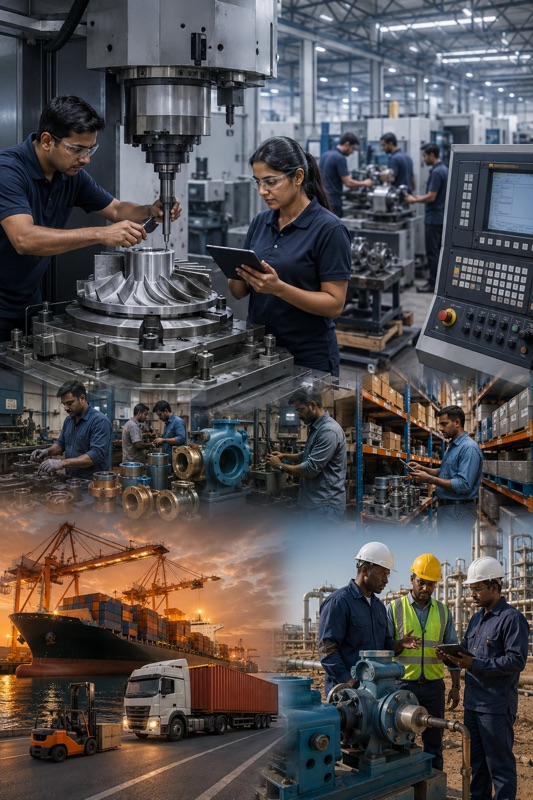
 The sector that determines the strength of every other sector
Capital goods are the machines used to produce other goods. Machine tools, pumps, electrical equipment, industrial machinery, boilers, processing systems and automation equipment form the productive backbone of an economy. A country that imports most of its machinery may manufacture final products, but it remains dependent on technology developed elsewhere.
India’s post-independence industrial strategy understood this clearly. Heavy engineering enterprises, research institutions and public-sector production were created to build national technological capacity. Economic liberalisation later increased competition and access to global machinery. It improved efficiency, but it also exposed domestic manufacturers to imported equipment supported by deeper technology ecosystems and cheaper finance.
Record exports, rising vulnerability
India’s merchandise exports reached a record $44.24 billion in July 2026, supported partly by engineering goods. This is positive, but the same month produced a trade deficit of nearly $32 billion. Exporters also faced higher freight, insurance and delivery costs because of disruptions along important shipping routes.
Headline export growth can therefore hide shrinking margins. An MSME may report higher export revenue while earning less after paying for imported components, energy, finance, containers and insurance. Delayed delivery can also damage buyer relationships that took years to build.
This is why export success should be measured through value addition, profitability, technological content and market diversity—not export value alone.
Africa is not simply another destination
The revival of preferential-trade negotiations between India and the Southern African Customs Union could create opportunities for machinery, electrical equipment, pharmaceuticals, automobiles and textiles. It could also improve access to minerals required for batteries and clean-energy manufacturing.
But African markets cannot be approached as places to sell surplus products. Machinery exports require installation, operator training, maintenance, spare parts and dependable after-sales service. Large companies can establish local offices. Small exporters often cannot.
Engineering clusters must therefore create shared service networks, local technical partnerships and regional spare-parts centres. A machine that cannot be repaired quickly becomes an advertisement against the exporting country.
The coming machinery divide
Artificial intelligence, robotics, sensor-based maintenance and connected production systems are changing the meaning of machinery. Future equipment will not simply perform a mechanical task. It will generate data, communicate with other machines and continuously improve production decisions.
This transformation can produce a serious divide. Large manufacturers will buy intelligent equipment while MSMEs continue using isolated machines. Productivity differences will widen, and smaller suppliers may lose their place in organised value chains.
Cluster policy must respond through shared automation centres, technology-demonstration facilities, retrofitting services and financing for digital machinery. India does not always need to replace every old machine; in many cases, sensors, controllers and software can upgrade existing equipment at a lower cost.
Industrial sovereignty begins with machines
India cannot become a major manufacturing power by assembling products through imported technology indefinitely. Capital-goods policy must connect research institutions, component suppliers, equipment manufacturers, exporters and industrial users.
The real test is not whether India can export more machines this year. It is whether Indian machines can shape factories in Africa, Asia and India over the next twenty years. Export promotion can open the door, but technology, service and trust will determine whether Indian engineering remains inside.
#RenewableEnergy #SolarPower #GreenManufacturing #MSME #CleanEnergy #CircularEconomy





No comments:
Post a Comment