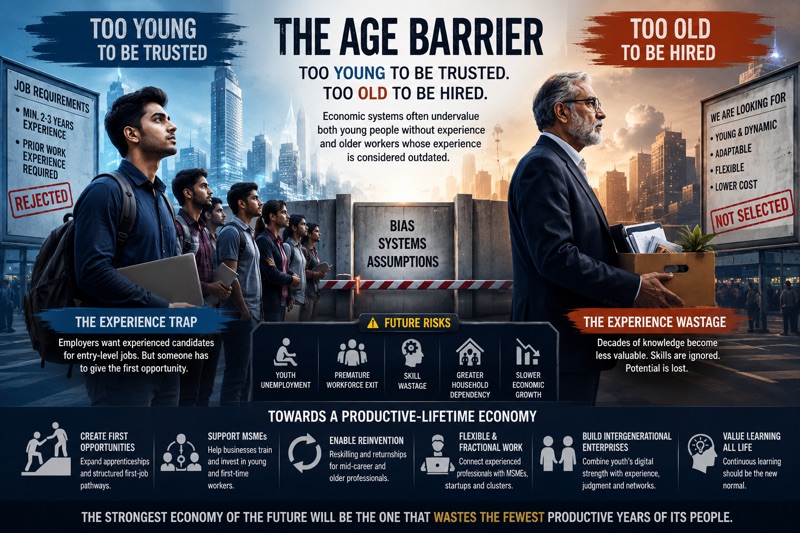
 Economic exclusion is usually discussed through income, education, gender, geography or skills. But another barrier is becoming increasingly powerful and strangely invisible: age. The modern labour market often tells a young person that they cannot be trusted because they have too little experience, while telling an older professional that their experience belongs to another era. Between these two judgments lies a huge economic contradiction. We spend heavily on educating the young and decades building the knowledge of experienced workers, yet the labour market can undervalue both.
From Experience as an Asset to Experience with an Expiry Date
Historically, age and experience were closely connected with economic value. An artisan became more valuable after years of mastering a craft. A trader accumulated relationships. An engineer accumulated practical knowledge. A manager understood people, markets and institutional memory. In family businesses and traditional production systems, knowledge often moved from one generation to another.
Industrialisation changed this relationship but did not destroy it. Large organisations still depended on long careers, apprenticeships and gradual movement through occupational hierarchies. The digital economy is creating something different. Technology, automation and rapidly changing business models are shortening the perceived shelf life of knowledge.
This creates a dangerous assumption: newer skills automatically mean better skills.
They do not.
A 25-year-old may understand a new technology better than a 55-year-old manager. But the manager may understand customers, negotiations, production failures, supply-chain relationships and organisational behaviour in ways that cannot be downloaded through a training course. The future economy requires both. Yet recruitment systems increasingly behave as if generations are substitutes rather than complements.
India’s Young Worker Paradox: Experience Required Before Experience Is Given
India faces a particularly sharp version of the age barrier because it has a very large young population entering a labour market undergoing technological and structural change. The problem is no longer simply whether young people are educated. The deeper question is whether education can be converted into economically valuable experience.
A graduate encounters a strange first gate: employers frequently want work experience for jobs that are supposed to provide the first work experience.
This creates an experience trap.
Employers are not necessarily irrational. Hiring and training inexperienced workers costs money. Smaller businesses especially may lack formal training systems and therefore prefer workers who can become productive quickly. But what makes sense for one enterprise can become economically damaging when repeated across thousands of enterprises. If everybody wants experienced workers but too few organisations are willing to create experience, the labour market begins consuming a resource that it is unwilling to produce.
Internships partly address this problem, but poorly structured internships can simply create another layer of inequality. Young people from financially secure households can sometimes afford months of low-paid work, relocation and experimentation. Those from weaker economic backgrounds may need immediate income. Consequently, the ability to acquire experience itself becomes connected to family resources.
The age barrier therefore quietly becomes a class barrier.
The Other End of the Labour Market: Too Experienced to Employ
The opposite problem appears after 40, 45 or 50. A professional who loses a job, closes a business, returns after caregiving responsibilities or attempts to change sectors can discover that twenty years of experience does not necessarily improve employability.
Sometimes it reduces it.
Employers may assume that experienced candidates will demand higher salaries, resist younger managers, struggle with new technology or find it difficult to adjust to new organisational cultures. Some of these concerns can exist in individual cases, but treating them as characteristics of an entire age group converts perception into exclusion.
This is particularly damaging in India because formal social protection remains limited for large parts of the workforce. Premature employment exit therefore does not affect only one worker. It can affect household savings, children’s education, elderly dependants and retirement security.
A 50-year-old professional who becomes economically inactive may still have fifteen or twenty productive years ahead. Losing those years is not merely a personal employment problem. It is destruction of accumulated human capital.
Artificial Intelligence Could Make the Age Barrier Much Worse
The next stage may be more serious.
AI will not simply eliminate some jobs. It will continuously reorganise tasks inside jobs. Skills that once remained useful for decades may require repeated updating. This could produce a labour market in which workers experience several cycles of technological obsolescence during a single career.
The traditional model was simple:
Education → Employment → Experience → Retirement
The emerging model may become:
Education → Employment → Reskilling → Employment → Technological disruption → Reskilling → Career transition → Reinvention → Employment again.
If institutions do not adapt, every transition becomes another opportunity for age discrimination.
Recruitment technology can intensify the problem. Algorithmic screening may appear neutral while indirectly reproducing age preferences through graduation year, salary history, career gaps, experience patterns or previous job titles. The future age barrier may therefore become harder to see because nobody needs to explicitly reject someone because of age. The system can simply rank that person lower.
India Should Stop Thinking Only About Jobs and Start Thinking About Productive Lifetimes
India’s employment debate is heavily concentrated on job creation. That is necessary, but insufficient. The more important economic question is how many productive years society extracts from the capabilities it creates.
Imagine two people.
One is 23, educated but unemployed because nobody will give them their first meaningful opportunity.
The other is 52, highly experienced but unemployed because companies prefer younger and cheaper candidates.
They appear to represent completely different problems. Economically, they represent the same failure: unused human capability.
India therefore needs to move beyond age-defined employment towards a productive-lifetime economy. Apprenticeships should become much larger pathways into real employment rather than marginal programmes. MSMEs could be supported to train first-time workers because they cannot always bear training costs alone. Mid-career apprenticeships and returnships should become normal rather than exceptional. Skill programmes should increasingly serve 40-plus and 50-plus workers instead of concentrating overwhelmingly on young entrants.
Most importantly, experienced professionals should not be viewed only as conventional employees. India has millions of MSMEs that cannot afford full-time specialists in finance, exports, technology, quality, design, marketing or production management. Digital platforms could connect experienced professionals with clusters of smaller businesses on fractional, project or mentoring arrangements.
A retired export manager helping ten small manufacturers enter foreign markets may generate more economic value than remaining unemployed while searching for one conventional corporate position.
The Intergenerational Enterprise Could Become the New Competitive Advantage
The most interesting future may not belong to young companies or experienced companies. It may belong to intergenerational companies.
Young workers often bring technological familiarity, experimentation and different consumer understanding. Experienced workers bring judgment, networks, institutional memory and the ability to recognise patterns before they become crises.
AI actually makes this combination more valuable. Technology can increasingly supply information. What remains scarce is judgment about what information means.
The 25-year-old who understands AI and the 55-year-old who understands an industry should not be competing for relevance. Their combined capability can be significantly more powerful than either operating separately.
India’s industrial clusters could become laboratories for such models. Experienced engineers, retired bankers, former exporters, production specialists and marketing professionals could be connected with startups and MSMEs while younger professionals support digitalisation, AI adoption, e-commerce and data systems. Knowledge would then circulate between generations instead of disappearing when someone leaves formal employment.
The Coming Crisis Is Not Ageing. It Is Economic Expiry
The conventional fear is that societies grow old. But a much bigger danger is that economies begin declaring people economically old too early while simultaneously declaring young people economically inexperienced for too long.
That creates a shrinking productive middle.
Young people wait longer to establish themselves. Older workers leave productive employment earlier. Families support economically dependent adults for longer periods. Governments face greater pressure for employment programmes and social protection. Businesses simultaneously complain about shortages of skilled workers.
This is an extraordinary contradiction: skill shortages can coexist with skill wastage.
The future labour market should therefore be measured not simply by how many jobs it creates but by how effectively it uses human capability across an entire lifetime.
A country cannot become a developed economy by repeatedly discarding experience and delaying opportunity.
The real economic divide of the future may not simply be between skilled and unskilled workers. It may be between people whose capabilities are continuously renewed and people whose capabilities are allowed to expire.
India has an unusual opportunity because it simultaneously possesses a huge young workforce and a rapidly expanding pool of experienced professionals. If these generations are treated as competitors, the age barrier will become another invisible tax on growth. If they are connected, India can create something much more powerful: an economy where experience does not become obsolete, youth does not have to wait for permission to become productive, and learning does not end with formal education.
The strongest economy of the future will not be the youngest economy. It will be the economy that refuses to waste people at any age.
#AgeBarrier #Employment #Youth #FutureOfWork #AI #Skills #MSME #IndianEconomy #HumanCapital #Reskilling


No comments:
Post a Comment