
For decades, nations feared famine because they did not produce enough food. Today, the challenge has changed. Many countries produce sufficient food in good years, yet millions continue to struggle because food prices move like financial markets. One season tomatoes become so expensive that families stop buying them. A few months later farmers are forced to dump the same crop on roads because prices collapse below production costs. The crisis is no longer about the availability of food. It is about the inability to keep food affordable for consumers while ensuring fair returns for producers.
India represents this contradiction more clearly than many other economies. It is one of the world’s largest producers of cereals, fruits, vegetables, milk and spices, yet food inflation repeatedly becomes a national concern. At the same time, thousands of farmers continue to face financial distress because market prices often fail to cover their costs. The same system that produces expensive food for consumers can simultaneously produce poor incomes for farmers. That is the paradox that deserves greater attention.
Food Markets Are Becoming More Fragile
Historically, food prices moved gradually because agriculture was largely local and seasonal. Today the food economy is connected to climate change, global trade, energy costs, logistics, digital platforms and government policy. A flood in one state, a drought in another, rising fuel prices, restrictions on exports or disruptions in transport can all influence prices within days. Food has become part of a highly interconnected economic system where one disturbance spreads rapidly across markets.
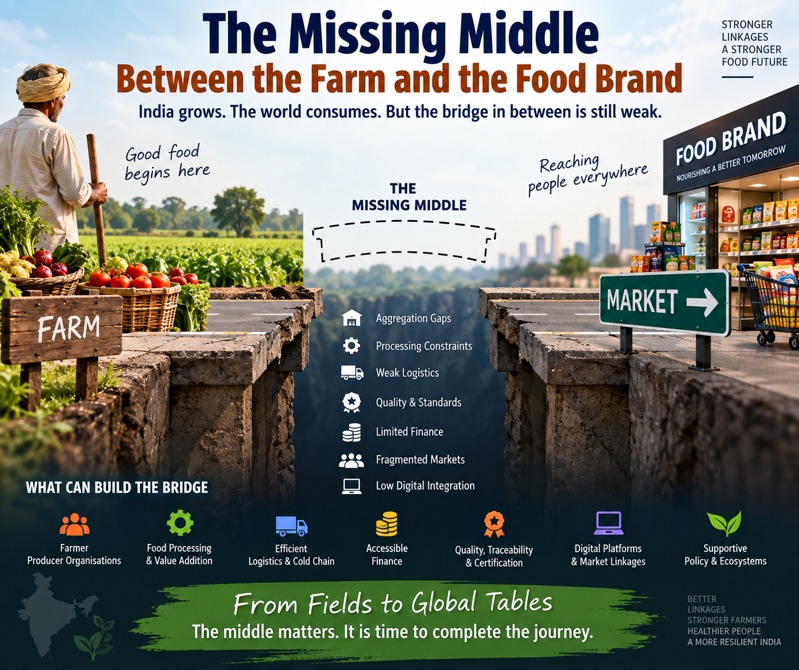
India has improved agricultural production significantly over the past decades, but storage infrastructure, cold-chain capacity, processing facilities and integrated logistics have not expanded at the same pace. As a result, shortages and surpluses often exist simultaneously in different parts of the country. Instead of balancing markets, these weaknesses amplify price swings.
Weather Is Becoming an Economic Risk
Climate change is no longer only an environmental issue. It has become a direct economic challenge. Rising temperatures, irregular monsoons, heat waves, floods and changing pest patterns are reducing predictability in agriculture. Farmers are finding it increasingly difficult to estimate production, while governments struggle to anticipate market shortages.
The future may witness agriculture becoming less predictable every year. Instead of one poor harvest every decade, extreme weather could become a regular feature. This would make food price volatility a permanent economic condition rather than an occasional disruption. Countries that fail to build climate-resilient agriculture may experience repeated cycles of inflation and farmer distress.
Supply Chains Decide Prices More Than Farms
Many people assume that food prices are determined only by production. In reality, prices are increasingly shaped by everything that happens after harvest. Poor roads, inadequate warehouses, limited cold storage, fragmented transport systems and multiple intermediaries often increase costs before food reaches consumers.
India has invested heavily in infrastructure, yet significant gaps remain in connecting farms with modern markets. Every delay increases spoilage, reduces quality and creates artificial shortages. Improving logistics may become as important as increasing agricultural production itself. The next agricultural revolution could take place not only on farms but also in warehouses, transport networks and digital marketplaces.
Policy Cannot Keep Chasing Prices
Governments often respond to rising food prices through export restrictions, stock limits or emergency market interventions. These measures may provide temporary relief but can also create uncertainty for producers and investors. Farmers hesitate to invest when policies change frequently, while businesses become cautious about expanding storage, processing or exports.
The future requires moving from reactive policy to predictable policy. Markets perform better when governments provide stable rules, transparent information and long-term confidence rather than frequent emergency responses.
The Hidden Cost Is Nutrition
Food inflation affects far more than household budgets. It influences nutrition, education and long-term public health. When nutritious food becomes expensive, families often shift towards cheaper and less balanced diets. Children may receive fewer proteins, fruits and vegetables, while adults reduce food quality to manage household expenses.
This silent nutritional decline creates costs that appear years later through poor health, lower productivity and reduced human capital. Food price volatility therefore becomes both an economic and a social challenge.
Data May Become the New Irrigation
The next transformation in agriculture may not be driven solely by larger farms or better seeds. It may come from information. Artificial intelligence, satellite monitoring, digital crop forecasting, real-time market intelligence and predictive weather systems could help governments, traders and farmers anticipate shortages before they become crises.
Countries that combine technology with strong agricultural institutions will likely experience greater price stability. Those that ignore digital intelligence may continue reacting after markets have already become unstable.
Stability Will Become More Valuable Than Production
The future of agriculture will not be judged only by how much food a country produces. It will increasingly be judged by whether families can afford healthy food throughout the year and whether farmers can earn stable incomes despite changing weather and volatile markets.
The Food Price Volatility Crisis reminds us that agriculture is no longer simply about cultivation. It is about economics, climate resilience, logistics, technology, governance and trust working together. Nations that build resilient food systems will strengthen both economic stability and national security. Those that continue treating every price shock as an isolated event may discover that the greatest threat is not the lack of food, but the growing unpredictability of its price.
#FoodSecurity #Farmers #India #FoodInflation #Agriculture #ClimateChange #Economy #Future #SupplyChain #Development




No comments:
Post a Comment