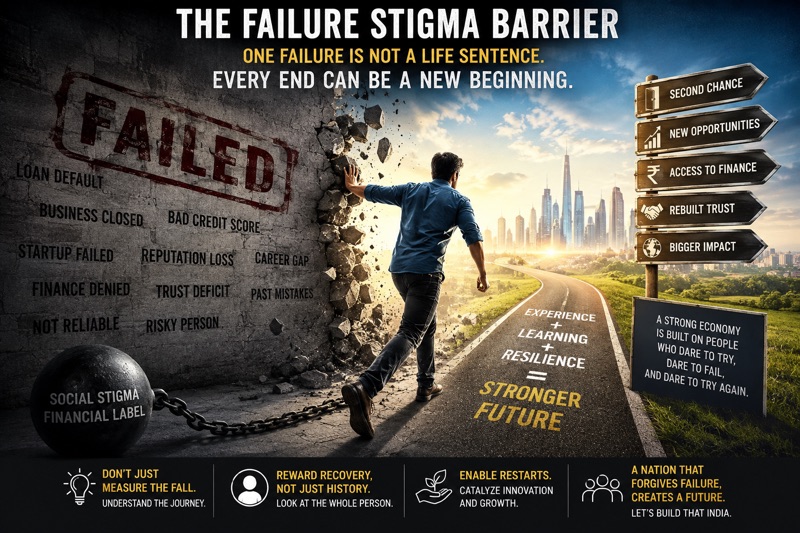
 Economic progress is normally explained through investment, technology, infrastructure, skills and markets. But there is another institution that receives far less attention: the right to fail and return.
Every dynamic economy produces failure. Businesses close. Startups run out of money. Technologies become obsolete. Workers lose jobs. Farmers make investments that do not work. Exporters enter markets at the wrong moment. Professionals interrupt careers because of family responsibilities. Borrowers sometimes default because the economy around them changes faster than their ability to repay.
The important question is therefore not whether an economy produces failure. It is what happens to people after failure.
An economy becomes less entrepreneurial when failure stops being an event and becomes an identity.
That is the Failure Stigma Barrier.
From Survival Economies to Risk Economies
For most of human history, economic survival depended heavily on continuity. Families remained attached to occupations, land, communities and established trading networks. Failure could be devastating because opportunities to restart were limited.
Industrial capitalism gradually changed this relationship. Modern corporations introduced limited liability. Bankruptcy systems developed. Financial institutions became better at distinguishing business risk from personal character. Labour markets allowed people to move between employers and occupations.
These were not merely legal innovations. They represented an important economic idea: productive risk requires the possibility of recovery.
The modern innovation economy takes this principle even further. Experimentation necessarily produces unsuccessful experiments. Venture capital portfolios themselves are built around the assumption that several investments may fail while a small number generate exceptional returns.
Yet society frequently celebrates successful entrepreneurs while forgetting that experimentation statistically requires unsuccessful ventures.
India wants more startups, exporters, manufacturers, innovators and entrepreneurs. But this ambition creates a contradiction if the institutional system encourages people to take risks before failure and distrusts them after failure.
India Has Improved Exit Laws, but Social Exit Is Much Harder
India has made important institutional progress. The Insolvency and Bankruptcy Code created a more structured framework for resolving financial distress. Startup policy has increasingly recognised closure and restructuring as normal parts of entrepreneurship. Digital lending, formal credit histories and expanding financial information systems have also improved the ability to evaluate borrowers.
But legal closure does not automatically produce economic rehabilitation.
A business may close legally while its promoter continues carrying the reputational burden for years. A borrower may eventually settle a difficult loan but remain viewed primarily through the history of default. A startup founder whose first venture failed may find the next round of finance considerably harder. A professional returning after a long career interruption may discover that employers value continuous employment more than accumulated capability.
The problem becomes particularly serious for MSMEs.
A large corporation can survive a failed product, a bad acquisition or several quarters of losses because failure is absorbed by the organisation. For a small entrepreneur, business and personal reputation are often inseparable.
The company fails, but socially the entrepreneur is considered to have failed.
That distinction matters enormously.
The Credit System Can Remember Longer Than the Economy Should
Financial discipline is necessary. Banks cannot simply ignore defaults. Credit information is essential because lending ultimately depends on assessing probability of repayment.
But there is an important difference between remembering financial history and permanently defining someone by it.
Suppose two entrepreneurs approach a lender.
One has never started a business and therefore has never experienced business failure. Another created a company, employed people, developed suppliers, learned a market, suffered a major shock, closed the business, resolved previous obligations and now proposes a stronger enterprise.
A mechanical interpretation of risk may sometimes make the first borrower appear safer.
An economic interpretation may reach a different conclusion.
The second entrepreneur possesses something difficult to teach in a classroom: knowledge acquired through failure.
Future financial systems will therefore need to move beyond simply identifying whether something went wrong. They will increasingly need to understand why it went wrong, how the borrower responded, what obligations were resolved and what changed afterwards.
The future of credit assessment should be contextual memory rather than permanent suspicion.
India May Be Creating a Paradox of Entrepreneurship
India has built one of the world’s most energetic startup environments and has greatly expanded the language of entrepreneurship. Young people are encouraged to innovate, build enterprises, export, digitise and create employment.
But entrepreneurship cannot flourish sustainably if society celebrates entry while quietly penalising exit.
This creates a strange incentive.
People may become willing to start businesses but unwilling to close unsuccessful ones.
That can be economically damaging.
An entrepreneur who believes closure will permanently damage reputation may continue borrowing to keep an unviable enterprise alive. Families may inject savings into businesses whose economics have already disappeared. Suppliers may remain unpaid because promoters are desperately postponing closure. Financial distress becomes hidden until it becomes much larger.
A system intended to discourage failure can therefore produce more destructive failure.
Early failure is often inexpensive.
Delayed failure can become systemic.
Failure Stigma Can Become an Invisible Tax on Innovation
Innovation requires experimentation, and experimentation produces uncertainty.
Imagine that ten entrepreneurs test ten new business models. Some will work. Some will not. Society benefits not only from the successful firms but also from the information generated by unsuccessful experiments.
Failure tells the economy something.
The technology may not be ready. Consumers may not want the product. Distribution may be too expensive. The market may be too small. Regulation may make the model unviable. The business may have expanded too quickly.
This information has economic value.
But if failure carries severe social and financial penalties, rational people begin avoiding experiments where outcomes are uncertain.
They move toward safer occupations, familiar industries, property, established trading activities or secure employment.
The visible consequence is fewer startups.
The invisible consequence is more serious: fewer experiments.
An economy can therefore become stable and stagnant at the same time.
The Biggest Cost May Be Hidden Human Capital
When a business fails, physical capital can often be sold. Machinery can change ownership. Buildings can be reused. Inventory can be liquidated.
Human learning is different.
An entrepreneur who spent five years building a manufacturing company may have accumulated deep knowledge of suppliers, workers, customers, production bottlenecks, regulations, logistics and cash-flow management.
If the business fails and the entrepreneur is excluded from future opportunities, the economy effectively discards that accumulated knowledge.
The same applies to workers.
A professional who takes several years away from employment may still possess valuable skills. A manager associated with an unsuccessful project may understand operational risk better than someone who has only managed successful projects.
Yet conventional recruitment systems often reward uninterrupted success histories.
The economy therefore risks selecting people partly according to how effectively they have avoided visible failure.
That is not necessarily the same as selecting people capable of solving difficult problems.
Artificial Intelligence Could Make the Barrier Better or Much Worse
The next phase of this problem will be digital.
Credit scoring, recruitment platforms, insurance systems and AI-based risk assessment increasingly convert human histories into datasets.
This creates enormous possibilities for better assessment.
It also creates the possibility of automated stigma.
A traditional banker might eventually reconsider a borrower after understanding the circumstances behind an earlier default. An algorithm trained primarily on historical correlations may simply discover that people with certain histories statistically represent higher risk.
The judgement then becomes invisible.
A loan is rejected.
An insurance premium rises.
A job application receives a lower ranking.
A platform restricts access.
Nobody explicitly says that the person is being punished for an event from eight years earlier. The algorithm simply assigns a score.
India therefore needs to think about something much deeper than data protection: the economic right to rehabilitation in an algorithmic society.
Digital memory is becoming nearly permanent.
Human economic systems cannot afford to make economic punishment equally permanent.
We Need a Rehabilitation Economy
The policy conversation should move beyond bankruptcy towards rehabilitation.
The objective should not be to erase legitimate financial history. That would weaken credit discipline and encourage irresponsible borrowing. The objective should be to distinguish inability from dishonesty, temporary distress from habitual behaviour, external shocks from deliberate misconduct and resolved failure from continuing risk.
Banks and financial institutions could increasingly incorporate rehabilitation indicators into credit decisions. A previous default should matter, but so should subsequent repayment behaviour, restructuring compliance, business experience, market conditions and evidence that the causes of the original failure have changed.
Startup ecosystems could create structured second-chance financing mechanisms.
Incubators could actively recruit experienced founders whose previous ventures failed.
Government entrepreneurship programmes could recognise prior entrepreneurial experience rather than treating every new applicant as a first-time entrepreneur.
Recruitment systems could evaluate career breaks more intelligently.
Business associations and industrial clusters could create mentoring networks where experienced entrepreneurs who have faced distress help younger firms identify early warning signs.
Even entrepreneurship education needs to change. Business schools frequently teach students how companies are created. They should spend much more time teaching how companies decline, restructure, close and restart.
Knowing how to exit intelligently is part of knowing how to enter intelligently.
The Future Competitive Advantage May Be the Speed of Recovery
During the twentieth century, countries competed through factories, infrastructure, education and capital.
During the twenty-first century, another capability may become equally important: institutional recovery speed.
How quickly can a worker retrain after losing a job?
How quickly can an entrepreneur restart after an unsuccessful venture?
How quickly can capital move from an unproductive company into a productive one?
How quickly can someone rebuild creditworthiness after genuine financial distress?
How quickly can society convert failure into learning?
These questions will become increasingly important because technological disruption is accelerating.
Artificial intelligence will destroy some occupations while creating others. Climate shocks will make some businesses unviable. Global trade fragmentation will suddenly alter export markets. Automation will change production economics. New technologies will make established business models obsolete much faster than before.
In such an economy, failure will not necessarily indicate incompetence.
Sometimes it will simply indicate that the world changed.
A society that permanently punishes people for being on the wrong side of one technological or economic transition may eventually become frightened of the next transition.
The Dangerous Economy Is Not the One Where Businesses Fail
There is a tendency to judge economic strength by survival. More surviving businesses appear to indicate a healthier economy.
But this can be misleading.
An economy where almost nobody fails may actually be an economy where nobody experiments.
The deeper objective should be productive churn: enterprises should be easy enough to create, unsuccessful ones should be possible to close without endless destruction, resources should move toward better uses, and capable people should be able to return.
India therefore needs to rethink the cultural meaning of economic failure.
Fraud must have consequences.
Wilful default must have consequences.
Reckless behaviour must have consequences.
But genuine entrepreneurial failure cannot become a lifetime economic sentence.
Because once failure becomes permanent, rational people begin protecting themselves from it.
They choose safety over experimentation.
Families encourage secure careers over uncertain enterprises. Businesses avoid unfamiliar markets. Banks prefer yesterday’s borrowers. Workers hesitate to change professions. Entrepreneurs remain small because expansion increases exposure.
Eventually the economy itself becomes cautious.
And that may be the greatest failure of all.
The real test of an entrepreneurial economy is not how loudly it celebrates those who succeed the first time.
It is how intelligently it treats those who are ready to try again.
#Entrepreneurship #MSME #Startups #IndianEconomy #Innovation #BusinessFailure #SecondChance #FinancialInclusion #Credit #FutureOfWork #ArtificialIntelligence #EconomicReform #RiskTaking #StartupIndia #EconomicDevelopment




No comments:
Post a Comment