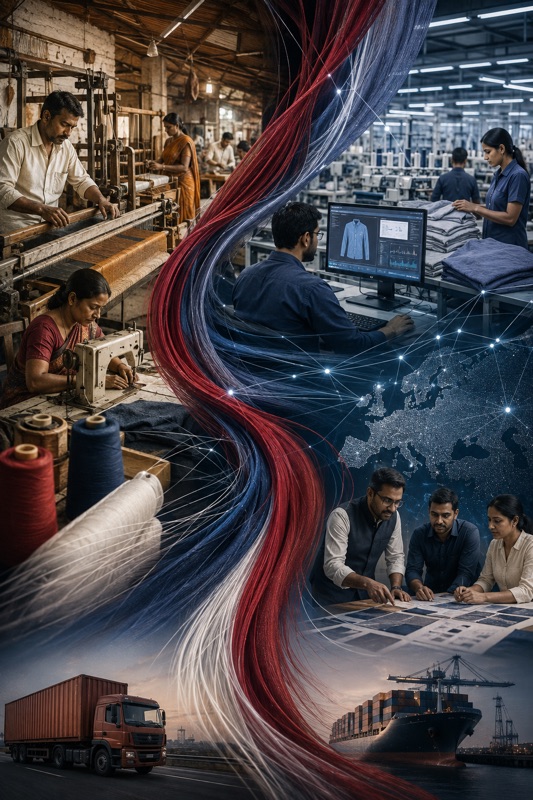
 From colonial raw material to global supplier
India’s textile history carries a strange reversal. Before colonial rule, Indian fabrics travelled across the world and were valued for design, craftsmanship and quality. Colonial economic structures gradually pushed India towards supplying raw materials while weakening local production. After independence, the country rebuilt an extensive textile base consisting of mills, powerlooms, garment factories, handlooms and household enterprises.
Today, India is again a major textile and apparel exporter. Yet the sector remains divided between globally connected companies and thousands of smaller units operating with narrow margins, outdated machinery and limited market information. This division becomes dangerous when export markets change suddenly.
The American market is no longer enough
India’s textile, apparel and handicraft exports reached approximately ₹3.25 lakh crore in 2025–26. However, exports to the United States declined, while shipments to several European markets increased. The decision of a major company such as Raymond Lifestyle to increase Europe’s share in its exports is not merely a corporate development. It signals a broader movement towards market diversification.
But diversification is easier for large companies. They can establish international marketing teams, maintain compliance departments, operate factories in more than one country and absorb the cost of entering a new market. An MSME in Tiruppur, Ludhiana, Panipat, Surat or Jaipur cannot change its export destination so easily. Its production system may have been built around one buyer, one product and one country.
Europe is a different production system
Selling more garments in Europe does not mean sending the same product to a different port. European buyers increasingly demand chemical safety, material traceability, environmental documentation, recycled-content verification, responsible labour practices and proof of supply-chain transparency. Orders may also be smaller, more design-intensive and more frequently changed.
This creates a new barrier. The factory may be capable of stitching the garment but incapable of producing the required data. In the future, the digital record attached to a product may become almost as important as the product itself. Smaller firms without traceability systems could be excluded even when their price and quality are competitive.
Clusters must become shared intelligence systems
Traditional cluster policy concentrated on roads, buildings, machinery and common facilities. The next generation of textile clusters needs shared market intelligence, sustainability specialists, digital traceability platforms, testing laboratories, design studios and compliance services. These facilities should be accessible to small firms on a common-use basis.
Export promotion must also move beyond exhibitions and buyer–seller meetings. An MSME receiving an international enquiry still needs support in costing, sampling, certification, contract negotiation and delivery management. Without this last-mile support, market promotion produces visibility but not sustainable orders.
The future garment will carry evidence
The future of textiles will not be decided only by low wages or production volume. Buyers will increasingly ask where the fibre came from, how much water was used, what chemicals were applied, who made the product and whether it can be recycled.
India has the advantage of a complete textile value chain and strong clusters. But this advantage can disappear if compliance remains concentrated among large exporters. Export diversification must therefore become a cluster-level production transformation. Otherwise, India may enter new markets statistically while leaving most of its textile MSMEs outside the door.
#Textiles #ApparelExports #MSME #Tiruppur #Ludhiana #ExportDiversification #IndustrialClusters #SustainableFashion


No comments:
Post a Comment