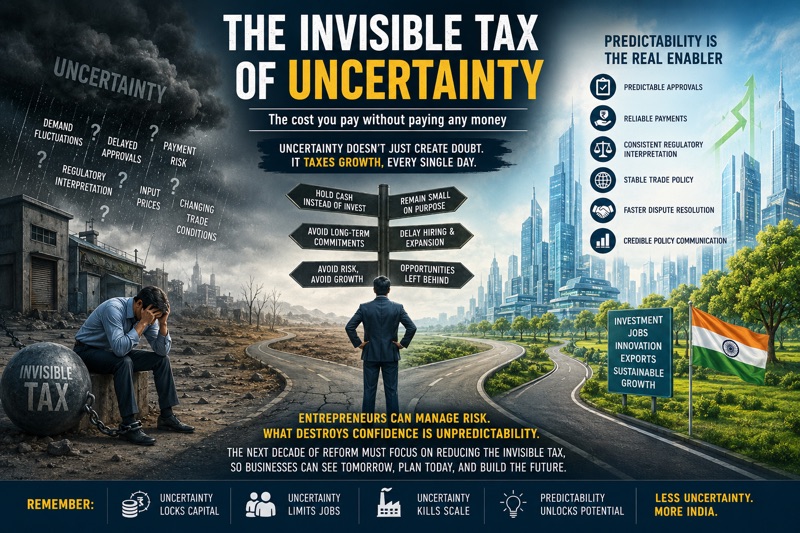
 Economic debates usually focus on taxes that can be counted. Corporate tax has a rate. GST has a rate. Customs duties have a rate. Interest has a rate. But there is another cost imposed on businesses that appears in no tax notification and is collected by no government department. It is the cost of not knowing what comes next.
Uncertainty behaves like an invisible tax.
A business that does not know when its customer will pay, whether demand will remain strong, how an authority will interpret a regulation, what an imported input will cost three months later, whether a trade restriction will suddenly change, or how long an approval will take begins to behave differently. It delays investment. It keeps more cash. It hires cautiously. It avoids debt. It reduces inventory. It refuses large orders that require substantial working capital. Sometimes it deliberately remains small.
This is where uncertainty stops being merely a business problem and becomes an economic development problem.
From Licence Raj to the Age of Unpredictability
India has travelled a remarkable distance from the controlled economy that existed before the reforms of 1991. Industrial licensing was reduced, trade barriers came down, private investment expanded, foreign capital entered, financial markets deepened and India became increasingly connected with global production and technology.
But economic reform has an unfinished dimension.
The old problem was often the difficulty of obtaining permission. The new problem can be the difficulty of predicting outcomes.
A company may formally be free to invest, yet hesitate because it cannot confidently estimate future demand, payment cycles, compliance requirements, logistics costs or global market access. Economic freedom therefore requires more than removing restrictions. It requires reasonable predictability.
This distinction becomes particularly important for MSMEs.
A large corporation can maintain legal departments, compliance teams, treasury operations, multiple suppliers and substantial cash reserves. A small manufacturer may have the owner performing several of these functions personally. The same uncertainty therefore does not impose the same cost on every enterprise.
The invisible tax is highly regressive.
A ₹1 Crore Order Can Become a Liability
Imagine a small engineering company receiving a large order. On paper, this is good news.
The company must purchase raw materials, pay wages, finance electricity, arrange transport and possibly borrow working capital before receiving payment. If payment arrives within the agreed period, the order generates profit.
But suppose payment is delayed for several months.
The company still pays interest. Workers still expect salaries. Suppliers still demand payment. Banks still expect instalments. GST and other obligations operate according to their own timelines.
Suddenly, growth creates a liquidity problem.
This produces one of the strangest outcomes in business economics: a rational entrepreneur may refuse additional business because the financial risk of growth is greater than the expected return from growth.
The economy sees an MSME unwilling to expand. The entrepreneur sees a balance sheet that may not survive another delayed payment.
That difference matters.
India Has Many Entrepreneurs but Too Much Defensive Entrepreneurship
Indian businesses have become exceptionally skilled at surviving uncertainty. But survival capability should not be confused with productivity.
Many enterprises maintain multiple suppliers because they fear disruption. They keep extra inventory because delivery schedules are uncertain. They rely heavily on informal relationships because contractual enforcement can be slow. They avoid ambitious expansion because future demand is difficult to estimate. They retain cash because the next shock is unknown.
Each decision may be individually sensible.
Collectively, however, they create an economy operating below its productive potential.
Money sitting defensively in a bank account does not buy machinery. A factory postponing expansion does not create new jobs. An entrepreneur avoiding formal borrowing does not build productive capacity. A company unwilling to enter a new market does not become an exporter.
Uncertainty therefore does not simply reduce confidence. It changes capital allocation.
The Tax Has Many Collectors
The unusual feature of the uncertainty tax is that no single institution imposes it.
Part of it comes from government processes. Part comes from delayed commercial payments. Part comes from volatile commodity prices. Part comes from financial institutions. Part comes from infrastructure failures. Part comes from global trade disruptions. And increasingly, part comes from geopolitics.
A manufacturer today may have to think simultaneously about exchange rates, shipping routes, tariffs, energy prices, technology changes, environmental standards, carbon requirements, artificial intelligence, supply-chain concentration and geopolitical tensions.
The world has moved from an era in which efficiency was built around predictable globalisation towards an era in which resilience is being built around unpredictable fragmentation.
For India, this creates both danger and opportunity.
Companies around the world are reconsidering where they manufacture and source. India can benefit from diversification away from excessively concentrated global supply chains. But investors searching for alternatives are not comparing India only on wages or market size. They are increasingly comparing countries on reliability.
The competitive question of the future may therefore be surprisingly simple:
How predictable is it to do business here?
Why Small Firms Pay More
The invisible tax of uncertainty is particularly damaging because its effective rate falls as businesses become larger.
A corporation with operations across several states can absorb a disruption in one location. A small enterprise cannot. A multinational can hedge currency exposure. A small exporter often cannot. A large buyer can negotiate longer credit periods. A small supplier frequently accepts them. A large company can survive a delayed receivable. For a micro enterprise, the same delay can threaten salaries and loan repayments.
This creates a hidden mechanism of market concentration.
Repeated uncertainty can gradually transfer economic power towards organisations with the strongest balance sheets.
Every crisis accelerates the process. The financially strong survive, purchase distressed assets, gain market share and negotiate better terms. Smaller enterprises exhaust working capital, reduce employment or disappear.
The invisible tax can therefore eventually become a tax on competition itself.
The Dangerous Economics of Staying Small
Economic policy usually assumes that entrepreneurs want to grow.
That assumption deserves examination.
Growth means more workers, more machinery, larger loans, more customers, larger inventories and longer supply chains. Every additional commitment increases exposure to uncertainty.
If the institutional environment does not reduce that uncertainty, remaining small may become economically rational.
This creates a development trap.
India can produce millions of enterprises without producing enough medium-sized companies capable of competing internationally. The missing middle of enterprise development is therefore not merely a finance problem or a technology problem. It is partly a confidence problem created by uncertainty around the consequences of expansion.
An entrepreneur who has spent twenty years surviving may value control more than scale.
That is not necessarily lack of ambition. It can be accumulated economic memory.
Artificial Intelligence Will Reduce Some Uncertainty and Create New Forms of It
The next decade will make this issue more complicated.
Artificial intelligence, predictive analytics, digital payments, GST data, account aggregators, satellite information, digital supply chains and real-time logistics systems can dramatically improve business forecasting. Banks may assess credit risk faster. Manufacturers may predict demand more accurately. Governments may identify bottlenecks earlier. Supply chains may become increasingly visible.
Technology could therefore reduce part of the uncertainty tax.
But it will create another layer.
Businesses will face uncertainty about which technologies will survive, which occupations will disappear, which skills will remain valuable, how AI will be regulated, who owns commercially valuable data and whether investments made today will become obsolete within a few years.
Technology may make tomorrow more measurable while simultaneously making the day after tomorrow less predictable.
This is why the traditional five-year business plan may gradually lose relevance. Companies will increasingly need flexible investment models, shorter decision cycles, diversified supply chains and continuous scenario planning.
Predictability Should Become Economic Infrastructure
India spends enormous resources building physical infrastructure. Roads reduce transport costs. Ports reduce logistics costs. Electricity infrastructure reduces production costs. Digital infrastructure reduces transaction costs.
Predictability should be understood in the same way.
A predictable approval system is economic infrastructure.
A reliable commercial payment system is economic infrastructure.
Consistent regulatory interpretation is economic infrastructure.
Stable and clearly communicated trade policy is economic infrastructure.
Fast contract enforcement is economic infrastructure.
Accessible information about future regulations is economic infrastructure.
These systems may not produce photographs of newly inaugurated assets, but they can generate enormous economic value.
This requires a shift in how governments measure ease of doing business. The important question should not simply be how many approvals have been digitised or how many regulations have been removed.
The deeper question is how much uncertainty has actually been removed from an entrepreneur’s decision.
India Needs an Uncertainty Reduction Policy
The next generation of economic reform should move beyond deregulation towards predictability.
Government departments could publish regulatory calendars indicating important proposed changes well in advance. Major rules affecting investment could include reasonable transition periods. Approval systems could provide legally meaningful timelines rather than merely digital application numbers. Delayed payments could be tracked as a systemic financial risk rather than treated only as disputes between individual firms.
Banks could increasingly evaluate MSME cash flows instead of depending excessively on collateral. Government procurement systems could automatically identify payment delays. Export policy could place greater weight on stability because international customers build supply chains over years, not weeks.
Industrial clusters could also become uncertainty-reduction institutions.
A strong cluster organisation can provide shared market intelligence, regulatory interpretation, technology forecasting, export information, common testing, pooled procurement and early warning about supply-chain disruptions. Instead of every small entrepreneur separately trying to understand an increasingly complex world, institutions can distribute the cost of knowledge across hundreds of firms.
This may become one of the most important roles of industry associations in the future.
The Real Ease of Doing Business Is the Ability to See Tomorrow
For decades, development policy has concentrated on reducing visible costs: taxes, tariffs, interest rates, logistics expenses and compliance burdens.
The next frontier is reducing invisible costs.
An economy becomes investment-friendly not merely when starting a business is easy, but when an entrepreneur can make a five-year commitment without constantly fearing that the assumptions behind the investment will suddenly collapse.
This does not mean eliminating risk. No government can guarantee demand, commodity prices, technology or geopolitics.
The objective should be to separate unavoidable market risk from avoidable institutional uncertainty.
That distinction is fundamental.
Entrepreneurs are supposed to take commercial risks. They should not have to gamble on administrative unpredictability.
India’s ambition to become a major manufacturing, exporting and innovation economy will therefore depend on something that rarely appears in industrial policy documents: confidence in the future.
Capital ultimately moves towards opportunity, but long-term capital stays where opportunity is accompanied by reasonable predictability.
The most powerful reform of the coming decade may consequently be neither another subsidy nor another scheme.
It may simply be making tomorrow easier to trust.
#MSME #IndianEconomy #Entrepreneurship #Manufacturing #Business #EconomicReforms #IndustrialClusters #Investment #India




No comments:
Post a Comment