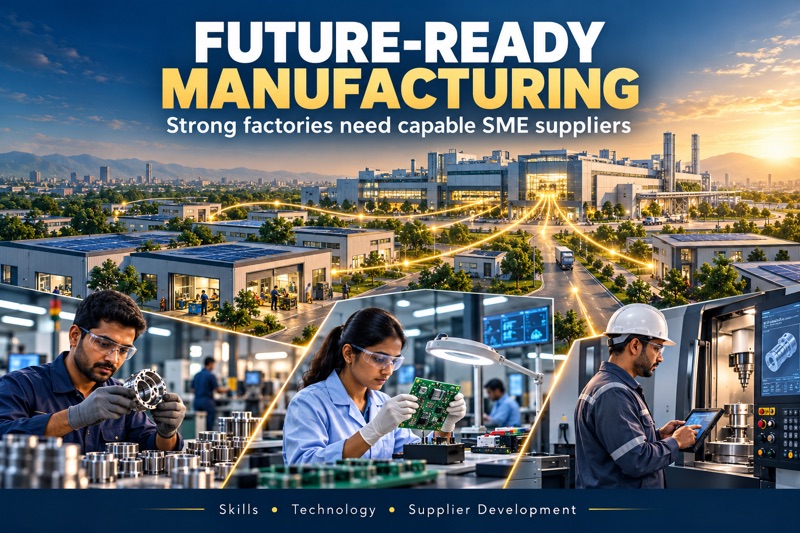
Why India’s manufacturing transformation must reach beyond the large plant
A modern factory can stand behind impressive gates while its suppliers struggle with outdated machines, uncertain orders and shortages of technical skills. The factory may be globally connected, but the surrounding production economy can remain fragile. This is the uncomfortable possibility behind industrial strategies that celebrate major investments without asking whether smaller enterprises can participate in the industries being created.
The OECD’s Fit-for-Future Manufacturing SMEs: Effective Policies for Transformation, published on 2 October 2026, brings this question into focus. Examining automotive, semiconductor and electronics, and machinery businesses across France, Germany, Japan, Korea and the United States, it shows why industrial transformation requires policies shaped around the position of smaller firms within particular supply chains. (oecd.org)
The old assumption has become expensive. Industrial development has often been imagined as a spreading process: attract a large manufacturer, expand production and allow knowledge, orders and technology to reach smaller suppliers. Such linkages can develop. But physical proximity alone cannot create them. A small enterprise located beside an advanced plant may still lack the testing capability, technical documentation or production consistency needed to supply it.
The OECD explicitly challenges the assumption that support for major industries will automatically benefit SMEs. It finds that direct, structured SME support often remains secondary to measures aimed at larger enterprises. Its central contribution is to examine digitalisation, low-carbon production and supply-chain disruption together, while recognising that their effects differ by industry. (oecd.org)
For India, the implication is significant: manufacturing policy needs to finance the connections between firms as deliberately as it finances the factories themselves.
Three transformations arrive at the same workshop. Consider a hypothetical component manufacturer. One customer asks for digital production records. Another wants energy and emissions information. A third requires alternative sources for critical inputs. Each request appears reasonable in isolation. Together, they demand investment, management time and new skills before additional revenue is assured.
Public programmes can make this harder when they treat technology, energy efficiency and resilience as separate administrative subjects. The enterprise experiences one business problem, while support arrives through several application forms.
An Indian supplier programme should therefore begin with a practical diagnosis: which changes will help this firm retain customers, enter a viable market or reduce a measurable operating risk? Funding should follow that sequence. Buying software before stabilising production records, or installing equipment before securing the skills to operate it, can leave expensive assets underused.
Automotive policy must start with the component’s future. The transition towards electric powertrains creates particular difficulties for suppliers whose capabilities and revenues depend on internal-combustion-engine components. The OECD identifies adaptation to new vehicle supply chains, or movement into other industries, as a central challenge for these businesses. (oecd.org)
For Indian automotive clusters, the first task should be to map exposure at the product level. Which components face declining demand? Which machining, casting, tooling or quality-control capabilities can serve new customers? Which investments remain commercially useful across several possible transition speeds?
Support could then combine traceability, engineering assistance, prototype testing and diversification finance. A technically capable firm should not be encouraged into an unfamiliar EV product simply because that category attracts policy attention. Its transition needs a credible customer, an achievable specification and a workable margin.
Electronics policy must build a route to qualification. A major electronics or semiconductor investment does not automatically create an accessible market for nearby small firms. The OECD highlights high entry barriers alongside opportunities in specialised components, design and maintenance services. (oecd.org)
India’s practical response should be to identify specific supply opportunities and work backwards from buyer requirements. A prospective supplier needs to know what must be tested, who can validate it, how long approval may take and what the process will cost.
Shared laboratories would help only if their capabilities and results are accepted by prospective buyers. Skills programmes should address actual production and engineering gaps. Access to design tools and intellectual property should be arranged through lawful, commercially workable licences.
Above all, finance should recognise the period between developing a credible product and receiving an approved commercial order. Otherwise, a technically promising enterprise can run out of money while waiting to become a supplier.
Machinery firms need a business-model transition. The OECD’s machinery analysis describes opportunities in digitally enabled services, alongside barriers involving investment, skills and organisational change. Smaller manufacturers can struggle to move beyond hardware production even when new service markets are emerging. (oecd.org)
For India, this suggests a wider agenda than subsidising new machines. A machinery enterprise could earn revenue through installation, remote diagnostics, retrofits, maintenance and application-specific customisation. These services require software capability, reliable field support and a clear agreement on access to customer data.
Cluster institutions could provide shared engineering and digital-service teams that individual firms cannot yet afford. Their performance should be judged by functioning services and paying customers. A demonstration centre that impresses visitors but changes no commercial practice has limited developmental value.
Public incentives should purchase supplier capability. A policy proposal follows from this analysis: large firms receiving public support should agree to proportionate, measurable supplier-development commitments.
These commitments could cover technical mentoring, supported qualification trials, predictable payment practices and verified improvements among participating suppliers. They should distinguish between suppliers merely attending a workshop, suppliers passing qualification and suppliers receiving repeat commercial orders.
Care is needed. A domestic procurement target alone may reward superficial localisation. An obligation to hold training sessions may generate attendance sheets rather than competence. The stronger test is whether suppliers can consistently meet specifications, improve productivity and compete for business beyond the original anchor firm.
Supplier development should expand a smaller enterprise’s commercial options. It should not create permanent dependence on one powerful customer.
Borrow the questions, test the answers locally. The OECD study offers a comparative diagnosis, not causal proof that particular programmes deliver particular outcomes. Its five-country setting also differs substantially from the institutional and technological conditions of many Indian clusters. The country analysis draws on sector evidence, policy reviews and stakeholder interviews. (oecd.org)
India should use these insights to design and test focused interventions. Begin with a defined supplier group, establish its starting capabilities, track results over time and examine whether improvements exceed what would otherwise have occurred. Publish failures alongside successes. This would provide a firmer basis for expansion than counting beneficiaries or expenditure alone.
The future of manufacturing will be shaped by the capabilities distributed across thousands of smaller enterprises. A large plant can introduce advanced production. A capable supplier network can make that advancement durable, adaptable and locally rooted.
India’s industrial ambition should be measured by how many smaller firms become capable of supplying the next generation of industry—and how much knowledge, bargaining power and value they retain while doing so.


No comments:
Post a Comment