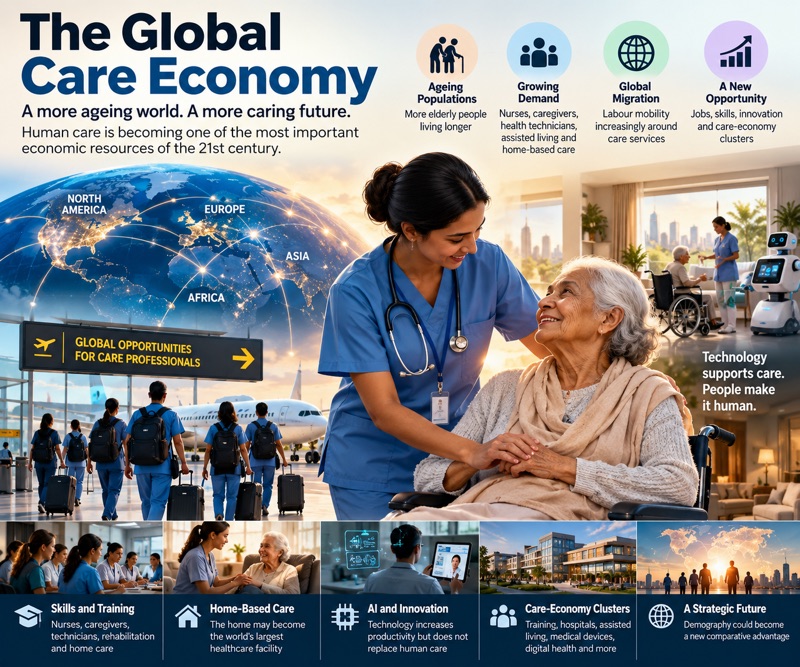
For most of economic history, care was treated as a social responsibility rather than an economic sector. Families looked after children, older people and the sick, while governments concentrated on hospitals and basic public health. Much of the actual work of caring remained unpaid, invisible and disproportionately carried by women. The twenty-first century may overturn this arrangement. As societies grow older, families become smaller and millions of people live longer with chronic conditions, care itself is becoming economic infrastructure. The next great labour shortage may not be in factories. It may be beside hospital beds, inside assisted-living facilities and, increasingly, inside ordinary homes.
From the Baby Boom to the Care Deficit
The post-war economic model was built around an expanding workforce supporting a relatively smaller retired population. That demographic pyramid is gradually being inverted in many countries. Japan entered this transition early. Much of Europe followed. South Korea and China are ageing rapidly, while North America faces its own expanding elderly population. The problem is not simply that people are living longer. Fertility has fallen, family sizes have declined and younger workers increasingly live far away from ageing parents.
This produces what may become one of the largest structural shortages of the coming decades: the care deficit.
Hospitals can be constructed. Medical equipment can be manufactured. AI systems can analyse scans. But an elderly person recovering from surgery may still need someone to help them walk, eat, bathe, take medicines and remain socially connected. Technology can increase the productivity of care, but much of care remains stubbornly human.
The Strange Economics of Care
This creates an economic paradox. Some of the jobs societies will need most are among those they have historically valued least.
Nurses, nursing assistants, caregivers, physiotherapists, laboratory technicians, rehabilitation workers and home-health workers often operate under considerable physical and emotional pressure. Yet care systems in many economies depend on relatively low wages, informal employment or migrant labour.
That model becomes increasingly difficult when almost every ageing country starts looking for the same workers.
The care economy could therefore experience something similar to the global competition for engineers and software professionals—but on a much larger human scale. Countries may compete not only for doctors but for nurses, geriatric-care workers, rehabilitation technicians and trained home caregivers.
Migration May Change Direction
The industrial age created large migration corridors around mines, factories, construction sites and infrastructure projects. The next generation of international labour mobility could increasingly be organised around hospitals, nursing homes and private households.
This would fundamentally alter the geography of migration.
Countries with younger populations could become major suppliers of care professionals to ageing economies. India, the Philippines, Indonesia, Vietnam and parts of Africa could occupy an increasingly important position in this labour market.
But exporting caregivers is very different from exporting garments or engineering components. Human beings cannot be treated as another export commodity. Training standards, language skills, certification, worker protection, portability of qualifications, social security and ethical recruitment will become central parts of future migration agreements.
Bilateral trade negotiations may therefore gradually acquire an unusual new chapter: mobility agreements for care workers.
India Could Become a Care Superpower—but There Is a Trap
India has an unusual demographic opportunity. It has a large young population, a substantial healthcare education system and considerable experience supplying nurses and medical professionals internationally. With systematic investment in geriatric care, language training, nursing assistance, rehabilitation, emergency support and home healthcare, India could build one of the world’s largest skilled-care workforces.
This could create millions of jobs, particularly for women and young people from smaller cities.
But there is an uncomfortable question.
If rich ageing countries can pay substantially more for trained workers, who will care for India’s own ageing population?
A strategy based only on exporting nurses and caregivers could reproduce an old development problem: developing countries finance education while richer economies capture the skilled worker.
India therefore needs to build care capacity rather than merely export care labour.
Training institutions should be expanded well beyond traditional nursing colleges. District-level care-skilling clusters could combine healthcare training, geriatric care, physiotherapy assistance, digital health, language education, international certification and placement services.
The Care Cluster Could Become a New Development Model
Industrial policy normally thinks geographically about automobile clusters, textile clusters, electronics clusters and food-processing clusters. The same thinking could be applied to care.
Imagine a care-economy cluster consisting of nursing colleges, hospitals, rehabilitation centres, assisted-living facilities, home-care companies, medical-device firms, telemedicine providers, skill centres and international recruitment agencies operating within a common ecosystem.
Such clusters could simultaneously serve domestic patients and international labour markets.
This is particularly important because the care economy will not consist only of caregivers. Around every care worker will emerge demand for medical devices, monitoring equipment, mobility products, diagnostic services, specialised food, insurance, digital health platforms, housing, transport and assistive technologies.
The economic multiplier could therefore be much larger than the employment numbers initially suggest.
Technology Will Enter the Bedroom, Not Replace the Caregiver
AI, robotics and remote monitoring will inevitably enter the care economy. Sensors may detect falls. Algorithms may monitor medication. Wearable devices may identify health deterioration before hospitalisation. Robots may assist with lifting, mobility and routine tasks.
But this should not automatically be interpreted as replacement of human workers.
Technology may instead become essential because there will simply not be enough caregivers.
The future care worker could therefore look very different from today’s domestic caregiver. A trained worker may simultaneously use remote diagnostics, AI-supported monitoring, wearable data and telemedicine connections while providing physical and emotional assistance.
The productivity revolution in care may come from technology surrounding the human worker rather than eliminating the worker.
The Home Could Become the World’s Largest Healthcare Facility
Another major transformation is likely to occur outside hospitals.
Institutional healthcare is expensive. As populations age, governments and insurers will increasingly try to move appropriate care from hospitals into homes. Remote monitoring, portable diagnostics, telemedicine and professional home-care networks will accelerate this transition.
The home may gradually become the most important unit of elderly healthcare.
That would create enormous markets for home nursing, physiotherapy, medical equipment rental, diagnostics, medication management, specialised nutrition, emergency response and assisted-living technologies.
The healthcare economy may therefore shift from treating illness episodically to managing human capability continuously.
The Biggest Risk Is Building a Cheap Global Care Workforce
There is, however, a darker possibility.
Rich countries could attempt to solve their demographic problem by importing inexpensive workers from poorer countries without fundamentally improving wages, working conditions or career progression.
That would create a global care economy built upon demographic inequality.
The countries with capital would import youth from countries that still possess it.
This model would be economically tempting but socially unstable. Care workers who perform essential functions cannot indefinitely remain at the bottom of labour markets. Regulation will eventually have to address minimum standards, working hours, accommodation, recruitment fees, social protection and pathways for professional advancement.
The care economy cannot sustainably expand through cheap labour alone.
Demography May Become the New Comparative Advantage
The twentieth century taught economics to think about comparative advantage through land, labour, capital, technology and natural resources. The twenty-first century may add another factor: demographic structure.
Countries with younger populations may possess something ageing economies increasingly lack—not simply workers, but human time.
That could become extraordinarily valuable.
The global competition for care workers may eventually resemble today’s competition for semiconductors, energy or critical minerals. Governments may sign mobility partnerships, subsidise training institutions and establish international qualification frameworks simply to secure enough people to look after ageing populations.
And this changes how the care economy should be understood.
It is not merely another branch of healthcare.
It sits at the intersection of demography, migration, technology, gender, skills, urban development and international economics.
The countries that recognise this early will not simply train more nurses. They will build complete care ecosystems.
The Future Economy May Be Surprisingly Human
For two centuries, economic progress was associated with replacing human labour with machines. Agriculture mechanised. Factories automated. Offices digitised. AI may now automate parts of knowledge work.
But ageing could produce the opposite economic force.
The richer and more technologically advanced societies become, the more they may discover that one of their scarcest resources is something technology cannot manufacture easily: another human being willing and trained to care for someone else.
That may be the great contradiction of the future economy.
The age of artificial intelligence may simultaneously become the age in which human care acquires unprecedented economic value.
And the countries that prepare for this transformation today could discover that one of the world’s largest emerging industries is not built around a new machine.
It is built around an old human need: to be cared for when we can no longer fully care for ourselves.
#CareEconomy #FutureOfWork #Ageing #Healthcare #GlobalMigration #Skills #India #Employment #Demography #EconomicDevelopment


No comments:
Post a Comment