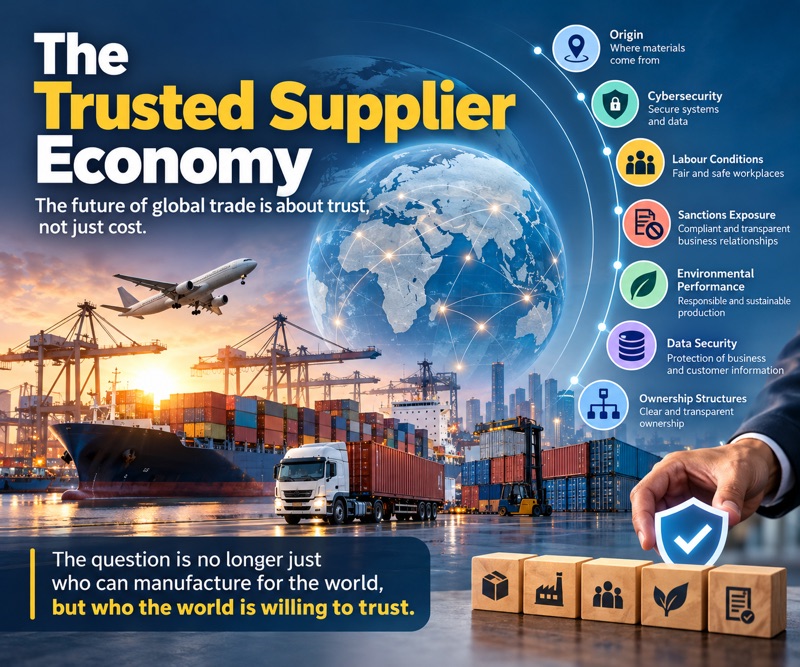
The Future of Global Trade Will Depend Not Only on What Countries Produce, but on Whom the World Is Willing to Trust
From the Cheapest Supplier to the Most Trusted Supplier
For much of modern economic history, international trade followed a relatively simple principle. Countries produced goods where costs were lowest, companies sourced from suppliers offering competitive prices, and global supply chains expanded across borders in search of efficiency. A product manufactured in one country could contain components from several others, use technology developed elsewhere, and reach consumers thousands of kilometres away. The central commercial questions were price, quality, delivery and reliability.
That model is undergoing a fundamental transformation.
The global economy is entering an era in which producing a competitive product may no longer be sufficient to secure international business. Buyers increasingly want to know who owns the factory, where its raw materials originate, how workers are treated, whether production damages the environment, whether digital systems are secure, and whether any part of the supply chain is exposed to sanctions or geopolitical restrictions.
The question is gradually shifting from where a product was made to whether the entire system behind its production can be trusted.
This transformation is creating what may be called the Trusted Supplier Economy, in which the credibility of a supplier’s entire business ecosystem becomes an economic asset.
Globalisation Is Not Ending. Its Conditions Are Changing.
The first major phase of modern globalisation was driven by trade liberalisation, containerisation, cheaper communications and the international fragmentation of production. From the 1980s onward, multinational corporations reorganised manufacturing around global value chains. China emerged as the world’s manufacturing centre, Southeast Asia became an important production network, and countries such as India developed specialised strengths in pharmaceuticals, textiles, engineering, information technology and business services.
The economic logic was straightforward. Production should move to locations offering the greatest efficiency.
The financial crisis of 2008 exposed weaknesses in this model. The pandemic revealed the risks of excessive geographical concentration. Semiconductor shortages demonstrated that a relatively small disruption could interrupt entire industries. Geopolitical conflicts, sanctions and technological rivalry subsequently brought national security directly into commercial decision-making.
The result is not necessarily deglobalisation. It is a more selective form of globalisation.
Companies are increasingly evaluating suppliers through a combination of cost, resilience, regulatory exposure, technological security and political risk.
A cheaper supplier may no longer be the preferred supplier if its ownership is opaque, its digital systems are vulnerable, or its production depends on restricted technologies.
International trade is therefore moving from a predominantly cost-based allocation system towards a more complex system of risk-adjusted sourcing.
The Invisible Factory Behind Every Product
A modern product is rarely the output of a single factory. It represents an interconnected network of suppliers, subcontractors, logistics companies, technology providers, financial institutions and service organisations.
A garment exported from India may use imported synthetic fibres, foreign dyes, internationally sourced machinery, cloud-based production software and several layers of subcontracted processing. A pharmaceutical product may depend on imported chemical intermediates, specialised packaging and testing laboratories. An electric vehicle battery may incorporate minerals extracted, refined and processed in different countries.
The finished product carries the commercial identity of the exporter, but its risks may originate much earlier in the supply chain.
This is why conventional country-of-origin documentation is becoming insufficient for some products and markets.
Origin establishes where a product qualifies as having been made under applicable rules. Trust requires a broader assessment of the organisations, processes, technologies and relationships involved in its production.
The distinction is important. A product may satisfy customs origin rules and still raise concerns about forced labour, cybersecurity, sanctions exposure, environmental claims or hidden ownership.
Future competitiveness will increasingly depend on the ability to understand and document these relationships.
Compliance Is Becoming a Form of Industrial Infrastructure
Industrial policy traditionally concentrated on roads, electricity, industrial estates, finance, machinery and skills. These remain essential, particularly for developing economies.
But a new category of industrial infrastructure is emerging.
Testing laboratories, accredited certification agencies, secure data platforms, traceability systems, environmental monitoring facilities, beneficial-ownership verification, supplier-risk databases and independent audit capabilities are becoming part of the productive ecosystem.
Regulatory developments illustrate this transition. The European Union’s Carbon Border Adjustment Mechanism introduces carbon-related reporting and financial obligations for covered imports. The EU’s Deforestation Regulation establishes due-diligence requirements for specified commodities and products. The EU’s battery rules introduce sustainability, information and traceability requirements in phases. The United States’ Uyghur Forced Labor Prevention Act creates significant import restrictions for goods linked to prohibited forced labour.
These frameworks differ in scope, implementation schedules and legal requirements. Yet together they demonstrate a broader change: market access increasingly depends on evidence extending beyond the physical characteristics of the product.
The critical economic implication is that compliance capability may become as important as production capability.
A factory with excellent machinery but weak documentation may struggle to enter certain markets. A smaller producer with credible traceability, reliable certification and secure digital systems may gain access to customers previously beyond its reach.
The competitive advantage is shifting from the factory alone to the institutional ecosystem supporting the factory.
The New Geography of Trust
For decades, developing countries competed for international investment through lower wages, tax incentives, industrial parks and infrastructure subsidies.
These instruments will continue to matter, but they may become less decisive when buyers assess long-term supply-chain risks.
Countries capable of offering transparent institutions, predictable regulations, reliable certification, secure digital infrastructure and enforceable contracts could enjoy an advantage over locations with lower production costs but higher uncertainty.
This creates a new dimension of economic geography.
Manufacturing locations may increasingly be classified not simply by cost and capability but by the level of confidence international buyers place in their institutions and supply networks.
However, trust will not always be defined objectively.
Geopolitical alliances may influence procurement decisions. Security restrictions may favour suppliers from politically aligned countries. Competing regulatory systems may impose different standards on the same product.
A supplier considered acceptable in one market may face additional scrutiny in another.
The danger is that trust becomes a commercial justification for political exclusion.
The global economy could gradually fragment into overlapping networks of preferred suppliers, approved technologies, trusted digital systems and politically acceptable production locations.
Such fragmentation would increase costs, reduce competition and create particular difficulties for smaller exporting economies.
Cybersecurity Is Now a Manufacturing Issue
Industrial competitiveness was once measured largely through machines, materials, productivity and engineering skills.
Today, a factory can be disrupted without any physical attack.
Production schedules, product designs, customer information, logistics instructions and financial transactions increasingly move through interconnected digital systems. Industrial machinery itself may rely on remote maintenance, connected sensors and external software providers.
A cybersecurity weakness in one supplier can therefore expose an entire international production network.
This changes the meaning of supplier reliability.
A supplier must increasingly demonstrate not only that it can manufacture a component accurately, but also that it can protect sensitive information, maintain secure systems and recover from digital disruption.
For defence-related industries, critical infrastructure, advanced electronics, medical technology and strategically sensitive equipment, these requirements can be particularly important.
Digital trust is becoming inseparable from industrial trust.
The Ownership Question: Who Really Controls the Supplier?
One of the least visible changes in global sourcing concerns corporate ownership.
International buyers and regulators may need to understand not only the immediate contracting company but also the individuals or entities exercising ultimate ownership or control.
Complex corporate structures, indirect shareholding, shell companies and opaque financial relationships can create sanctions, corruption, procurement and security risks.
This is especially relevant in sectors involving strategic technology, sensitive data, critical minerals and government procurement.
The implications extend beyond large multinational corporations.
Even smaller exporters may encounter greater demands for corporate disclosures, supplier declarations, financial transparency and verification of ownership relationships.
The future supplier may therefore be evaluated through three interconnected identities: the physical producer, the digital operator and the legal ownership structure.
Trust will increasingly depend on consistency across all three.
The MSME Paradox: Trust Can Open Markets and Close Them
The Trusted Supplier Economy presents a major contradiction for developing countries.
On one side, it creates opportunities for capable small and medium enterprises to differentiate themselves through reliable production, ethical practices, transparent sourcing and documented quality.
On the other, it introduces fixed costs that smaller firms are often least equipped to absorb.
Large corporations can maintain specialised compliance departments, employ cybersecurity professionals, commission international audits and invest in sophisticated traceability platforms.
A small garment exporter, engineering unit or food processor may lack the financial resources and technical expertise required to meet multiple buyer-specific requirements.
The problem becomes more serious when different customers demand different formats, audits and certification systems.
A factory may satisfy one buyer’s requirements only to discover that another demands an entirely different documentation process.
The result could be a new form of exclusion from international trade.
MSMEs may remain productive and price-competitive but lose access to premium markets because they cannot afford to prove their reliability.
This creates a difficult policy question: will the Trusted Supplier Economy reward responsible production, or will it concentrate international business among companies large enough to finance compliance?
Without deliberate institutional intervention, both outcomes are possible.
Industrial Clusters Must Become Trust Ecosystems
The traditional industrial-cluster model was built around geographical concentration, specialised suppliers, shared labour markets, subcontracting relationships and common infrastructure.
That model now requires an important extension.
A successful industrial cluster must increasingly provide collective capabilities that individual enterprises cannot efficiently develop on their own.
Consider Tiruppur’s garment industry, Ludhiana’s engineering and knitwear enterprises, Surat’s textile processors, Morbi’s ceramic producers, Pune’s automotive suppliers or India’s pharmaceutical manufacturing clusters.
Their future competitiveness may depend not only on machinery modernisation and productivity improvements but also on shared environmental monitoring, supplier verification, accredited testing, cybersecurity support and digital product documentation.
A cluster-level trust platform could help enterprises maintain verified supplier information, document material origins, manage certification records, assess common risks and respond to international buyer requirements.
This would lower the cost of compliance while improving the credibility of the entire production ecosystem.
However, such systems must protect commercially sensitive information and avoid creating another expensive layer of bureaucracy.
The objective should not be to generate more certificates. It should be to reduce uncertainty through reliable, reusable and independently verifiable evidence.
The industrial cluster of the future may be judged not only by how much it produces, but by how confidently international buyers can source from it.
India Has an Opportunity, but Geography Alone Will Not Deliver It
India is frequently discussed as a potential beneficiary of global supply-chain diversification.
Its large domestic market, manufacturing capabilities, expanding infrastructure, skilled workforce and geopolitical position offer genuine advantages.
But the assumption that international buyers will automatically relocate production to India because they want alternatives to existing suppliers is too simplistic.
Diversification creates an opportunity. It does not guarantee competitiveness.
Indian exporters must demonstrate consistent quality, reliable delivery, secure data handling, transparent subcontracting and credible environmental and labour practices.
In many industries, the challenge is not the capability of leading firms. It is the uneven capability of the supplier networks surrounding them.
A large exporter may possess international certifications, but its second- and third-tier suppliers may operate with limited documentation, weak digital systems and inadequate testing support.
The resulting trust gap can affect the entire value chain.
India’s industrial policy must therefore move beyond supporting individual factories towards strengthening the credibility of complete supplier networks.
District export hubs, industrial clusters, export promotion councils, testing institutions and technology centres could become important components of this transition.
Public support should prioritise shared compliance infrastructure, interoperable digital records, affordable certification, technical assistance and international recognition of credible testing systems.
Trust cannot be created merely through promotional campaigns. It must be demonstrated through institutional performance.
The Risk of a Two-Tier Global Economy
The most serious long-term risk is that the world develops two parallel trading systems.
One system may consist of highly documented, digitally verified and institutionally trusted suppliers serving premium markets, strategic industries and regulated procurement networks.
The other may consist of producers operating with limited verification capabilities, serving markets where requirements are less demanding and price competition remains dominant.
Such a division would have consequences extending beyond international trade.
Trusted suppliers could attract better investment, longer-term contracts, advanced technology partnerships and more stable customer relationships.
Less-documented suppliers could face narrower market opportunities, weaker bargaining power and greater dependence on intermediaries.
This would reinforce existing inequalities between countries and between large and small enterprises.
There is also a risk that verification becomes an industry whose costs grow faster than the improvements it delivers.
Repeated audits, overlapping certifications and proprietary compliance platforms could transfer substantial income from producers to intermediaries without necessarily producing proportionate gains in safety, sustainability or reliability.
The central policy challenge is therefore to distinguish meaningful trust from expensive paperwork.
The Next Decade: Trust as an Economic Asset
By the 2030s, international procurement could increasingly rely on integrated supplier-risk systems combining verified corporate identity, product traceability, environmental data, cybersecurity assessments, financial exposure and operational performance.
Artificial intelligence may help identify inconsistencies in supply-chain records, detect unusual transactions and assess disruptions across multiple supplier tiers.
Digital product passports and interoperable information systems may reduce the need to repeatedly submit the same evidence.
Yet technology will not eliminate the need for independent verification. Poor-quality data can produce misleading assessments, while automated systems can reproduce biases or exclude legitimate suppliers.
A trustworthy supplier economy will therefore require transparency, proportionality, privacy safeguards and mechanisms for challenging incorrect assessments.
Countries that build these capabilities at scale could develop an important new competitive advantage.
The opportunity extends beyond manufacturing. Compliance technology, traceability services, cybersecurity, testing, accreditation, environmental accounting and supplier verification could themselves become significant export industries.
Developing countries need not remain passive recipients of standards designed elsewhere. They can build the technical and institutional capabilities needed to participate in shaping the systems through which trust is established.
The Final Economic Question: Who Will Be Allowed to Supply the World?
The industrial economy of the twentieth century rewarded countries that could produce efficiently. The global value-chain economy rewarded those that could integrate production across borders. The emerging Trusted Supplier Economy may increasingly reward those capable of demonstrating that their entire production networks are reliable, transparent, secure and responsible.
But this transformation contains a fundamental contradiction.
Trust can make international trade safer, more sustainable and more resilient. It can also become a mechanism through which powerful economies and large corporations determine who is permitted to participate.
The future of trade will therefore depend not simply on the expansion of compliance requirements, but on whether trustworthy participation becomes affordable and accessible.
For developing economies, the strategic priority is clear. Building factories without building verification capability may create industrial capacity that cannot fully access international markets.
For MSMEs, the challenge is even more immediate. The ability to manufacture a good product must be accompanied by the ability to demonstrate the integrity of the processes behind it.
The next generation of industrial policy must treat trust as productive infrastructure, not merely as a regulatory obligation.
The old global economy asked who could produce at the lowest cost. The emerging global economy will increasingly ask who can produce at an acceptable cost, with acceptable risk, and with credible evidence.
And the most important question may no longer be who can manufacture for the world, but who the world is prepared to trust as its supplier.
The Trusted Supplier Economy | Global Trade, Industrial Competitiveness, MSMEs and the Future of Supply Chains




No comments:
Post a Comment