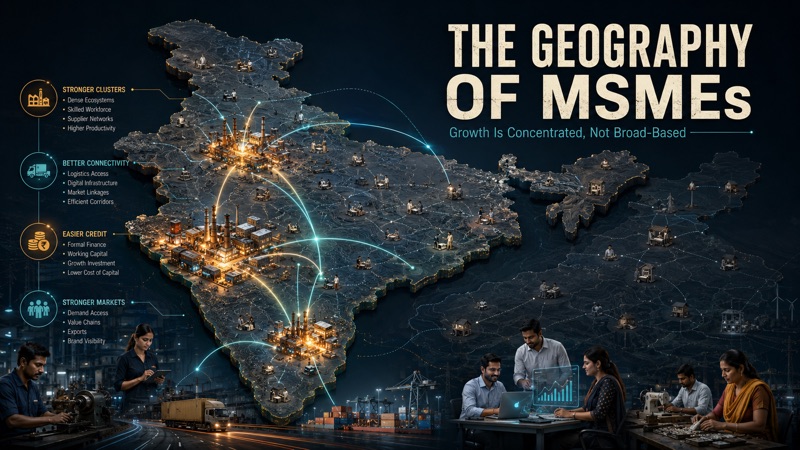
 India often describes the growth of its micro, small and medium enterprises through impressive national totals. More registrations, more loans and more enterprises are presented as signs that entrepreneurship is spreading across the country. Yet national averages hide a more uncomfortable geography. MSMEs may be present almost everywhere, but productive enterprise ecosystems are not. Industrial capability, formal credit, specialised skills, reliable infrastructure and access to large buyers remain concentrated in a relatively small number of states, districts and urban corridors.
The geographic and sectoral analysis published by Debopam Chaudhuri, Surbi Mantri and Parnika Gupta of the Piramal Group in June 2026 draws attention to this difference. Based on official and financial-sector data, it suggests that enterprise numbers alone do not demonstrate balanced industrialisation. Several regions may report a large number of businesses while still lacking the credit, markets and institutions required to convert those businesses into productive and scalable enterprises. Even within relatively successful states, economic activity can remain heavily concentrated in a few districts. India, therefore, does not merely have an inter-state MSME divide. It has a deeper district-level divide hidden beneath state-level success.
From Industrial Corridors to Islands of Capability
This concentration is not historically accidental. India’s industrial geography developed around port cities, railway junctions, administrative centres, raw-material locations and early public investment. Mumbai, Ahmedabad, Kolkata, Chennai and Kanpur emerged as industrial centres because capital, transport, labour and markets came together in these places. After Independence, industrial estates, development finance institutions and public-sector investments attempted to spread manufacturing into less-developed regions. However, many investments created factories without creating complete ecosystems around them.
Economic liberalisation intensified a different pattern. Regions that already possessed suppliers, banks, technical institutions, export connections and entrepreneurial networks were able to respond faster to new market opportunities. Bengaluru could build on engineering and research capabilities. Pune benefited from automotive and manufacturing depth. Tiruppur developed a dense network of specialised garment enterprises. Surat combined entrepreneurship, trading networks and rapid production systems. Noida and Gurugram gained from their proximity to Delhi, infrastructure and large corporate markets.
Success consequently became cumulative. Enterprises attracted suppliers, skilled workers and financial institutions. These, in turn, attracted more enterprises. Less-developed regions faced the opposite cycle. Weak markets discouraged investment, limited investment restricted employment, and poor employment prospects encouraged skilled people to migrate. India’s industrial map gradually became a collection of high-capability islands surrounded by much larger territories of shallow enterprise activity.
Registration Is Not Industrialisation
The rapid expansion of formal MSME registration is an important administrative achievement, but registration must not be confused with productive transformation. A registered enterprise may still be extremely small, technologically weak, dependent on local demand and unable to access formal credit. It may exist on a government database without participating meaningfully in a supply chain.
This distinction matters because enterprise numbers can create a misleading impression of geographic inclusion. A district may contain thousands of registered businesses, but if most are survival-oriented establishments with low investment and limited market reach, it does not necessarily possess an industrial ecosystem. Productive ecosystems require relationships: firms linked to buyers, producers linked to testing facilities, workers linked to training institutions, and enterprises linked to finance, technology and logistics.
Enterprise density must therefore be interpreted alongside productivity, employment quality, market access, investment intensity and institutional capability. Otherwise, policy may reward the appearance of entrepreneurship while overlooking the conditions that allow enterprises to grow.
The Credit Map Follows Confidence
Credit concentration is often treated as evidence that banks are neglecting certain regions. This can be partly true. Financial institutions frequently prefer established industrial districts because information is easier to obtain, collateral values are clearer and business risks appear more predictable. A lender in a mature cluster can assess an enterprise through its buyers, suppliers, production history and local reputation. In a weak ecosystem, even a capable entrepreneur can appear risky because the surrounding economic environment provides fewer signals of reliability.
But the relationship between credit and regional performance is not one-directional. Low credit may constrain enterprise growth, yet weak enterprise performance may also discourage lending. The available descriptive evidence cannot conclusively determine which force dominates. This is an important limitation. It would be too simple to assume that raising loan volumes alone will generate productive clusters.
Credit policy must move beyond numerical disbursement targets. A district receiving more loans is not necessarily becoming more competitive if the finance supports consumption, working-capital distress or fragmented low-productivity activity. Regional credit benchmarks should consider whether finance improves technology, product quality, energy efficiency, market access and enterprise survival. The real question is not merely how much credit enters a region, but what productive capability it creates.
The District Matters More Than the State
State-level statistics can conceal extraordinary internal inequality. A state may appear industrially successful because a handful of districts generate most of its manufacturing, exports and formal credit. The remaining districts may contribute little beyond registrations and informal employment. Policy framed only at the state level therefore risks directing additional resources towards already-advantaged locations while calling the outcome regional development.
The district—or, more accurately, the functional economic region—should become the central unit of MSME strategy. Administrative boundaries do not always reflect how enterprises actually operate. A production network may cross several districts, while a large district may contain disconnected local economies. Planning must identify real flows of labour, inputs, knowledge, finance and goods.
This requires a new generation of district economic maps. Such maps should not merely count enterprises. They should identify anchor buyers, supplier relationships, skill bases, logistics costs, available land, testing facilities, technology gaps and market destinations. Without this intelligence, industrial policy will continue to distribute schemes without understanding economic systems.
The New-Cluster Announcement Trap
India has frequently used cluster development as a tool for MSME promotion. Properly designed clusters can reduce shared costs, support specialisation and create collective institutions. But a cluster cannot be manufactured simply by announcing one. A common facility centre surrounded by weak enterprises, limited demand and poor institutional coordination can quickly become an underused asset.
Before declaring a new cluster, policymakers should establish whether the location has sufficient entrepreneurial density, production capability, buyer demand and potential for inter-firm cooperation. Some regions may require basic enterprise development before physical cluster infrastructure. Others may need logistics, design support, quality certification or working capital rather than another industrial estate.
This does not mean that policy should invest only in already-successful regions. That would deepen concentration. It means that investments in lagging regions must follow a realistic sequence. A region without established firms may first need market-linked entrepreneurship programmes, supplier-development partnerships and institutional capacity. Physical infrastructure should follow credible economic opportunity—not substitute for it.
From Equal Distribution to Intelligent Regional Balancing
Balanced development does not mean giving every district an identical industrial park, credit target or subsidy package. Different regions possess different combinations of resources, skills and market access. Uniform distribution can waste public money while producing little economic transformation.
A more intelligent approach would distinguish between three types of regions. Mature clusters need technological upgrading, export diversification and decarbonisation. Emerging regions need stronger buyer connections, specialised skills, finance and quality infrastructure. Economically thin regions may require foundational investments in connectivity, entrepreneurship and institutional capability before conventional cluster interventions become viable.
Public policy must also recognise that not every district should attempt to manufacture everything. Specialisation should emerge from credible capabilities and future market opportunities. The objective is not to reproduce Tiruppur, Pune or Surat in every location. It is to help each region identify productive functions that it can realistically perform within wider national and global value chains.
The Future Risk: Digital Concentration
Technology is often expected to eliminate geographic disadvantage, but it may initially strengthen successful regions. Artificial intelligence, advanced manufacturing, digital finance and data-driven logistics reward places that already possess skilled workers, reliable infrastructure and sophisticated enterprises. Digital platforms may connect remote businesses to customers, yet visibility without quality, fulfilment capability and working capital rarely produces durable competitiveness.
India could therefore experience a new form of industrial concentration: digital access becoming widespread while productive gains remain geographically narrow. Less-developed districts may become consumers of technology created elsewhere rather than producers within the emerging economy. Their skilled young people may participate remotely, but the firms, intellectual property and high-value employment may continue to accumulate in established centres.
The next phase of cluster policy must consequently build local technological absorptive capacity. Small firms need more than software subscriptions. They need trusted institutions that can help them reorganise production, train workers, manage data, meet standards and negotiate with larger buyers.
Broad-Based Growth Requires Ecosystems, Not Statistics
The central lesson is simple but disruptive: the presence of enterprises is not the same as the presence of an enterprise ecosystem. Registrations show that economic actors exist. Credit data show that financial transactions are occurring. Neither measure, by itself, proves that firms are productive, innovative or capable of sustained growth.
India must stop treating MSME development as the arithmetic expansion of registrations, loans and schemes. The more difficult task is to build economic relationships in places where they are currently weak. This means connecting entrepreneurs to buyers, finance to capability, infrastructure to actual demand and cluster institutions to measurable productivity.
The geography of Indian growth will not become balanced merely because more businesses appear on a national portal. It will become balanced when enterprises in presently underserved districts can acquire technology, attract skilled workers, obtain appropriate finance and sell competitively beyond their immediate locality. Until then, India may continue to report broad-based entrepreneurship while its productive economy remains concentrated in a few powerful corridors. The future of MSME policy lies in closing this gap between statistical presence and economic power.
#MSME #ClusterDevelopment #RegionalDevelopment #IndustrialPolicy #IndiaGrowth




No comments:
Post a Comment