 India has spent decades telling small businesses to become competitive. Perhaps it is finally beginning to ask a more uncomfortable question: competitive against what?
An MSME can manufacture a good product, employ skilled workers, obtain orders and deliver on time, yet still fail because somebody else does not pay it on time. This is one of the strange realities of Indian enterprise. The entrepreneur carries the risk of production while the buyer often enjoys the power of delaying payment.
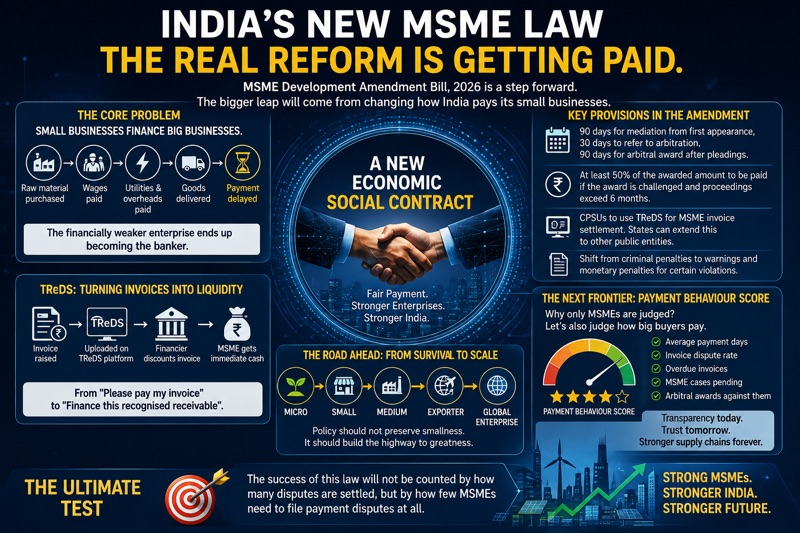
The recently passed Micro, Small and Medium Enterprises Development Amendment Bill, 2026 tries to change part of this equation. Parliament cleared the Bill in August 2026, almost exactly twenty years after the MSMED Act of 2006 created the basic legislative architecture for the sector. The new legislation strengthens the delayed-payment framework, introduces tighter timelines for dispute resolution, expands the role of digital systems and moves some regulatory violations away from criminal-style treatment towards graded monetary penalties. (PRS Legislative Research)
The amendment is important. But its real test will not be whether India has created a better MSME law. Its test will be whether a small entrepreneur becomes less afraid of selling to a powerful buyer.
The Real MSME Problem Was Never Only Credit
For decades, Indian MSME policy has largely revolved around one assumption: small businesses suffer because they cannot obtain enough finance.
That is true, but incomplete.
Many MSMEs need loans because money already earned by them is trapped somewhere else.
Imagine a small engineering company supplying components worth ₹20 lakh to a large organisation. It has already purchased steel, paid electricity bills, paid wages, transported the components and possibly borrowed working capital to manufacture them. Once the product is delivered, the economic risk should largely move to the buyer.
Instead, if payment is delayed, the supplier effectively becomes the financier of the buyer.
This creates one of the most perverse structures in Indian business: the financially weaker enterprise can end up financing the financially stronger enterprise.
The new amendment should therefore be understood not simply as an MSME welfare measure. It is an attempt to change the economics of working capital.
From 2006 to 2026: Twenty Years Reveal the Difference Between Having a Right and Being Able to Use It
The MSMED Act of 2006 was itself a landmark because it created a dedicated legal framework for micro, small and medium enterprises and established protections concerning delayed payments.
But legislation does not automatically equal bargaining power.
A small supplier may legally be entitled to timely payment and still hesitate to challenge its largest customer. The reason is simple. The customer who owes yesterday’s payment may also control tomorrow’s order.
This is where conventional policy thinking often misunderstands MSMEs. It assumes that two businesses entering a commercial transaction are approximately equal economic actors.
They frequently are not.
A ₹5 crore supplier negotiating with a ₹5,000 crore buyer may have contractual rights but very little commercial power. Taking legal action can recover one invoice while potentially destroying a business relationship representing years of future orders.
Therefore delayed payment is not merely a legal problem.
It is a power problem inside the supply chain.
And that distinction matters enormously.
TReDS Could Become More Important Than Another Credit Scheme
One of the strongest elements of the new framework is the requirement that Central Public Sector Enterprises settle MSME procurement invoices through the Trade Receivables Discounting System, or TReDS. The law also enables governments to extend such requirements to other public entities. (PRS Legislative Research)
This may sound technical. Economically, it could be transformational.
TReDS converts an invoice into something closer to a financial asset. Instead of an MSME waiting passively for a buyer to release payment, financiers can provide liquidity against an accepted receivable.
That changes the conversation from please pay my invoice to finance this recognised receivable.
The government had already moved in this direction in June 2026 by mandating that operating Central Public Sector Enterprises route settlement of MSME invoices through RBI-authorised TReDS platforms. (Press Information Bureau)
But India should go much further.
The future should be a national digital receivables architecture in which every significant invoice raised by a registered MSME against a large corporate or government buyer becomes digitally visible, timestamped and financeable.
Banks should not need to ask a small manufacturer for endless collateral when the financial system can see that a credible buyer owes that manufacturer money.
In the long run, invoice history itself should become part of MSME creditworthiness.
The 90-Day Revolution Will Depend on Whether Ninety Days Actually Means Ninety Days
The amendment introduces important timelines. Mediation is to be completed within 90 days from the first appearance. If mediation fails, referral to arbitration must occur within 30 days, while an arbitral award is to be made within 90 days after completion of pleadings. (PRS Legislative Research)
These numbers matter because uncertainty has a cost.
A ₹10 lakh payment recovered after three years is economically very different from ₹10 lakh recovered after three months. During those three years, machinery may remain unpurchased, workers may leave, bank interest accumulates and the entrepreneur’s attention shifts from building the business to chasing old money.
The amendment also strengthens protection when awards are challenged. Where proceedings for setting aside an award remain pending beyond six months, at least 50 per cent of the awarded amount is to be paid to the MSME supplier. (PRS Legislative Research)
This attacks a familiar weakness in commercial justice: delay itself can become a negotiating weapon.
But here lies the danger.
India has repeatedly created statutory timelines that gradually become administrative aspirations.
If Facilitation Councils are understaffed, digital systems fragmented, mediators insufficient and enforcement weak, ninety days can quietly become nine hundred days.
The reform therefore needs institutional capacity as much as legislative language.
Decriminalisation Is Sensible, But Trust Must Work in Both Directions
Another significant change is the movement towards graded penalties and warnings for certain violations rather than treating every compliance failure through a punitive framework. For example, specified registration-related violations can first attract a warning, followed by monetary penalties for subsequent contraventions. (PRS Legislative Research)
This reflects a broader evolution in Indian economic governance.
For decades, regulation often began with suspicion. The entrepreneur had to prove that he was not violating something.
A modern economy needs a different principle: regulate serious wrongdoing strongly, but do not criminalise ordinary business mistakes unnecessarily.
Yet trust-based regulation cannot mean trust only for the enterprise.
MSMEs must also be able to trust government portals, procurement agencies, banks, large buyers and dispute-resolution institutions.
Ease of doing business is ultimately not the number of forms removed. It is the amount of uncertainty removed.
The Numbers Reveal Why This Reform Matters
The scale of the sector makes the issue far larger than small-business policy. The Ministry of MSME’s 2025–26 Annual Report says the sector contributes around 31.1 per cent of India’s GDP and more than 48.5 per cent of exports. (MSME Official)
Government registration data also illustrate the enormous scale of formalisation. By late July 2026, the MSME dashboard showed close to nine crore registrations through Udyam and the Udyam Assist Platform, overwhelmingly classified as micro enterprises. (MSME Dashboard)
This produces an uncomfortable policy question.
If India has millions upon millions of enterprises, why does it still have relatively few globally scaled firms?
Perhaps the problem is not entrepreneurship.
Perhaps the problem is graduation.
India is exceptionally good at creating small firms but much less successful at helping small firms become medium firms, and medium firms become internationally competitive companies.
Payment reform helps survival. It does not automatically create scale.
The Missing Reform: Protect the Small Firm Without Encouraging It to Remain Small
This is where the new law needs to become the beginning rather than the conclusion of MSME reform.
India’s future industrial policy cannot permanently revolve around protecting smallness.
The objective should be to make small firms stronger enough that they eventually stop needing protection.
That requires a graduation architecture connecting finance, technology, productivity, digitalisation, quality certification, design, exports, skills and cluster infrastructure.
An enterprise entering the MSME ecosystem should be able to see a pathway:
Micro → Small → Medium → Exporter → Global Supplier.
Today these transitions remain too difficult.
A firm may receive assistance because it is small but discover that becoming larger brings new compliance obligations, greater taxation exposure, more formal labour requirements and higher institutional scrutiny.
The hidden message can therefore become contradictory: grow, but do not cross the line.
That is economically dangerous.
The Next Frontier Should Be Buyer Behaviour
For years India has collected enormous amounts of information about MSMEs.
The next stage should collect better information about those who buy from MSMEs.
Imagine a future digital procurement ecosystem where large companies and public institutions have a Payment Behaviour Score.
How quickly do they accept invoices?
How frequently do they dispute them?
What is their median payment period?
How many MSME claims are pending against them?
How often have arbitral awards been issued against them?
Suddenly transparency would move in both directions.
Today banks assess whether an MSME is creditworthy.
Tomorrow markets should also assess whether a buyer is MSME-worthy.
That could change payment culture more effectively than thousands of individual recovery cases.
Artificial Intelligence Could Make the Law Much More Powerful
By 2030, MSME protection should not depend mainly on entrepreneurs filing complaints after damage has occurred.
Digital systems could detect abnormal payment behaviour automatically.
If thousands of invoices from suppliers to the same corporation begin crossing payment thresholds, algorithms could identify systemic stress before businesses collapse.
TReDS, GST data, Udyam information, procurement platforms and banking information, subject to appropriate privacy and governance safeguards, could eventually create an early-warning system for MSME financial stress.
The philosophy would change from dispute resolution to dispute prevention.
That would be the genuinely futuristic version of this reform.
But There Is One Serious Institutional Risk
The Bill creates stronger administrative machinery, including a role for the Development Commissioner in adjudication and appeals within the MSME administrative framework. (PRS Legislative Research)
More institutional capacity can help.
But India must be careful not to solve an administrative problem by creating another administrative layer.
Every new authority should therefore be judged by one question:
Does it reduce the entrepreneur’s transaction cost or merely move the entrepreneur from one government desk to another?
The most successful MSME institution of the future may actually be the one the entrepreneur barely notices because data moves automatically, invoices are recognised automatically, finance becomes available automatically and disputes are resolved digitally.
The Most Radical MSME Policy May Be Simply Paying Small Businesses on Time
Governments often announce credit schemes, subsidies, guarantees, technology programmes and export incentives for MSMEs.
All have their place.
But there is something slightly absurd about lending an entrepreneur more money because somebody has failed to pay the entrepreneur money already earned.
Before creating another loan scheme, another subsidy or another portal, India should perfect something much simpler:
Make the economic system pay small enterprises on time.
The MSME Development Amendment Bill, 2026 is important precisely because it moves closer to this basic principle.
But legislation alone cannot correct decades of unequal bargaining power.
The deeper reform must transform India’s small-business ecosystem from one based on applications, concessions and grievance filing into one based on predictable cash flow, enforceable contracts, digital trust and enterprise growth.
India does not need MSMEs that remain permanently dependent on MSME policy.
It needs small businesses capable of becoming large businesses.
That should be the ultimate measure of this amendment.
The success of the new MSME law should therefore not be counted by how many disputes the system settles. It should eventually be measured by how few payment disputes MSMEs need to file at all.
#MSME #MSMEIndia #IndianEconomy #SmallBusiness #Entrepreneurship #Manufacturing #TReDS #MakeInIndia #IndustrialDevelopment #EconomicReforms #India




No comments:
Post a Comment