Friday, January 9, 2026

When a Teacher Becomes a Cab Driver: A Structural Signal from India’s Economy

In contemporary India, the sight of a trained schoolteacher driving a cab is no longer an anecdote meant to shock; it is a structural signal. It reflects not an individual failure, but a deeper transformation in the way the Indian economy creates, allocates, and values work. At a time when the country officially acknowledges a shortage of nearly a million teachers across public schools, thousands of qualified educators find themselves locked out of classrooms and pulled into the gig economy, navigating cities instead of shaping young minds. This paradox sits at the heart of India’s current employment crisis.

Historically, teaching in India was a classic avenue of social mobility. It was stable, respected, and tied closely to the expanding welfare role of the state after Independence. The post-1990 liberalization period altered this trajectory. While demand for education expanded rapidly—through population growth, rising aspirations, and private schooling—the structure of employment within education did not keep pace. Public sector hiring slowed due to fiscal constraints, bureaucratic bottlenecks, and policy uncertainty. Private schools proliferated, but often with low pay, contractual appointments, and limited job security. The result is a surplus of trained teachers competing for a shrinking pool of dignified teaching jobs.

At the same time, India’s broader economic transformation has been marked by what economists describe as “jobless growth.” Services dominate GDP, but they generate fewer stable jobs than expected. Manufacturing, which historically absorbs semi-skilled and educated labor in large numbers, has underperformed relative to India’s workforce expansion. The education system continues to produce graduates—teachers included—at a faster pace than the formal economy can absorb them. This mismatch pushes qualified individuals into informal or semi-formal work, not because it matches their skills, but because it offers immediate income.

The gig economy enters precisely at this fault line. Platform-based work such as cab driving, food delivery, or online tutoring requires low entry barriers, flexible hours, and minimal credential screening. For an unemployed teacher facing loan repayments, family responsibilities, or prolonged recruitment delays, driving a cab becomes a rational short-term choice. Yet when such “temporary” adjustments become permanent for large sections of the workforce, they indicate structural underemployment rather than flexibility. Skills accumulated over years of training depreciate, professional identities erode, and productivity losses quietly accumulate in the economy.

This phenomenon also reflects a deeper reordering of risk. In earlier decades, the state absorbed employment risk through permanent jobs. Today, risk is shifted onto individuals. A teacher without a posting bears the cost of waiting; a cab driver absorbs fuel price volatility, platform commissions, and demand uncertainty. While the economy appears dynamic on the surface, it is increasingly characterized by precarious livelihoods beneath.

India is not alone in facing this contradiction. Globally, similar patterns have emerged wherever higher education expanded faster than suitable employment. In parts of North Africa and the Middle East, university graduates have long driven taxis or worked in informal trade due to weak private sectors. In developed economies, immigrant academics and even local teachers often supplement incomes through ride-hailing platforms. What distinguishes India is the scale: a young population, rapid educational expansion, and limited high-quality job creation converging simultaneously.

Looking ahead, the long-term implications are serious. Persistent educated underemployment can weaken faith in education itself, distort career incentives, and deepen inequality between those who access elite institutions and those who do not. It can also fuel social frustration, as aspirations collide with economic reality. From a growth perspective, the economy loses twice—first by failing to use trained human capital productively, and second by normalizing low-productivity work as a substitute for structural reform.

The teacher-turned-cab-driver is therefore not merely a story of personal resilience; it is a mirror held up to India’s development model. Addressing this challenge requires more than gig-economy absorption. It demands synchronized reforms in public hiring, education quality and planning, labor-intensive manufacturing, and service sectors capable of generating dignified, skill-appropriate employment. Without such alignment, India risks becoming an economy where degrees multiply, but destinies shrink—where classrooms train minds that the labor market has no place for, except behind a steering wheel.#EducatedUnemployment
#JoblessGrowth
#SkillMismatch
#Underemployment
#GigEconomy
#StructuralTransformation
#LabourMarketShift
#HumanCapitalWaste
#PrecariousWork
#YouthEmploymentCrisis

Wednesday, January 7, 2026

Technology, IPR, and the Future of Developing Economies

From the steam engine to semiconductors and now artificial intelligence, the history of economic development has always been intertwined with control over technology. In earlier industrial revolutions, technology diffusion occurred slowly and often informally, allowing latecomers to imitate, adapt, and eventually innovate. In the twenty-first century, however, innovation is increasingly locked behind formal intellectual property rights (IPR) regimes. This shift fundamentally alters how developing economies access technology, build capabilities, and position themselves in global value chains.

At its core, IPR represents a trade-off. Strong protection rewards innovation and reduces uncertainty for investors, while weak protection lowers barriers to imitation and diffusion. For developing economies, the challenge is not whether IPR matters, but how it is designed, sequenced, and enforced in an era dominated by data-driven technologies, platform monopolies, and frontier sciences such as AI and biotechnology.

IPR as an Engine of Growth—and Concentration


Over the last two decades, stronger IPR frameworks in parts of Asia have coincided with rising foreign direct investment, expanding patent filings, and the emergence of domestic R&D ecosystems. Countries such as India, China, and several ASEAN economies have used patent systems to signal credibility, attract multinational firms, and stimulate local innovation. The result has been rapid scaling in electronics, pharmaceuticals, and increasingly, digital technologies.

Yet the same mechanisms that reward innovation also concentrate power. Patent portfolios in AI, semiconductors, and biotech are becoming deeper, broader, and more strategically defensive. Large firms are no longer protecting single inventions; they are fencing entire technological pathways. For developing economies, this raises the cost of entry. Innovation shifts from imitation-led learning to capital-intensive research, sophisticated legal expertise, and access to global patent pools—resources that are unevenly distributed.

Structural Challenges in the Age of AI and Biotech


The next wave of technological change intensifies these tensions. Artificial intelligence thrives on data, compute power, and proprietary algorithms, all of which are increasingly protected through a mix of patents, trade secrets, and platform control. Unlike earlier manufacturing technologies, AI does not diffuse easily through reverse engineering. This creates a risk that developing economies remain users rather than producers of frontier technologies, locked into dependent roles in global digital ecosystems.

Biotechnology poses a parallel challenge. Patents on genetic materials, vaccines, and agricultural inputs can dramatically improve productivity and health outcomes, but they also raise ethical and economic concerns around access. High licensing costs, restrictive terms, and limited local manufacturing capacity can delay diffusion precisely where social returns are highest. Without careful policy design, IPR can deepen inequality—both between countries and within them.


TRIPS Flexibilities: Policy Space That Still Matters


Recognizing these risks, the global IPR framework does contain built-in flexibilities. The TRIPS agreement allows for compulsory licensing, transition periods for least-developed countries, and tailored implementation aligned with development priorities. Historically, these tools have played a crucial role in expanding access to essential medicines and supporting nascent industries.


The strategic importance of these flexibilities is growing, not shrinking. As patent activity accelerates in AI, climate technologies, and life sciences, developing economies face pressure to adopt “TRIPS-plus” standards through trade agreements. How governments use existing policy space—whether to encourage technology transfer, protect biodiversity, or support public interest innovation—will shape long-term development trajectories. The debate is no longer legalistic; it is fundamentally economic and geopolitical.

A Futuristic Outlook: Divergence or Strategic Catch-Up?


Looking ahead, technology IPR will be a decisive fault line in the global economy. One path leads to deeper divergence, where a handful of countries dominate frontier innovation while others remain structurally dependent. This outcome is plausible if IPR regimes become increasingly rigid, enforcement asymmetries persist, and collaborative innovation remains limited.


The alternative path is strategic catch-up. Middle-income economies that invest in domestic research, strengthen enforcement selectively, and actively use TRIPS flexibilities can still carve out space in emerging technologies. Evidence already suggests that targeted reforms, public-private research partnerships, and regional innovation ecosystems can accelerate learning even under strong IPR regimes.


In the long run, the question is not whether IPR protects innovation, but whose innovation it protects and at what stage of development. For developing economies, the future will depend on aligning IPR policy with industrial strategy, human capital formation, and digital infrastructure. If done well, technology IPR can become a bridge to inclusive growth. If done poorly, it risks becoming a new form of economic enclosure—one that defines global inequality in the age of algorithms and genes.


#TechnologyIPR

#DevelopingEconomies

#InnovationPolicy

#ArtificialIntelligence

#Biotechnology

#TRIPSFlexibilities

#TechnologyTransfer

#GlobalValueChains

#DigitalDivide

#InclusiveGrowth

Tuesday, January 6, 2026

Technology at the Edge of Survival: Climate Repair and the Reinvention of Medicine

Throughout history, humanity has turned to technology most urgently when confronted with existential threats. The steam engine answered scarcity of labor, antibiotics confronted mass mortality, and digital networks reorganized global production. Today, climate instability and biological limits to human health represent a new dual crisis—one planetary, the other deeply personal. Emerging technologies are increasingly positioned not merely as tools of efficiency, but as instruments of survival. Their promise is transformative, but so are the risks embedded in their scale, speed, and political misuse.

Re-engineering the Planetary System

Decarbonization has entered a phase where incremental efficiency gains are no longer enough. The most stubborn emissions come from sectors built on physics that resist easy substitution—steel, cement, shipping, aviation. Here, green hydrogen and carbon capture have emerged not as silver bullets, but as structural reinforcements for an economy that cannot simply switch off fossil fuels overnight. Hydrogen made from renewable electricity offers a pathway to zero-carbon industrial heat, while carbon capture acts as a containment strategy for legacy systems that will persist for decades.

Parallel to this is the quiet revolution in grid-scale energy storage. Solar and wind have already won the cost battle; reliability is now the frontier. Large-format lithium-ion batteries, alongside sodium-ion and iron-air chemistries, are turning electricity into a time-shiftable commodity. This fundamentally changes power economics: energy is no longer just generated, it is banked. The grid begins to behave less like a fragile pipeline and more like a resilient financial system with buffers and reserves.

More controversial interventions signal how desperate the climate equation has become. Solar geoengineering—reflecting a fraction of sunlight back into space—resembles a planetary emergency brake. Its attraction lies in speed; its danger lies in asymmetry. Temperature could fall rapidly, but rainfall patterns, ecosystems, and geopolitical trust could fracture just as fast. It is a reminder that technological capability does not automatically translate into moral legitimacy.

Meanwhile, nuclear fusion has shifted from a state-driven scientific dream to a venture-capital-fueled engineering race. Private fusion projects promise abundant, carbon-free baseload power—the kind of energy density that could support electrified industry, desalination, and AI infrastructure simultaneously. If even one reaches commercial viability, it would represent not just an energy transition, but an energy regime change.

China’s push into the low-altitude economy—drones, autonomous air mobility, and aerial logistics—illustrates how climate and efficiency goals are merging with urban redesign. Short-range electric flight is not about glamour; it is about reducing congestion, optimizing delivery, and compressing urban energy use. Transport is being reimagined vertically, not just horizontally.

Medicine Rewritten by Algorithms and Molecules

If climate technology seeks to stabilize the external environment, medical technology is rewriting the internal one. For decades, pharmaceutical innovation has suffered from a paradox: more data, higher costs, slower breakthroughs. Artificial intelligence is now disrupting this trajectory by attacking the root cause—decision failure. Instead of testing thousands of molecules blindly, AI systems model disease pathways, predict molecular behavior, and eliminate dead ends before human trials begin. The effect is not incremental efficiency but structural acceleration, with the realistic prospect of doubling R&D productivity.

This computational turn converges with advances in mRNA technology, enabling medicine to move from population averages to individual biology. Personalized cancer vaccines exemplify this shift. By decoding the unique mutations in a patient’s tumor and training the immune system to recognize them, treatment becomes adaptive rather than standardized. Medicine begins to behave like software—iterative, customized, and responsive.

Demography adds another layer of urgency. Aging populations are no longer a future concern; they are a present economic constraint. The emerging silver economy blends smart diagnostics, remote monitoring, and preventive therapeutics to extend not just lifespan, but functional independence. Healthcare is shifting from episodic intervention to continuous management, from hospitals to homes, from cure to resilience.

Interdependence, Power, and the Risk of Technological Overconfidence

What binds these climate and health technologies together is not innovation alone, but interdependence. AI-driven drug discovery requires vast data centers; those data centers require stable, low-carbon power; that power increasingly points back to nuclear and advanced grids. The system is circular, not linear. Weakness in one node cascades across others.

This interdependence also exposes risk. High capital costs concentrate control in a few corporate and national hands. Data scarcity and algorithmic opacity threaten equity and accountability. Most dangerously, the existence of technological “fixes” may tempt governments to delay politically difficult emissions reductions or public health reforms, outsourcing responsibility to machines that cannot govern themselves.

The deeper lesson is historical. Technology has always amplified human intent more than it has corrected human judgment. These emerging systems are best understood not as saviors, but as force multipliers. They can extend human reach, compress time, and manage complexity—but only within frameworks of restraint, ethics, and collective governance.

If climate breakdown and health crises are a rapidly spreading fire, emerging technologies resemble intelligent detection systems and automated suppression tools. They sense faster, act sooner, and scale wider than human hands ever could. But without disciplined operators, reliable power, and clear rules of engagement, even the most advanced systems can misfire. The future, therefore, is not a choice between technology and restraint—it is the hard work of mastering both at once.

#ClimateTech
#GreenHydrogen
#EnergyStorage
#NuclearFusion
#SolarGeoengineering
#AIDrugDiscovery
#PersonalizedMedicine
#mRNATherapies
#SilverEconomy
#TechRisk

Monday, January 5, 2026

Carbon Rules Are Redrawing the Industrial Map

For much of modern economic history, factories were built where land was cheap, labour abundant, and logistics convenient. Environmental regulations were treated as local irritants—costly but manageable. That logic is now breaking down. With the emergence of CBAM-style mechanisms, green public procurement norms, and private-sector carbon disclosure mandates, carbon intensity is no longer a peripheral compliance issue; it is fast becoming a core determinant of industrial location, product design, and long-term competitiveness.

This shift marks a structural change comparable to the trade liberalisation waves of the 1990s or the China-centric supply chain expansion of the 2000s. The difference is that this time, the driver is not tariffs or wages, but embedded emissions.

From Environmental Externality to Cost Variable

Historically, carbon emissions were classic externalities—economically real but financially invisible. That invisibility allowed carbon-heavy manufacturing to flourish as long as energy was cheap and regulations uneven. CBAM-style rules fundamentally alter this equation by pricing carbon at the border, converting emissions into a measurable and monetisable cost.

What matters now is not just how efficiently a factory produces, but how cleanly it produces. A tonne of steel, cement, aluminium, or chemicals carries with it a carbon signature that increasingly determines market access, pricing power, and buyer preference. In effect, carbon intensity is becoming a shadow tariff, embedded in supply chains rather than imposed at customs desks.

Factory Location in the Age of Carbon Geography

As carbon pricing spreads across jurisdictions and procurement rules tighten, factory location decisions are being re-evaluated through a new lens: carbon geography. Proximity to low-carbon electricity—renewables, nuclear, or hydro—now rivals proximity to ports and highways. Regions with cleaner grids, reliable green power contracts, and transparent emissions accounting gain a structural advantage.

This is already reshaping industrial clustering. Instead of chasing the lowest labour cost, firms are increasingly clustering near decarbonised energy ecosystems, green hydrogen hubs, and circular-material zones. Over time, this may create a bifurcated global manufacturing system: one segment optimised for low-cost domestic markets, and another optimised for low-carbon export markets.

Product Design as a Carbon Strategy

Carbon rules are not only influencing where factories are built, but also what they produce and how products are designed. Lightweighting, modularity, recyclability, and material substitution are becoming strategic decisions rather than engineering afterthoughts. Design teams are now required to think in lifecycle terms—raw material extraction, processing, transport, usage, and end-of-life recovery.

This shift rewards firms that integrate carbon accounting early in the design stage. Products engineered for lower embedded emissions enjoy longer shelf lives in regulated markets and face fewer disruptions as standards tighten. Over time, carbon-efficient design becomes a form of intellectual property, difficult to replicate and increasingly valuable.

Green Procurement and the Power of Buyers

Government and large institutional buyers are emerging as powerful enforcers of carbon discipline. Green procurement rules—covering infrastructure, defence, transport, and public utilities—create guaranteed demand for low-carbon products. Unlike carbon taxes, which penalise behaviour, procurement rules reward compliance, accelerating industrial transformation without explicit bans.

Once large buyers move, private supply chains follow. Tier-1 suppliers pass carbon requirements downstream, forcing SMEs and component manufacturers to adapt or exit premium markets. The result is a cascading effect where carbon discipline travels through value chains, reshaping industrial ecosystems from the top down.

A Historical Parallel: Standards as Silent Trade Policy

There is a historical echo here. Just as technical standards, safety norms, and quality certifications once quietly reshaped global trade, carbon standards are now emerging as the next generation of industrial governance. Countries that set the rules shape markets without overt protectionism; countries that fail to adapt risk being locked into low-value, high-emission segments of global production.

The critical difference is speed. Climate timelines compress adjustment windows. Unlike earlier regulatory shifts, firms have less time to amortise old assets or relocate gradually. This raises the risk of stranded industrial capacity and uneven development, particularly for late-industrialising economies.

The Futuristic Outlook: Carbon as Industrial Strategy

Looking ahead, carbon rules will increasingly blur the line between climate policy and industrial policy. Nations that align decarbonisation with manufacturing competitiveness—through grid reform, green finance, and emissions-linked incentives—will attract the next wave of investment. Those that treat carbon rules as external impositions will struggle with declining export relevance.

In this emerging order, carbon efficiency is not a moral advantage; it is an economic one. The factory of the future will be judged not just by output and cost, but by its emissions profile, data transparency, and adaptability to tightening rules. Industrial success will depend less on scale alone and more on carbon intelligence embedded across design, production, and logistics.

The quiet truth is this: carbon rules are not ending industrialisation—they are redefining it. And the map of global manufacturing is being redrawn accordingly.

#CarbonCompetitiveness #CBAM #GreenManufacturing #IndustrialLocation #EmbeddedEmissions #GreenProcurement #LowCarbonSupplyChains #ProductDesign #CarbonPricing #FutureIndustry

Review of Pradhan Mantri Kaushal Vikas Yojana (PMKVY) i

Pradhan Mantri Kaushal Vikas Yojana (PMKVY) has been the flagship skill-development intervention of the Government of India since 2015, designed to address the persistent mismatch between education, skills, and employability. With multiple phases rolled out over nearly a decade, PMKVY has undeniably built a nationwide skilling infrastructure and brought skill training into the mainstream policy discourse. However, the latest Performance Audit by the Comptroller and Auditor General of India (CAG) offers a sobering assessment of how far the scheme has fallen short of its core objective—creating sustainable, demand-linked employment.

Scale without commensurate outcomes

The most striking feature of PMKVY is its scale. Over successive phases, the scheme certified more than a crore candidates and absorbed thousands of training partners into a common skilling framework. From a supply-side perspective, PMKVY succeeded in rapidly expanding training capacity and standardising qualification packs and assessments. Yet, the CAG audit makes it clear that this quantitative expansion was not matched by qualitative labour-market outcomes. Certification became the dominant metric of success, while indicators such as job quality, employment duration, income stability, and productivity gains remained weakly tracked or altogether absent.

Weak planning and poor demand alignment

A central criticism in the CAG report relates to planning. PMKVY was implemented without a robust, periodically updated national or district-level skill development plan. Training targets and job roles were often finalised without granular skill-gap analysis or credible forecasting of sectoral and regional demand. As a result, the composition of training frequently diverged from projected employment needs, particularly in labour-intensive sectors such as construction, logistics, and local services. This planning deficit meant that even well-trained candidates often entered labour markets with limited absorption capacity, undermining the employability promise of the scheme.

Fragmentation and lack of convergence

The audit also highlights the broader institutional weakness of India’s skilling ecosystem—namely, poor convergence. Skill development activities continue to be spread across multiple ministries, state governments, and autonomous bodies, with PMKVY operating more as one scheme among many rather than as a unifying framework. Despite repeated policy statements on convergence, overlapping roles, inconsistent standards, and fragmented monitoring systems persisted. This diluted accountability and reduced the overall effectiveness of public expenditure on skilling.

Declining and uneven placement performance

Placement outcomes emerge as one of the most critical fault lines in PMKVY’s design and execution. While early phases reported moderate placement rates, PMKVY 3.0 witnessed a sharp decline. The CAG audit documents wide inter-state variation, with some states reporting reasonable placement outcomes and others showing negligible results. More concerning was the weak verification of placement data, including instances of inadequate or unreliable documentation. The heavy reliance on self-reported placement evidence and limited post-placement tracking weakened confidence in the scheme’s employment claims and exposed structural flaws in incentive design.

Monitoring and accountability gaps

PMKVY relied heavily on digital monitoring tools, particularly Aadhaar-enabled biometric attendance systems, to ensure training integrity. However, the audit reveals widespread non-compliance and post-facto relaxations, especially for Recognition of Prior Learning (RPL) components. In practice, attendance verification and training duration controls were inconsistently enforced, reducing assurance that candidates actually received the training hours prescribed. These monitoring gaps increased the risk of superficial training delivery and eroded value for public money.

RPL and employer-led skilling: promise versus practice

Recognition of Prior Learning, especially under the Best-in-Class Employer (BICE) model, was conceptually one of PMKVY’s strongest innovations. It aimed to formalise existing skills and improve labour mobility. Yet, CAG findings suggest that weak employer validation, insufficient evidence standards, and inadequate oversight diluted the credibility of RPL certifications. In several cases, the foundational assumption of a genuine employer–employee relationship was not convincingly established, turning what should have been a high-impact instrument into a volume-driven certification exercise.

Financial governance and institutional oversight

From a financial management perspective, the audit points to avoidable weaknesses rather than systemic fraud. Issues such as inconsistent accounting of interest income, excess administrative charges, and delays in transferring funds to district-level skill institutions indicate gaps in oversight and internal controls. While these may appear technical, they collectively signal governance fragility and undermine confidence in the scheme’s stewardship of public resources.

Limited local anchoring and mobilisation

Finally, PMKVY struggled to build a strong district-level skilling ecosystem. Candidate mobilisation was largely driven by training partners and informal networks rather than structured career guidance, industry outreach, or local employment mapping. Institutional mechanisms such as District Skill Committees and Skill Information Centres remained underutilised, reinforcing the perception of PMKVY as a centrally driven supply-side programme rather than a locally embedded employment strategy.

Overall assessment

In essence, PMKVY represents a classic case of ambitious scale meeting weak institutional foundations. The scheme succeeded in creating visibility for skill development and standardising training delivery, but it failed to evolve into a genuinely demand-driven labour-market instrument. The latest CAG audit underscores that without credible planning, strong convergence, rigorous monitoring, and verifiable employment outcomes, skilling risks becoming an end in itself rather than a means to productive employment. For PMKVY to fulfil its original promise, future iterations must shift decisively from counting certificates to building durable, locally anchored pathways into work.#PMKVY
#SkillDevelopment
#Employability
#CAGAudit
#LabourMarketMismatch
#PlacementOutcomes
#GovernanceReforms
#DemandDrivenSkilling
#VocationalTraining
#PublicPolicy

Sunday, January 4, 2026

Technology Is Not the Problem — Power Is

In every era of rapid technological change, society looks for a convenient villain. Today, that villain is artificial intelligence, algorithms, smartphones, and digital platforms. We speak of technology as if it has a will of its own—an unstoppable force reshaping jobs, privacy, democracy, and even human behaviour. But this framing misses the real issue.

As Timandra Harkness argues in Technology Is Not the Problem, technology itself is rarely the root cause of social harm. The deeper problem lies in how power is embedded, exercised, and concealed within technological systems.

Our Love–Hate Relationship with Technology

Modern society is deeply conflicted about technology. We rely on it for efficiency, convenience, and connection, yet we increasingly distrust it. Smartphones organise our lives, algorithms curate our choices, and automated systems make decisions that once required human judgment. At the same time, we feel watched, nudged, ranked, and profiled.

This contradiction exists because technology is often presented as neutral—an objective tool that simply optimises outcomes. In reality, every technological system reflects human priorities. What is measured, what is optimised, and what is ignored are all political and economic choices.

Algorithms Are Not Neutral Actors

One of the most dangerous myths of the digital age is that algorithms are impartial. Data is treated as truth, and automated decisions are framed as objective. But data is always selective. It reflects past behaviour, existing inequalities, and institutional biases.

When algorithms decide who gets credit, insurance, welfare benefits, or visibility online, they do not eliminate discrimination—they often scale it. Technology does not create inequality; it amplifies whatever inequality already exists in society.

Technology as a Mask for Power

Perhaps the most important insight is that technology often acts as a shield behind which responsibility disappears. Decisions once made by identifiable officials are now attributed to “the system.” Accountability becomes diffused. When something goes wrong, blame is shifted to code, models, or data rather than to the institutions that designed them.

This is not a technological failure; it is a governance failure. The problem is not automation, but the absence of democratic oversight over automated systems. When markets and states deploy technology without transparency, power becomes harder to question and easier to abuse.

Why This Matters for Economics and Policy

From an economic perspective, digital technology is accelerating concentration—of data, market power, and influence. Platform economies reward scale, lock in users, and weaken competition. Without strong institutions, technology strengthens monopolies rather than markets.

For policymakers, the challenge is not to slow innovation but to modernise regulation. The real task is to ensure that technological systems serve public goals rather than narrow private interests. This requires asking uncomfortable questions about ownership, incentives, and accountability.

Not Anti-Technology, But Pro-Human

Crucially, this is not an argument against innovation, AI, or digital transformation. It is an argument for responsibility. Technology can enhance productivity, inclusion, and governance—but only if societies consciously decide how it should be used.

The future will not be shaped by machines alone. It will be shaped by the institutions, laws, and values we embed into those machines.

A Necessary Shift in the Debate

Instead of asking whether technology is good or bad, we should ask: Who controls it?
Who benefits from it?
Who bears the risks?

Until these questions are central to public debate, blaming technology will remain an easy distraction from the real issue—unchecked power operating behind a veil of code.

Technology is not the problem.
The problem is unaccountable power disguised as progress.#Technology
#Power
#Algorithms
#Accountability
#Governance
#ArtificialIntelligence
#DigitalEconomy
#DataEthics
#Inequality
#PublicPolicy

Friday, January 2, 2026

The Meaning of India Becoming the World’s Fourth-Largest Economy

India crossing the threshold to become the world’s fourth-largest economy is not merely a statistical milestone; it is a historical signal about the direction of global economic gravity. For the first time since independence, India’s aggregate output—now exceeding four trillion dollars in nominal terms—places it decisively among the top tier of global economies, behind only the United States, China, and Germany. In raw numerical terms, it marks the overtaking of Japan, a country that symbolised post-war industrial discipline, technological excellence, and middle-class prosperity for decades.

Yet the deeper meaning of this moment lies less in the ranking itself and more in the contradictions it reveals. India’s ascent is real, but it is also uneven, fragile in places, and incomplete in its social outcomes.

From Planned Economy to Scale Economy

Historically, India’s economic journey has been one of delayed scale. For nearly four decades after independence, growth was constrained by inward-looking policies, limited capital formation, and modest productivity gains. Liberalisation in the early 1990s unlocked market forces, but for a long time India remained a “potential story” rather than a scale story.

The transition from being a lower-middle-income economy to a four-trillion-dollar economy has been driven by a combination of domestic consumption, services-led growth, financial deepening, and gradual institutional reforms. Unlike East Asian economies that relied heavily on export-led industrialisation, India’s rise has been powered disproportionately by internal demand, urbanisation, and services. This makes India’s growth structurally different—and both more resilient and more unequal.

What This Rank Truly Signals

At the global level, India’s new position signals credibility. Large economies matter not just because of output, but because scale attracts capital, technology, and geopolitical attention. Being the fourth-largest economy enhances India’s bargaining power in trade negotiations, global governance institutions, and strategic alliances. It reassures investors that India is no longer a peripheral emerging market but a core pillar of global demand growth.

For policymakers, the ranking offers political and fiscal room. Higher nominal GDP allows greater borrowing capacity, larger welfare budgets, and sustained public investment in infrastructure, defence, and digital public goods. Initiatives aimed at manufacturing expansion, logistics modernisation, and supply-chain resilience gain international legitimacy when backed by scale.

The Prosperity Paradox

However, aggregate size hides distributional weakness. India’s per-capita income remains a fraction of that in advanced economies—and even well below several smaller Asian peers. The lived experience of economic growth is therefore sharply divided. Urban professionals, large firms, technology platforms, and asset-owning households are the most visible beneficiaries of this expansion. Capital markets reflect optimism, foreign investors chase growth stories, and formal-sector wages in select industries have risen.

In contrast, a large share of India’s workforce remains informal, low-paid, and vulnerable to shocks. Manufacturing has not absorbed labour at the pace required for a country with millions entering the workforce every year. Youth unemployment and underemployment persist despite headline growth rates, creating a psychological gap between national pride and individual anxiety.

This explains a critical paradox: India is getting richer as a country, yet many Indians do not feel richer in their own lives.

Why Growth Feels Uneven

The fourth-largest-economy status reflects output, not quality of life. Public services—health, education, urban housing, and social security—have not yet reached the scale or consistency required to convert GDP growth into broad-based wellbeing. Inflation, especially in food and essential services, erodes real incomes for lower-income households. Regional disparities remain sharp, with growth concentrated in a few urban and coastal clusters.

Moreover, the nature of growth matters. Services-led expansion creates high value but limited mass employment, while capital-intensive manufacturing improves productivity without proportionate job creation. Without a sustained push into labour-absorbing industries, the benefits of scale risk remaining concentrated.

A Future Lens: What Must Change by the Next Decade

Looking forward, the real test is not whether India can climb to third place, but whether it can convert size into shared prosperity. By the early 2030s, India could plausibly become the world’s third-largest economy. But unless per-capita incomes rise faster, inequality narrows, and job creation accelerates, rankings will lose political and social meaning.

The future phase of India’s growth must therefore shift focus—from celebrating aggregate milestones to engineering inclusive outcomes. That means prioritising manufacturing depth, skilling at scale, urban governance reform, and social infrastructure that matches economic ambition. It also requires recognising that GDP rankings are not endpoints but instruments—useful only if they translate into dignity, opportunity, and security for the majority.

The Bottom Line

India becoming the world’s fourth-largest economy is a moment of national significance, but not national arrival. It confirms that India has achieved scale; it does not confirm that it has achieved prosperity. History will judge this milestone not by the rank itself, but by what India does next—whether it uses size as leverage to build an economy that is not only large, but fair, productive, and resilient.

In that sense, the fourth-place ranking is less a destination and more a warning light: growth has outrun inclusion, and the next decade will determine whether India’s economic rise becomes a shared success or a missed opportunity.#FourthLargestEconomy

#IndiaGrowthStory
#EconomicScale
#InclusiveDevelopment
#DemographicDividend
#ManufacturingTransition
#GlobalEconomicShift
#InequalityChallenge
#StructuralReforms
#FutureOfGrowth

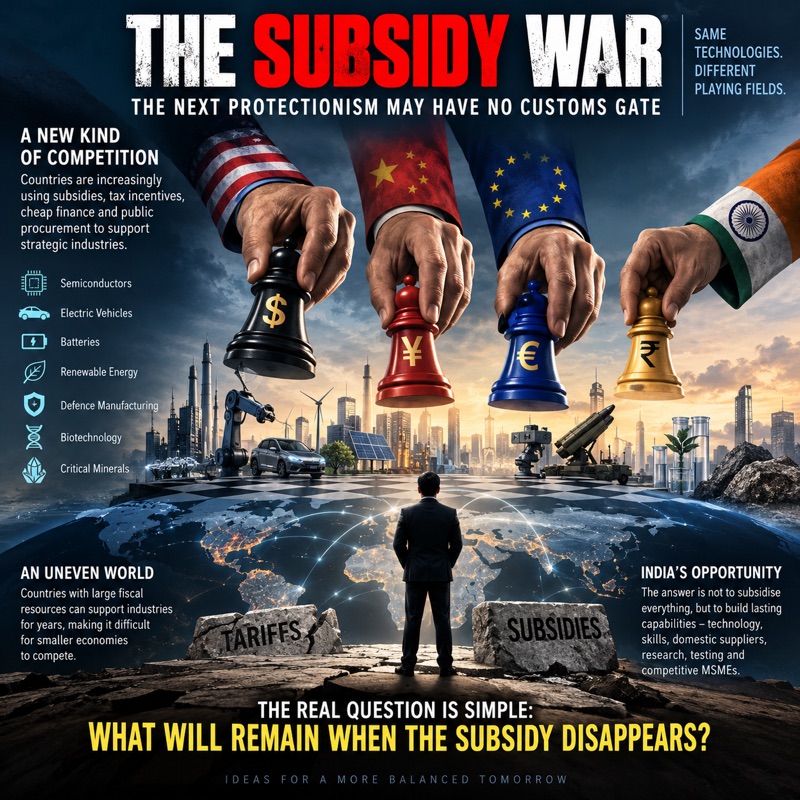
The Subsidy War: When Governments Become Competitors

For much of the last three decades, the visible face of protectionism was the tariff. Governments raised duties, imposed quotas or restricte...