Sunday, November 2, 2025

The Shape-Shifting Oil Market: Lessons for India from a World That Refuses to Slow Down

The story of the global oil market is a story of remarkable adaptability. Despite sanctions, embargoes, and the geopolitical efforts of major powers to choke certain flows, oil continues to move—sometimes through new routes, sometimes under new ownership, but almost always finding a way. History shows that energy, like water, resists containment. Today’s shifting oil networks only reaffirm that reality.

A Historical Pattern of Resilience

Oil markets have always evolved in response to political shocks. During the 1970s oil crises, supply shocks originating in OPEC decisions reshaped global alliances, forcing the West to diversify energy sources and create strategic petroleum reserves. In the 1990s, following the Gulf War, energy routes shifted again—this time favoring U.S. and European control over Middle Eastern exports.

Fast forward to the 2020s: sanctions on Russia after the Ukraine conflict were expected to isolate one of the world’s largest oil suppliers. Yet, just as history predicted, the global oil system recalibrated. Russian crude flowed to Asia at discounted rates, often rebranded or blended, while European refiners sourced alternatives from the U.S., Africa, and the Middle East. Tankers changed flags, intermediaries emerged in the shadows of trade routes, and new hubs—from Fujairah to Singapore—absorbed redirected flows.

The message was unmistakable: the world’s oil arteries never truly close; they reroute.

India’s Place in the Rewired Oil Geography

India has emerged as a strategic pivot in this global oil realignment. With one of the fastest-growing energy demands in the world and a refining capacity that ranks among the largest globally, India is both a major consumer and a refining hub for global markets.

As The Economic Times recently highlighted, India’s position in this evolving trade map is not accidental—it’s structural. While Western sanctions targeted Russian exports, India’s refiners, driven by economic logic and domestic demand, leveraged the opportunity to purchase discounted crude. This pragmatic move helped India control inflation and sustain growth at a time when other economies were battling energy-induced recessions.

But the same editorial also offered a sober warning: favorable terms may not last forever. As U.S. and European policies evolve—especially those that distinguish between crude used domestically and that exported as refined products—India could face pressure to adjust. Washington’s tolerance for indirect re-exports may narrow as global politics tighten, putting India in a position where balancing strategic autonomy with global expectations becomes crucial.

The Geopolitical Undercurrents: Tariffs, Policy, and Energy Diplomacy

Oil today is no longer just a commodity—it is a tool of diplomacy and economic statecraft. The use of tariffs, export controls, and selective sanctions to advance political agendas marks a departure from the post-Cold War era of open energy markets.

For instance, the U.S. policy on Russian oil has effectively differentiated between domestic consumption (where sanctions aim to cut direct dependency) and third-country trade (where flexibility is often granted to stabilize global prices). This dual approach allows countries like India to operate within a “gray zone” of compliance—legal yet politically sensitive.

However, India’s continued success in this zone depends on policy agility and diversification. Future disruptions—be it from Middle Eastern instability, Red Sea chokepoints, or shifts in global currency settlement systems—could redefine cost structures overnight.

Transition or Trap?

The future of oil will not simply be about who produces or consumes it—it will be about who adapts fastest. As the world transitions toward renewables, the global oil trade will still persist but in increasingly regionalized forms. Digital platforms and real-time tracking technologies are already transforming transparency and pricing. In this context, India’s ability to modernize its energy logistics, invest in alternative fuels, and deepen ties with both suppliers (Russia, Gulf, Africa) and consumers (Southeast Asia) will determine its energy sovereignty.

In the long term, India’s policy challenge is twofold:

1. To remain opportunistic in a world of shifting alliances, while avoiding overdependence on temporary advantages.


2. To build strategic depth in refining, storage, and renewable integration, ensuring that external policy shifts don’t destabilize domestic energy security.

Watching the Currents, Steering with Intent

The global oil system’s resilience tells a story of ingenuity and interdependence, not isolation. Sanctions and tariffs may slow flows, but they rarely stop them. For India, this is both a lesson and a warning. It must stay watchful, flexible, and forward-looking—treating energy not as a commodity gamble but as a strategic lever.

History reminds us that nations which adapt their energy diplomacy ahead of crises often shape the next order. India now stands at precisely that crossroads.

#OilMarkets #IndiaEnergyPolicy #GlobalTrade #Geopolitics #EnergySecurity #RussianOil #USPolicy #RefiningHub #Sanctions #StrategicAutonomy

Saturday, November 1, 2025

India’s Paradox: A Booming Services Sector and the Jobless Growth Dilemma

The Services Miracle with a Missing Link

India’s services sector has been hailed as the backbone of its economic transformation — contributing nearly 55–60% of GDP, driving exports, and symbolizing its rise as a knowledge economy. Yet, this “services miracle” conceals a paradox: while output soars, employment generation lags sharply behind. The disconnect between high growth and low job creation in services is now one of India’s most pressing structural challenges — one that threatens inclusive growth, income equality, and long-term productivity.

From IT Revolution to Structural Skew

The roots of this imbalance trace back to India’s post-liberalization period in the 1990s. As global firms outsourced IT and business processes, India emerged as a hub for software exports and IT-enabled services (ITES). Cities like Bengaluru, Hyderabad, and Pune became symbols of global integration. However, while value added per worker rose dramatically in IT and financial services, employment elasticity — the rate at which jobs grow per unit of output growth — declined.

Unlike East Asian economies that experienced industrial-led employment expansion before moving to services, India leapfrogged from agriculture to services, bypassing large-scale manufacturing. This premature shift created a dual structure: a high-productivity enclave of modern services (IT, finance, telecom) coexisting with low-productivity informal services (retail, logistics, personal care, etc.).

Growth Without Jobs

Recent data from the NITI Aayog and CMIE (2024) shows that services contribute nearly 59% of GDP but employ only around 29% of the workforce. Within this, modern sub-sectors like IT and financial services employ less than 5 million people combined, despite contributing over one-fifth of total services output. Conversely, low-wage informal services absorb the majority of workers but offer minimal productivity gains.

This growing disconnect is further widened by automation, AI, and platformization. The IT and BPO sectors — once major employers of graduates — are increasingly relying on AI-driven process automation, limiting new hiring even as exports grow. Meanwhile, platform-based gig work (delivery, ride-hailing, freelance design) expands employment in quantity but not in quality — characterized by instability, absence of benefits, and low wage security.

Structural and Policy Blind Spots

Several interlinked factors explain this imbalance:

1. Skill Polarization — The high-end services (AI, fintech, analytics) demand advanced digital skills, while millions of graduates lack employability, creating a mismatch.


2. Informality Trap — Over 75% of service employment remains informal, reflecting the absence of scale, capital, and formalization incentives.


3. Urban Concentration — Services growth is spatially concentrated in metros, leaving smaller towns excluded from the high-growth story.


4. Policy Myopia — India’s industrial and trade policies continue to prioritize capital-intensive formal sectors, while neglecting labor-intensive service sub-sectors like tourism, logistics, and healthcare.

Futuristic Outlook: Rethinking the Service Economy

To align growth with employment, India must reimagine the architecture of its service economy in the coming decade. The future lies not merely in IT exports but in domestic service transformation — sectors that combine technology with human capital.

1. AI-Augmented Services for Scale and Inclusion
Rather than displacing workers, AI can augment productivity in retail, logistics, education, and health. Public-private digital infrastructure (like ONDC, UPI, and India Stack) can democratize access for small service providers.


2. Decentralized Urban Growth
Tier-2 and Tier-3 cities should become service hubs through investment in digital infrastructure, local skilling, and transport connectivity — creating “distributed employment ecosystems.”


3. Skill Transition Frameworks
The Skill India 2.0 agenda must evolve into a lifelong learning model, integrating vocational pathways into mainstream education and aligning them with emerging global service markets.


4. Gig Worker Formalization and Protection
The Social Security Code 2020 offers a framework; implementation should include portable benefits, minimum wage norms, and tax incentives for platforms promoting secure employment.


5. Green and Care Services as Future Job Engines
India’s demographic profile supports expansion in healthcare, elderly care, and environmental services — sectors that are both labor-intensive and socially necessary.

Towards a Human-Centered Growth Model

India’s economic narrative cannot rely indefinitely on high-growth sectors that employ too few. The services sector must now evolve beyond elite enclaves to become a broad-based employment engine. The challenge for policymakers is to link digital transformation with job creation — ensuring that the next decade of India’s service economy is not just about faster growth, but fairer growth.

#ServicesSector #Employment #JoblessGrowth #IndiaEconomy #AIandAutomation #SkillDevelopment #InformalEconomy #DigitalTransformation #InclusiveGrowth #FutureOfWork

Friday, October 31, 2025

India’s Edible-Oil Industry: Why Modernisation Is No Longer Optional

From Fields to Frying Pans: A Paradox of Plenty

India’s edible-oil story is one of the country’s biggest agricultural paradoxes. Despite having nearly 28 million hectares under oilseed cultivation, the nation still imports over 60 % of its edible-oil requirements, making it the world’s largest importer of palm, soybean, and sunflower oils. This dependence—costing the exchequer around USD 20–22 billion annually—makes India highly vulnerable to global price shocks, exchange-rate fluctuations, and geopolitical disruptions in commodity supply chains.

Historically, India’s Green Revolution focused on cereals like wheat and rice, while oilseeds remained outside the policy spotlight. Though initiatives such as the Technology Mission on Oilseeds (TMO, 1986) temporarily boosted domestic output, a lack of sustained investment in processing, refining, and value-addition left the sector structurally weak.


The Missing Middle: Processing, Not Production

At the heart of India’s edible-oil challenge lies an underdeveloped processing ecosystem.
While farmers grow mustard, groundnut, soybean, and sunflower in abundance, much of this produce leaves villages in raw form—unprocessed, unbranded, and low-value. The absence of integrated processing chains means that India exports oilseeds at lower margins and imports refined oil at higher prices.

This “missing middle” between farms and retail shelves reflects both infrastructural and institutional gaps:

  • Fragmented value chains: Farmers, millers, refiners, and traders rarely operate in synchrony.
  • Outdated technology: Many small-scale oil mills still use mechanical expellers rather than modern solvent-extraction or refining units.
  • Weak logistics and cold storage: Post-harvest losses and poor oil recovery rates depress returns.

If India wants to insulate its farmers from the volatility of Kuala Lumpur or Jakarta commodity markets, it must build domestic value-chains that are globally competitive.


Why Modernisation Matters Now

The global edible-oil market is undergoing a technological transformation. Countries like Indonesia, Malaysia, and Brazil have adopted digitally tracked, integrated agri-processing ecosystems linking farmers to exporters through smart contracts, sustainability certification, and AI-driven yield management.

In contrast, Indian processors face challenges such as inconsistent feedstock, outdated refining standards, and limited export branding.
Modernisation—through automated refining plants, traceability systems, and blockchain-based supply-chain transparency—is now essential for:

  • Reducing import dependence and saving foreign exchange.
  • Increasing farmer income through better realisation for oilseeds.
  • Capturing global markets for branded and value-added products like cold-pressed oils, nutraceutical blends, and bio-diesel inputs.

Integration Is the New Innovation

For policymakers and agripreneurs, the key lies in integrating the supply chain—farmers → processors → exporters.
The National Mission on Edible Oils–Oil Palm (NMEO-OP) launched in 2021 is a step forward, but its focus remains skewed toward palm oil cultivation. What India truly needs is a cluster-based processing model, where mini-refineries, seed-crushing units, and packaging facilities operate near production zones.

Such decentralised processing hubs—supported by logistics parks and digital procurement platforms—can create agro-industrial corridors similar to those in Southeast Asia.
Moreover, aligning MSME food-processing clusters with PLI-style incentives could draw private investment and technology infusion.


Historical Perspective: Learning from Past Oversights

Between 1990 and 2010, India’s oilseed output rose modestly, but domestic refining stagnated. Import liberalisation under WTO rules made it cheaper to import palm oil than to process local crops.
This policy imbalance disincentivised domestic value addition—a lesson India cannot afford to repeat as it builds its “Atmanirbhar Bharat” framework.

History shows that industrial modernisation, not agricultural acreage alone, drives export competitiveness. Just as India’s IT sector rose by integrating global standards into domestic talent, its agri-processing sector must now integrate global technology into domestic production.


Futuristic Outlook: A Sustainable, Smart, and Sovereign Oil Economy

By 2030, the edible-oil industry could evolve into a “smart bio-agro network” where:

  • Drones and IoT sensors optimise oilseed yields.
  • AI analytics forecast demand and global price trends.
  • Farmers receive digital payments linked to quality and oil content.
  • Bio-refineries co-produce edible oil, bio-fuel, and organic cake for livestock feed.

India’s comparative advantage will depend less on acreage and more on technological sophistication.
A robust, traceable processing chain will not only reduce vulnerability to global shocks but also allow India to export trust, not just oil.

Processing Is the New Productivity

India’s edible-oil dependence is not merely an import-export issue—it’s a test of agricultural industrialisation.
Without bold reforms in processing infrastructure, the country risks staying a price-taker in global commodity markets.
With them, it could emerge as a value-creator—a nation that feeds itself efficiently, uplifts its farmers, and competes globally on quality, not quantity.

#EdibleOil #AgriProcessing #ValueAddition #FarmToFactory #FoodSecurity #AtmanirbharBharat #SustainableAgriculture #SupplyChainIntegration #BioEconomy Agritech 

Thursday, October 30, 2025

India Mobile Congress 2025 — AI as the New Engine of India’s Digital Future

A Historic Turning Point in India’s Tech Evolution

India Mobile Congress (IMC) 2025 marks a defining moment in India’s digital journey. Now in its ninth edition, the event will showcase nearly 800 artificial-intelligence (AI) use-cases across diverse sectors — healthcare, agriculture, logistics, telecom, and finance — making it one of the most ambitious technology showcases ever hosted in Asia.

From a historical perspective, India’s digital transformation began with the rollout of mobile connectivity and broadband access. The Digital India mission accelerated this by democratizing access to government services and digital payments. IMC 2025 represents the next frontier — a decisive shift from connectivity to cognitive intelligence, where AI becomes the core driver of productivity and competitiveness across industries.

Diffusion of AI into the MSME Ecosystem

Perhaps the most strategic signal emerging from IMC 2025 is the diffusion of AI into micro, small and medium enterprises (MSMEs). Traditionally, MSMEs have lagged behind large corporations in technology adoption due to cost barriers and lack of technical expertise. The focus on AI-driven use-cases in logistics, supply-chain management, credit-risk assessment, and customer service reveals a clear direction — the mainstreaming of digital/ICT tools into small-scale operations.

This diffusion represents an economic inflection point. In a country where MSMEs contribute nearly 30% to GDP and 45% of exports, embedding AI in their processes could unlock enormous efficiency gains. The government-industry partnership symbolized by IMC demonstrates intent: to make AI a productivity multiplier for every layer of the economy — from rural farmers to fintech startups.

From Policy Vision to Implementation

Events of this scale are not merely exhibitions; they are signals of regulatory and policy alignment. IMC 2025 underlines how India’s AI strategy, still evolving through frameworks like the IndiaAI Mission, is being operationalized in partnership with the private sector.

This synergy highlights three trends:

1. Policy-backed digital transformation, where the government facilitates infrastructure, data frameworks, and ethical AI norms.


2. Industry-led innovation, with startups and telecom giants creating scalable, localized AI applications.


3. Inclusive technology diffusion, targeting the “long tail” of users — farmers, small manufacturers, and service providers.


By emphasizing use-cases rather than just concepts, IMC 2025 bridges the gap between policy intent and grass-roots implementation.

Historical Parallels and Future Outlook

Looking back, the industrial revolutions of the past were driven by energy (coal, oil, electricity). The fifth industrial revolution, led by AI, is driven by data and algorithms. India, with its vast data ecosystem — from UPI transactions to Aadhaar authentication — stands uniquely positioned to build context-specific AI solutions for its 1.4 billion citizens.

However, the future will depend on how effectively the nation addresses three challenges:

Skill readiness — ensuring the workforce can adapt to AI-enabled processes.

Data governance — balancing innovation with privacy and ethical use.

Infrastructure parity — enabling smaller towns and rural enterprises to access computing power and connectivity.


The coming decade will thus test India’s ability to make AI inclusive and indigenous, not just imported and elite.

 AI as India’s Economic Equalizer

If India’s 2010s were about digitizing inclusion, the 2020s and beyond will be about intelligent inclusion. AI can become the great economic equalizer — enabling small farmers to predict weather patterns, MSMEs to automate logistics, and local clinics to deliver precision diagnostics.

IMC 2025, by showcasing 800 AI use-cases, isn’t just a tech fair — it’s a preview of India’s cognitive economy, where human insight and machine intelligence co-create value. For a country seeking to become a $5 trillion economy, this convergence of policy, innovation, and inclusion could well define its 2030 trajectory.

#IndiaMobileCongress #ArtificialIntelligence #DigitalTransformation #MSME #AIInnovation #PolicyReforms #DataEconomy #InclusiveGrowth #TechnologyAdoption #FutureOfIndia

Wednesday, October 29, 2025

Global Agricultural Outlook 2025–2034: Productivity, Pressures, and the Path to Sustainability

From Green Revolution to Climate Transition

The mid-20th century Green Revolution expanded food production dramatically through high-yield varieties, fertilizers, and irrigation. Yet, it also sowed the seeds of today’s sustainability crisis: degraded soils, excessive water use, and emission-intensive farming systems.

Now, the global agricultural system is at a similar inflection point — one defined not by expansion, but by efficiency, innovation, and equity. The challenge is to produce 14 % more food by 2034 while curbing emissions growth and managing shrinking arable land.

The Demand Story — Urbanisation and Rising Incomes

Most of the projected consumption growth will come from low- and middle-income countries, where urbanisation and rising incomes are reshaping diets. The shift from cereals toward animal-source foods and fish reflects an aspiration for higher protein intake, but it also raises sustainability questions.

For instance, producing one kilogram of beef emits 10 times more greenhouse gases than an equivalent nutritional value of pulses. Hence, while dietary shifts improve nutrition, they could intensify environmental pressures unless technology and policy frameworks evolve rapidly.

The Supply Side — Technology, Productivity, and Emission Intensity

The report estimates that agricultural and fish production will grow ~14 % by 2034, while direct greenhouse-gas emissions rise only 6 %, assuming continued gains in productivity and adoption of low-emission technologies.
Precision agriculture, gene-editing, regenerative practices, and digital farm management tools are central to this transition.

Yet, these technologies remain unevenly distributed. Smallholders — who dominate Asian and African agriculture — often lack access to finance, digital infrastructure, and extension services. The next decade’s “green transformation” must therefore be inclusive, integrating MSMEs, cooperatives, and women farmers into modern value chains.

Falling Real Prices and Producer Pressure

Real (inflation-adjusted) agricultural commodity prices are expected to trend slightly downward, continuing a century-long pattern of declining farm-gate prices. This is good for consumers but harsh for producers, especially smallholders with limited productivity gains.

The resulting “cost–price squeeze” underscores the urgency of value-addition: rather than exporting raw produce, countries must invest in processing, branding, and export diversification. For example, India’s push to modernise its edible-oil refining sector or Africa’s investments in agro-industrial parks signal a structural response to this price-pressure challenge.

Trade and Food Security — Why Rules Still Matter

The OECD-FAO report reaffirms that international trade and a rules-based multilateral system remain essential for global food security. Yet, the rise of export bans (as seen during the 2022-23 grain crisis) and the weaponisation of food supplies have fractured trust in global markets.

Future resilience depends on balancing strategic autonomy with global integration — ensuring that trade supports local livelihoods rather than undermining them. Transparent rules under the WTO framework, coupled with digital traceability systems, could restore predictability and fairness in food trade.

Toward Agriculture 5.0

By 2034, global agriculture will likely converge around four transformative trends:

1. AI-powered agriculture — predictive analytics for climate-smart cropping and supply-chain optimisation.


2. Bio-innovation — lab-grown proteins, microbial fertilizers, and next-gen seed genetics.


3. Decentralised trade networks — blockchain-enabled traceability linking producers directly to consumers.


4. Carbon-linked value systems — where emission reductions and soil-carbon sequestration are monetised.

If embraced equitably, these innovations can make agriculture not just a source of food, but a driver of climate solutions.

The Decade of Smart Transformation

The Agricultural Outlook 2025–2034 is more than a forecast — it’s a strategic warning. Production will rise, but the winners will be those who combine productivity with sustainability and inclusivity.

Without technology diffusion, small producers risk exclusion from value chains; without climate-smart innovation, productivity gains will erode; and without fair trade systems, global food security will remain fragile.

The world’s next agricultural revolution must therefore be digital, data-driven, and democratised — ensuring that every farmer, from Punjab to Peru, participates in and benefits from the global food future.

#AgricultureOutlook #FAO #OECD #FoodSecurity #SustainableFarming #AgriInnovation #ClimateSmartAgriculture #TradePolicy #AgriTech #FutureOfFarming 🌍

Monday, October 27, 2025

When a Trade War Becomes a Food Fight: The Weaponization of Food in Global Trade

From Tariffs to Tables

Global trade wars were once defined by steel, semiconductors, and cars. Today, they are increasingly defined by soybeans, wheat, rice, and fertilizers. The battlefield has shifted from factory floors to farmlands. In the last decade, trade policy has quietly but forcefully entered the domain of food security, turning agricultural trade into a geopolitical instrument rather than a mere exchange of commodities.

From Corn Laws to Corn Tariffs

History shows that food has always carried political weight.

In the 19th century, Britain’s Corn Laws determined not just bread prices but also the country’s class politics.

During the Cold War, the U.S. used grain exports to the Soviet Union as leverage.

The 2018–2020 U.S.–China trade war revived this trend: China imposed retaliatory tariffs on American soybeans, slashing U.S. exports by nearly 75% in one year, while turning to Brazil and Argentina to fill the gap.


These moments remind us that food, when entangled in tariff politics, becomes both a weapon and a vulnerability.

The Modern Food-Trade Nexus

The 2020s have intensified this nexus between trade and food:

Export controls on fertilizers (e.g., China’s phosphate restrictions in 2021 and Russia’s nitrogen limits during the Ukraine war) disrupted global crop cycles and raised global food prices by over 30% according to FAO estimates.

Tariff wars have distorted agricultural supply chains, forcing countries to hoard essential items like rice and wheat. India’s temporary rice export bans in 2023–24 were a reflection of this—meant to protect domestic consumers but amplifying global price instability.

Climate-linked shocks (droughts in the Americas, floods in Asia) now intersect with trade barriers, magnifying volatility.


In essence, the food market has become a theater of economic nationalism.

Data Signals — How Food Became a Strategic Asset

Recent WTO data show that global agricultural trade exceeded USD 1.9 trillion in 2024, up from USD 1.3 trillion in 2015. But the number of trade interventions — including export bans, quotas, and tariffs — has more than doubled in the same period.
The trend is clear: countries view food not just as an economic good but as a strategic reserve.

This “food weaponization” is visible in:

The U.S.–China soybean standoff (2018–2020)

The Russia–Ukraine grain corridor crisis (2022–2024)

The India–UAE rice and onion trade limits (2023–2025)
Each episode reflects a growing pattern where food security is national security.


The Risks of Economic Isolationism

While protecting domestic food supply is politically tempting, the long-term risks are severe:

Trade isolation increases volatility: When multiple nations impose simultaneous restrictions, global markets enter panic mode, pushing up prices even in food-surplus regions.

Small farmers lose global access: Protectionist measures often benefit middlemen or corporates rather than marginal producers.

Nutritional inequality deepens: Import restrictions can limit access to essential foods (e.g., pulses, edible oils) in developing economies.
The world risks creating a dual food system — one for wealthy nations with diversified imports, and another for poorer ones facing chronic shortages.

Food Trade in the Age of Tech and Tension

The next decade will test how nations blend technology, trade, and trust in their food systems:

Digital traceability (e.g., blockchain in agri-exports) will make supply chains more transparent and resilient.

AI-driven crop forecasting may help anticipate trade disruptions before they hit markets.

Regional food corridors — such as India’s push for South-South grain trade and Africa’s AfCFTA agricultural network — could redefine food diplomacy.


However, the underlying tension remains: if trade wars continue to spill into agriculture, food will no longer unite nations through commerce — it will divide them through scarcity.

From Competition to Cooperation

A trade war that turns into a food fight is not just about tariffs; it’s about values. It challenges the global commitment to sustainable development and the right to food.
The lesson from history — from the Corn Laws to COVID-19 — is that protectionism may buy time but not stability. The future calls for multilateral frameworks that protect both farmers and consumers, balancing sovereignty with solidarity.

#GlobalFoodSecurity #TradeWar #FoodPolicy #TariffImpact #ExportControls #AgricultureEconomy #Geopolitics #SupplyChain #FoodDiplomacy #FuturisticTrade

Sunday, October 26, 2025

India’s Silent Growth Brake: Human-Capital Risks via Nutrition and Health


1. Two Decades of Growth and a Shadowed Domain

Over the past two decades, India has frequently been lauded as one of the world’s fastest-growing major economies. GDP growth, rising global integration, digital growth and services export strength have occupied centre-stage in the narrative. But behind the headline figures lies a subtler, more insidious constraint: the country’s human capital base — particularly as shaped by nutrition and health deficits — is emerging as a significant drag on future growth potential.

This blog takes a historical lens to trace how nutrition and health have mattered for India’s economic trajectory; examines how they are flagged today as growth constraints; and offers a futuristic, critical outlook on how these human-capital risks could shape India’s next decade (or more). Importantly, we will draw on data, reasoning and criticality (rather than mere optimism) — because if human capital is the bedrock of growth, neglecting it means mounting risk.

2. Nutrition, Health and Human Capital in India

2.1 A persistent legacy of under-nutrition

Despite economic reforms and growth since the early 1990s, India has continued to carry a heavy burden of childhood under-nutrition. Studies show that stunting, wasting and underweight children remained endemic in large parts of India even when income growth was strong. 

For instance, the paper “Nutrition Research in India: Underweight, Stunted or Wasted?” noted that India was “burdened with an unfinished agenda of under-nutrition” even as it underwent rapid growth. 

2.2 Human Capital and Growth – the missing link

Human capital is often thought of in terms of education and skills. But health and nutrition are equally foundational. The World Bank’s Human Capital Index (HCI) for India shows how under-investment in health and nutrition reduces future incomes. 

Empirical research in the Indian context reveals a strong link: poor nutrition in early childhood correlates with lower adult human-capital attainment (education, labour productivity) and thus weaker economic returns. 

2.3 Growth without broad human-capital gains

Interestingly, the relationship between economic growth and nutrition is complex in India. For example, an econometric study found that while economic growth Granger-causes improvements in nutrition intake, the reverse (nutrition driving growth) was not clearly established. 

In other words: India may have seen rising incomes, but these have not automatically translated into commensurate improvements in the human-capital stock via better health and nutrition.

3. Why Nutrition and Health are a Growth Constraint

3.1 Nutrition & health as infrastructure for growth

A recent policy study highlights that maternal health, early-childhood nutrition, and universal healthcare are as important to GDP growth as physical infrastructure (roads, power, etc.). 

In India’s context this means: if large cohorts of children enter adulthood with sub-optimal health or cognitive development, their productivity will lag — and this drags down aggregate growth potential.

3.2 Persistent regional and socio-economic disparities

Data from the project “India Policy Insights” shows that across 720 districts and 543 parliamentary constituencies, health and social-determinant indicators vary widely. 

Such heterogeneity means that while some states or districts may march ahead, large pockets remain where human-capital formation is weak — creating a structural drag.

3.3 Nutrition deficits translate into macro-losses

A piece by Observer Research Foundation emphasises that poor nutrition “costs billions in lost productivity” in India. 

These are not small numbers: when children are stunted, or adults carry health burdens (e.g., anaemia, chronic illness), their lifetime contributions to GDP diminish; the economy loses through reduced labour participation, lower efficiency, higher healthcare costs.

4. What Could the Future Hold?

4.1 Scenario 1 – Business-as-usual: Sub-optimal growth

If current patterns persist (uneven human-capital development, pockets of under-nutrition, weak health infrastructure), India could see moderate growth but below its full potential. Instead of becoming a high-income economy by mid-century, it might plateau at upper-middle income, with productivity growth hampered by human-capital deficits.

In this scenario:

A sizeable portion of the workforce enters adulthood with inadequate cognitive/physical preparation

The “demographic dividend” may become a demographic burden (if large cohorts are unhealthy or under-skilled)

Growth could be driven by capital and technology but human-capital multiplier weakens, leading to increasing inequality and frustration.


4.2 Scenario 2 – Human-capital redemption: Growth acceleration

Alternatively, if India manages a breakthrough in early childhood nutrition, universal health access, and widespread skill development, the payoff could be large. Improved human capital would amplify productivity, innovation and growth — potentially allowing India to punch above its weight globally.

Key enablers would be:

Strong public investment and reform in maternal/child health, nutrition programmes, early education

Integration of health, nutrition, education and labour policy into a human-capital agenda

Private-sector and social-sector collaboration to close gaps in hard-to-reach regions

Use of technology and data analytics to target interventions precisely.


4.3 Risks on the horizon

Even as we hope for scenario 2, there are critical risks:

Rising non-communicable diseases (NCDs) with urbanisation and changing diet patterns could increase health burdens.

Nutrition transition: over-nutrition and obesity may offset gains from reducing under-nutrition, especially in urban/rural low-income groups.

Climate change, air pollution and environmental stress pose further health challenges, especially for children and the poor.

If human-capital gaps remain unaddressed, inequality could deepen, leading to social and political instability — which in turn undermines growth.


4.4 The importance of timing

One of the most crucial aspects is timing: The earlier the intervention in the lifecycle (pre-birth, early childhood), the higher the human-capital returns. Delays mean that deficits compound, are harder to reverse, and the economic cost widens.

5. Policy and Strategic Imperatives for India

Elevate nutrition and health as core elements of the economic growth strategy — not just welfare concerns.

Prioritise early childhood development: maternal health, infant nutrition, preschool education — as foundational.

Strengthen data systems and district-level analytics (as emerging via the India Policy Insights project) to target lagging geographies and groups. 

Bridge urban–rural and inter-state disparities: national averages may hide concentrated vulnerabilities.

Adapt to emerging challenges: NCDs, environmental health risks, nutritional transition — and ensure human-capital policy is future-proof.

Mobilise public–private partnerships and innovation (e.g., in nutrition delivery, tele-health, skill-building) to scale interventions.

Monitor and reform large programmes (e.g., the Integrated Child Development Services – ICDS) to ensure effectiveness, quality and coverage.

6. A Strategic Warning and Opportunity

India stands at a pivotal moment. On one side is the opportunity to convert its demographic and growth potential into sustained high-income status — if it gets human capital right. On the other side lies the risk that nutrition and health deficits will erode that potential invisibly, creating long-term drag.

In critical terms: growth is not just about infrastructure, capital, or technology — it is also about people. If large sections of India’s human capital are under-nourished, under-prepared or unhealthy, then the gains from other inputs will be muted.

From a futurist’s vantage, consider this: in the global economy of 2040–50, competitiveness will depend not just on robots or AI but on the quality of human capital — health, cognitive ability, creativity, adaptability. If India lags, it may find itself competing not as peer to advanced economies but as follower in the middle-income trap.

Conversely, if India invests now, decisively and early in its human-capital base, the dividend could be vast: a leap in productivity, innovation and global resilience — turning what is currently framed as a “risk” into one of India’s greatest strategic assets.#HumanCapital
#NutritionEconomy
#HealthAsGrowthDriver
#IndiaDevelopment
#DemographicDividend
#ProductivityChallenge
#InclusiveGrowth
#PublicHealthInvestment
#SustainableFuture
#EconomicResilience

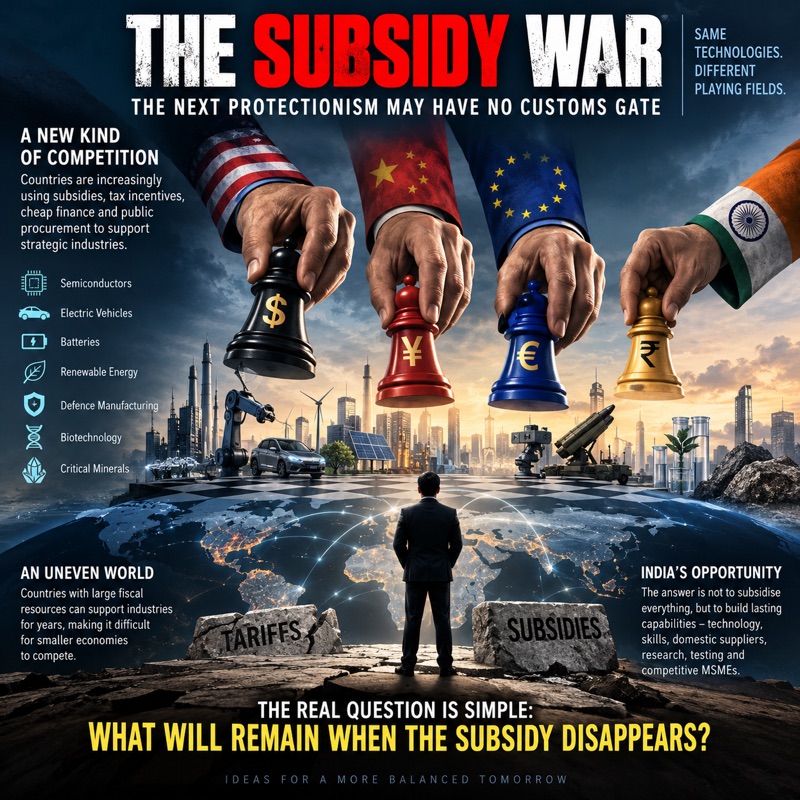
The Subsidy War: When Governments Become Competitors

For much of the last three decades, the visible face of protectionism was the tariff. Governments raised duties, imposed quotas or restricte...