Friday, May 30, 2025

Celebrating India's GI Heritage: The Sweet Success of Litchi Honey

India’s journey in promoting Geographical Indications (GI) has seen a vibrant transformation in recent years, with grassroots innovations and farmer-led branding efforts gaining national prominence. Among these, the initiative to promote GI-certified litchi honey from Bihar is a remarkable example of how local produce can be elevated through strategic collaborations, awareness programs, and festive cultural engagement.

The Role of Agricultural Universities in GI Promotion

India is home to three Central Agricultural Universities (CAUs), each playing a pivotal role in agricultural research, rural development, and farmer engagement. One such university in Bihar has emerged as a leader in championing the GI movement, particularly for litchi honey — a product rooted in the unique agro-climatic conditions of the region.

The university recently hosted a festival that not only celebrated litchi honey but also brought together stakeholders from across the agri-value chain — from policymakers and scientists to students and farmers. The event included an innovative “litchi-eating competition,” combining cultural vibrancy with awareness generation on the economic and ecological importance of GI products.

Litchi Honey: A GI Success Story

Litchi honey stands as a symbol of how regional biodiversity can be transformed into a high-value product. The distinct floral source — litchi orchards — imparts a unique taste, aroma, and medicinal value to the honey, making it a strong contender in domestic and international markets. With proper GI registration, producers of this honey can command premium prices while protecting their product from imitation.

By organizing festivals and demonstrations, institutions help promote consumer awareness and ensure traceability and quality, which are essential for building brand credibility.

Collaborating for Rural Prosperity

The festival was graced by senior representatives from the government, including the Horticulture Commissioner of India and senior faculty from the Central Agricultural University. Their presence underscored the institutional commitment to making the GI movement farmer-centric and market-oriented.

Such collaborations are essential to address challenges in:

Farmer Capacity Building: Providing training on sustainable practices, branding, and packaging.

Market Linkages: Connecting GI producers to buyers through fairs, exhibitions, and e-commerce platforms.

Scientific Validation: Ensuring the authenticity and quality of GI products through lab-based certifications and research support.


Towards a GI Revolution

The litchi honey festival marks a step forward in taking the GI revolution deeper into the Indian countryside. With over 400 registered GIs and many more in the pipeline, India’s GI ecosystem is poised for transformation, especially when linked with government schemes, private sector involvement, and rural entrepreneurship programs.

Events like these create visibility not just for the product but for the producers, many of whom are women and smallholder farmers. By recognizing and rewarding local knowledge, India can nurture inclusive growth, protect its cultural identity, and build resilient rural economies.

Honey with Heritage

India’s GI journey is not just about intellectual property — it’s about identity, innovation, and income. Litchi honey from Bihar is more than a sweet delight; it is a testament to how geographical uniqueness, when acknowledged and protected, can lead to global competitiveness. With the support of academic institutions, government bodies, and passionate individuals, the GI movement is not only protecting traditions but also creating livelihoods.
#GeographicalIndication
#LitchiHoney
#RuralDevelopment
#AgriculturalInnovation
#GICertification
#FarmersEmpowerment
#BiharAgriculture
#SustainableLivelihoods
#AgriEntrepreneurship
#IndiaGIRevolution

Tuesday, May 27, 2025

Revolutionizing Diagnostics: AI-Driven Blood Tests at Niloufer Hospital Mark a New Era in Sustainable Healthcare

In a landmark development for India's healthcare sector, Niloufer Hospital in Hyderabad has introduced an AI-powered diagnostic innovation that may transform the way blood tests are conducted. Developed by the tech startup Quick Vitals, this breakthrough uses artificial intelligence to perform blood tests through facial scans—without the need for needles or invasive procedures. What’s more, it delivers results in under a minute.

This leap in diagnostic technology not only improves patient comfort but also aligns with the broader goal of creating sustainable, efficient, and patient-centric healthcare systems.

The Science Behind the Innovation

The AI system works by analyzing facial blood flow patterns and other physiological markers to predict key vital parameters. While this technology is still under scrutiny for large-scale validation, its early success at Niloufer Hospital underscores its potential to reduce costs, eliminate procedural pain, and significantly improve turnaround times for diagnostics.

With conventional blood tests taking hours or even days and requiring trained phlebotomists and laboratory infrastructure, this contactless method offers several strategic advantages:

  • Speed: Real-time processing enables faster medical decisions.
  • Accessibility: Beneficial for rural areas and underserved populations where lab infrastructure is weak.
  • Sustainability: Reduces reliance on disposable medical supplies like syringes and gloves.

Why This Is a Game Changer for Healthcare

India's diagnostic market, projected to grow to over USD 20 billion by 2027, is in dire need of scalable and cost-effective solutions. AI-based diagnostics, such as the one now piloted at Niloufer, can bridge critical gaps in availability and affordability.

This technology also promises substantial impact in pediatric care—Niloufer being a children's hospital—where conventional blood draws are often traumatic. By replacing needles with facial scans, the technology redefines patient experience, reduces infection risk, and encourages preventive testing.

Setting a Benchmark in Medical Innovation

Niloufer Hospital’s early adoption of this AI tool demonstrates leadership in healthcare innovation. As one of the first institutions in India to implement this AI-led diagnostic model, it sets a precedent for public hospitals to embrace technology not just for efficiency, but for inclusivity and sustainability.

Healthcare leaders and policymakers should closely watch the pilot’s success to assess its potential for replication across the public health system. Integration into telehealth platforms and community health programs can be next steps, making diagnostics seamless across India’s diverse geographies.

Final Thoughts

This AI-driven initiative at Niloufer is not just a marvel of medical engineering—it is a timely reminder that innovation must be humane, inclusive, and scalable. With mounting pressure on health infrastructure, such forward-looking solutions offer hope for a future where diagnostics are faster, safer, and more accessible.

Kudos to Niloufer Hospital and Quick Vitals for setting a powerful example. As healthcare continues to evolve, such partnerships between medical institutions and AI innovators will be crucial in delivering 21st-century care.

#MedicalInnovation #AIinHealthcare #SustainableHealth #DiagnosticsRevolution 

Monday, May 26, 2025

Strengthening India's Medium Enterprises: The Missing Middle in MSME Policy

India’s MSME (Micro, Small, and Medium Enterprises) sector is a powerhouse of the economy, contributing nearly 29% to GDP, 40% to exports, and employing over 60% of the workforce. However, a closer look reveals a troubling imbalance—medium enterprises account for only 0.3% of all registered MSMEs. Despite their small share, these firms are pivotal: they generate 40% of MSME export income and exhibit higher innovation capacity than their micro and small counterparts.

Yet, policy support for medium enterprises remains fragmented and under-optimized. Acknowledging this, the recent policy framework proposes a six-pronged strategy to catalyze the growth of medium enterprises, aiming to transform them into key drivers of industrial resilience, innovation, and employment

1. Tailored Financial Initiatives: Bridging the Capital Gap

Medium enterprises often require larger and more flexible capital than micro and small units, but financial schemes rarely differentiate by enterprise size. A dedicated financing mechanism is proposed, including:

Concessional rate loans via a Medium Enterprise Financing Scheme.

A sectoral approach to credit risk assessment.

Pre-approved credit cards with limits up to ₹5 crore.


This initiative targets the chronic working capital shortage faced by medium firms and encourages formalization through institutional credit.

2. Technology Integration: Building SME 4.0 Competence

The policy advocates for converting existing MSME Technology Centres (TCs) into "India SME 4.0 Competence Centres", focusing on:

Advanced manufacturing

Digital automation

AI and robotics


This transition is critical as global supply chains become increasingly tech-driven. Without significant tech adoption, India’s medium enterprises risk being outcompeted both domestically and internationally.

3. R&D Promotion: Making Innovation a Pillar of Growth

Medium enterprises, with their manufacturing intensity and export orientation, must become centres of innovation. The policy suggests a three-tier governance framework:

An Expert Committee to set research priorities.

A Research Funding Management Committee to disburse R&D grants.

A Project Review Committee to track outcomes.


This approach aligns with the need for cluster-specific innovation and complements initiatives like the Self-Reliant India Fund by earmarking funds for medium enterprise R&D.

4. Testing and Cluster-Based Quality Infrastructure

Extending the MSE-CDP (Micro and Small Enterprises – Cluster Development Programme) to include medium enterprises can ease access to:

Quality assurance labs

Product certification

Regulatory compliance


This is particularly important in high-growth sectors like textiles, pharmaceuticals, and engineering, where adherence to global standards is non-negotiable for export success.

5. Customized Skill Development: Addressing Talent Deficits

To remain competitive, medium enterprises need tailored skilling programs that address regional and sectoral workforce gaps. The policy calls for:

Mapping enterprise-level skill needs.

Developing customized courses under the ESDP (Entrepreneurship and Skill Development Programme).

Advanced management and domain-specific training modules.


This initiative targets the mismatch between industrial demand and current skilling outputs, which hinders productivity and innovation.

6. Centralized Portal: Unified Access to Schemes and Resources

A major operational pain point is the lack of consolidated access to information. A new sub-portal within Udyam tailored for medium enterprises is proposed, offering:

Basic enterprise information

Application processes for support schemes

Market research and sectoral insights

Such a portal will reduce information asymmetry, lower transaction costs, and promote higher scheme uptake among medium enterprises.

A Strategic Push for India’s Industrial Backbone

Medium enterprises are the “missing middle”—too large for micro-level support yet too small to compete with corporates without tailored interventions. The current policy landscape tends to focus on the extremes, leaving medium firms in a policy blind spot. This proposed framework from the NITI Aayog Report on Medium Enterprises represents a critical rebalancing—not by adding new schemes, but by realigning existing resources and capacities to the specific needs of medium enterprises.

With coordinated implementation, this policy could unlock a powerful engine for export growth, job creation, and industrial innovation, propelling India’s long-term economic resilience.


#MediumEnterprises #MSMEPolicy #IndiaSME4.0 #FinancialInclusion #TechnologyAdoption #RDInnovation #SkillDevelopment #ClusterDevelopment #ExportPromotion #DigitalIndia

Saturday, May 24, 2025

Environmental and Energy Security Risks: Managing the Economic Fallout of a Warming World

As we move further into the 21st century, the twin threats of climate change and energy insecurity are reshaping global economic strategies. These environmental risks are not just ecological in nature—they are deeply economic, altering productivity, destabilizing markets, and exacerbating inequality. Policymakers, investors, and industries now face a complex landscape where environmental disruptions and energy supply shocks are no longer outliers, but systemic risks.

Climate Change: A Direct Hit on GDP and Livelihoods

Climate change is no longer a distant threat—it is an economic reality. A rise of 3°C in global temperatures could shrink world GDP by up to 40% by 2100, with coastal cities like Miami and Shanghai expected to suffer real estate losses exceeding $1.47 trillion by 2055. These aren't just asset losses; they represent permanent damages to capital, labor, and infrastructure productivity.

In India, even a 1°C temperature increase may cut GDP by 3%, largely driven by agricultural decline, heat-induced labor productivity loss, and public health crises. For a country where agriculture still supports over half the population, the stakes are existential.

Extreme weather events, such as Cyclone Amphan in 2020, which inflicted $13 billion in damages, underscore the growing cost of inaction. More broadly, crop failures, food inflation, and flooding threaten to push an additional 50 million Indians into poverty by 2040, worsening regional and economic inequality.

Energy Security: Rising Risks in a Resource-Hungry World

Energy security remains one of the most geopolitically volatile elements of economic planning. The global scramble for resources is intensifying, especially with rising industrial demand from India and China. For example, 77% of U.S. defense energy needs still rely on petroleum, underscoring vulnerability to supply shocks.

Events like fuel price hikes in 2025 have already triggered protests in import-dependent nations, highlighting how energy volatility fuels inflation and political instability. Compounding this, infrastructure risks such as pipeline sabotage, cyberattacks, and natural disasters threaten the security of critical supply lines.

These vulnerabilities translate directly into rising production costs, lower consumer spending, and fragile investor sentiment, all of which deepen economic uncertainty.

The Renewable Transition: High Costs Now, High Gains Later

The move toward renewables is essential but expensive. Establishing solar farms, wind parks, battery systems, and inter-state transmission grids demands massive upfront capital. Yet, if executed efficiently, clean energy transitions can reduce U.S. wholesale electricity prices by 20–80% by 2040 and raise wages by 2–3%, according to Brookings research.

However, geographical disparities matter. Solar-rich states like Arizona benefit disproportionately, making the case for national coordination and grid modernization to balance uneven supply.

Critically, redirecting policy focus from merely improving fossil fuel efficiency to expanding clean technology ecosystems could catalyze faster innovation and growth.

Interconnected Risks: When One Crisis Fuels Another

Perhaps most dangerously, environmental and energy security risks are deeply interconnected. Droughts, intensified by climate change, reduce hydropower output, while heatwaves boost energy demand for cooling—both straining grids already vulnerable to cyber or geopolitical threats. Meanwhile, delayed clean transitions create a feedback loop of higher emissions, increased disasters, and long-term economic fragility.

The World Economic Forum’s Global Risks Report 2025 ranks environmental threats as the top five long-term global risks, warning that biodiversity loss, air pollution, and resource depletion will only worsen economic fragmentation and social instability.

A Call for Coordinated Action

Solving these intertwined challenges requires more than domestic policies. It demands global climate finance, equity in energy access, and investment in resilient infrastructure. Proposals such as cross-border green grids, carbon pricing mechanisms, and disaster-resilient urban planning must move from the drawing board to implementation.

The path forward is narrow but navigable. A failure to act decisively today will not only burden future generations but undermine decades of development gains, particularly in vulnerable nations.

Climate change and energy security are not siloed risks; they are systemic disruptors of the global economy. The complexity lies not only in understanding their individual effects but in recognizing how they amplify one another. The costs of inaction are far greater than the costs of transition. The economic challenge of our time is to manage this transformation equitably, sustainably, and urgently.
#ClimateRisk
#EnergySecurity
#CleanEnergyTransition
#EconomicInequality
#SustainableDevelopment
#ExtremeWeatherCosts
#FossilFuelDependency
#GlobalResilience
#CarbonTransition
#GreenInfrastructure


Friday, May 23, 2025

Bridging India’s ₹30 Lakh Crore MSME Credit Gap: Insights, Challenges & A Way Forward

India’s Micro, Small, and Medium Enterprises (MSMEs) are the unsung backbone of the economy—contributing over 30% to GDP, nearly 50% to exports, and employing over 110 million people. Yet, despite their strategic importance, MSMEs face a staggering ₹30 lakh crore credit gap, as per the Small Industries Development Bank of India (SIDBI). This financial shortfall remains a critical component roadblock in unlocking the sector’s full potential. Recent reports by SIDBI and FICCI reveal a grim but instructive picture of the barriers and the solutions needed to transform MSME finance in India.

The Anatomy of the Credit Gap

The SIDBI report highlights that this credit gap is not uniform but is particularly severe in specific sub-segments:

Service-oriented enterprises

Women-owned businesses

Garment manufacturing

Grocery retail

Food processing

IT/ITeS sectors


These businesses face disproportionately higher challenges in accessing formal credit. Despite 90% of surveyed MSMEs using digital payments, only 18% have adopted digital lending options, indicating a significant untapped opportunity in fintech-driven financing.

The Reliance on Traditional and Informal Channels

Data from FICCI’s 2023 SME report further enriches this narrative. A survey of 610 enterprises found:

Bank loans are the primary source of funding for 85.4% of SMEs, accounting for 58% of their total financing.

Self-funding is used by 50.5% of enterprises.

NBFCs and informal lenders are relied upon by 30% and 25.9% of SMEs respectively.


Critically, micro-enterprises rely on informal sources for 12% of their funding—much higher than small (3%) and medium enterprises (2%). This indicates that the smallest businesses, which are also often the most vulnerable, are the least served by institutional finance.

Structural Barriers: Why MSMEs Stay Unbanked

Two major systemic challenges underpin this gap:

1. Lack of Formalization:
About 35% of MSMEs remain unregistered, largely due to a lack of awareness or fear of regulatory scrutiny. Without formal status, access to bank credit is virtually impossible.


2. Mismatch in Credit Assessment Norms:
There is a significant misalignment between MSME business cycles and the regulatory framework. The RBI’s 90-day NPA (Non-Performing Asset) rule for classifying bad loans does not reflect the working capital cycle of many MSMEs, which often exceeds 90 days—from procurement to sales realization. This mismatch forces MSMEs to prematurely divert operating capital toward loan repayment, hurting daily operations.


Proposed Solutions: Complementary but Critical

Both SIDBI and FICCI outline actionable recommendations to close this massive funding gap:

Sector-Specific Interventions:
SIDBI emphasizes tailored policies for high-impact but high-risk sectors like women-led enterprises, garments, and IT services.

Promoting Digital Lending:
Fintech platforms, if leveraged properly, could drastically improve access to credit for underserved segments. SIDBI sees this as a game-changer, given the digital payment maturity but low adoption of digital loans.

Extending NPA Classification Period:
FICCI recommends extending the NPA recognition period from 90 to 180 days, aligning better with real MSME cash flow cycles.

Encouraging Cash-Flow-Based Lending:
A shift from collateral-based to cash-flow-based credit models can benefit newer or asset-light businesses.


A Call for Multi-Stakeholder Action

Bridging this ₹30 lakh crore gap is not the responsibility of banks alone. It requires a coordinated approach involving:

Government: Reforms in NPA guidelines, simplified compliance for registration, incentives for digital adoption.

Financial Institutions: Flexibility in lending models, onboarding of first-time borrowers, and better risk assessment frameworks.

Industry Bodies: Awareness drives, digital financial literacy, and handholding of informal businesses into formal ecosystems.

Technology Providers: AI-driven risk modeling, alternative credit scoring based on transaction history, and real-time data integration to support MSME underwriting.


From Gap to Growth

India’s journey to becoming a $5 trillion economy cannot bypass the MSME sector. Addressing the credit gap is no longer a matter of policy deliberation—it’s a structural imperative. SIDBI and FICCI’s insights pave the way for bold, tech-enabled, and inclusive financial interventions. What’s needed now is execution, collaboration, and a relentless focus on translating intent into access—for every entrepreneur, no matter how small.
Source : Blog based on the content and insights from the SIDBI and FICCI reports

Thursday, May 22, 2025

India’s Glass and Ceramics Industry: Export Potential and Cluster-Driven Growth

The global glass and ceramics industry stands at a compelling inflection point. With the glass-ceramics segment projected to grow from $1.66 billion in 2025 to $2.60 billion by 2033, the sector is evolving beyond its traditional boundaries. Notably, India’s domestic glass-ceramics market is estimated at $6.3 billion in 2025, with a robust CAGR of 8.5%. This presents a paradox: while domestic growth is impressive, India's share in global exports remains underutilized. This blog critically examines the industry's export potential, focusing on regional industrial clusters and systemic challenges that must be addressed if India is to emerge as a key player in global supply chains.

India’s inherent advantages in raw material availability, labor cost, and geographic diversity of production zones offer a solid foundation for global competitiveness. Yet, the export success of this sector cannot be assumed—it must be engineered. The rapid rise in domestic demand across segments such as construction, electronics, healthcare, and automotive creates economies of scale, but without parallel strategies in innovation, branding, and logistics, India risks remaining a marginal exporter in a value-driven global market.

The application spectrum of glass and ceramics is wide-ranging. In the construction sector, Indian tiles, countertops, and façade claddings already enjoy rising global visibility, particularly in emerging markets across the Middle East, Latin America, and Africa. However, the demand for high-end, customized ceramic applications in Europe and North America is still dominated by countries like Italy and Spain. In electronics, where glass ceramics are critical to screen durability and thermal stability, Indian firms often serve as tier-2 suppliers, rarely breaking into OEM (original equipment manufacturer) contracts. In the healthcare sector, while domestic production of dental and surgical ceramic tools is rising, the inability to meet stringent global regulatory and precision benchmarks limits exports to high-value markets like the U.S. and EU.

The role of industrial clusters in this landscape is central but complex. Gujarat’s Morbi cluster is a classic example of scale without branding. It houses over 800 manufacturing units and accounts for a significant share of India’s ceramic tile exports. Yet, the products often serve as low-cost substitutes, not as brand-driven or value-added offerings. The dominance of price over quality limits upward mobility. Similarly, Firozabad, the iconic glass city of Uttar Pradesh, is celebrated for its artisanal glassware, yet lacks global outreach and fails to integrate into high-growth sectors like labware or lighting solutions. Bangalore, on the other hand, has emerged as a niche cluster for technical ceramics used in electronics and defense. However, its ecosystem is fragmented, with little convergence between academia, startups, and legacy manufacturers. Khurja’s famed pottery market still primarily serves domestic and diaspora niches, unable to match the precision, packaging, and aesthetic expectations of Western design houses.

This pattern of uneven development across clusters signals deeper structural issues. First, energy costs remain high and volatile. Since glass and ceramics are energy-intensive industries, often relying on coal, furnace oil, or LNG, any fluctuations in global fuel prices immediately impact cost competitiveness. Second, the absence of advanced R&D infrastructure and reliance on outdated kilns and equipment curtails the ability of manufacturers to meet global technical specifications. Third, the regulatory bottlenecks, particularly in obtaining quality certifications and export clearances, disproportionately affect MSMEs—the backbone of this industry.

India’s glass and ceramics sector must also confront increasing competition from Southeast Asian countries and China. These nations have rapidly scaled up capabilities in high-performance ceramics, investing heavily in research, technology adoption, and global branding. If India wishes to compete, it must shift from being a volume player to a value player. That means fostering design-led innovation, establishing testing and certification labs in export clusters, and offering targeted export subsidies for technical and healthcare ceramics.

Policymakers must recognize the export potential of this sector not in isolation, but as part of India’s broader goal to increase manufacturing’s contribution to GDP. Designating key clusters like Morbi, Firozabad, and Bangalore as Export Facilitation Zones (EFZs) with dedicated infrastructure, customs clearance support, and green energy subsidies could turn them into global manufacturing hubs. Public-private partnerships must be encouraged to set up skill centers, innovation incubators, and export readiness programs within these clusters.

Moreover, international branding is key. While India has successfully built narratives around tea, yoga, and spices, glass and ceramics remain an untapped story. Strategic participation in global expos like Ambiente (Germany), Cersaie (Italy), or Maison & Objet (France) must be supported through national campaigns. With sustainability becoming a central concern in global trade, India must also promote its traditional, handmade, low-emission ceramic techniques as environmentally superior alternatives to industrial mass production.

In conclusion, India’s glass and ceramics industry holds strong potential—but potential alone is not policy. The future lies in systematically strengthening export capabilities through cluster development, technology infusion, energy optimization, and global positioning. In a world where value chains are being restructured, India must seize the moment to become not just a supplier of goods, but a creator of design, innovation, and quality in glass and ceramics. Otherwise, the nation risks remaining a large market with small ambition.


Wednesday, May 21, 2025

Crafting the Cities of Tomorrow: Cultural Livelihoods and Urban Resilience

As the world urbanizes rapidly, the need to shape future-ready cities that are inclusive, resilient, and economically vibrant has never been more urgent. At the recent National Urban Conclave on Future Ready Cities organized by the Indian Institute of Public Administration (IIPA), a significant session on Urban Economy and Poverty shed light on a critical, often overlooked dimension—the role of craft and cultural economies in shaping sustainable urban livelihoods.

The session focused on how India's rich heritage in craft-based livelihoods continues to evolve in modern urban contexts. Drawing on the case studies of the Berhampur and Maheshwar handloom clusters, the presentation argued that urban economic strategies must go beyond tech-driven models and consider culturally embedded economies that provide identity, employment, and social fabric to cities.

The Cultural Economy as a Pillar of Urban Futures

The handloom sector, for instance, supports over 4.3 million people in India, with a significant concentration in urban and peri-urban spaces. Clusters like Berhampur in Odisha and Maheshwar in Madhya Pradesh have demonstrated how traditional skills can become engines of economic growth when aligned with urban markets, modern design interventions, and digital platforms.

These clusters are not merely relics of the past. They represent dynamic systems of economic resilience, where women, artisans, and micro-entrepreneurs sustain livelihoods through inter-generational knowledge and collective practices. Such economies also contribute to the low-carbon footprint and sustainable production systems—a key consideration in climate-resilient urban planning.

Lessons from Academia and Policy Research

The talk, inspired by two exemplary student capstone projects, underscores the power of applied academic research in influencing real-world policy and development. The session was chaired by Dr. Pushpa Pathak from the Centre for Policy Research, and featured insights from Ms. Shalini Pandey of the Ministry of Housing and Urban Affairs, reflecting a growing recognition in policymaking circles of cultural livelihoods as vital to the urban economy.

As highlighted in the session, future-ready cities must be inclusive of informal economies that already exist within them. By supporting these sectors through improved infrastructure, marketing support, training, and integration into urban planning, policymakers can unlock a massive economic potential that is often marginalized in mainstream narratives.

The Path Forward: Bridging Policy, People, and Place

Thanks to the support of visionaries like Prof. Kamla Kant Pandey and Shri S.N. Tripathi (IAS, Retd.), such platforms are emerging where academic insights, administrative leadership, and grassroots realities intersect. Moving forward, a few critical directions are needed:

Integrated Planning: Cultural and craft clusters should be included in city master plans and economic development strategies.

Urban Policy Innovation: Schemes should recognize creative economies as formal contributors to GDP, employment, and export potential.

Digital Enablement: Technology must be harnessed to connect traditional artisans to global markets without disrupting their local ecosystems.

Youth and Gender Inclusion: Training programs should focus on engaging youth and empowering women within these clusters to lead future enterprises.

The future of Indian cities will not just be shaped by concrete and code—it will also be defined by color, craft, and community. Recognizing the value of cultural economies and integrating them into the broader urban agenda is not a nostalgic choice; it is an intelligent one rooted in economic pragmatism and social justice.
#FutureReadyCities
#UrbanEconomy
#CulturalLivelihoods
#HandloomClusters
#SustainableUrbanDevelopment
#CraftEconomy
#InclusiveGrowth
#UrbanResilience
#CreativeEconomy
#PolicyInnovation

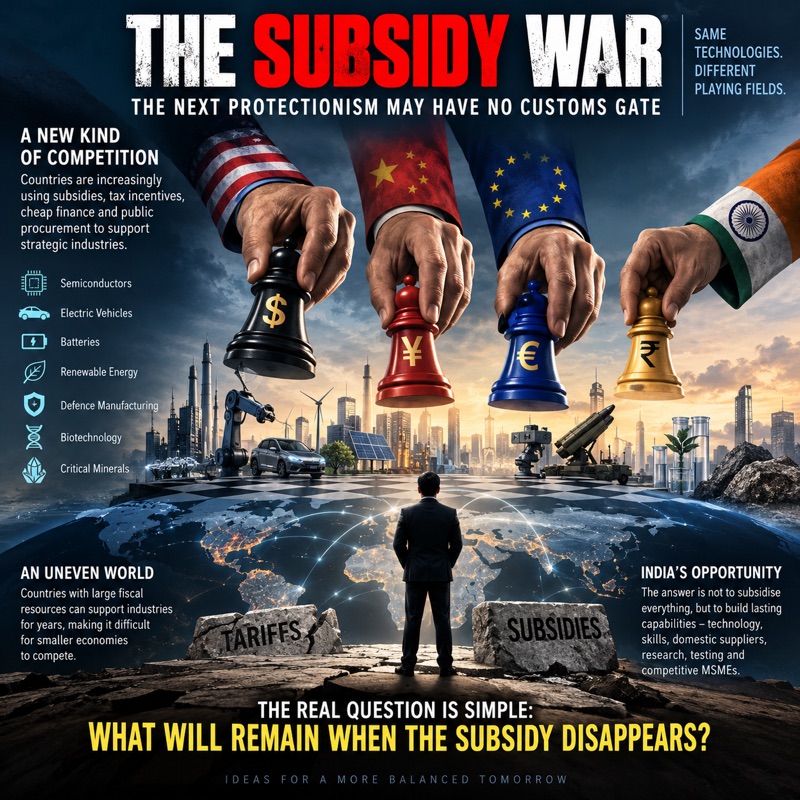
The Subsidy War: When Governments Become Competitors

For much of the last three decades, the visible face of protectionism was the tariff. Governments raised duties, imposed quotas or restricte...