Wednesday, April 30, 2025

Embracing Uncertainty: The Core Strength of Entrepreneurs

Entrepreneurship is often romanticized as a bold journey marked by innovation, independence, and success. But at its heart lies a far more demanding reality: a constant engagement with uncertainty. Every decision—from ideating a product to launching a business model—demands navigating risks that are financial, market-based, technological, or even reputational. For entrepreneurs, this environment of ambiguity is not just a backdrop; it is the proving ground that defines their journey.

As noted by Wharton Online, risk-taking is not a peripheral trait but a central pillar of the entrepreneurial mindset. This capacity to act amidst incomplete information, fluctuating markets, or changing consumer behavior is what distinguishes entrepreneurs from conventional business managers. Entrepreneurs do not merely react to risks—they often actively seek them out, identifying gaps that others ignore and turning volatility into opportunity.

The Many Faces of Entrepreneurial Risk

1. Financial Risk: The most immediate and visible form of risk comes in the form of capital investment. Bootstrapping, borrowing, or convincing investors to believe in an untested idea requires a high tolerance for potential financial loss. Entrepreneurs must balance cash flow, ensure liquidity, and yet invest enough to scale the business.


2. Market Risk: Consumer preferences shift rapidly. Even the most promising product can falter if timing, branding, or messaging misses the mark. Market risk entails understanding demand, predicting trends, and continuously adapting to keep the business relevant.


3. Technological Risk: For tech-driven startups, innovation brings its own uncertainty. Will the technology scale? Is it secure, user-friendly, and future-ready? Entrepreneurs in this space are often building in real-time, refining as they grow.


4. Reputational Risk: In today’s hyper-connected world, one misstep can lead to public backlash. Entrepreneurs are increasingly aware that branding and communication require as much careful planning as operations and finances.

Why Risk-Takers Lead Innovation

The critical link between risk-taking and innovation lies in the ability to operate where data may be limited or outcomes unpredictable. While many professionals wait for certainty, entrepreneurs move ahead with conviction, often shaping the market instead of waiting for it to shape them.

For instance, during economic downturns or technological disruptions, many shy away from investment. Yet history shows that some of the world’s most successful startups—Airbnb, Uber, and Slack—emerged during uncertain times. Their founders assessed the same risks others feared but interpreted them as windows of opportunity.

Developing a Risk-Tolerant Mindset

Entrepreneurship education and ecosystems today increasingly focus on building resilience and mental agility—traits necessary for embracing risk productively. Risk tolerance is not about being reckless; it’s about being strategic, knowing when to pivot, and learning fast from failure.

Successful entrepreneurs often use tools like lean startup methods, MVPs (Minimum Viable Products), A/B testing, and agile frameworks to minimize the cost of uncertainty while maximizing the speed of learning. These tools allow them to take calculated risks and iterate quickly.

The Way Forward: Cultivating a Culture of Informed Risk

To foster innovation at scale, societies and institutions must build environments where entrepreneurial risk is supported—not punished. This includes regulatory reforms that reduce red tape, access to seed capital and mentorship, and platforms that allow experimentation without existential penalties for failure.

As the global economy becomes more interconnected and technology rapidly transforms industries, the ability to make bold bets will remain a key differentiator. Entrepreneurs, by design, are not guaranteed success—but their mindset of turning risk into opportunity is what moves industries forward.

In the final analysis, it is not risk avoidance but risk navigation that defines entrepreneurship. As Wharton Online rightly emphasizes, the willingness to engage with uncertainty is not just a personal trait—it is the very engine of innovation. Entrepreneurs who embrace this truth position themselves not only to survive but to lead in times of change.
#Entrepreneurship
#RiskTaking
#Innovation
#StartupMindset
#BusinessUncertainty
#FinancialRisk
#MarketVolatility
#AgileThinking
#StrategicPlanning
#ResilientLeadership


Tuesday, April 29, 2025

The Global Craft Sector Outlook 2025: A New Era of Growth, Innovation, and Challenges

The global craft sector is stepping into a new era of opportunity and transformation. Fueled by rising consumer appreciation for authenticity, sustainability, and craftsmanship, the handicrafts industry is poised for robust growth over the next decade.

A Soaring Global Market

Recent projections highlight the booming prospects for crafts worldwide. The global handicrafts market, valued at $906.8 billion in 2024, is set to almost double to $1.94 trillion by 2033, growing at an impressive CAGR of 8.8%. Parallelly, the arts and crafts segment is anticipated to expand from $48.33 billion in 2025 to $65.18 billion by 2029, reflecting increasing consumer interest across both emerging and mature economies.

Key Drivers Behind the Boom

Several forces are propelling this surge:

Demand for Handmade & Unique Goods: As mass production saturates global markets, buyers are seeking products that carry a personal touch, cultural richness, and a human story behind them.

Rise of Digital Platforms: E-commerce and global marketplaces like Etsy, Amazon Handmade, and regional platforms have empowered artisans to bypass traditional barriers and directly reach global consumers.

Policy Push and Cultural Events: Many governments are stepping up efforts to promote local crafts through policies, subsidies, and international exhibitions, providing artisans greater visibility and support.

Changing Consumer Lifestyles: Higher disposable incomes and a shift toward experiential, meaningful consumption are reinforcing demand for artisan goods.


Emerging Trends Reshaping the Craft Sector

The future of handicrafts is not just about preserving traditions but also about adapting to new consumer values and technologies:

Eco-Conscious Crafting: Sustainable materials such as bamboo, jute, organic fibers, and recycled components are becoming mainstream, catering to eco-aware buyers.

Digital Integration: Artisans are increasingly using social media, digital marketing, online workshops, and even virtual reality experiences to showcase and sell their work.

DIY Movement and Cross-Sector Collaborations: The growing "maker" culture, fueled by DIY trends, is encouraging new partnerships between traditional artisans and designers, tech innovators, and sustainable brands.

Youth Influence: Millennials and Gen Z, with their emphasis on sustainability, authenticity, and personalized products, are emerging as the primary consumer base for artisan crafts.


Challenges That Cannot Be Ignored

Despite its promising trajectory, the craft sector faces some serious headwinds:

Mass-Produced Competition: Cheaper, machine-made alternatives flood markets, sometimes mimicking traditional designs and eroding the value of genuine craftsmanship.

Fragmentation and Financial Hurdles: Many artisans, especially in developing countries, struggle with limited access to capital, marketing, training, and technology.

Generational Skill Gap: As younger generations migrate to urban centers for more lucrative opportunities, traditional skills and artisanal knowledge risk being lost.


Regional Spotlight: Where Growth is Happening

India: A powerhouse in global handicrafts, India’s sector is expected to grow at a CAGR of 14% between 2025 and 2035, driven by its diverse craft traditions and increasing government focus on sustainable development.

Australia and Beyond: Other regions like Australia are witnessing double-digit growth, fueled by both domestic appreciation and international demand for indigenous and handmade products.


Final Reflections: Crafting a Sustainable Future

The international outlook for the craft sector in 2025 and beyond is overwhelmingly positive but demands a nuanced approach. Strategies that combine heritage preservation with digital innovation, sustainability with scalability, and artisan empowerment with global outreach will determine long-term success.

Supporting artisans through education, technology adoption, and fair-trade initiatives will be crucial to ensuring that the craft sector not only thrives but also retains its soul in an increasingly commercialized world.
#GlobalCraftMarket
#HandicraftGrowth
#SustainableCrafts
#ArtisanEmpowerment
#DigitalCraftEconomy
#EcoFriendlyProducts
#CraftSectorChallenges
#HandmadeInnovation
#MillennialConsumers
#CraftSectorFuture

Saturday, April 26, 2025

Navigating the Complex Landscape of Global Cybercrime

In today's hyperconnected world, cybercrime has emerged as one of the most critical global threats, posing serious risks to national security, economic stability, and personal freedoms. As digital ecosystems expand rapidly, the need for a strong, focused strategy to combat cybercrime has become more urgent than ever.

One of the biggest challenges in addressing cyber threats is the difficulty in distinguishing where national security concerns end and criminal activities begin. Cyber incidents today are not confined to simple hacking or data theft. They can range from large-scale industrial espionage, where sensitive corporate information is stolen to gain competitive advantages, to national defense strategies and military operations that use cyberspace as a battlefield. Often, these activities blend into profit-driven cybercrimes, such as ransomware attacks, blurring the lines between political, military, and financial motivations.

According to Cybersecurity Ventures, global cybercrime damages are expected to rise to $10.5 trillion annually by 2025, a figure that underlines the staggering scale and complexity of the problem. The rapid growth of cyber incidents also highlights another fundamental issue: the international debate over cyberwarfare, offensive digital capabilities, and the role of nation-states in cyberspace. The good news is that discussions around these topics are ongoing. Policymakers, defense strategists, and cybersecurity experts continue to debate how cyber conflicts should be governed, much like traditional arms control agreements in the past. Initiatives such as the Paris Call for Trust and Security in Cyberspace are steps in the right direction, aiming to build a common framework for responsible behavior online.

However, despite these conversations, a global consensus remains elusive. The problem is deeply political. Cybersecurity negotiations are not merely technical; they are deeply tied to national pride, security doctrines, economic interests, and differing political ideologies. What one country may view as legitimate espionage, another may classify as an act of war. Furthermore, competing geopolitical interests and the growing emphasis on cyber sovereignty make global alignment even harder to achieve.

The reality is that while dialogues about cyber norms are taking place, they are unlikely to lead to a comprehensive international agreement anytime soon. Until then, individual nations and organizations must continue to invest heavily in cybersecurity defenses, strengthen regional collaborations, and build resilience against an increasingly complex array of digital threats. The future of cybersecurity will demand not just technological innovation but also sustained diplomatic engagement, political will, and a collective commitment to protect cyberspace as a global commons. 

#Cybercrime
#NationalSecurity
#Cyberwarfare
#IndustrialEspionage
#GlobalConsensus
#DigitalThreats
#CyberSecurityStrategy
#PoliticalChallenges
#OffensiveCapabilities
#ResilientInfrastructure

Wednesday, April 23, 2025

GP Sir: The Silent Sculptor of Justice from Chandigarh

In the serene city of Chandigarh, where the Punjab and Haryana High Court stands tall as a beacon of law and order, resides a man whose impact reaches far beyond courtrooms. Advocate Gurinder Pal Singh, fondly known as GP Sir, is not just a respected figure in the legal fraternity—he is a mentor, a guide, and for many, an angel who walked into their lives with purpose.

GP Sir’s journey is the stuff of inspiration. A self-made legal mind, deeply respected in the Punjab and Haryana High Court, he never let his success overshadow his roots. Having once walked the path of struggle himself, he saw in others what few ever care to notice—potential buried under poverty, brilliance overlooked by society.

But what makes GP Sir’s story extraordinary is not his practice—it is his purpose.

For years, GP Sir has quietly trained students from the bottom of the pyramid—those with dreams too big for their circumstances, and pockets too small for coaching fees. These were students from rural Haryana, small-town Punjab, and underserved urban colonies. And GP Sir never charged a fee. Not once.

He trained them not just for exams, but for life in black robes. He taught them the nuances of law, the power of ethics, and most importantly, the strength to believe in themselves. His evenings, weekends, and holidays were spent building something no money could buy—a new generation of judges.

Today, the results of his dedication shine across courtrooms in Punjab and Haryana. Nearly 20 judges—yes, 20—in the lower judiciary owe their journey to the selfless guidance of GP Sir. Many of them were first-generation graduates. Some came from farming families, others from homes where dreams were considered luxuries. But with his mentorship, they rose—each one a testament to the transformative power of one man’s belief.

One young woman, now serving as a judge in the Haryana judiciary, said it best:
“GP Sir didn’t just teach us law—he made us believe that the bench was within our reach. His voice echoes in my courtroom every time I pronounce judgment.”

Another judge from Punjab remarked:
“He turned our fears into confidence and our doubts into discipline. Without GP Sir, I wouldn’t be wearing this robe today.”

Despite his towering achievements and reverence in the legal world, GP Sir remains humble. When asked why he devotes so much of his life to mentoring, his reply is simple:
“These young minds are the future of our judiciary. Justice should not depend on privilege—it should be powered by merit and character.”

To some, he is an advocate. To many, he is a legend. But to those 20 judges—and to countless others whose lives he continues to shape—GP Sir is justice in human form. A silent sculptor carving futures in the name of fairness.


BluSmart’s Governance Crisis: A Wake-Up Call for Indian Boardrooms

What happened at BluSmart isn’t just a blip on the radar of Indian startups—it’s a cautionary tale echoing across boardrooms from Mumbai to Berlin. The company’s recent crisis, stemming from alleged financial misrepresentation and compliance lapses, underscores a systemic issue: the failure of governance at the top.

Where Was the Board?

When signs of ethical breaches and regulatory non-compliance emerge, one must ask: where was the board? Why did no one speak up? These are not rhetorical questions—they are critical inquiries for every boardroom, especially in founder-led companies where oversight can often be compromised by charisma, control, and complacency.

In theory, boards exist to provide checks and balances, to ensure that leadership is held accountable, and to act as guardians of stakeholder trust. But too often, they devolve into passive echo chambers—composed of familiar faces, personal networks, and loyalists rather than skilled professionals who can challenge the status quo.

Diversity Isn’t Just a Buzzword

As one experienced female board member recently observed, many boards are not built on merit, diversity, or independence. This lack of diversity—particularly gender diversity—has real consequences. Studies consistently show that women are more likely to raise red flags on ethical and compliance issues. A 2020 Harvard Business Review study found that companies with more gender-diverse boards had significantly fewer governance-related scandals and performed better on risk metrics.

Diverse voices bring new perspectives, challenge groupthink, and enhance decision-making. Yet in many Indian startups, especially those that have scaled quickly on venture capital, governance has taken a backseat to growth-at-any-cost strategies.

Founder-Driven Doesn’t Mean Founder-Controlled

BluSmart's situation is a lesson in why founder-driven should not mean founder-controlled. Many of India’s most celebrated startups are still led by their founders, who often wield disproportionate influence over operations, hiring, and even board composition. This model can work—until it doesn’t.

Without robust checks, ethical frameworks, and independent oversight, even well-intentioned leadership can falter. Governance needs to evolve in step with valuation.

The Ripple Effects: Regulation and Reputation

BluSmart's downfall isn’t just their problem. Such failures invite sweeping regulatory responses that affect the entire ecosystem. From stricter due diligence norms for funding to tighter scrutiny of startup finances, the risk is that overregulation stifles innovation—even among those playing by the rules.

As the startup ecosystem matures, governance must too. The path forward lies in building boards not just for fundraising optics, but for operational integrity.

Let’s stop normalizing passive boards filled with “yes men.” Let’s ensure that our boardrooms are not the last line of defense, but the first. That means appointing professionals with courage, independence, and the competence to lead—not just to nod.

Cases like BluSmart will continue unless we radically rethink how governance works in high-growth ventures. Accountability must be embedded into the DNA of corporate leadership—from day one.

Let’s build boardrooms where courage isn’t optional, and competence isn’t compromised.


Tuesday, April 22, 2025

Rethinking Innovation in India: Why Public Sector Science May Be Our Best Bet

India’s global rise as a service powerhouse often overshadows an uncomfortable truth—our private industrial and technology sectors have yet to become serious contenders in innovation. While Indian conglomerates dominate sectors like steel, pharmaceuticals, and IT services, a glaring gap remains in cutting-edge R&D and core engineering breakthroughs. Despite the demographic dividend, a growing digital economy, and global talent recognition, the country continues to punch below its weight in technological invention and IP creation.

Private Sector: An Implementation Powerhouse, Not an Innovation Leader

Most Indian engineering and IT firms serve global supply chains as service providers and system integrators. Their business models focus on cost arbitrage, operational efficiency, and outsourced delivery—making them “implementers,” not innovators. From TCS to Infosys and L&T to Tech Mahindra, the emphasis remains on fulfilling client needs rather than creating novel solutions that redefine industries.

There is no Indian equivalent of a SpaceX, Nvidia, or Huawei—firms that not only commercialize ideas but push technological frontiers. Even India’s most celebrated unicorns and tech startups largely function within frameworks built on existing Western platforms—delivery apps, fintech APIs, edtech SaaS—rather than true homegrown scientific or hardware innovation.

Startups: Orphans of the Corporate Ecosystem

The Indian startup ecosystem, though vibrant in numbers, often finds itself isolated from mainstream corporate India. Unlike ecosystems in the U.S. or Israel where large firms partner with, invest in, or even acquire startups to scale ideas, Indian conglomerates have shown reluctance. The lack of mentorship, capital infusion beyond VCs, or procurement opportunities from Indian firms means startups often look Westward for validation and survival.

Public Sector: The Unsung Heroes of Indian Innovation

In this vacuum, India’s state-backed scientific institutions remain the only true bastions of R&D. From ISRO’s cost-effective space launches to Bhabha Atomic Research Centre’s nuclear capabilities, and DRDO’s defense systems, public institutions are the ones leading innovation. While not always perfect—HAL being often criticized for inefficiency and delay—their contributions still far outpace their private counterparts in IP generation and indigenous design.

Time to Empower National Champions

India must rethink its industrial policy and reinvest in public-sector-led R&D. This means:

  1. Creating more ISROs and BARC-like centers in emerging fields like AI, quantum computing, biotechnology, and green hydrogen.
  2. Funding interdisciplinary R&D clusters with tie-ups across IITs, CSIR labs, and government R&D agencies.
  3. Mandating private sector contribution to national tech missions—whether through PPPs, innovation funds, or joint R&D projects.

Countries like China have demonstrated the power of state-backed enterprises and academic-industrial collaboration to leapfrog in technologies. For India, relying on a handful of billionaires to lead innovation is not just risky—it’s strategically shortsighted.

The Potential of the Indian Mind

Indian scientists and engineers continue to excel globally—from running NASA missions to driving Google’s AI research. What they need is not validation, but a visionary ecosystem at home. A National Innovation Mission, built on the strengths of public sector science, coupled with structured private sector participation, could close the gap with the West and China in a decade.

A reality we can no longer ignore: India cannot rely on market forces alone to deliver technological sovereignty. If the private sector won't lead, the public sector must. With strategic intent and bold policy, India can nurture its own DARPA-style ecosystem—deep tech, mission-driven, and aligned with national interest.

It is time to empower the Indian mind, not just for global admiration but for national 

Sustainability in a Changing World: A Global Perspective on Challenges and Opportunities

The world is witnessing an unprecedented intersection of geopolitical shifts, climate change, and economic volatility. These factors are reshaping industries and compelling businesses to adopt sustainable strategies for long-term competitiveness. Recent collaborations between governments, industries, and knowledge-sharing platforms are paving the way for more resilient and circular economies. This blog explores how sustainability is becoming a critical business strategy and how global partnerships are facilitating cross-border learning and implementation.

The Urgency of Sustainability in a Globalized Economy

Climate Change and Its Impact on Industries

The increasing frequency of extreme weather events has disrupted industries worldwide. In Kenya, excessive flooding has made it impossible for farmers to plant crops, affecting food production and supply chains. Similarly, in South Africa, severe water scarcity has led to mandated "days off water," forcing industries to halt production. These environmental challenges are no longer localized concerns but global disruptions affecting entire economies.

The rising cost of fossil fuels and commodities further exacerbates the situation. With inflationary pressures mounting, industries are recognizing the need to transition towards sustainability—not just as a regulatory requirement but as a competitive necessity. Sustainable practices now determine an enterprise’s ability to maintain business continuity in an unpredictable economic environment.

Geopolitical Challenges and Cross-Border Learning

The world is increasingly interconnected, and the complexities of geopolitics impact trade, regulations, and industrial practices. Cross-border learning has become vital in addressing shared challenges. For instance, initiatives in Kenya and South Africa provide valuable insights into climate resilience that can be adapted in India.

Global partnerships, such as those between India and Sri Lanka, emphasize knowledge sharing and technology transfer. By leveraging collective experiences, countries can develop localized yet effective solutions to sustainability challenges. The ability to learn from one another ensures that businesses and policymakers are not reinventing the wheel but rather refining and adapting proven strategies.

Sustainability as a Competitiveness Strategy

Circular Economy and Life-Cycle Thinking

A key approach to sustainability is the adoption of circular economy principles. Instead of focusing solely on end-of-life recycling, industries are integrating life-cycle thinking into their production processes. This means:

Using alternative raw materials with lower environmental footprints

Designing products that are easier to recycle and reuse

Reducing waste and water consumption in manufacturing

Switching to renewable energy sources to minimize dependence on fossil fuels


The effectiveness of sustainability efforts can be amplified when industries operate in clusters. Cluster-based production allows businesses to share resources, optimize logistics, and enhance efficiency. In India, prioritized clusters have been identified for implementing sustainable practices in partnership with the government. This initiative ensures that industries within close proximity collaborate on sustainability efforts, maximizing impact.

Knowledge Sharing and Global Initiatives

India has taken significant steps towards sustainability through partnerships with international stakeholders. The launch of the Budapest Initiative with India's Minister of State underscores the country's commitment to aligning sustainability with industrial growth. Programs focusing on cross-border knowledge transfer facilitate faster adoption of best practices, bridging the gap between research and real-world implementation.

For instance, the National Technical Action Center has been instrumental in transferring expertise to Kenyan counterparts, demonstrating how knowledge-sharing initiatives strengthen global sustainability efforts. Such initiatives ensure that industries worldwide have access to practical solutions that can be tailored to their specific challenges.

The Role of Innovation in Sustainable Practices

One of the biggest hurdles to sustainability is ensuring that businesses remain profitable while adopting eco-friendly practices. Innovation plays a crucial role in this transformation.

Material Science Advancements: New chemical compositions in manufacturing processes can reduce environmental impact without compromising product quality.

Recycled Content Integration: Increasing the use of recycled materials in production while maintaining clarity on material composition enhances circular economy effectiveness.

Energy Efficiency Measures: Investing in cleaner energy sources and optimizing industrial operations can significantly reduce operational costs and carbon footprints.


The key is to transition from a reactive to a proactive approach—rather than responding to environmental crises after they occur, businesses must integrate sustainability into their strategic planning.

The Path Forward

Sustainability is no longer an optional consideration; it is an imperative for businesses and economies worldwide. Climate change, geopolitical uncertainties, and resource scarcity are driving industries toward more resilient and efficient operational models. The collaborative efforts between India, Kenya, South Africa, and Sri Lanka highlight the importance of knowledge-sharing and collective problem-solving.

By adopting a life-cycle approach, embracing circular economy principles, and fostering innovation, industries can navigate the complexities of a rapidly changing world. Governments, businesses, and global institutions must continue to work together to ensure that sustainability is not just a regulatory requirement but a fundamental driver of economic resilience.

The time to act is now. As industries, policymakers, and consumers, we all play a role in shaping a sustainable future. By leveraging global partnerships and learning from each other’s experiences, we can build a more sustainable and competitive world for generations to come.

#Sustainability
#ClimateChange
#CircularEconomy
#Geopolitics
#ResourceScarcity
#CrossBorderLearning
#IndustrialClusters
#Innovation
#RenewableEnergy
#EconomicResilience

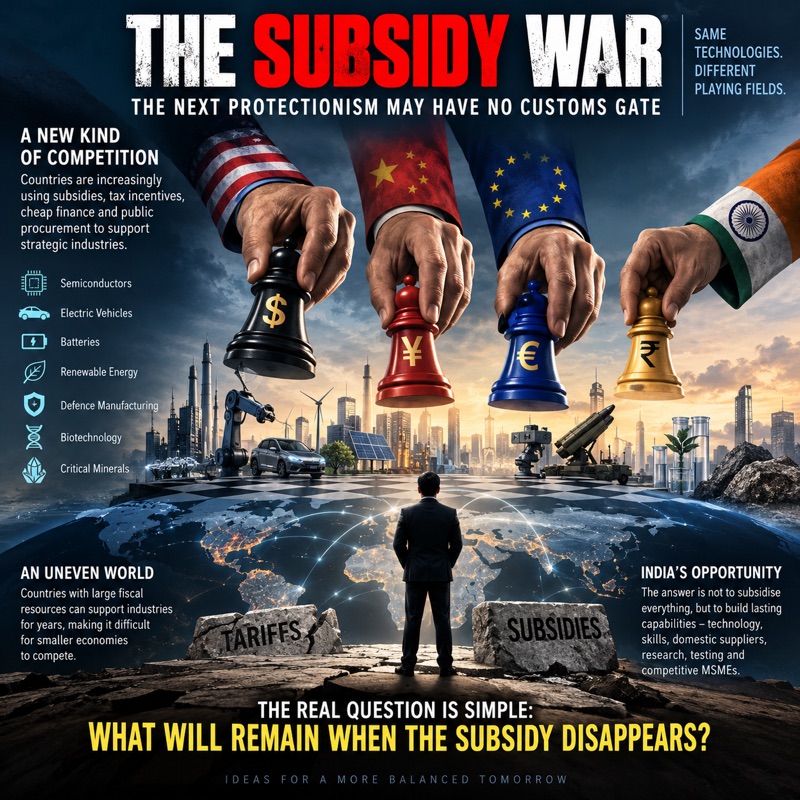
The Subsidy War: When Governments Become Competitors

For much of the last three decades, the visible face of protectionism was the tariff. Governments raised duties, imposed quotas or restricte...