Wednesday, June 26, 2024

The Persistent Credit Challenges for MSMEs in India

Micro, Small, and Medium Enterprises (MSMEs) play a crucial role in propelling economic growth, promoting innovation, and creating employment opportunities. Despite their undeniable significance, MSMEs in India continue to grapple with substantial credit shortages, a concern recently reiterated by RBI Deputy Governor Dr. M. D. Patra. This blog sheds light on the persistent credit challenges faced by MSMEs and explores potential solutions.

The Current State of Credit Penetration

While there has been notable progress in credit delivery to priority sectors such as agriculture and MSMEs, the credit needs of MSMEs are still significantly underserved. According to Dr. Patra, almost half of the self-help groups (SHGs) are yet to be credit-linked, and a considerable number of small and marginal farmers remain excluded from bank credit facilities. This credit gap underscores the pressing need for more targeted efforts to ensure adequate financial support for MSMEs.

Key Challenges in Securing Credit

1. Lack of Credit History: Many MSMEs, particularly newer enterprises, struggle to secure loans due to their insufficient or non-existent credit history. This lack of historical financial data makes banks wary of extending credit.
   
2. Inadequate Collateral: MSMEs often lack the collateral required by traditional banks to secure loans. The tangible assets possessed by these enterprises are generally not adequate to meet stringent collateral requirements.

3. Lack of Awareness About Government Schemes: Despite the existence of numerous government schemes designed to support MSMEs, such as the Credit Guarantee Fund Trust for Micro and Small Enterprises (CGTMSE), many business owners remain unaware of these initiatives and their benefits.

4. High-Interest Rates: When credit does become available, it is frequently accompanied by prohibitively high-interest rates, discouraging MSMEs from borrowing.

5. Limited Lender Trust: Due to the volatile nature of MSME operations and their perceived higher risk of default, banks and financial institutions often exhibit limited trust in lending to this sector.

Solutions

To bridge the credit gap and support MSME growth, a multi-pronged approach is essential. Dr. Patra advocates for greater involvement from state-level bankers' committees (SLBCs) in addressing these challenges. Here are some suggested strategies:

1. Promotion of Fintech Solutions: Fintech can revolutionize the process of credit assessment and delivery. By leveraging data analytics and alternative credit scoring models, fintech solutions can evaluate potential borrowers more accurately and extend credit efficiently.

2. Partnerships With Government Bodies: Collaborations with government agencies can help align banking initiatives with developmental programs, ensuring that the credit reaches the intended recipients.

3. **Data-Driven Analysis**: SLBCs should conduct detailed analyses using data analytics and field surveys to identify the root causes of stagnant credit growth. Understanding regional economic activities and local credit needs will enable the development of targeted credit plans.

4. Improving Financial Literacy: Enhancing financial literacy among MSME owners will ensure that they are more aware of available financial products and government schemes, thereby making informed borrowing decisions.

5. Exploring Unsecured Loan Options: Financial institutions can develop and promote unsecured loan products, which do not require collateral and are specifically designed for MSMEs.

By implementing these strategies, financial institutions and policymakers can work together to create an enabling environment for MSMEs, ensuring that they receive the credit necessary to thrive and contribute robustly to the economy.

Although significant strides have been made in improving credit penetration, MSMEs in India continue to face formidable credit challenges. Addressing these issues requires a concerted effort from all stakeholders, including banks, fintech companies, government bodies, and the MSMEs themselves. By fostering a supportive financial ecosystem, we can empower MSMEs to overcome credit constraints and achieve their full potential, driving sustainable economic growth and development.
Citations:
[1] Despite progress, MSMEs still face credit shortages: DG Swaminathan https://www.business-standard.com/industry/news/despite-progress-msmes-still-face-credit-shortages-dg-swaminathan-124062400881_1.html
[2] Mint Street Memos - Reserve Bank of India https://www.rbi.org.in/Scripts/MSM_Mintstreetmemos13.aspx
[3] Challenges with MSME lending and how Embedded Finance solves ... https://finbox.in/blog/msme-lending-credit-financial-inclusion/
[4] Challenges of MSMEs in India - PSB Loans in 59 Minutes https://www.psbloansin59minutes.com/knowledge-hub/challenges-of-msmes-in-india
[5] Challenges faced by the MSME sector in India - 5paisa https://www.5paisa.com/blog/challenges-faced-by-the-msme-sector-in-india

Sustainable Funds and Sustainable Development

As the global focus on mitigating climate change intensifies, investors and finance professionals are exploring ways to align their portfolios with environmentally positive outcomes. One investment vehicle that has garnered significant attention is the sustainable or ESG (Environmental, Social, and Governance) fund. These funds claim to invest in companies with strong environmental practices, among other ethical considerations. However, a critical question often emerges: Do sustainable funds genuinely reduce carbon footprints, especially given their sometimes limited competitiveness compared to traditional funds?

Understanding Sustainable Funds

Sustainable funds, also known as ESG or green funds, integrate environmental, social, and governance factors into their investment decisions. These funds aim to achieve financial returns while simultaneously promoting positive social and environmental impacts. Among these impacts, reducing carbon emissions is one of the primary focuses, as it directly contributes to combating climate change.

Mechanisms of Carbon Footprint Reduction

 1. Investment in Low-Carbon Companies
Sustainable funds prioritize investments in companies that have lower carbon emissions relative to their industry peers or those actively working to reduce their carbon footprint. For instance, such funds might favor companies embracing renewable energy over those reliant on fossil fuels.

2. Influence on Corporate Behavior
By allocating capital to environmentally responsible companies, sustainable funds incentivize other companies to adopt greener practices. The logic is straightforward: as ESG criteria become essential for attracting investment, more businesses will improve their environmental performance.

 3. Shareholder Engagement and Activism
Sustainable funds often engage in shareholder activism, using their stakes in companies to push for greener policies and practices. This can lead to significant changes in a company’s approach to carbon emissions, energy usage, and overall sustainability strategy.

Evaluating the Impact

Reduction of Carbon Emissions
Studies suggest that sustainable funds do tend to have a lower carbon intensity compared to traditional funds. This implies that, on an aggregate level, the investments made by these funds are in companies emitting less carbon. However, measuring the real-world impact of this reduction is complex and often subject to debate.

Raising Awareness and Changing Norms:
Even if the immediate reduction in carbon emissions might not be monumental, the role of sustainable funds in raising awareness and setting a precedent for responsible investing can't be overlooked. By shifting capital towards more responsible companies, they contribute to a broader industry-wide push towards sustainable practices.

Competitiveness Concerns

Financial Performance
A common criticism of sustainable funds is their perceived lack of competitiveness compared to traditional funds. Historically, some data suggested that ESG funds might underperform due to restricted investment universes or higher management fees. However, recent trends indicate that sustainable funds can and do perform competitively. Many ESG funds have shown robust performance, sometimes even outpacing traditional funds, driven by growing consumer demand for sustainability and regulatory shifts.

Risk Management
Beyond pure returns, sustainable funds offer significant risk management benefits. Companies with strong ESG practices are often better managed, less prone to scandals, and more adaptable to new regulations, translating to potentially more stable, long-term investments.

Do Sustainable Funds Reduce Carbon Footprints?

Yes, sustainable funds do contribute to reducing carbon footprints, albeit the extent of this reduction may vary. They achieve this by:
- Directing capital towards environmentally superior companies.
- Incentivizing better corporate practices across the board.
- Engaging in shareholder activism to push for greener policies.

While there are valid concerns regarding their competitiveness, the gap is closing as more investors recognize the long-term value and risk management benefits associated with ESG criteria. The growing popularity of sustainable funds signifies an important shift in the investment landscape – one that aligns financial goals with critical environmental needs.

As investors, we need to continue supporting and refining these funds, acknowledging that every step towards sustainable investing is also a step towards a healthier planet. Balancing financial performance with environmental responsibility isn't just possible; it's becoming increasingly necessary. By investing with a conscience, we not only aim for returns but also contribute to a broader, more sustainable future.

Thursday, June 20, 2024

The "One District One Product" (ODOP)

The "One District One Product" (ODOP) program was launched by the Government of India in January 2018. Initially, it was implemented in Uttar Pradesh, one of India's states, covering all its 75 districts. The initiative was later expanded to other states and districts across the country, aiming to cover each of India's 739 districts. The program intends to identify, promote, and develop unique products from each district to enhance local economies and create jobs while preserving cultural heritage.

Several states have set up ODOP cells and facilitation centers to provide necessary support to local producers, including skill development programs, financial assistance, and marketing support. Collaborations with e-commerce platforms and partnerships with private enterprises have been fostered to improve market access and amplify the reach of these district-specific products.

While the vision behind ODOP is commendable, a critical perspective reveals several challenges and complexities that merit discussion. The initiative encourages the development of local industries, generating employment opportunities and promoting economic growth at the grassroots level. It helps in preserving and promoting traditional crafts and industries that might otherwise fade into obscurity, thereby maintaining cultural heritage. By highlighting unique products, ODOP can potentially open new markets, both domestically and internationally, thus promoting exports and enhancing the global footprint of Indian products. The focus on specific products can lead to targeted skill development and training programs, thus improving the quality and competitiveness of these products.

However, many districts lack the necessary infrastructure for efficient production, storage, transportation, and distribution of products. Effective implementation of ODOP requires substantial investment in infrastructure. Adequate branding and marketing strategies are critical for the success of ODOP, but many local producers may not have the expertise or resources to effectively market their products on a larger scale. Maintaining consistent quality standards across various producers within a district can be challenging and is crucial for gaining consumer trust and sustaining demand. Not all districts may have a unique or high-potential product to promote, leading to uneven benefits across regions, enhancing already developed areas rather than uplifting underdeveloped districts. Over-reliance on a single product could be detrimental in the long run, especially if market demand fluctuates. Additionally, intensive focus on a single product might lead to environmental degradation if sustainable practices are not followed.

Effective coordination between various government departments, local authorities, and private sector stakeholders is required for implementation. Ensuring that adequate financial resources and technical assistance are allocated to all districts is crucial, as skewed distribution of resources could worsen regional inequalities. Comprehensive training programs should be established to equip local artisans and producers with the necessary skills in modern production techniques, marketing, digital literacy, and business management.

ODOP should be integrated with other regional development schemes to ensure a more comprehensive enhancement of local economies. Encouraging partnerships with private enterprises can bring in additional expertise, capital, and innovation needed to scale up local industries. Continuous monitoring and evaluation mechanisms should be established to assess the impact of the initiative and make necessary adjustments. Emphasizing the adoption of sustainable and environmentally friendly practices will ensure long-term viability and minimize ecological impact.

In conclusion, the "One District One Product" initiative has the potential to be transformative for India's local economies, provided it addresses the above challenges with a well-rounded strategy. Through careful planning, adequate resource allocation, and effective monitoring, the initiative can achieve its goal of promoting regional development and preserving India's diverse cultural heritage.

Sunday, June 16, 2024

Challenges Ahead for India's New Government


India's new government, led by Prime Minister Narendra Modi and the Bharatiya Janata Party (BJP), has taken office amidst high expectations and ambitious promises. However, the new administration will face a number of significant challenges in the months and years ahead.

One of the key issues will be the state of the Indian economy. Growth has slowed in recent years, and the new government will need to find ways to boost investment, create jobs, and address problems like high inflation and a large fiscal deficit. Modi has pledged to make India a manufacturing powerhouse, but this will require major reforms to improve the business climate and infrastructure. The new government's ability to manage the economy effectively will be crucial to its political fortunes.

Another key challenge will be addressing social and communal divisions within Indian society. The BJP's rise to power has stoked fears among religious minorities, particularly Muslims, that their rights and security may be under threat. There are concerns that the new government may pursue a Hindu nationalist agenda that could inflame sectarian tensions. Maintaining social stability and protecting the rights of all citizens regardless of religion or caste will be critical.

The new government will also have to grapple with India's complex foreign policy challenges. Relationships with key partners like the United States, China, and Pakistan will require deft handling. India's role in global institutions and regional organizations will also be an important consideration. How the Modi government navigates India's international position could have major ramifications.

Additionally, the new government will inherit a number of pressing policy issues, from improving public services and infrastructure to reforming the education and healthcare systems. Addressing the needs of India's vast population, especially the hundreds of millions living in poverty, will be an enormous undertaking.

Ultimately, the BJP's limited victory has given the new government a strong challenge for change. But transforming India's economy and society in line with the party's vision will be an immense challenge. The Modi government's ability to deliver on its ambitious promises may determine the country's trajectory for years to come.

Friday, June 14, 2024

India's Economic Paradox: The Dichotomy Between GDP Size and Per Capita Wealth

India, often celebrated as the world’s largest democracy, has achieved a significant milestone by becoming the fifth largest economy globally, surpassing prominent European nations such as the United Kingdom. This remarkable feat, driven by a burgeoning service sector, dynamic agrarian frameworks, and expansive industrial growth, paints a picture of a nation on the rise. However, a deeper dive into the metrics reveals a civilization grappling with profound economic disparities. When examined through the lens of per capita income, India finds itself at a disconcerting 130th position amongst 190 countries, underscoring a glaring imbalance in wealth distribution.

The Gross Domestic Product (GDP) provides a snapshot of economic prowess, reflecting the total monetary value of all goods and services produced within a country. By this measure, India’s economy appears robust and burgeoning, particularly when juxtaposed against various European and Asian counterparts. Nevertheless, GDP figures alone can be deceiving, as they often eclipse the lived realities of the populace. This is where the distinction between aggregate economic size and average wealth per individual becomes pivotal. While India's GDP is colossal, the wealth is far from evenly distributed, leading to significant economic stratification.

Unpacking the Skewed Per Capita Income

The concept of per capita income serves as a barometer for average economic well-being, calculated by dividing the nation’s GDP by its population. India's vast population, exceeding 1.4 billion, dilutes the per capita income considerably, even as the GDP scales new heights. This indicates that while the country as a whole may be generating immense wealth, the share enjoyed by the average citizen remains meager.

Several factors contribute to this skewing:

1. Income Inequality: A salient issue is the pronounced income inequality. Wealth concentration in the hands of a minuscule fraction of the populace creates a formidable chasm between the affluent and the impoverished. The burgeoning sector of billionaires contrasts starkly with the vast swathes of the rural poor and urban underprivileged.

2. Regional Disparities: India’s economic landscape is not uniform. States like Maharashtra, Karnataka, and Tamil Nadu boast robust economies with relatively higher per capita incomes, while states such as Bihar, Uttar Pradesh, and Jharkhand lag significantly behind. This regional imbalance exacerbates the national per capita discrepancy.

3. Urban-Rural Divide: Urban centers like Mumbai, Delhi, and Bangalore have emerged as economic powerhouses, driving much of the country’s GDP growth. Conversely, rural areas, home to the majority of the population, often witness lethargic economic progress and inadequate infrastructural development. 

4. Education and Skill Levels: Disparities in education and vocational training further fuel economic imbalances. Higher literacy and skill levels in certain urban pockets result in enhanced earnings, while vast portions of the rural and semi-urban populace struggle with low educational attainments and limited income opportunities.

5. Employment Patterns: The nature of employment also plays a crucial role. A significant number of Indians are engaged in informal sectors where earnings are unregulated, inconsistent, and substantially lower than those in formal employment, impacting the overall per capita income.

Addressing the Imbalance

To transition from a nation's impressive GDP numbers to a more equitable economic environment, a multi-faceted approach is essential:

1. Policy Interventions: Government policies need to be more inclusive, targeting the upliftment of marginalized and vulnerable groups. Balanced regional development initiatives focusing on lagging states can bridge the economic divide.

2. Educational Reforms: Broad-based educational reforms aimed at universal literacy and vocational training can equip individuals with the skills necessary for better earning potential, thereby increasing the per capita income.

3. Infrastructure Development: Strengthening rural infrastructure, including transportation, healthcare, and digital connectivity, can invigorate rural economies, making them more self-sufficient and less reliant on urban centers.

4. Employment Opportunities: Creating formal employment opportunities, particularly in rural and semi-urban regions, can lead to more stable and higher earnings, reducing the income skew.

5. Social Welfare: Expanding social welfare nets to cover healthcare, unemployment benefits, and old-age pensions can act as a buffer for those in the lower income brackets, helping in redistributing wealth more evenly.

India's standing as the fifth largest economy is commendable, reflective of its vast potential and dynamic contributions on the global stage. However, the journey towards equitable wealth distribution remains fraught with challenges. Addressing the skewed per capita income necessitates a holistic and inclusive approach that prioritizes the economic upliftment of all citizens, ensuring that the fruits of growth are enjoyed by the many rather than the few. Only then can India not only boast a large economy but also a prosperous and equitable one.


By examining the multifaceted economic reality of India, it becomes clear that while national pride in GDP rankings is justified, true progress lies in mitigating disparities and fostering inclusive growth.

Thursday, June 13, 2024

The Impact of Remote Work on Urban Real Estate Prices

In recent years, the adoption of remote work has skyrocketed, a trend significantly accelerated by the global pandemic. As businesses and employees alike have realized the benefits of remote work, this shift has begun to influence various aspects of our daily lives, including urban real estate prices. This blog will delve into how remote work is transforming urban landscapes and what this means for the future of real estate.

The Rise of Remote Work

Remote Work – A New Norm
The pandemic forced companies worldwide to adopt remote work quickly. While initially met with resistance, this shift has shown numerous advantages, such as increased flexibility, reduced commute times, and better work-life balance. Many companies have decided to make remote work a permanent or semi-permanent option.

Tech Advancements Driving Change
Advanced communication tools like Zoom, Microsoft Teams, and Slack have made remote work not just possible but often more efficient. These technologies allow for seamless collaboration and productivity, rendering physical office spaces less critical.

Impacts on Urban Real Estate

Decline in Urban Office Space Demand
As companies continue to support remote work, the demand for office space in bustling urban areas has seen a significant drop. High-rise buildings that once teemed with activity may now find it challenging to fill their office spaces. This shift has the potential to cause a decline in commercial real estate prices.

Urban Exodus – Moving to Suburbs and Beyond
Many individuals are opting to leave expensive urban centers in favor of more affordable housing in the suburbs or even rural areas. Without the need to be close to a physical office, people have more freedom in choosing a home based on lifestyle preferences rather than proximity to work.

Repurposing Urban Spaces
The reduced demand for traditional office spaces provides an opportunity to repurpose these buildings for other uses, such as residential units, community centers, or co-working spaces. This shift could lead to more vibrant, multi-functional urban environments.

Future Trends and Considerations

Hybrid Work Models
While fully remote work is gaining traction, many companies are considering hybrid models that combine remote and in-office work. This approach may moderate the decline in urban real estate demand but still influence a shift towards more flexible, adaptive workspaces.

Investment Opportunities
With the changing real estate landscape, investors might find new opportunities in suburban developments or in converting commercial properties for alternative uses. Real estate markets that were once dominated by high demand and high prices may see increased volatility and new growth potentials.

Urban Planning and Policy Changes
City planners and policymakers will need to adapt to these changes, potentially rethinking zoning laws, infrastructure investments, and public transportation systems to better suit an evolving urban-rural dynamic.


The impact of remote work on urban real estate prices is a multifaceted issue that will continue to evolve. As remote work becomes a permanent fixture in our professional lives, the ripple effects on urban spaces will offer both challenges and opportunities. Whether you are a homeowner, a renter, a business owner, or an investor, staying informed about these trends can help you navigate this changing real estate landscape effectively.

Tuesday, June 11, 2024

Capital Expenditures vs. Rural Reforms in India which way to go?

The dichotomy between capital expenditures and rural reforms in India can be seen as a reflection of the diverging priorities and needs of different segments of the population and the broader economic strategy. This dichotomy is particularly relevant in the context of election mandates, where the government's focus shifts based on the support it receives from various regions.
Capital Expenditures
These refer to government spending on infrastructure projects such as roads, bridges, ports, and power facilities.
Such investments are crucial for long-term economic growth because they improve productivity, create jobs, and can lead to higher economic output in the future.
A government focusing on capital expenditures likely aims to stimulate economic growth, attract investment, and boost industrial and urban development.
Rural Reforms
These involve measures aimed at improving the living standards and productivity in rural areas. Examples include agricultural subsidies, rural development projects, land reforms, access to credit, and healthcare and education improvements.
Enhancing rural development ensures that the benefits of economic growth are more broadly shared, thus addressing poverty and inequality which may be prevalent in rural areas.
Impact of Election Mandate
If the recent election mandate shows strong support from rural areas, the government might be compelled to prioritize rural reforms to meet voter expectations. Conversely, urban and industrial centred mandates might call for more capital expenditures geared toward infrastructure development.
Prudential Fiscal Measures
Fiscal Discipline:
Maintaining balance while pursuing capital expenditures or rural reforms is essential to ensure sustainable economic growth.
Excessive spending in either domain without adequate revenue can lead to high fiscal deficits and debt, undermining economic stability.
Indicators to Watch:
Fiscal Deficit: The government will need to monitor its fiscal deficit closely. Higher spending necessitated by election promises (whether it is on capital expenditures or rural reforms) should not lead to unsustainable fiscal deficits.
Debt-to-GDP Ratio: It's important for the government to maintain a prudent debt-to-GDP ratio to ensure long-term economic stability.
Revenue Generation: Effective tax collection and innovative means of revenue generation will be key in financing expenditures without resorting to excessive borrowing.
Possible Strategies:
Balancing short-term rural reforms with long-term capital expenditure programs.
Phased implementation of projects to avoid fiscal imbalance.
Encouraging public-private partnerships (PPPs) to share the financial burden of large-scale capital projects.
Strengthening tax base and compliance to increase revenue.

Striking a balance between capital expenditures and rural reforms is indeed challenging yet crucial, particularly in light of the political mandate derived from the latest election. The government must ensure that its fiscal measures are aligned with prudential norms to sustain growth while meeting the immediate needs of rural development. Economic parameters such as fiscal deficit and debt levels must be kept within manageable limits to ensure long-term economic health and stability

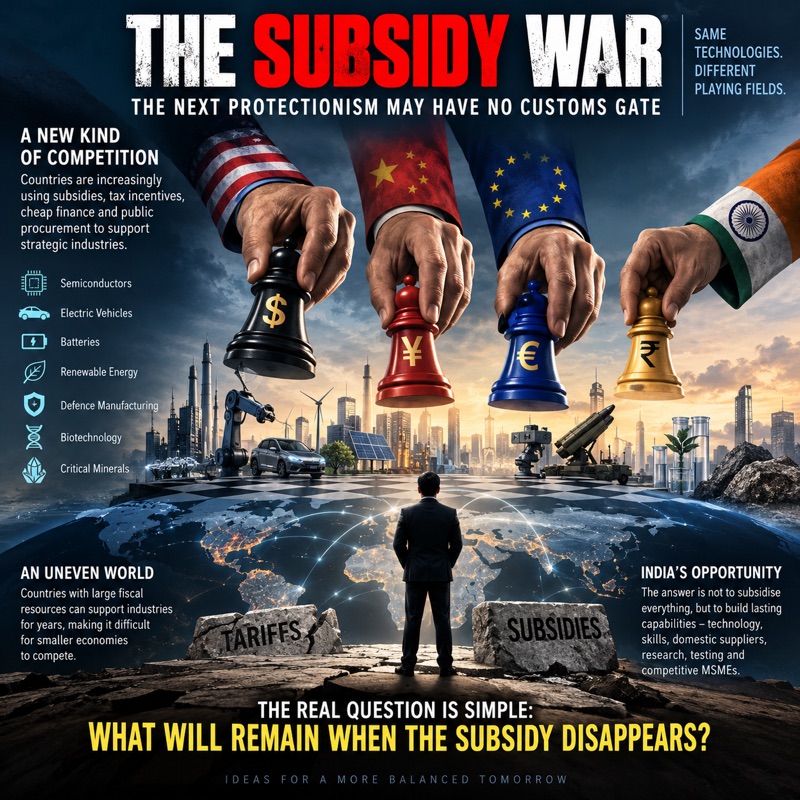
The Subsidy War: When Governments Become Competitors

For much of the last three decades, the visible face of protectionism was the tariff. Governments raised duties, imposed quotas or restricte...