Wednesday, June 15, 2011

Cluster Governance

The recent civil society agitations have highlighted an important issue of governance within the congress party. In spite of all good intentions by the government, what is missing is the face of governance. There is excess of virtual governance by the leadership. This has to some extent resulted into trust deficit with the common men.Dr. Manmohan Singh need to more visible to common public to convert the values of government in the belief of people. Similarly the role of field agency and leadership is critical important to make any cluster globally competitive. How a cluster leadership conduct itself in the cluster is very important. The play of cluster norms through cluster networks converting into functional trust is direct function of leadership or more clearly the visible leadership.

Thursday, April 21, 2011

NEW STAKEHOLDERS IN CLUSTER DEVELOPMENT IN INDIA

In the last six month there is daily news in the newspaper on the role of national chambers in the development of clusters. A new bred of stakeholders in the cluster development work is evolving due to a large chunk of funds is allocated to Clusters related activities by Government India.

Most of the National Industry Chambers suddenly activated interest in MICRO SMALL AND MEDIUM ENTERPRISES (most of these Chamber don’t even have provision to make MSMEs as their members). The inorganic growth of such stakeholders also doesn’t understand the actual meaning of cluster. There is now competition among chambers to control the large amount of funds available for cluster development.

The very interesting part of the scenario is that anything and everything related to group of firms is equated to a cluster (unlike network) if CII is working with 10 companies for quality improvement they call it cluster development programme.

The cluster concept by new stakeholders in cluster development is perceived in a much narrower and very limited sense and to a great extent not even actually applying cluster development tools for actual competitiveness of the clusters.

Wednesday, November 26, 2008

100 GIs in India

The registration of Geographical Indications has reached to 100 in the last 4 four years .  An interesting dimension observed in GI registration is that a number of government agencies specially state governments have not only started the facilitation of GI work in their respective states but also started owning some GIs on behalf of local Communities. One of the first states to play a proactive role in GIs was Himachal Pradesh. Similarly, Karanataka and WestBengal have also filed a number of GI cases.
Recently,  GOI has given mandate to APEDA to work on filling of GI for basmati rice. 
The Genesis of GI Act rest on the fact that the owner of the GI should ensure benefits of GI registration should go the producers of the product. With the rise of third party ownership of GI registration there is strong possibility that such benefits will dilute or may not accrue to the producers.

The  best model to own GI is the producers themselves. The most appropriate example of this is Darjeeling TEA, where the TEA board, which is a producers organisation, own the Darjeeling TEA GI. Needless to say that after GI TEA producers have been jointly benefited.

With 100 GIs another undesired development observed  is mad rush for GI registration. There are different kinds of arguments like in one the cases in Karnataka a particular type of banana is registered to revive its production.

It seems that there is need for more sensitisation on the significance of GI in three different contexts. Regional Context- where GI can become one of the tools to empower local economy secondly,  at the national level where  through GI  misuse of potential market may be avoided third at international level where GI  may help in better respect for our products in international markets.

The issues such as quality control, good supply chain management and traceability of GI products require special attentions by the owners of GI.

The use of Information Communication Technology specially use of web in popularising of GI products, list of producers and unique qualities may be very useful.


Thursday, July 10, 2008

THE EXPERIENCE SHARING OF CLUSTER RELATED DEVELOPMENTS

Cluster Development Policy initiatives are increasing in number in both developed and developing countries. In the next six months two important events happening to share such experiences.
The conference on 22nd and 23rd September in Berlin presents latest achievements and new initiatives of cluster development in European countries . The focus will be on know-how on the current development of European cluster initiatives and efficient cluster management. International experts will show solutions for national and regional authorities. Representatives of cluster initiatives share their experience on management tools, transnational clusters, national programmes and the role of national authorities in regional development policies. As a communication platform this conference brings together actors of cluster management from public institutions in charge of innovation and regional development policy, research institutes, universities and the private sector

The conference brouchure is available at : http://www.europaeische-akademie.net/fileadmin/user_upload/dateien/seminare/Brochure_Cluster-Policy_PR.pdf

The second event will take place at Cape Town, South Africa. The theme of the conference is CLUSTERS: Meeting the Challenge of Globalization. The conference will during its three days programme 29-31 october will cover the following main areas:
Clear methodologies around managing cluster programmes
1. Shifting the frontiers regarding the measurement and impact of cluster initiatives
2. Fine tuning the practical tools to be applied by cluster practitioners
3. Identification of the challenges and opportunities in running cluster initiatives and programmes
More information on conference is available at :
http://www.sbs.co.za/tci2008/

Friday, June 6, 2008

Information and Communication Technology Infrastructure in Industrial Clusters

To integrate into global economy is one of the biggest challenges for MSMEs. Due to limited financial capabilities there are challenges to invest in technology which is necessary for such integration. Recently, during the discussion with one of the buying houses the doubts were raised on the logistic readiness of MSMEs to match with international retail chains. What should we do for this? Internationally Technology Centers are playing an important role to support small and medium enterprises by providing state of art ICT support. Recently, Microsoft under project Vikas has set up India’s first E-readiness centre to facilitate extensive application of ICT in Tirupur Knitwear Cluster in India. It will help more than 5000 textile units to get access to latest useful IT applications, an interesting read in todays’ THE HINDU at http://www.thehindu.com/2008/06/06/stories/2008060657360100.htm

Friday, May 23, 2008

Cluster Development Strategy

MSMEs to become Globally Competitive it requires a strategy over and above the normal production function. Michael E. Porter is arguably the best known name in the world for competitive strategy. Is it possible to use his strategy for the competitiveness of MSMEs? Porter in his work on Competitive advantage of Nations in 1998 observed that the 18th century work of Adam Smith and David Ricardo on factor comparative advantage cannot provide explanations for most of the trade that takes place today. The diamond model proposes four interrelated facets, each of which representing a determinant of regional advantage: (1) firm strategy, structure and rivalry; (2) demand conditions; (3) factor conditions; and (4) related and supporting industries. “Chance” and the “government” are two factors that influence these four determinants, but are not determinants themselves. Together these six factors form a system that differs from location to location, thus explaining why some firms (or industries) succeed in a particular location. Not all six factors need to be optimal for firms or industries to be successful.

However it is argued that Porter’s model is more effective in developed countries rather than in developing countries. There are some alternative strategies explaining the competitiveness of MSMEs in current global scenario. These are Collective efficiency by Schmitz (1995) and flexible specialization by Piore and Sabel (1984)

This week The Times of India covered a very interesting interview on M porter’s views on Strategy http://timesofindia.indiatimes.com/Business/Strategy_is_about_competitive_advantage/articleshow/3054691.cms
Also very interesting read for two alternate theories at http://www.ifama.org/tamu/iama/conferences/2001Conference/Papers/Area%20VI/Neven_David.PDF

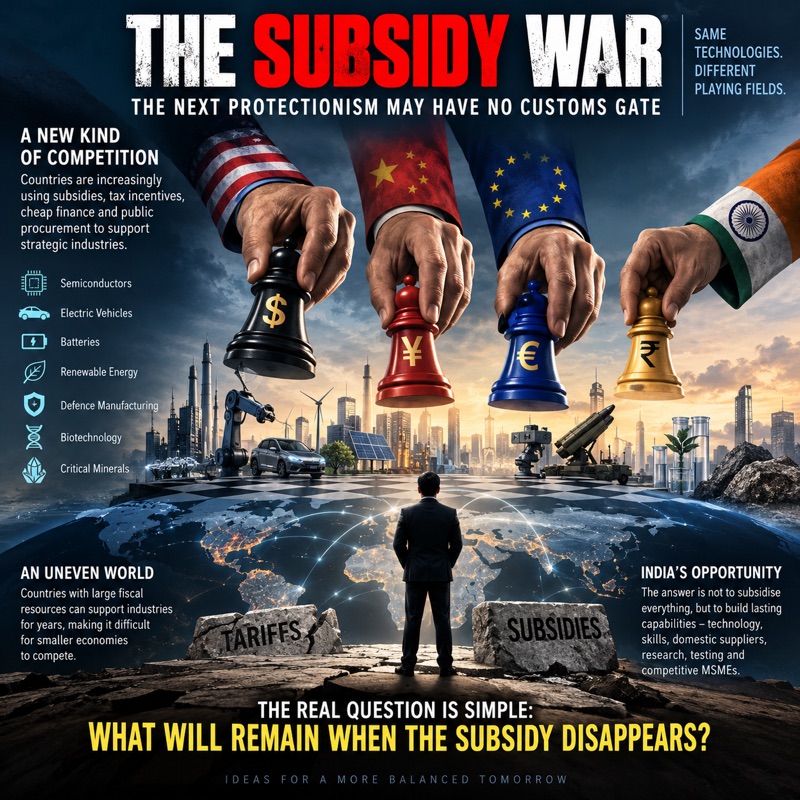
The Subsidy War: When Governments Become Competitors

For much of the last three decades, the visible face of protectionism was the tariff. Governments raised duties, imposed quotas or restricte...