Thursday, July 10, 2025
Startups, Substance, and the Indian Dilemma: Rethinking Our Investment Priorities
Wednesday, July 9, 2025
The Quick Commerce Onslaught: Are India’s Kirana Stores Being Sidelined in Their Own Streets?
Sunday, July 6, 2025
Micro Enterprises, Multi-Skills, and the Power of Scalability: What India Can Learn from a Leather Repair and Barbershop Model in Washington DC
Saturday, July 5, 2025
India’s MSMEs and the Commonwealth Opportunity: Tapping Global Value Chains Through Inclusive Trade
Roughly 70% of India’s MSMEs operate in the services sector, while the remaining contribute to manufacturing—an area recognized as a key pillar of both domestic self-reliance and export-oriented growth. As India intensifies its integration into global trade ecosystems, there is increasing focus on how the country’s MSMEs can leverage the Commonwealth's unique economic framework to expand their footprint across borders.
The Commonwealth of Nations, comprising over 50 member states that share historical ties, a common language base, and often similar institutional and legal structures, presents a fertile ground for small enterprises seeking market access. The trust, compatibility, and lower entry barriers within the Commonwealth bloc offer strategic advantages for MSMEs, particularly those from developing economies like India.
India has actively championed initiatives aimed at enhancing cross-border trade, procurement linkages, and shared digital platforms for MSMEs. The emphasis is now on deepening collaboration within the Commonwealth—through joint platforms, harmonized standards, digital infrastructure, and shared learning frameworks—to facilitate the participation of smaller firms in global value chains.
However, the path is not without challenges. MSMEs often struggle with limited access to finance, inadequate exposure to international markets, and compliance with diverse regulatory frameworks. These constraints become even more pronounced when entering new territories. Yet, the very nature of the Commonwealth—as a voluntary association with collaborative ethos—provides the foundation to address such issues through shared resources and policy harmonization.
One of the key messages emerging from ongoing trade dialogues is that while challenges are inevitable in such a diverse economic family, there also exist collective solutions. Building bridges through knowledge sharing, capacity building, and digital connectivity can significantly ease the burden for smaller enterprises aspiring to go global.
India’s MSMEs, with their innovative edge, cost competitiveness, and sectoral diversity, are well positioned to play a leading role in shaping the future of inclusive Commonwealth trade. Whether it's services-driven startups or traditional manufacturers, the opportunity lies in creating ecosystems that are mutually reinforcing, scalable, and open to transformation.
By fostering strategic partnerships and creating a shared agenda for MSME internationalization, India and its Commonwealth partners can unlock new pathways for sustainable development and trade resilience. The future of MSMEs lies not just in domestic reforms, but in international cooperation that translates ambition into access and potential into performance.
#IndiaMSMEs
#InclusiveTrade
#CommonwealthTrade
#GlobalValueChains
#SMEInternationalization
#MarketAccess
#TradeResilience
#SustainableGrowth
#CrossBorderTrade
#MSMEOpportunities
Friday, July 4, 2025
Redefining Urban Innovation: The UAE–India Model for Equitable Urban Growth
India is projected to add over 400 million urban dwellers by 2050, making urban management a top policy concern. Simultaneously, the UAE, with its futuristic cities like Dubai and Abu Dhabi, is positioning itself as a global hub for smart urban solutions. What makes this partnership unique is not merely the scale of infrastructure investments or commercial linkages, but the shared vision of urban transformation through innovation and inclusive governance.
At the heart of this collaboration lies the concept of city diplomacy—where cities themselves act as actors in international relations. This model enables direct exchange of urban policy practices, digital governance frameworks, and technology-enabled solutions for real-time challenges such as traffic congestion, waste management, energy efficiency, and equitable housing.
For instance, India’s Smart Cities Mission and the UAE’s Smart Dubai initiative have found common ground in areas such as AI-driven urban planning, public service digitization, and data governance. Joint ventures in these sectors are not only promoting economic integration but also helping align urban development with the Sustainable Development Goals (SDGs), particularly Goal 11: Sustainable Cities and Communities.
Furthermore, trade and investment flows between the two nations—fueled by initiatives like the India–UAE Comprehensive Economic Partnership Agreement (CEPA)—are strengthening the foundation for technology transfers and capacity building. These developments are enabling Indian cities to leapfrog outdated models and adopt scalable smart city frameworks that are financially sustainable and environmentally responsible.
What also stands out is the emphasis on equitable growth. Urban innovation, when solely driven by private capital, often risks deepening socio-economic divides. However, by embedding principles of inclusivity and knowledge-sharing into the UAE–India cooperation model, there is a deliberate effort to ensure that the benefits of modernization reach marginalized communities as well. From affordable housing blueprints to skill development programs and inclusive public transport systems, these initiatives aim to democratize urban opportunity.
As global cities continue to face climate volatility, demographic pressures, and resource scarcity, partnerships like that of UAE and India point toward a future where mutual learning and joint innovation are key to resilient urban ecosystems. By going beyond the hardware of development and focusing on the software—data, dialogue, and diplomacy—this collaboration offers a replicable blueprint for other nations aspiring to build smarter, fairer, and more livable cities. #UrbanInnovation
#CityDiplomacy
#SmartCities
#IndiaUAEPartnership
#EquitableGrowth
#DataDrivenGovernance
#SustainableUrbanDevelopment
#TechnologyCollaboration
#SmartInfrastructure
#InclusiveUrbanization
Wednesday, July 2, 2025
India’s Employment Puzzle: Growth Without Jobs?
Tuesday, July 1, 2025
Unlocking Profitable Manufacturing Potential from Forestry Products in India
#ForestryManufacturing
#BambooIndustry
#TimberProcessing
#NonTimberProducts
#ValueAddition
#SustainableBusiness
#Agroforestry
#BiomassEnergy
#ForestBasedEnterprises
#EcoFriendlyProducts
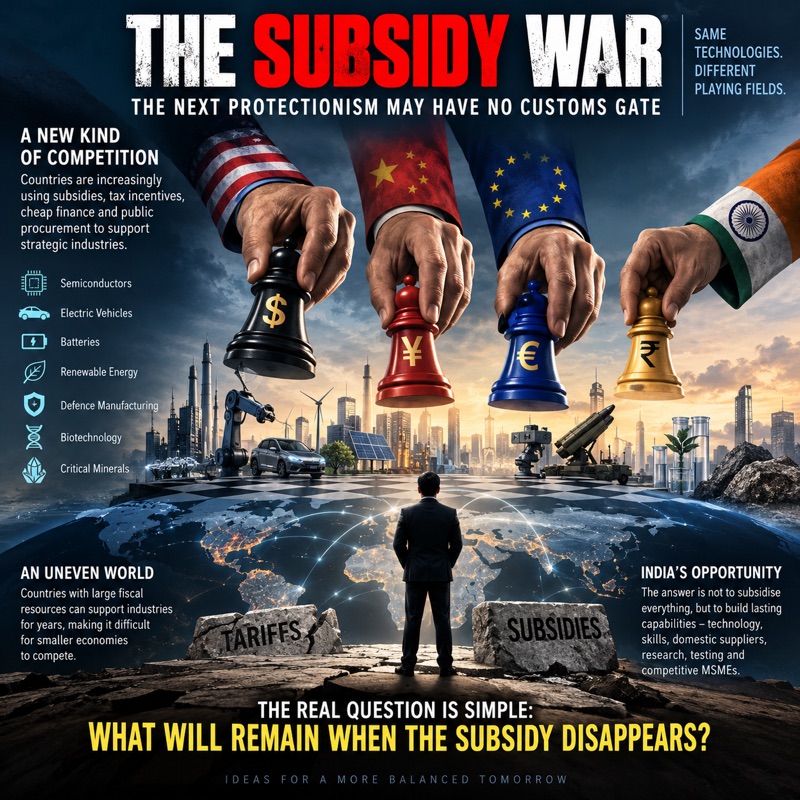
The Subsidy War: When Governments Become Competitors
For much of the last three decades, the visible face of protectionism was the tariff. Governments raised duties, imposed quotas or restricte...
-
A Moment of Transition: Setting the Stage for Global AI Governance The recent AI summit held in New Delhi stands as a pivotal po...
-
India’s agricultural economy is with a structural shift that could redefine how farmers earn, how sustainability is rewarded, an...
-
Agriculture has long been the bedrock of civilisation — from ancient ploughs turning soil in the Fertile Crescent, to the high-t...