Tuesday, June 10, 2025

Gen Z’s Saree Revival: Drape, Disrupt, Define

From international film festivals to skate parks in Indian cities, the saree is staging a remarkable comeback — and the credit goes to Gen Z. This generation, known for its creativity and willingness to defy convention, is redefining the way sarees are worn, shared, and celebrated. With fluid identities and a strong digital presence, Gen Z is taking a traditionally feminine and formal garment and turning it into a symbol of self-expression, inclusivity, and innovation.

Social media has become the new runway for this transformation. A growing wave of young content creators is making sarees relevant again by combining tradition with personal style — pairing them with sneakers, jackets, crop tops, and even skateboards. Tutorials and fashion content around alternative drapes — over jeans, palazzos, and modern silhouettes — are gaining traction online, making the saree more accessible to younger audiences. These new-age stylings eliminate the need for conventional blouses or petticoats and replace them with items already in most wardrobes, encouraging experimentation over expectation.

The trend is not confined to India alone. Among the diaspora and even among non-Indian consumers, interest in sarees is growing. This was highlighted when a major international luxury brand labeled an unconventional draped ensemble as a saree at a high-profile film festival, drawing attention from fashion critics and younger audiences alike. Iconic appearances in traditional handwoven textiles by well-known Indian personalities also fueled interest, leading to wider social media engagement and fashion coverage.

This resurgence is also being seen at the business end of the fashion industry. Several boutique saree labels have reported a significant shift in their buyer demographics, noting a sharp rise in customers aged 18 to 25. What used to be a garment largely bought by women above 25 is now being embraced by college students and young professionals — despite average price points starting at ₹2,500 and higher. Younger consumers are no longer deterred by perceptions of complexity or conservatism. In fact, they are actively embracing the saree’s versatility.

Some saree brands focused on everyday wear and handwoven comfort have found that Gen Z is not only one of their fastest-growing consumer groups but also a major driver of intergenerational appeal. Often, it’s the younger buyers who introduce older family members to new-age saree brands through digital content and social media engagement. These brands, some with annual revenues exceeding ₹70 crore, are leveraging this new enthusiasm by expanding their presence through exclusive brand outlets.

For Indian-origin entrepreneurs selling globally, the demand from international markets is equally promising. Sarees are now being purchased in large volumes across countries like the U.S., U.K., Australia, Canada, and Singapore. One such brand, which began with sales on a global handmade marketplace, now derives 90% of its revenue from abroad — with over 65% coming from the U.S. alone. Interestingly, the very first order they received was from a non-Indian customer in France — a signal of how cultural curiosity and fashion fluidity are blurring traditional boundaries.

Sarees are no longer boxed into weddings, religious ceremonies, or ethnic days at work. They are being reimagined as tools of everyday elegance, cultural pride, and gender fluidity. Even men and members of the LGBTQIA+ community are participating in this shift, using drape therapy and custom styling to reclaim the saree on their own terms.

This saree revival isn’t just about a garment — it’s about storytelling. It reflects a desire to connect with roots while staying global, to honor tradition while staying free from its limitations. And Gen Z is not waiting for permission. They are styling the saree as they please — playful yet powerful, experimental yet elegant — turning a once ceremonial outfit into a canvas of personal expression.

In short, this is not a return to the saree — it’s a reinvention. And it’s here to stay.

#GenZFashion
#SareeRevival
#ModernDrapes
#CulturalFusion
#SustainableStyle
#DigitalInfluence
#GenderFluidFashion
#GlobalIndianWear
#SareeNotStereotype
#TraditionMeetsTrendy

Sunday, June 8, 2025

New York and NCR Delhi – Insights and Learnings

The metropolitan areas of New York and Delhi NCR stand as two of the most complex and dynamic urban regions in the world. Each represents the economic, political, and cultural heartbeat of its respective country. Yet, these megaregions are vastly different in their size, population, governance structures, and developmental models. By understanding these differences, and by drawing lessons from one another, especially from New York’s structured regional planning, India’s National Capital Region (NCR) can gain valuable insights for its own sustainable and inclusive growth.

The New York Metropolitan Area, often referred to as the Greater New York or the Tri-State Area, includes New York City and its surrounding regions in the states of New York, New Jersey, Connecticut, and even parts of Pennsylvania when viewed through the lens of the Combined Statistical Area (CSA). The core New York–Newark–Jersey City metro area spans approximately 6,140 square miles (15,903 km²), while the broader CSA stretches to around 13,318 square miles (34,493 km²). Within this vast urban sprawl, the actual developed landmass stands at about 4,669 square miles (12,093 km²).

On the other hand, the National Capital Region (NCR) of India, anchored by the National Capital Territory (NCT) of Delhi, includes surrounding districts from the states of Haryana, Uttar Pradesh, and Rajasthan. This region is significantly larger in area than the New York metro, covering approximately 55,083 km² (21,267 square miles). However, the urban core of Delhi itself is compact, covering just 1,484 km² (573 square miles).

Population dynamics between the two megaregions also present stark contrasts. The New York metropolitan area is home to an estimated 19.15 million people as of 2025. New York City itself, one of the most densely populated urban centers globally, has a density of around 29,303 individuals per square mile (11,314/km²). In contrast, the NCR Delhi region is much more populous, with estimates suggesting a population exceeding 46 million. Even Delhi’s core alone had a population of 16.8 million back in 2011, which has grown significantly in recent years. The population density in Delhi city proper was recorded at 11,297/km² in 2011.

While both megaregions span multiple jurisdictions—four states in the case of New York and three states plus a Union Territory in the case of Delhi—their governance structures differ. NCR Delhi is overseen by the National Capital Region Planning Board (NCRPB), a centralized authority that coordinates planning across state lines. Conversely, New York’s metro governance is more decentralized, handled by multiple municipal and state-level bodies such as the Metropolitan Transportation Authority (MTA) and regional planning councils. Despite this fragmentation, New York has succeeded in maintaining functional infrastructure and inter-state collaboration, a model Delhi could adapt more effectively.

Economically, both metros are pivotal to their countries. New York, however, is unmatched in its global economic influence, with the metro area boasting the world’s largest gross metropolitan product. Delhi NCR, while powerful regionally, is still evolving in its ability to compete on the same global scale, particularly in terms of integrated infrastructure and livability.

The contrast between these two megaregions is not just academic. It opens a window for valuable urban policy cross-learning, especially from New York’s Tricity region—referring to New York–Newark–Jersey City—which offers several best practices that can inform the future of NCR Delhi.

A key lesson is in integrated regional planning. New York's ability to coordinate between states for transportation, housing, and environmental management is crucial for sustainable development. NCR Delhi, with its rapidly expanding suburbs and cross-state migration, requires similarly robust coordination mechanisms. While NCRPB exists, its effectiveness is hampered by weak enforcement and limited funding authority.

Public-private partnerships have played a transformative role in New York’s urban development—from the revitalization of Times Square to the High Line park. Delhi can adopt such models to upgrade public spaces, improve housing quality, and boost infrastructure without solely relying on public funds.

Transportation is another area of divergence. New York’s highly integrated system of subways, buses, ferries, and regional trains is a global benchmark. It allows millions to commute efficiently every day. Delhi’s Metro system is commendable and growing rapidly, but lacks last-mile connectivity and seamless integration across NCR districts. Enhancing regional rail, building multimodal transit hubs, and improving walkability should be top priorities for Delhi planners.

New York also serves as a leader in climate adaptation and urban resilience. Facing challenges like sea-level rise, the city has integrated green infrastructure and long-term sustainability into its urban fabric. NCR Delhi, on the other hand, battles severe air pollution, water scarcity, and urban heat without adequate systemic responses. Strategic investments in environmental resilience—such as urban forests, water reuse, and sustainable zoning—are imperative.

Finally, New York’s emphasis on inclusivity and community participation stands out. The city’s zoning regulations, housing initiatives, and public engagement forums aim to reduce inequality and give voice to marginalized groups. Delhi can take inspiration from this to ensure slum rehabilitation, affordable housing, and participatory urban planning reach the underserved populations in satellite towns like Ghaziabad, Faridabad, and Bhiwadi.

In summary, while NCR Delhi surpasses New York in physical area and population, it still lags in terms of integrated governance, infrastructure coordination, and environmental planning. Learning from New York’s successes in regional collaboration, transit innovation, and inclusive urbanism can help Delhi evolve into a truly global megaregion.

As the challenges of rapid urbanization continue to mount, the path forward lies not just in growing bigger, but in becoming smarter, more inclusive, and more resilient—values that New York exemplifies and NCR Delhi must now embrace.
#UrbanPlanning
#NCRDelhi
#NewYorkMetro
#RegionalGovernance
#MassTransit
#SustainableDevelopment
#PopulationDensity
#PublicPrivatePartnership
#ClimateResilience
#InclusiveCities


Friday, June 6, 2025

Creative and Cultural Industries: Powering the Next Wave of Global Growth

In an era increasingly driven by intangible assets, Creative and Cultural Industries (CCIs) have emerged as powerful engines of economic, social, and cultural transformation. From film and music to fashion, publishing, design, digital arts, and heritage, CCIs weave together innovation and identity — and in 2025, their role is more vital than ever.


🌍 Market Size and Global Significance

As of 2025, the global market value of Creative and Cultural Industries exceeds $2.4 trillion, contributing over 3% to global GDP, and employing nearly 30 million people worldwide. Notably, these industries are growing faster than traditional manufacturing sectors in many economies — particularly in emerging markets.

Asia-Pacific leads in CCI exports (China, South Korea, and India), while Europe dominates cultural tourism and design services.

In countries like Nigeria, Mexico, and Indonesia, CCIs contribute significantly to youth employment and national branding.

🧠 Key Features That Set CCIs Apart

1. Human-Centric and Skill-Intensive
Unlike capital-heavy industries, CCIs rely primarily on creativity, talent, and cultural expression — making them accessible, scalable, and inclusive, especially for youth and women.


2. Fusion of Art and Technology
CCIs are at the forefront of digital transformation — merging tradition with innovation through streaming platforms, NFTs, AI-generated design, and AR/VR in gaming and immersive storytelling.


3. Cultural Diplomacy and Soft Power
Countries are increasingly using CCIs as tools of soft power — promoting their global image through cinema (e.g., Bollywood, K-pop), fashion, crafts, and cuisine.

📈 Economic Impact and Employment Trends

Job Creation: According to UNESCO, CCIs generate one job every second globally, with growth driven by digital media, advertising, design, and content production.

Gig and Freelance Ecosystem: A large share of employment is freelance, providing flexibility but also posing challenges related to job security and social protection.

Urban and Rural Linkages: While urban centers host design studios and digital firms, rural areas contribute through handicrafts, folklore, textiles, and local heritage tourism.

🌱 Sustainability and Inclusion

Green CCIs: There's a growing push for sustainable practices in design, fashion, and architecture — with upcycling, slow fashion, and eco-art gaining ground.

Gender and Diversity: Women-led enterprises are thriving in sectors like publishing, visual arts, and artisan crafts. CCIs also amplify marginalized voices and promote cultural pluralism.

🚧 Challenges and Critical Reflections

Despite their promise, CCIs face systemic challenges:

Intellectual Property Rights (IPR): Weak enforcement in many regions undermines creators’ income and innovation.

Informality: Many artists and artisans operate outside the formal economy, lacking access to finance, insurance, and institutional support.

Digital Divide: While technology boosts reach, digital exclusion still affects rural and underprivileged communities.

🔑 Policy Priorities and Strategic Opportunities

Governments and institutions can unlock the potential of CCIs through:

1. Creative Clusters and Innovation Hubs
Establishing CCI zones in cities and rural districts to foster collaboration, training, and entrepreneurship.

2. Education and Skill Development
Introducing creative economy curricula in schools and universities, alongside vocational training in crafts, media, and design.

3. Public Investment and Incentives
Offering grants, tax breaks, and incubation support for startups and creative entrepreneurs.

4. Export Facilitation
Supporting artisans, filmmakers, designers, and cultural firms to access global markets through branding, certifications (like GI tags), and trade fairs.

5. IPR Reform and Regulation
Enhancing frameworks to protect creativity and enable monetization of digital content.

🔮 Creativity as Capital

In the 21st-century economy, creativity is not a luxury — it is capital. CCIs exemplify how economic value can arise from human imagination, storytelling, and heritage. They connect tradition with modernity, employment with empowerment, and local identity with global visibility.

If harnessed properly, CCIs can not only revive post-pandemic growth but also reshape economies to be more inclusive, innovative, and resilient.
#CreativeEconomy
#CulturalHeritage
#DigitalArts
#DesignThinking
#SoftPower
#CreativeJobs
#CulturalTourism
#SustainableDesign
#IPRProtection
#GlobalBranding

Wednesday, June 4, 2025

The Brainpower Economy: Why the Quaternary Sector Fuels Future Growth

As the global economy evolves, it is increasingly powered not by physical labor or natural resources, but by knowledge, innovation, and digital services. This transformation is embodied in the quaternary sector—the branch of the economy focused on information technology, research and development (R&D), data analytics, consultancy, education, and intellectual services.

Often overshadowed by agriculture, manufacturing, and traditional services, the quaternary sector is fast becoming the most strategic pillar of modern economic development and employment growth. Here's why:

1. High-Quality Job Creation That Fuels Demand

The quaternary sector generates high-skilled, well-paying jobs that significantly elevate purchasing power and stimulate broader economic activity. Jobs in fields such as artificial intelligence, cloud computing, biotech research, and fintech not only increase personal incomes but also support the growth of ancillary industries—from housing and education to transport and leisure. In economies transitioning from industrial to knowledge-based systems, this sector has become the main engine of employment generation. 

2. Catalyst for Innovation and Technological Leapfrogging

This sector is the heart of innovation ecosystems. R&D labs, tech startups, and research institutions drive the creation of new technologies and ideas. The spillover effect of this innovation cycle enhances productivity in manufacturing, agriculture, and services alike. For example, advancements in AI have revolutionized logistics, precision agriculture, and even urban planning, increasing efficiency and output economy-wide. 

3. Economic Diversification and Shock Resistance

Unlike traditional sectors that are vulnerable to price volatility or climate shocks (e.g., agriculture or oil), the quaternary sector builds economic resilience. It fosters the emergence of dynamic industries like software, fintech, medical research, and e-learning, which are less dependent on physical inputs and more aligned with global demand trends. Countries that invest in this sector tend to withstand global recessions better, as their economies are less mono-structured. 

4. Cross-Sectoral Efficiency Booster

The impact of the quaternary sector is amplified through its support role to all other sectors. Smart farming technologies, digital platforms for MSMEs, cloud-based financial tools for SMEs, and big data analytics in retail are prime examples of how knowledge services raise productivity, competitiveness, and market access across the board. Without these inputs, traditional sectors cannot scale in the digital era. 

5. Boost to Tax Revenues and Public Investments

With higher wages, digital businesses, and exportable services, the quaternary sector expands the tax base. This allows governments to invest more in education, infrastructure, and welfare, creating a virtuous cycle of development. This is especially critical in developing countries where public finance needs are rising. Economies like South Korea, Singapore, and Israel showcase how knowledge industries can finance national aspirations. 
6. Global Competitiveness and Soft Power

In the 21st century, intellectual capital is global currency. Nations strong in the quaternary sector attract FDI, top talent, and innovation partnerships, giving them a competitive edge on the world stage. Whether it's India’s software exports, Israel’s cybersecurity prowess, or Germany’s engineering consultancy, countries with strong quaternary industries also enjoy enhanced geopolitical influence 


From Brawn to Brains

The rise of the quaternary sector signals a decisive shift in the architecture of modern economies—from brawn to brains, from factories to ideas, from manual labor to intellectual services. Its contributions to economic development, quality employment, and resilience make it not just important, but indispensable in the path toward sustainable and inclusive growth.

As governments and businesses reimagine their development strategies, investing in the quaternary sector is no longer optional—it’s imperative.

#KnowledgeEconomy #QuaternarySector #EmploymentGrowth #InnovationDrivenDevelopment #DigitalTransformation #ITandR&D #EconomicResilience #HighSkillJobs #SmartEconomy #SustainableGrowth

Tuesday, June 3, 2025

The Silent Storm: India’s Looming Agricultural Crisis and Its Far-Reaching Implications

India’s agricultural sector—often called the backbone of the nation—is now on the brink of a deep and multifaceted crisis. While agriculture continues to provide livelihood to over 50% of India’s workforce, its contribution to GDP has steadily declined, now hovering below 18%. This paradox—high employment yet low productivity and economic return—reveals a sector burdened by systemic challenges. What lies ahead is not merely a downturn, but potentially a crisis that could disrupt rural livelihoods, food security, and the broader economy.

Understanding the Depth of the Crisis

The emerging agricultural crisis is not due to one single cause—it is the cumulative outcome of several intersecting forces, including:

1. Climatic Stress and Unpredictability

Erratic monsoons, extended dry spells, and increasing frequency of extreme weather events like floods and heatwaves are severely affecting crop cycles.

According to IMD data, rainfall variability has increased by over 25% in the last two decades, disrupting sowing and harvesting patterns.

Groundwater depletion, particularly in Punjab, Haryana, and parts of Maharashtra, is further exacerbating the crisis, limiting irrigation capacity for millions of farmers.

2. Economic Distress and Input Cost Escalation

Farmers are struggling under the weight of rising input costs—including seeds, fertilizers, diesel, and pesticides—while farmgate prices remain stagnant.

According to NSSO data, the average monthly income of an agricultural household in India was ₹10,218 in 2019, of which a significant portion comes from non-farm activities.

Margins are being squeezed tighter, forcing many into a cycle of debt, and pushing small and marginal farmers into distress.

3. Environmental Degradation and Soil Health Decline

Years of excessive fertilizer use and monocropping (especially of rice and wheat) have led to nutrient-deficient soils and declining yields.

The National Bureau of Soil Survey estimates that nearly 30% of India’s land is degraded, impacting long-term agricultural sustainability.

4. Socio-Structural Vulnerabilities

Small and fragmented landholdings—more than 86% of farmers hold less than 2 hectares—limit the scope for mechanization and economies of scale.

Young people are migrating away from farming, considering it unviable and unattractive, resulting in an aging farming population and weakening rural structures.

5. Policy Paralysis and Structural Disconnect

While schemes like PM-KISAN, e-NAM, and crop insurance exist, implementation gaps and lack of localized planning reduce their effectiveness.

MSP (Minimum Support Price) benefits often fail to reach farmers in remote or eastern states due to weak procurement infrastructure.

Agricultural reforms have been politically sensitive, with trust deficits between farmers and policymakers hampering modernization efforts.

Why This Is a National Concern

The potential collapse of agriculture has implications beyond rural India. Here's why this crisis must be seen as a national economic risk:

Food Security: A drop in domestic production could trigger price inflation and increased dependence on imports, undermining India’s self-sufficiency.

Rural Economy: With agriculture being a primary rural employer, the ripple effects on employment, consumption, and demand could stall broader economic recovery.

Social Stability: Unaddressed rural distress could lead to migration surges, urban unemployment, and agrarian unrest, as seen in past farmer protests.

Fiscal Stress: Government spending on subsidies, loan waivers, and relief measures would rise, potentially compromising investment in infrastructure and innovation.

Charting the Way Forward

Addressing this looming crisis requires multi-dimensional reforms, not quick fixes. Some key imperatives include:

Agro-climatic zoning and diversified cropping patterns to make agriculture climate-resilient.

Investing in irrigation infrastructure, soil health cards, and precision farming tools to boost productivity sustainably.

Revamping the agri-market ecosystem, especially with better storage, transportation, and procurement systems, to ensure farmers receive fair prices.

Credit accessibility and financial literacy, so that farmers move away from informal loans and high-interest borrowing.

Youth engagement programs, such as promoting agri-tech startups, farm cooperatives, and skill training to revitalize rural entrepreneurship.

 From Crisis to Opportunity

India’s agriculture stands at a critical juncture. Ignoring the early warnings of this impending crisis could lead to severe socio-economic upheaval. However, with bold vision, inclusive policymaking, and ground-level interventions, this can be transformed into an opportunity to reinvent Indian agriculture—making it more resilient, remunerative, and sustainable.

The time to act is now. Because when agriculture fails, the entire nation trembles.

#IndianAgriculture #AgrarianCrisis #ClimateImpact #FarmersDistress #RuralEconomy #SoilDegradation #AgriculturalReforms #FoodSecurity #AgriPolicy #SustainableFarming

Monday, June 2, 2025

Unlocking Startup Potential in India: A Deep Dive into Government-Backed Funding and Support Schemes

India’s startup ecosystem has witnessed an explosive growth in recent years, becoming the third-largest in the world. However, funding constraints and early-stage challenges remain key roadblocks for new ventures. Recognizing this, the Indian government has rolled out several strategic schemes to provide financial and structural support to startups across sectors. These schemes not only catalyze innovation but also aim to create inclusive and sustainable entrepreneurial growth.

Here’s a closer look at five high-impact startup support initiatives in 2025, supported by data-backed reasoning and policy alignment.

1. Credit Guarantee Scheme for Startups (CGSS)

What’s New:
The maximum guarantee cover has been raised to ₹20 crore per borrower, reflecting the growing capital needs of scale-up stage startups.

Impact and Analysis:
This move significantly reduces the barrier of collateral for startups that often lack tangible assets, enabling them to access institutional credit through recognized lenders. With the rise of capital-intensive tech and manufacturing ventures, such collateral-free support is a game changer. Importantly, this scheme is restricted to DPIIT-recognized startups, ensuring accountability and eligibility monitoring.

2. Startup India Seed Fund Scheme (SISFS)

What It Offers:
Grants of up to ₹50 lakh for proof of concept, prototype development, product trials, and market entry.

Why It Matters:
Early-stage funding is often the riskiest and hardest to secure. SISFS directly addresses this ‘valley of death’ phase where many startups fail to transition from idea to product. For DPIIT-recognized startups incorporated within the last two years, this grant serves as essential seed capital, fostering innovation at its roots.

3. IN-SPACe Technology Adoption Fund

Scope:
With a corpus of ₹500 crore, this fund supports technology adoption and commercialization in India’s emerging space tech sector.

Funding Size:
Up to ₹25 crore per project.

Strategic Relevance:
As India intensifies its ambitions in the commercial space economy, this fund positions startups to lead innovation in satellite tech, space-based applications, and aerospace components. The fund underlines India’s shift from government-dominated space activities to a robust private participation model.

4. Mukhyamantri Yuva Udyami Vikas Abhiyan (CM Yuva) – Uttar Pradesh

Support Provided:
Interest-free, collateral-free loans up to ₹5 lakh for young entrepreneurs.

Eligibility:
Open to youth in Uttar Pradesh launching micro-enterprises.

Critical Importance:
This state-level intervention bridges the rural-urban divide in startup access. By offering interest-free capital, the scheme empowers grassroots entrepreneurship and contributes to balanced regional development, particularly among youth and marginalized communities.

5. Fund of Funds for Startups (FFS)

Structure:
Operates by investing in SEBI-registered Alternative Investment Funds (AIFs), which then deploy capital into promising startups.

Corpus:
₹10,000 crore.

Strategic Advantage:
This indirect funding model ensures that professional fund managers vet and guide investments, improving startup survival rates. By de-risking private investments and encouraging capital inflow from institutional investors, FFS plays a crucial role in nurturing innovation across diverse sectors.

Building a Startup Nation

India’s proactive funding and policy ecosystem demonstrates a strong commitment to nurturing innovation, job creation, and global competitiveness. These schemes reflect a tiered approach — supporting startups from ideation (SISFS) to growth (CGSS), to sectoral scaling (IN-SPACe), to inclusive regional development (CM Yuva), and finally, sustainable capital access (FFS).

For entrepreneurs navigating the Indian startup landscape, understanding and leveraging these schemes can mean the difference between stagnation and success.

#StartupIndia #SeedFunding #INSPACe #CMYuva #CollateralFreeLoan #InnovationFunding #DPIIT #Entrepreneurship #SpaceTechIndia #FundofFunds

Sunday, June 1, 2025

Empowering India's Startup Ecosystem: A New Dawn for Regional Innovation

India's startup revolution is no longer confined to the glass towers of Bengaluru or the co-working spaces of Gurugram. It has found its way to the vibrant towns of tier-2 and tier-3 India—places where ambition meets grit and dreams bloom beyond metros. One of the critical enablers of this transformation has been the evolution of media platforms that provide visibility to entrepreneurial voices otherwise lost in the crowd. Among them, one notable example has helped amplify over 100,000 stories of resilience, disruption, and innovation.

The startup media landscape in India began taking shape in the early 2000s, but it was only with the rise of digital storytelling platforms that grassroots narratives began receiving nationwide recognition. These platforms didn't just report on unicorn valuations—they spotlighted the underdogs, the social innovators, and the risk-takers from regions often left out of the mainstream economy.

A Startup Renaissance Beyond the Metros

This new ecosystem is being fortified by collaboration between visionary leaders and institutional capital. Backing from stalwarts such as Ratan Tata, leading venture funds like Kalaari Capital, and global entities like Qualcomm Ventures has brought not only legitimacy but critical funding to the ecosystem. Their investments have acted as catalysts—fuelling not just companies but communities of changemakers.

A prime example of this transformation is being witnessed in Assam. With dedicated support from the government and institutions alike, Assam is rapidly emerging as an innovation hotspot in India’s northeast. The recognition of regional ventures is not just symbolic—it marks a watershed moment for India’s decentralized startup landscape.

Assam’s Startup Vision: From Dream to Unicorn

This recognition reflects a shift in narrative—from viewing the northeast as a periphery to positioning it as a frontier of opportunity. The support aligns with Assam Chief Minister Himanta Biswa Sarma’s vision of fostering job creators instead of job seekers. This is in sync with the national agenda of Prime Minister Narendra Modi, who has long emphasized entrepreneurship as the backbone of India’s economic future.

But vision alone isn’t enough. Assam has paired ambition with action. The state became the first in India to establish a dedicated Department of Innovation, Incubation and Startups. This bold move institutionalizes startup support, offering structured mentorship, access to funding, incubation facilities, and exposure to global best practices.

Institutional Partnerships: The Backbone of a Thriving Ecosystem

The momentum in Assam is not just a policy push—it’s backed by academic, scientific, and technological collaborations. Universities like Tezpur University, Gauhati University, Kaziranga University, Royal Global University, and institutions such as the Guwahati Biotech Park and Central Institute of Technology, Kokrajhar are playing an instrumental role. These institutions are not only nurturing talent but actively participating in R&D, incubation, and commercialization of ideas.

National bodies like MeitY Startup Hub, Startup India, and industry forums like USISPF are bridging the gaps between innovation and market readiness. Coupled with platforms like MyGov India and digital media networks, the startup ecosystem is receiving the visibility and validation it needs.

The Road Ahead: Regional Ecosystems as Engines of Growth

India’s next wave of unicorns may very well emerge from cities not previously known for entrepreneurship. With over 85% of India's population residing outside metro cities, empowering tier-2 and tier-3 startups isn't just about inclusion—it's an economic imperative.

To sustain this momentum, the following steps are essential:

Robust infrastructure: From logistics to digital connectivity, enablers must match the ambition of regional entrepreneurs.

Access to capital: Venture capital needs to be democratized, with more funds willing to bet on early-stage, regional innovators.

Mentorship networks: Experienced professionals must volunteer time and guidance to nurture fledgling businesses.

Localized incubation: Incubators should align with local industries—agritech in rural belts, biotech in academic clusters, and crafts in heritage zones.


A Rising Tide of Inclusive Innovation

India’s entrepreneurial landscape is no longer homogenous. With conscious efforts to empower regional innovation, the country is paving the way for a more equitable, decentralized, and inclusive growth model. Platforms, policymakers, investors, and institutions are aligning to turn aspirations into accelerations. What we are witnessing today is not just a startup boom—it is a national movement of innovation, resilience, and economic transformation.
Innovation
#Entrepreneurship
#StartupIndia
#Tier2India
#AssamStartup
#JobCreators
#DigitalTransformation
#InclusiveGrowth
#InstitutionalSupport
#RegionalDevelopment

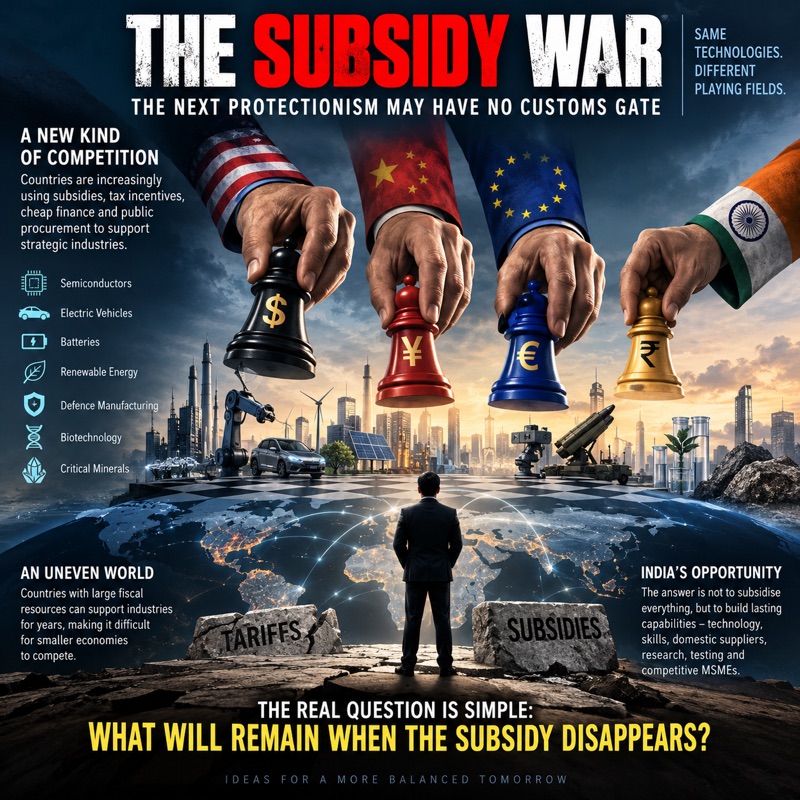
The Subsidy War: When Governments Become Competitors

For much of the last three decades, the visible face of protectionism was the tariff. Governments raised duties, imposed quotas or restricte...