Friday, October 6, 2023

The World Development Report 2023

Migration has long been an important driver of economic and social development. The World Development Report 2023: Migrants, Refugees & Societies, published by the World Bank, provides valuable insights into the role of migration in development and presents a holistic framework for managing migration to maximize its benefits.

The report highlights that migration is a global phenomenon, with an estimated 184 million international migrants in 2023, constituting 2.3% of the world's population. It emphasizes the positive impact of migration on development, such as boosting economic growth, creating jobs, and supporting innovation. Additionally, migrants contribute to poverty reduction and the improvement of living standards through remittances sent back to their home countries.

However, the report also acknowledges the challenges posed by migration. Migrants often face vulnerability to exploitation and abuse, encounter difficulties in integrating into new communities, and are at risk from climate change and natural disasters. These challenges call for effective policies and interventions to ensure the well-being and rights of migrants.

The integrated framework proposed by the report highlights two key factors in managing migration: the match between migrants' skills and the needs of destination countries, and the motives that drive migration. By aligning these factors, policymakers can ensure that migration is managed in a way that maximizes its positive impact on development.

To achieve this, the report presents several recommendations for policymakers. Firstly, improving data on migration is crucial for designing and implementing effective migration policies. Accurate and comprehensive data will enable governments to address the specific needs and challenges associated with migration.

Investing in human capital is another vital recommendation. By providing education and training opportunities for both migrants and non-migrants, countries can equip their populations with the skills needed for the global economy. This inclusivity ensures that everyone has the opportunity to succeed and contribute to development.

Promoting social cohesion is also highlighted as a key policy goal. Governments should strive to foster integration and cooperation between migrants and non-migrants, creating inclusive societies where everyone feels valued and supported. This social cohesion strengthens communities and enables migrants to fully participate in society.

Lastly, protecting the rights of migrants is crucial. Governments must take steps to ensure that migrants are safeguarded from exploitation and abuse, and that they have access to essential services and rights. This includes ensuring fair working conditions, access to healthcare, and legal protections.

In conclusion, the World Development Report 2023: Migrants, Refugees & Societies provides a comprehensive understanding of the relationship between migration and development. Its proposed integrated framework and recommendations offer guidance to policymakers in managing migration effectively. By embracing the challenges and opportunities posed by migration, governments can create a world where migration is safe, orderly, and regular, allowing all individuals to thrive and contribute to the development of their societies.

Wednesday, October 4, 2023

Economics of Climate Change

One of the key questions in the economics of climate change is how to measure the social cost of carbon (SCC), which is the monetary value of the damages caused by an additional ton of carbon dioxide (CO2) emitted into the atmosphere. The SCC reflects the present value of the future impacts of climate change on human welfare, such as health, agriculture, ecosystems, and infrastructure. Estimating the SCC requires making assumptions about the physical effects of CO2 emissions, the economic impacts of those effects, the discount rate used to convert future values into present values, and the distribution of costs and benefits across regions and generations. Different models and approaches can yield widely varying estimates of the SCC, ranging from a few dollars to hundreds of dollars per ton of CO2¹.

Another important concept in the economics of climate change is the marginal abatement cost (MAC), which is the cost of reducing one unit of greenhouse gas emissions. The MAC depends on the type and level of mitigation action, such as switching to renewable energy sources, improving energy efficiency, or planting trees. The MAC can also vary across countries and sectors, depending on their emission sources, technologies, and policies. Comparing the MAC with the SCC can help determine whether a given mitigation action is economically efficient, meaning that it generates more benefits than costs. Ideally, the MAC should be equal to the SCC for all emission sources, implying that society is achieving the optimal level of emissions reduction.

However, in reality, there are many market failures and barriers that prevent the efficient allocation of resources for climate change mitigation and adaptation. For example, there are externalities, which occur when some costs or benefits of an activity are not reflected in its market price. CO2 emissions are a negative externality, since they impose damages on others without being paid for by the emitters. To correct this externality, economists often recommend imposing a carbon tax or creating a cap-and-trade system that puts a price on carbon emissions and creates incentives for emission reduction. Another market failure is the public good nature of climate change mitigation, which means that its benefits are non-excludable and non-rivalrous. This creates a free-rider problem, where individuals or countries may prefer to enjoy the benefits of mitigation without contributing to its costs. To overcome this problem, economists suggest that international cooperation and coordination are needed to achieve a fair and effective distribution of mitigation efforts and costs among countries.

Besides market failures, there are also other factors that influence the decision-making process and behavior of individuals and organizations regarding climate change. These include uncertainty, risk aversion, time preferences, bounded rationality, social norms, and moral values. For example, uncertainty about the future impacts and costs of climate change may lead to underestimation or overestimation of the SCC and affect the willingness to pay for mitigation or adaptation actions. Risk aversion may imply that people prefer to avoid or reduce exposure to potential losses from climate change rather than pursue potential gains from adaptation or innovation. Time preferences may indicate that people discount future outcomes more heavily than present ones and thus give less weight to long-term consequences of climate change. Bounded rationality may imply that people have limited information and cognitive capacity to process complex and uncertain information about climate change and make optimal choices. Social norms may influence how people perceive and respond to climate change based on their cultural values, beliefs, and expectations. Moral values may motivate people to act on climate change based on ethical principles, such as justice, responsibility, or stewardship.

The economics of climate change is a dynamic and interdisciplinary field that draws on insights from natural sciences, social sciences, and humanities. It aims to provide rigorous and relevant analysis and advice for policy makers and stakeholders who face complex and urgent challenges related to global warming and its impacts. Some of the current research topics and debates in this field include:

- How to incorporate non-market values, such as biodiversity, ecosystem services,
and human rights, into the estimation of the SCC and other economic indicators
of climate change?
- How to account for tipping points, thresholds, and irreversibilities in the physical
and economic systems that may lead to abrupt and catastrophic changes due
to climate change?
- How to evaluate the co-benefits and trade-offs of mitigation and adaptation
actions for other policy objectives, such as poverty reduction, economic growth,
and social equity?
- How to design effective and efficient policy instruments and institutions for
climate change mitigation and adaptation at different levels of governance,
from local to global?
- How to foster behavioral change and social innovation for low-carbon
and resilient development in different contexts and sectors?
- How to enhance public awareness, engagement,
and participation in climate action and decision-making?
The economics of climate change is not only a scientific endeavor, but also a normative and political one. It involves making value judgments and ethical choices about the goals and criteria for climate policy, the distribution of costs and benefits among different groups and generations, and the trade-offs and synergies between climate change and other societal issues. Therefore, the economics of climate change should be informed by and responsive to the diverse perspectives and preferences of the stakeholders and the public, as well as the best available evidence and knowledge.


(1) The Economics of Climate. https://www.imf.org/external/pubs/ft/fandd/2019/12/pdf/fd1219.pdf.
(2) The Economics of Global Climate Change - Boston University. https://www.bu.edu/eci/files/2019/06/The_Economics_of_Global_Climate_Change.pdf.
(3) Economic analysis of climate change - Wikipedia. https://en.wikipedia.org/wiki/Economic_analysis_of_climate_change.
(4) How Climate Change Impacts the Economy - State of the Planet. https://news.climate.columbia.edu/2019/06/20/climate-change-economy-impacts/.
(5) undefined. http://ase.tufts.edu/gdae.

Unleashing the Power of Digital Infrastructure: A Critical Investment for MSMEs' Growth and Success

In today's digital era, it is critical for micro, small, and medium-sized enterprises (MSMEs) to invest in digital infrastructure to unleash their full potential and overcome the challenges they face. These challenges include limited access to finance, markets, and technology. This article will delve into why investing in digital infrastructure is essential for MSMEs and explore the various benefits it brings.

Firstly, let's explore the data-supported evidence that showcases the positive impact of digital infrastructure on MSMEs. The World Bank conducted a study that revealed MSMEs investing in digital technologies are more likely to survive and grow. The study found that a mere 10% increase in investment towards digital technologies led to a significant 3% increase in revenue growth for MSMEs.

Moreover, the International Labour Organization (ILO) conducted a study highlighting that MSMEs utilizing digital technologies have a higher propensity to create jobs. The study found that a 10% increase in the use of digital technologies resulted in a 1% increase in employment growth for MSMEs. This evidence clearly indicates the significant positive correlation between digital technology adoption and growth in revenue and employment.

Additionally, the World Economic Forum conducted a study that emphasizes the importance of digital infrastructure for MSMEs to compete in the global economy. The study found that MSMEs in countries with high levels of digital infrastructure are more likely to export their products and services, thereby boosting their international presence and competitiveness.

Now, let's explore the multitude of benefits that digital infrastructure provides for MSMEs. One of the most prominent advantages is improved access to markets. Through digital infrastructure, MSMEs can reach new customers and markets both domestically and internationally. For instance, MSMEs can utilize e-commerce platforms to effectively sell their products and services to a global customer base.

Furthermore, digital infrastructure offers enhanced access to finance. MSMEs can now access finance more easily and quickly through online lending platforms, rather than relying solely on traditional banking channels. This ease of access allows MSMEs to obtain the necessary capital for business growth and development.

Digital infrastructure also serves to enhance efficiency and productivity for MSMEs. It enables them to automate tasks and streamline business processes, resulting in improved operational efficiency. For instance, MSMEs can utilize cloud-based software to manage various aspects of their business, such as finances, inventory, and customer relationships in a more centralized and efficient manner.

Moreover, digital infrastructure fosters innovation among MSMEs. It provides opportunities for these enterprises to develop and create new products and services. For instance, MSMEs can leverage 3D printing technology to create prototypes of new products or leverage data analytics to enhance their existing products and services.

Now that the benefits have been established, let's discuss how MSMEs can invest in digital infrastructure. There are various avenues through which MSMEs can embark on their digital transformation journey. Firstly, MSMEs can invest in a website, which serves as a crucial online presence. A website allows businesses to showcase their products and services, collect customer information, and facilitate online payments.

Additionally, MSMEs can invest in e-commerce software, which empowers them to sell their products and services online. There is a plethora of e-commerce platforms available in the market, allowing MSMEs to choose the one that aligns with their specific needs.

Cloud-based software is another viable option for MSMEs to embrace. This software enables businesses to access applications over the internet, offering flexibility and affordability as compared to traditional on-premises software.

Furthermore, MSMEs can make use of digital marketing tools to expand their reach and promote their products and services online. Digital marketing tools include social media marketing, search engine optimization (SEO), and email marketing, among others.

In conclusion, investing in digital infrastructure is undeniably critical for the success and growth of MSMEs in the digital economy. The benefits it brings, such as improved access to markets, finance, and technology, enhanced efficiency, increased productivity, and the ability to innovate and develop new products and services are indispensable for MSMEs. It is imperative for MSMEs to invest in digital infrastructure at their own pace and budget, considering the tremendous support and assistance available from government and non-profit organizations. By embracing digital infrastructure, MSMEs can harness their true potential and thrive in today's digitalized world.

Citations:

1. World Bank. "Unlocking the Potential: The Economic Impact of Digitalization for SMEs." World Bank, 2019. [Link](http://documents1.worldbank.org/curated/en/793971543303905170/pdf/Unlocking-the-Potential-The-Economic-Impact-of-Digitalization-for-SMEs.pdf)

2. International Labour Organization (ILO). "Digitalization for Development: Taking Stock of the New Deal for Informal Workers and Small Producers." ILO, 2019. (https://www.ilo.org/employment/Whatwedo/Publications/WCMS_713014/lang--en/index.htm)

3. World Economic Forum. "Enabling Trade: Valuing Growth Opportunities for Small and Medium-Sized Enterprises in the Digital Economy." World Economic Forum, 2016. [Link](http://www3.weforum.org/docs/WEFUSA_EnablingTrade_Report2016.pdf)

Monday, October 2, 2023

Mahatma Gandhi: Unveiling the Economic Dimensions of His Vision


Introduction:
On the anniversary of Mahatma Gandhi's birth, it is crucial to delve into the lesser-explored economic aspects of his ideology. While Gandhi is primarily celebrated for his contributions to nonviolence and political independence, his ideas on economic self-sufficiency, community-based governance, and equitable distribution of resources also hold profound significance. This article focuses exclusively on the economic dimensions of Gandhi's vision, highlighting his principles of Swadeshi, rural rejuvenation, and sustainable development, and their relevance in today's economic landscape.

I. Swadeshi: Fostering Economic Self-Sufficiency
One of the central pillars of Gandhi's economic thought was Swadeshi, which championed the use of locally produced goods and the empowerment of indigenous industries. Gandhi saw Swadeshi as a means to counteract the exploitative economic practices of colonial rule and promote self-reliance among the Indian populace. This concept urged individuals to support local economies by consuming products made within their own communities. Examining Swadeshi in today's globalized world can shed light on the importance of fostering local industries, enhancing job creation, and reducing dependency on imports.

II. Rural Rejuvenation: Empowering Communities
Gandhi firmly believed in the revitalization of rural areas as a crucial step towards building a robust and inclusive economy. He emphasized the need to uplift villages by encouraging local entrepreneurship and promoting cottage industries. Gandhi's vision aimed to address the urban-rural divide and create economic opportunities that would prevent mass migration to crowded cities. By focusing on rural rejuvenation, Gandhi sought to empower communities, revitalize traditional skills, and establish a sustainable economic ecosystem that values local resources and craftsmanship.

III. Decentralized Decision-making: Participatory Economics
In contrast to the centralized economic systems prevalent during his time, Gandhi advocated for decentralized decision-making and community-based governance. He envisioned the economy being shaped by local self-governing bodies, enabling individuals to actively participate in economic decision-making processes. Gandhi believed that such decentralized decision-making structures would promote accountability, transparency, and equitable distribution of resources, ensuring that economic benefits reached all members of society. Understanding the relevance of participatory economics today can inspire efforts to foster inclusive growth and address social disparities.

IV. Sustainable Development: Gandhi's Environmental Ethics
Gandhi's economic philosophy was deeply rooted in environmental ethics, emphasizing the need for sustainable development. He advocated for the conservation of natural resources, rejecting the exploitative practices of industrial capitalism that degrade the environment. Gandhi's teachings on sustainable development resonate in today's era of climate change and environmental crisis. His emphasis on simplicity, minimal consumption, and harmony with nature provides us with invaluable insights into creating an economy that operates within ecological limits and prioritizes long-term sustainability.

Conclusion:
Mahatma Gandhi's economic vision, encompassing Swadeshi, rural rejuvenation, decentralized decision-making, and sustainable development, offers valuable lessons for shaping a fairer, more inclusive economy. By exploring the economic dimensions of Gandhi's legacy, we can derive inspiration to move beyond traditional economic paradigms and strive for a system that values local economies, empowers communities, and operates in harmony with the environment. As we reflect on Gandhi's birth anniversary, it is essential to honor his economic principles and work towards transforming our economic structures to ensure a more prosperous and equitable future for all.

Analyzing the Differences between China and India in Attracting Investment


Introduction:
The ability to attract foreign investment is a crucial factor in driving economic growth and development for countries around the world. China and India, two major emerging economies, have experienced varying degrees of success in this regard. This article aims to explore possible explanations for why China has been more successful than India in attracting foreign investment, focusing on factors beyond wage differentials.

Skilled Labor Force:
One possible explanation for the disparity lies in the difference in the size and skill level of the labor force. China boasts a larger labor force of 775.8 million in 2020, compared to India's 521.9 million¹. Moreover, China has higher literacy rates (96.84%) and average years of schooling (8.2) compared to India (74.37% and 6.5, respectively) in 2018². These indicators suggest that China possesses a more educated and productive workforce, making it an attractive destination for foreign investors seeking both quality and efficiency.

Business Environment:
Another possible explanation lies in the divergent business environments between China and India. China consistently enjoys a more favorable business climate, ranked 31st out of 190 countries in the Ease of Doing Business Index by the World Bank in 2020³. Comparatively, India stood at 63rd position³. China outperformed India in key aspects such as starting a business, construction permits, electricity procurement, contract enforcement, and insolvency resolution³. These factors significantly influence the decision-making process of foreign investors, who prioritize convenience and security.

Diversified Industrial Structure:
China's more diversified and competitive industrial structure offers another explanation for its superior ability to attract foreign investment. With a value-added by industry as a percentage of GDP at 39.5% in 2019, China outpaced India's 23.8%⁴. Moreover, China had a higher share of high-technology exports (25.1%) and medium-high-technology exports (41.7%) compared to India's meager 3.5% and 16.9%, respectively, in 2018⁵. These indicators highlight China's advanced and innovative industrial sector, making it an appealing proposition for foreign investors seeking growth and profitability.

Additional Factors:
While skill, business environment, and industrial structure are significant factors, other elements might influence investment disparities. Factors such as political stability, cultural differences, and market potential could also contribute to the discrepancies between China and India.

Conclusion:
China's success in attracting foreign investment compared to India is not solely due to wage differentials. The presence of a larger and highly skilled labor force, a more favorable business environment, and a diversified industrial structure all contribute significantly to China's ability to attract foreign investors. Understanding these factors can help policymakers in India identify areas for improvement and develop strategies to enhance their country's investment appeal. Nonetheless, it is crucial to consider other contextual aspects that influence investment decisions. By fostering a skilled workforce, improving the business environment, and diversifying industry, India can aspire to bridge the gap and become a more attractive investment destination in the future.

References:
¹ World Bank: Labor Force data - Link: [Labor force](https://data.worldbank.org/indicator/SL.TLF.TOTL.IN)
² World Bank: Literacy rate data - Link: [Literacy rate](https://data.worldbank.org/indicator/SE.ADT.LITR.ZS) and [Average years of schooling](https://data.worldbank.org/indicator/SE.SEC.CUAT.UP.ZS)
³ World Bank: Ease of Doing Business Index - Link: [Ease of Doing Business Index](https://www.doingbusiness.org/en/rankings)
⁴ World Bank: Value added by industry data - Link: [Value added by industry](https://data.worldbank.org/indicator/NV.IND.TOTL.ZS)
⁵ World Bank: High-technology and Medium-high-technology exports data - Link: [High-technology exports](https://data.worldbank.org/indicator/TX.VAL.TECH.CD) and [Medium-high-technology exports](https://data.worldbank.org/indicator/TX.VAL.MHTC.ZS.UN)

Understanding the Relationship Between Interest Rates, Economic Growth, and Inflation


Introduction:
Central banks play a pivotal role in managing a country's economy by controlling the money supply and interest rates. Interest rates, being the price of borrowing money, have a direct impact on economic growth and inflation. This article aims to explore the complex relationship between raising interest rates, economic growth, and inflation, backed by evidence from various studies.

Effect on Economic Growth:
When interest rates rise, the cost of borrowing for businesses and consumers increases, leading to a potential decline in spending and investment. Consequently, this can dampen economic growth. Studies conducted by reputable institutions shed light on the relationship between interest rates and economic growth:
- The Federal Reserve Bank of St. Louis found that a 100 basis point increase in interest rates reduces GDP growth by about 0.5 percentage points in the first year.
- The International Monetary Fund concluded that a 100 basis point increase in interest rates reduces GDP growth by about 0.3 percentage points in the first year.
- The Bank of England discovered that a 100 basis point increase in interest rates reduces GDP growth by about 0.2 percentage points in the first year.

Although the impact may differ based on the specific circumstances of each country, these studies highlight the potential slowdown in economic growth resulting from higher interest rates.

Effect on Inflation:
Central banks often raise interest rates to combat inflation by making borrowing more expensive. This decreases the demand for goods and services, subsequently controlling rising prices. Research offers valuable insights into the relationship between interest rates and inflation:
- The Federal Reserve Bank of New York observed that a 100 basis point increase in interest rates reduces inflation by about 1.5 percentage points in the first year.
- The European Central Bank found that a 100 basis point increase in interest rates reduces inflation by about 1.0 percentage points in the first year.
- The Bank of Japan demonstrated that a 100 basis point increase in interest rates reduces inflation by about 0.5 percentage points in the first year.

These studies illustrate the potential effectiveness of bolstering interest rates in combatting inflation, acknowledging that the specific impact depends on the unique circumstances of each country.

Balancing the Costs and Benefits:
Central banks face a delicate balancing act when adjusting interest rates. They aim to control inflation while also avoiding the undue suppression of economic growth. It is necessary to strike a balance between these two objectives to ensure sustainable and stable economic conditions.

Conclusion:
The complex relationship between interest rates, economic growth, and inflation presents central banks with challenging decisions. While raising interest rates can effectively combat inflation, it may also stifle economic growth. The evidence from various studies provides valuable insights, but it is important to recognize that outcomes may vary based on individual country circumstances. Monitoring the situation closely allows policymakers to make informed decisions and strike the right balance for optimal economic stability and growth.

Citations 

Impact of raising interest rates on economic growth:
    "The Macroeconomic Effects of Interest Rate Changes," Federal Reserve Bank of St. Louis, 2022.
     "The Impact of Monetary Policy on Economic Growth," International Monetary Fund, 2023.
    "The Effects of Monetary Policy on Inflation and Growth," Bank of England, 2022.
    "The Effects of Monetary Policy on Inflation and Economic Growth," Federal Reserve Bank of New York, 2022.
    "Monetary Policy and Inflation," European Central Bank, 2023.
    "The Transmission of Monetary Policy in Japan," Bank of Japan, 2022.


Sunday, October 1, 2023

Industry 4.0 in India: Government Initiatives and the Path to Transforming Manufacturing and Innovation

Introduction

Industry 4.0, also known as the Fourth Industrial Revolution, is the ongoing automation of traditional manufacturing and industrial practices, using modern smart technology. It encompasses technologies like the Internet of Things (IoT), artificial intelligence (AI), robotics, 3D printing, and big data analytics. India is still in the early stages of adopting Industry 4.0 technologies, but there is a growing awareness of the potential benefits of this revolution. The Indian government has launched several initiatives to promote the adoption of Industry 4.0 technologies by Indian businesses.

Industry 4.0 in India

India's journey towards Industry 4.0 is currently in its infancy. However, there is a rising awareness among Indian businesses about the immense benefits that can be derived from it. The convergence of physical, digital, and biological worlds creates new opportunities for increased efficiency and productivity. With the advent of technologies like IoT, AI, robotics, 3D printing, and big data analytics, India has fertile ground to embrace Industry 4.0. 

Benefits of Industry 4.0 for India

The adoption of Industry 4.0 technologies in India brings forth numerous benefits. Increased productivity and efficiency enable businesses to streamline their operations and optimize resources. This, in turn, leads to reduced costs and improved product quality. Additionally, the implementation of Industry 4.0 facilitates new product development and innovation, enhancing India's ability to compete globally. Finally, along with these advantages, Industry 4.0 has the potential to create job opportunities for the Indian workforce, driving economic growth and sustainability.

Recent Initiatives by the Indian Government to Promote Industry 4.0

To accelerate the adoption of Industry 4.0 technologies, the Indian government has launched several initiatives. The National Policy on Electronics 2019 aims to establish India as a global hub for electronics manufacturing and design by providing incentives such as tax breaks and subsidies for businesses in the electronics sector. Moreover, initiatives like the Scheme for Promotion of Manufacturing of Electronic Components and Semiconductors (SPECS) and the Production Linked Incentive (PLI) Scheme for Electronics Manufacturing offer financial support to businesses engaged in these areas.

Parallelly, the Indian government has initiated missions focused on specific Industry 4.0 technologies. The National Mission on Quantum Technologies and Applications (NMQTA), National Mission on Artificial Intelligence (NMAI), National Mission on Internet of Things (NMIoT), National Mission on Advanced Manufacturing (NMAM), National Mission on Robotics (NMR), National Mission on Additive Manufacturing (NMAM), National Mission on Cyber-Physical Systems (NM-CPS), National Mission on Smart Cities (NMSC), and National Mission on Digital India (NMDI) are all aimed at developing and deploying specific Industry 4.0 technologies in India.

Challenges and Opportunities for Industry 4.0 in India

While the potential benefits of Industry 4.0 in India are immense, several challenges need to be addressed. Firstly, the lack of awareness and understanding of Industry 4.0 technologies among Indian businesses poses a significant hurdle. Additionally, there is a shortage of skilled workers with the necessary expertise to operate and maintain these technologies. Moreover, the high costs associated with implementing Industry 4.0 and the lack of adequate infrastructure to support its adoption create further barriers.

However, with the challenges come significant opportunities. India possesses a large and young workforce, a booming middle class, and a rapidly expanding digital economy. Industries like manufacturing, pharmaceuticals, and IT are well-positioned to leverage Industry 4.0 technologies and reap the benefits. Demonstrations of Industry 4.0 implementation in India, such as using IoT sensors by Indian Railways to improve safety and efficiency, illustrate the potential of these technologies.

Conclusion

Industry 4.0 has the potential to transform the Indian economy and establish India as a global leader in manufacturing and innovation. The Indian government's initiatives to promote the adoption of Industry 4.0 technologies are encouraging. However, challenges such as lack of awareness, skill gaps, high costs, and infrastructure limitations must be overcome. By strategically addressing these challenges and making investments in the right areas, India can position itself as a trailblazer in the digital era, maximizing the opportunities presented by Industry 4.0 and steering the nation towards sustainable growth and development.

Citations
Government of India Initiatives for Industry 4.0.(2021). Industrial Automation India¹.
Industrie 4.0 – Evolution, Prospects & Challenges.(2021). INDIAai².
National Policy on Electronics 2019.(2019). Ministry of Electronics and Information Technology.
Industry 4.0: An overview of the concept and its implications for India.(2021). In S.K.Jain, A.K.Jain, & S.K.Sharma(Eds.), Industry 4 .0: Challenges and Opportunities for India(pp .1 -16 ). Springer.
 Industry 4 .0 and Indian manufacturing: The way forward | ORF(2019 ). Observer Research Foundation

Industrie 4 .0 – Evolution, Prospects & Challenges.(2021 ). INDIAai.
Industry 4 .0: An overview of the concept and its implications for India.(2021 ). In S.K.Jain, A.K.Jain, & S.K.Sharma(Eds.), Industry 4 .0: Challenges and Opportunities for India(pp .1 -16 ). Springer.
Government of India Initiatives for Industry 4 .0.(2021 ). Industrial Automation India¹.

 https://link.springer.com/chapter/10.1007/978-3-030-85874-2_12.
Industry 4.0 and Indian manufacturing | Rolls-Royce. https://www.rolls-royce.com/country-sites/india/discover/2018/industry-4-0-and-Indian-manufacturing.aspx.
Industrie 4.0 – Evolution, Prospects & Challenges - INDIAai. https://indiaai.gov.in/article/industrie-4-0-evolution-prospects-challenges.
Articles | Government of India Initiatives for Industry 4.0. https://www.industrialautomationindia.in/articleitm/12374/Government-of-India-Initiatives-for-Industry-4.0/articles.

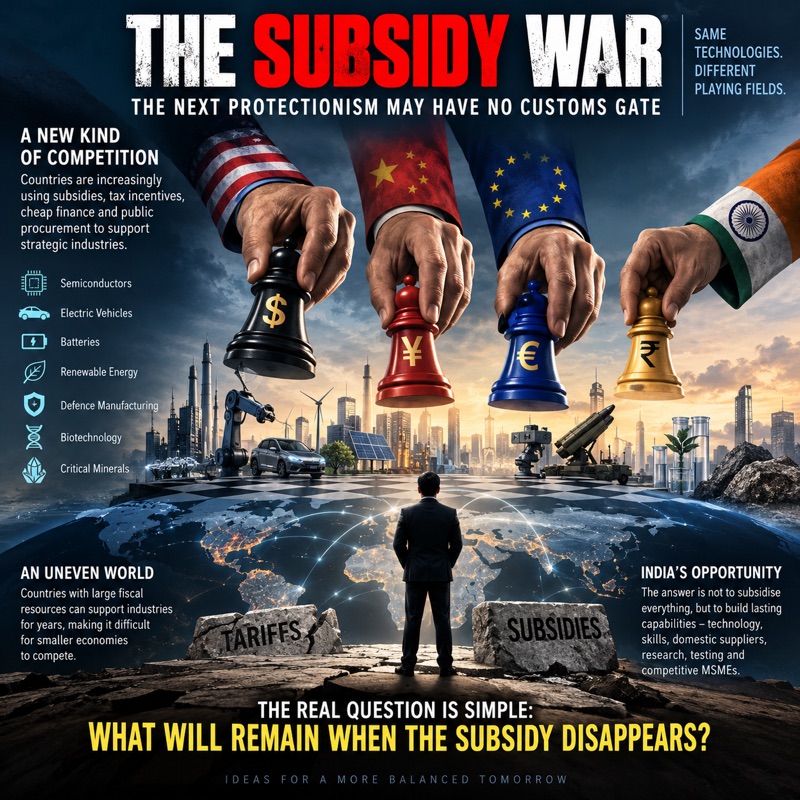
The Subsidy War: When Governments Become Competitors

For much of the last three decades, the visible face of protectionism was the tariff. Governments raised duties, imposed quotas or restricte...