Monday, September 18, 2023

Supporting MSMEs in International Trade: The Global Trade Helpdesk


Micro, Small and Medium-sized enterprises (MSMEs) play a vital role in the global economy. They account for a significant share of employment and GDP in many countries. However, MSMEs often face challenges in accessing trade-related information and services. This can hinder their ability to participate in international trade and grow their businesses.

In recognition of this, the G20 has called for the development of a platform that provides MSMEs with "appropriate, aggregated, trade-related information relevant for MSMEs (micro, small and medium enterprises)". This platform would provide MSMEs with easy access to information on trade policies, regulations, procedures, and market opportunities. It would also provide links to relevant government and international organizations.

The International Trade Centre (ITC), a joint agency of the World Trade Organization (WTO) and the United Nations, has been tasked with developing this platform. The ITC is currently working on a prototype of the Global Trade Helpdesk, which is expected to be launched in 2024.

The Global Trade Helpdesk will be a one-stop shop for MSMEs to access trade-related information and services. It will provide information on a wide range of topics, including:

  • Trade policies and regulations
  • Trade procedures
  • Market opportunities
  • Trade finance
  • Business development services

The Global Trade Helpdesk will be available in multiple languages and will be accessible to MSMEs from all over the world. It will be free to use and will be open to all MSMEs, regardless of their size or sector.

The development of the Global Trade Helpdesk is a welcome step forward in supporting MSMEs to participate in international trade. The platform will provide MSMEs with access to the information and services they need to grow their businesses and contribute to the global economy.

How will the Global Trade Helpdesk benefit MSMEs?

The Global Trade Helpdesk will benefit MSMEs in a number of ways, including:

  • Reduced costs: MSMEs will no longer need to spend time and money searching for trade-related information from different sources. The Global Trade Helpdesk will provide a centralized source of information, saving MSMEs time and money.
  • Improved access to information: The Global Trade Helpdesk will provide MSMEs with access to trade-related information in a clear and concise format. This information will be tailored to the specific needs of MSMEs, making it easier for them to understand and use.
  • Increased export potential: The Global Trade Helpdesk will help MSMEs to identify new export markets and opportunities. It will also provide information on trade policies and regulations, making it easier for MSMEs to export their goods and services.
  • Improved competitiveness: The Global Trade Helpdesk will help MSMEs to improve their competitiveness by providing information on trade finance, business development services, and other resources.

How can MSMEs use the Global Trade Helpdesk?

MSMEs will be able to access the Global Trade Helpdesk through a website or mobile app. The platform will be available in multiple languages and will be free to use.

To use the Global Trade Helpdesk, MSMEs will simply need to create an account and provide some basic information about their business. Once they have created an account, MSMEs will be able to access a wide range of trade-related information, including:

  • Trade policies and regulations
  • Trade procedures
  • Market opportunities
  • Trade finance
  • Business development services

MSMEs can also use the Global Trade Helpdesk to ask questions and get advice from trade experts. The platform will have a team of experts who are available to answer questions and provide guidance on trade-related matters.

The Global Trade Helpdesk is a valuable resource for MSMEs who are interested in exporting or expanding their export potential.

Sources of information:


Sunday, September 17, 2023

Socio-economic Impact Assessment of Food Delivery Platform Workers

Background

The National Council of Applied Economic Research (NCAER) initiated a comprehensive research program consisting of three segments to analyze the socio-economic impact experienced by food delivery platform workers in India. The inaugural component of this research program yielded a report titled "Socio-economic Impact Assessment of Food Delivery Platform Workers." The primary objective of this report was to conduct a comprehensive socio-economic impact assessment pertaining to individuals employed within the food delivery platform sector. An intriguing revelation from the report is that a significant 32 percent of food delivery workers hold college degrees, while an even more substantial 54 percent have completed their class XII education. Remarkably, the report also underscores a concerning trend of declining real wages among food delivery workers. Additionally, it reveals that approximately one-third of these workers possess graduate degrees, further underscoring the severity of the unemployment crisis. Furthermore, the report represents a dedicated endeavor to fathom the nature of the work performed by food delivery platform workers. It aspires to place this work within a coherent framework, offering an insightful exploration into the socio-economic implications that stem from the engagement of workers in this sector. Crucially, this report carries the potential to serve as a valuable guide for policymakers, offering insights that can aid in the formulation of suitable social welfare policies and the establishment of safety nets specifically tailored to address the unique circumstances of platform workers. Moreover, the report advocates for the active involvement of food delivery platforms in supporting gig workers through the e-Shram portal. It underscores the critical importance of granting gig workers access to social security measures, emphasizing the need for their economic and social well-being

The report finds that:

  • Over 32% of food delivery workers are college graduates and more than 54% have passed class XII education.
  • There has been a decline in the real wages of food delivery workers.
  • Around a third of food delivery workers hold graduate degrees, revealing a dire unemployment situation.

The report also highlights that food delivery platform workers face a number of challenges, including:

  • Long working hours
  • Unpredictable earnings
  • Lack of social security benefits
  • Exposure to occupational hazards

The report concludes that food delivery platforms play an important role in the Indian economy, but that more needs to be done to protect the rights and well-being of platform workers.

Recommendations of the Report

The report makes a number of recommendations to policymakers and food delivery platforms, including:

  • Policymakers should design appropriate social welfare policies and safety nets for platform workers.
  • Food delivery platforms should help gig workers on the e-Shram portal.
  • Gig workers need social security access.


Implications of the Report

The report has a number of important implications for policymakers, food delivery platforms, and platform workers themselves.

For policymakers, the report highlights the need to develop policies that protect the rights and well-being of platform workers. This could include providing social security benefits, such as health insurance and pension schemes, for platform workers.

For food delivery platforms, the report shows that more needs to be done to support platform workers. This could include providing them with training and development opportunities, as well as access to affordable healthcare.

For platform workers themselves, the report provides valuable insights into the socio-economic challenges they face. This information can help them to advocate for their rights and interests, and to demand better treatment from food delivery platforms.

https://www.ncaer.org/wp-content/uploads/2023/08/NCAER_Report_Platform_Workers_August_28_2023.pdf

India's Export Dynamics in 2023: Challenges, Opportunities, and Strategies for Sustainable Growth


Background

India's export landscape in 2023 presents a multifaceted picture, characterized by a blend of successes and challenges. Over the past few years, India has witnessed steady growth in exports of goods and services, achieving an unprecedented high of $419 billion in 2022-23. Several factors have fueled this growth, including robust global demand, a competitive exchange rate, and government-driven export promotion initiatives. However, this favorable trajectory has encountered hurdles in recent months, as evidenced by a marked slowdown in export growth during the first quarter of 2023-24, which stood at a modest 2.6%, down from the robust 10.5% seen in the corresponding quarter of the previous year. This deceleration can be attributed to a confluence of factors, including the ongoing Ukrainian conflict, surging inflation rates, and disruptive supply chain interruptions. This essay critically analyzes India's export scenario in 2023, delving into the key challenges faced by the nation's exporters, examining government initiatives aimed at fostering export growth, and offering strategic insights to ensure sustainable export prosperity.


Challenges Facing Indian Exports


Global Economic Slowdown

One of the foremost challenges confronting Indian exports in 2023 is the impending global economic slowdown. Economists and experts predict a gradual deceleration in the global economy, a phenomenon that could potentially diminish the demand for Indian exports. As economic growth rates taper off in various parts of the world, including key trading partners, Indian exporters may face difficulties in maintaining their export momentum. To navigate this challenge, India must adopt a forward-looking approach, diversifying its export portfolio and exploring emerging markets with robust growth potential.


Rising Inflation

Another formidable hurdle is the escalating inflation rates, both within India and among its major trading partners. Inflationary pressures can erode the competitiveness of Indian exports by driving up production costs and, consequently, export prices. The inflationary environment necessitates prudent monetary and fiscal policies to curb price instability and maintain export competitiveness. Additionally, Indian exporters must explore cost-efficient production methods and value-addition strategies to mitigate the impact of rising inflation on their global competitiveness.


Supply Chain Disruptions

The ongoing conflict in Ukraine and other geopolitical factors have disrupted global supply chains, affecting the smooth flow of materials and goods worldwide. These disruptions have a cascading effect on Indian exports, impacting the availability of inputs and causing delays in production and shipments. Addressing this challenge requires enhancing supply chain resilience through strategies like diversification of suppliers, alternative logistics routes, and investment in technology-driven solutions for supply chain management. Collaborative efforts with key partners can also help mitigate the impact of such disruptions.


Trade Protectionism

The specter of trade protectionism looms large in the global trade arena. An increasing number of countries are adopting protectionist measures that can make it more challenging for Indian exporters to access foreign markets. These measures include tariffs, non-tariff barriers, and restrictive trade practices. To counteract this trend, India should engage in diplomatic efforts to reduce trade barriers, advocate for free and fair trade practices, and explore bilateral and multilateral trade agreements that foster market access and a level playing field for Indian exporters.


Government Initiatives to Promote Exports


Recognizing the significance of exports for economic growth and development, the Indian government has introduced several initiatives to bolster the export sector:


Remission of Duties and Taxes on Exported Products (RoDTEP) Scheme

The RoDTEP scheme is a noteworthy initiative aimed at enhancing the competitiveness of Indian exports. It offers refunds of duties and taxes incurred on inputs used in the production of goods intended for export. By reducing the tax burden on exporters, this scheme encourages cost-effective production and contributes to the overall competitiveness of Indian products in the global market.


Merchandise Exports from India Scheme (MEIS)

The MEIS is an incentive scheme that provides financial support to exporters of specific goods. Under this scheme, exporters receive incentives based on the product and destination, thereby promoting the export of goods with high export potential. While this initiative has been beneficial, its effectiveness can be further enhanced by ensuring that incentives align with India's export diversification goals.


National Single Window System (NSWS)

The NSWS is a digital platform that streamlines export-related documentation processes. It offers a unified interface for exporters to submit documentation, reducing bureaucratic delays and enhancing the ease of doing business. This digital infrastructure facilitates smoother export transactions and contributes to the overall efficiency of India's export supply chain.


Issues Require Government Attention


While the government's initiatives to promote exports are commendable, a critical review reveals that a more comprehensive approach is required to address the multifaceted challenges facing Indian exporters in 2023.


Diversification of Exports

Diversification is imperative to reduce India's reliance on a few key products and markets. India should actively seek to expand its export basket by venturing into new product categories and exploring untapped markets. A diversified portfolio not only mitigates risks associated with overdependence but also positions India to capitalize on emerging opportunities in various sectors.


Infrastructure and Logistics Investment

Investing in infrastructure and logistics is vital to improve the efficiency of India's export supply chain. This includes upgrading ports, roads, railways, and airports to facilitate faster movement of goods. Additionally, modernizing warehousing and distribution facilities, implementing advanced tracking technologies, and streamlining customs procedures can significantly enhance India's export competitiveness.


Diplomatic Engagement for Trade

India must engage in diplomatic efforts to reduce trade barriers and promote free trade with its partners. This involves proactive negotiation of trade agreements that prioritize the interests of Indian exporters. Collaborating with like-minded countries and participating in regional and global trade organizations can also help create an environment conducive to unfettered trade.


Export Quality and Innovation

To maintain a competitive edge, Indian exporters should focus on enhancing product quality and innovation. Investment in research and development, adopting cutting-edge technologies, and adhering to global quality standards can elevate the reputation of Indian products and open doors to high-value markets.


Sustainable Export Practices

Sustainability is increasingly becoming a key criterion for global trade. Indian exporters should adopt sustainable practices, reduce environmental impact, and adhere to international standards related to sustainability and corporate responsibility. These efforts can not only enhance market access but also align with global sustainability goals.


Way Forward


 India's export scenario in 2023 is marked by a complex interplay of challenges and opportunities. While the nation has achieved significant export growth in recent years, it faces headwinds such as the global economic slowdown, rising inflation, supply chain disruptions, and trade protectionism. The government's initiatives to promote exports, including the RoDTEP scheme, MEIS, and NSWS, are commendable steps in the right direction. However, a more comprehensive strategy is required to secure long-term export prosperity. To overcome these challenges, India must diversify its export portfolio, invest in infrastructure and logistics, engage in diplomatic efforts to reduce trade barriers and prioritize product quality and innovation. Embracing sustainability in export practices is also crucial. By adopting a proactive and strategic approach, India can navigate the complexities of the global trade landscape and seize the opportunities that lie ahead, ensuring sustained growth and prosperity for its export sector in 2023 and beyond. 


ILO Research Reveals World is Falling Far Short of Achieving SDG 8


Introduction


The International Labour Organization (ILO) recently conducted a comprehensive analysis of the world's progress towards achieving Sustainable Development Goal 8 (SDG 8), revealing that the international community is falling significantly short of its targets. In this report, we will delve into the findings and implications of the ILO's assessment, highlighting the urgent need for action to align with the principles of sustainable development.

SDG 8 Overview


SDG 8 aims to "Promote sustained, inclusive, and sustainable economic growth, full and productive employment, and decent work for all." Notably, it stands out among the Sustainable Development Goals (SDGs) for its comprehensive coverage of economic, social, and environmental dimensions, underscoring the interconnectedness of these aspects in achieving sustainable development.

ILO's Assessment


The ILO's policy brief, titled "Sustainable Development, Decent Work, and Social Justice: An Update on Progress towards SDG 8," provides a sobering analysis of the global progress towards SDG 8. The assessment indicates that the world is veering off track on nearly two-thirds of the SDG 8 indicators, revealing that the international community is almost as distant from the SDG 8 targets as it was in 2015.

Dimensions of Lagging Progress


Economic Dimension:

Surprisingly, progress in the economic dimension of SDG 8 is outpacing that in the environmental and social dimensions. This is a noteworthy observation, suggesting that economic growth is being achieved at the expense of social and environmental sustainability.
Challenges and Recommendations

The ILO's report highlights critical challenges in SDG 8 progress and provides actionable recommendations for a course correction:

Just Transition to Sustainability:


The ILO recommends implementing policies that support a just transition towards environmentally sustainable economies and societies for all. This approach aims to reconcile economic growth with environmental sustainability and social equity.

Multilateral and National Action:


The report underscores the importance of increased multilateral and national action, emphasizing the need for integrated policies, whole-of-government, and whole-of-society approaches. Collaboration and holistic strategies are vital for addressing the multidimensional aspects of SDG 8.
Social Protection and Justice:

Multilateral support for decent work, universal social protection, and social justice in low-income and lower-middle-income countries is deemed essential. Ensuring that vulnerable populations have access to social protection is a critical step towards achieving SDG 8.
Debt Management and Fiscal Space:

Unsustainable debt burdens must be addressed to free up fiscal space for developing countries. This will enable investments in policies, systems, and institutions crucial for SDG progress, including social and labor protection, employment, informality, youth employment, and gender equality.

Policy Integration:


The integration of policy responses for SDG 8, decent work, and social justice is a key recommendation. This integration can be facilitated through initiatives like the Global Coalition for Social Justice, which promotes tripartism and social dialogue to enhance development outcomes, including universal social protection.

Support for Just Transitions:


The ILO emphasizes support for the Global Accelerator on Jobs and Social Protection for Just Transitions, a UN initiative led by the ILO. This initiative seeks to create 400 million decent jobs and extend social protection to an additional 4 billion people.
Conclusion

The ILO's assessment of progress towards SDG 8 paints a stark picture of the challenges ahead. The report calls for immediate and concerted efforts at both the national and international levels to accelerate progress. It underscores the need for a balanced approach that harmonizes economic growth, social equity, and environmental sustainability, echoing the core principles of the 2030 Agenda for Sustainable Development. SDG 8 represents a critical pillar of the global sustainability framework, and addressing its challenges is essential for achieving a more equitable and sustainable world.

Friday, September 15, 2023

"Navigating the EU's Carbon Border Adjustment Mechanism (CBAM): Impacts, Phases, and Prospects for Indian Exporters"


Summary 

The EU's Carbon Border Adjustment Mechanism (CBAM) is a policy that aims to put a fair price on the carbon emitted during the production of carbon-intensive goods that are entering the EU and to encourage cleaner industrial production in non-EU countries. The CBAM will be gradually introduced, aligned with the phase-out of the allocation of free allowances under the EU Emissions Trading System (ETS) to support the decarbonization of EU industry. The CBAM applies to goods produced in non-EU countries, including steel, aluminum, and cement imports into the EU. The CBAM will enter into application in its transitional phase on October 1, 2023, and extend through 2025. During this phase, importers will have a reporting obligation, and the first reporting period for importers will end on January 31, 2024. The full implementation of the CBAM will begin on January 1, 2026. The CBAM regulation would require importers of certain carbon-intensive goods to pay a levy on their imports corresponding to the charge imposed on comparable domestic industries under the EU ETS, thus extending the carbon price paid by EU firms to foreign producers of the same goods. The CBAM aims to address the risk of "carbon leakage," which would occur if the greenhouse gas emissions reductions achieved within the EU under the EU ETS were to be offset by increased emissions in non-EU countries. The impact of CBAM on Indian exporters will depend on the carbon intensity of the exported products and their substitutes in the EU market. The higher taxes on Indian products could make them less competitive in the EU market and lead to a shift in demand towards EU-made products. However, if the EU recognizes India's domestic carbon credit trading, it could help Indian exporters reduce the impact of CBAM on their products. 

The Policy 

The European Union's Carbon Border Adjustment Mechanism (CBAM) is a pioneering policy initiative aimed at addressing carbon emissions linked to imports while aligning with the EU's climate goals. This essay delves into the implications, implementation, and specific consequences for Indian exporters within the context of CBAM. 

 CBAM's Objectives and Implementation 


 Objective 1: 

Gradual Introduction and ETS Alignment CBAM's primary objective is to establish a fair price for the carbon emissions produced during the manufacture of carbon-intensive goods entering the EU. Simultaneously, it promotes cleaner industrial practices in non-EU nations. To achieve this, CBAM is being introduced gradually, mirroring the phasing-out of free emission allowances under the EU Emissions Trading System (ETS). This approach aids the EU in achieving its decarbonization goals.  

Objective 2: 

Levy on Imports CBAM enforces a levy on select carbon-intensive imports, reflecting charges equivalent to those imposed on similar domestic industries under the EU ETS. This ensures that the carbon cost of imported goods aligns with domestic production, thus preventing carbon leakage. 

Objective 3: 


Compatibility with WTO Rules CBAM is meticulously designed to be compatible with the regulations set forth by the World Trade Organization (WTO). This alignment aims to reduce the risk of trade disputes while simultaneously advancing climate objectives. 

Objective 4: 

Expanding Scope and Gradual Rollout Initially, CBAM applies to goods originating from non-EU countries, encompassing products such as steel, aluminium, and cement imports. However, it is expected to encompass a broader range of products over time. Full CBAM implementation is projected to be realized around 2030-2032, signifying comprehensive integration into the EU's trade framework. 

 Impact on Indian Exporters 


 Impact 1: 

Higher Taxes Projections suggest that CBAM may introduce a tax ranging from 20% to 35% on steel, aluminum, and cement imports into the EU, effective from January 1, 2026. This potentially increases the tax burden on Indian exports, potentially rendering them less competitive compared to EU counterparts. 

 Impact 2: 

Shift in Demand Elevated taxes on Indian goods may provoke a shift in demand towards EU-manufactured alternatives. This shift has the potential to influence the Indian manufacturing industry significantly. 

 Impact 3: 

Recognition of Domestic Carbon Credit Trading India has formally approached the EU with a request for the recognition of its domestic carbon credit trading. Such recognition, if granted, could offer Indian exporters a viable strategy to offset CBAM-related impacts through carbon credit trading. 

The EU's Carbon Border Adjustment Mechanism (CBAM) represents a pivotal development in harmonizing trade with climate objectives. Its phased implementation ensures equitable carbon pricing between imported and domestically produced goods, curbing carbon leakage and supporting EU decarbonization endeavors. While Indian exporters confront potential challenges, notably increased taxes and shifting demand, the potential recognition of domestic carbon credit trading provides a promising avenue for mitigating these challenges. The phased transition during the transitional phase of CBAM is engineered to ensure seamless integration of this transformative policy into the EU's trade framework. 


 Citations: 

[1] https://taxation-customs.ec.europa.eu/carbon-border-adjustment-mechanism_en [2] https://taxation-customs.ec.europa.eu/system/files/2023-07/20230714%20Q%26A%20CBAM_0.pdf [3] https://climatetrade.com/how-the-eus-carbon-border-adjustment-programme-cbam-strategy-is-evolving/ [4] https://www.jdsupra.com/legalnews/european-commission-adopts-reporting-9805066/ [5] https://www.csis.org/analysis/analyzing-european-unions-carbon-border-adjustment-mechanism [6] https://www.whitecase.com/insight-alert/eu-agreement-carbon-border-adjustment-mechanism

"Philosophical Insights in the Age of AI: Navigating Transformation with Critical Thinking and Ethics"


From rawpixel.com


In today's rapidly evolving world, the integration of philosophy and artificial intelligence is reshaping our understanding of various disciplines. As someone who studied economics at the master's level, I never anticipated the profound impact philosophy could have on the realm of artificial intelligence. However, a book titled "The Age of AI," penned by renowned authors Henry Kissinger, Eric Schmidt, and Daniel Huttenlocher, has shed light on this revolutionary connection.


"The Age of AI" explores how our approach to security, economics, order, and even knowledge itself has undergone a remarkable transformation in recent years. This transformation is largely attributed to the growing influence of artificial intelligence on various aspects of our lives. To comprehend this change, it is essential to delve into the profound implications philosophy has had on AI.


Philosophy, at its core, is concerned with understanding fundamental aspects of existence, knowledge, truth, and morality. It provides a framework for critical thinking and asks profound questions about the nature of reality. By integrating philosophical concepts into the development and application of AI, researchers and thinkers are able to tackle ethical, social, and existential quandaries arising from the advancement of technology.


One fundamental aspect of AI that philosophy addresses is the question of consciousness. Can machines attain consciousness, or is it an exclusively human trait? Philosophical theories of mind, such as functionalism and dualism, offer valuable insights into this debate. By exploring the nature of consciousness and its relationship with AI, we can better understand the limitations and potentials of artificial intelligence systems.


Moreover, philosophy encompasses epistemology, which seeks to comprehend the nature of knowledge itself. In the context of AI, this becomes crucial as machines increasingly become powerful tools of knowledge creation, analysis, and dissemination. The book "The Age of AI" highlights the transformative impact of AI on knowledge acquisition, challenging existing paradigms and redefining how we generate insights and gain understanding.


AI also has far-reaching implications for security and geopolitics. The integration of AI technology into military systems, surveillance, and cybersecurity has raised significant concerns about ethics, privacy, and national security. Philosophical discussions surrounding ethics and political philosophy provide a lens through which we can critically examine the impact of AI on these domains. By engaging with philosophical thought, policymakers, and technologists can navigate the complex ethical landscape, ensuring responsible and accountable use of AI in security and geopolitical contexts.


Furthermore, the economic ramifications of AI cannot be overlooked. AI has the potential to disrupt industries, reshape labor markets, and redefine economic systems. Philosophy, particularly the branch of philosophy of economics, offers insights into economic theories, models, and principles that can be applied to analyze and guide the integration of AI within the economic domain. By contemplating philosophical concepts of value, market mechanisms, and distributive justice, economists can better understand and navigate the challenges and opportunities presented by AI-driven economic transformations.


Lastly, philosophy brings to the forefront the concept of order and its relationship to AI. Given the immense power and influence AI can wield, questions surrounding the impact on societal order, governance, and democracy become paramount. Philosophers have long pondered and analyzed the nature of political and social order, providing frameworks for understanding legitimacy, power structures, and the balance between individual rights and collective well-being. The age of AI necessitates a thoughtful engagement with these philosophical ideas, enabling us to shape a future that upholds principles of justice, equality, and human dignity.


The integration of philosophy and artificial intelligence offers a profound understanding of the changing world we live in. By contemplating philosophical concepts such as consciousness, knowledge, ethics, political philosophy, economics, and societal order, we can navigate the complexities of AI-driven transformations. "The Age of AI," authored by Henry Kissinger, Eric Schmidt, and Deniel Huttenlocher, serves as a valuable resource in exploring these connections. Embracing philosophy in our exploration of AI ensures that we approach this new epoch with critical thinking, ethical considerations, and a commitment to shaping a future that benefits humanity as a whole.

Thursday, September 14, 2023

The Challenges and Solutions in the Microfinance Sector in India


 Microfinance is a form of financial inclusion that aims to provide access to credit and other financial services to the poor and low-income segments of society. Microfinance has been recognized as a tool for poverty alleviation, empowerment of women, and promotion of entrepreneurship in India. However, the microfinance sector in India also faces several challenges that hamper its growth and impact. Some of these challenges are:

Debt Overhang

This refers to the situation where borrowers take multiple loans from different sources and are unable to repay them on time. Over-indebtedness can lead to stress, harassment, default, and even suicide among borrowers. It can also affect the repayment capacity and creditworthiness of the microfinance institutions (MFIs) that lend to them. According to a report by PwC⁵, over-indebtedness is one of the major risks faced by the microfinance sector in India, especially in states like Tamil Nadu, Karnataka, Telangana, and West Bengal, where the average loan size and loan per borrower are high.

High-Interest Rates

The interest rates charged by MFIs are generally higher than those of mainstream banks, as they have to cover the high operational costs, credit risks, and regulatory compliance involved in lending to the poor. However, high interest rates can also deter potential borrowers from availing of microfinance services, or force them to resort to informal sources of credit such as moneylenders, who may charge even higher rates or exploit them in other ways. High interest rates can also reduce the net income and savings of the borrowers, and affect their ability to invest in productive activities.

Over-dependence on the Banking System

 The microfinance sector in India relies heavily on the banking system for its funding needs, as MFIs borrow from banks and other financial institutions to lend to their clients. However, this also exposes the sector to the liquidity and solvency risks of the banking system, as well as the fluctuations in interest rates and credit availability. For instance, the failure of Infrastructure Leasing & Financial Services (IL&FS) in 2018 triggered a liquidity crunch in the non-banking financial sector, which affected the funding profile and cost of funds of NBFC-MFIs⁴. Similarly, the COVID-19 pandemic has caused disruptions in banking operations and loan collections, which have impacted the cash flows and liquidity of MFIs.

Lack of Awareness and Financial Literacy 

Many potential and existing borrowers of microfinance lack awareness and financial literacy about the products and services offered by MFIs, their terms and conditions, their rights and responsibilities, and the grievance redressal mechanisms available to them. This can lead to mis-selling, over-borrowing, inappropriate use of loans, or inability to repay them. Lack of awareness and financial literacy can also limit the demand and uptake of other financial services such as micro-insurance, micro-savings, and digital payments, which can enhance the financial inclusion and well-being of the poor.

Regulatory Issues 

The microfinance sector in India is regulated by different authorities such as the Reserve Bank of India (RBI), the National Bank for Agriculture and Rural Development (NABARD), the Securities and Exchange Board of India (SEBI), and various state governments. This creates a complex and heterogeneous regulatory environment for MFIs, which have to comply with different norms and standards depending on their legal form, size, scope, and location. For instance, NBFC-MFIs have to follow the RBI's guidelines on loan size, loan tenure, interest rate cap, margin cap, borrower eligibility, etc., while non-profit MFIs are regulated by NABARD under different criteria. Moreover, some state governments have enacted their own laws or regulations for MFIs, such as imposing interest rate ceilings, loan waivers, moratoriums, etc., which can create conflicts or inconsistencies with the central regulations.

The Problem in the Identification of the Appropriate Model 

The microfinance sector in India comprises various types of MFIs such as NBFC-MFIs, non-profit MFIs (such as trusts, societies, and cooperatives), self-help groups (SHG) bank linkage programs (SBLP), joint liability groups (JLGs), etc., each with its own advantages and disadvantages. However, there is no clear consensus on which model is more suitable or sustainable for delivering microfinance services to the poor. For instance, some studies have suggested that SHGs are more effective than JLGs in empowering women and reducing poverty¹, while others have argued that JLGs are more efficient and scalable than SHGs². Similarly, some studies have found that NBFC-MFIs have better outreach and performance than non-profit MFIs³, while others have highlighted the social impact and innovation potential of non-profit MFIs⁵.

Recommendations

These are some of the major challenges faced by the Indian microfinance industry that need to be addressed through collective efforts by all stakeholders such as MFIs, regulators, policymakers, investors, donors, researchers, etc. Some possible solutions or recommendations are:

- Strengthening the credit information system and credit bureaus to prevent multiple lending and over-indebtedness, and to improve the credit assessment and risk management of MFIs.

- Promoting competition and innovation in the microfinance sector to reduce interest rates and operational costs, and to offer more diverse and customised products and services to the borrowers.

- Diversifying the sources and instruments of funding for MFIs, such as equity, debt, securitisation, bonds, etc., to reduce their dependence on the banking system and to enhance their liquidity and solvency.

- Enhancing the awareness and financial literacy of the borrowers through financial education campaigns, counseling, training, etc., to enable them to make informed and responsible financial decisions.

- Harmonising and simplifying the regulatory framework for MFIs, by adopting a uniform and proportionate approach based on the principles of consumer protection, financial stability, and financial inclusion.

- Encouraging collaboration and coordination among different types of MFIs, such as through partnerships, mergers, networks, etc., to leverage their respective strengths and synergies, and to achieve greater scale and impact.


Sources:

(1) Vision of microfinance in India - PwC. https://www.pwc.in/assets/pdfs/consulting/financial-services/vision-of-microfinance-in-india.pdf.

(2) Reserve Bank of India - RBI Bulletin. https://www.rbi.org.in/scripts/BS_ViewBulletin.aspx?Id=19775.

(3) Challenges faced by the Indian microfinance industry - Project Guru. https://www.projectguru.in/challenges-indian-microfinance-industry/.

(4) . https://bing.com/search?q=micro+finance+challenges+india.

(5) Microfinance: Status, Benefits, Challenges and Solutions - ForumIAS. https://blog.forumias.com/microfinance-status-benefits-challenges-and-solutions-explained-pointwise/.

(6)https://mfinindia.org/assets/upload_image/publications/Studies/MFIN%20India%20Microfinance%20Review%20FY%2020-21.pdf.

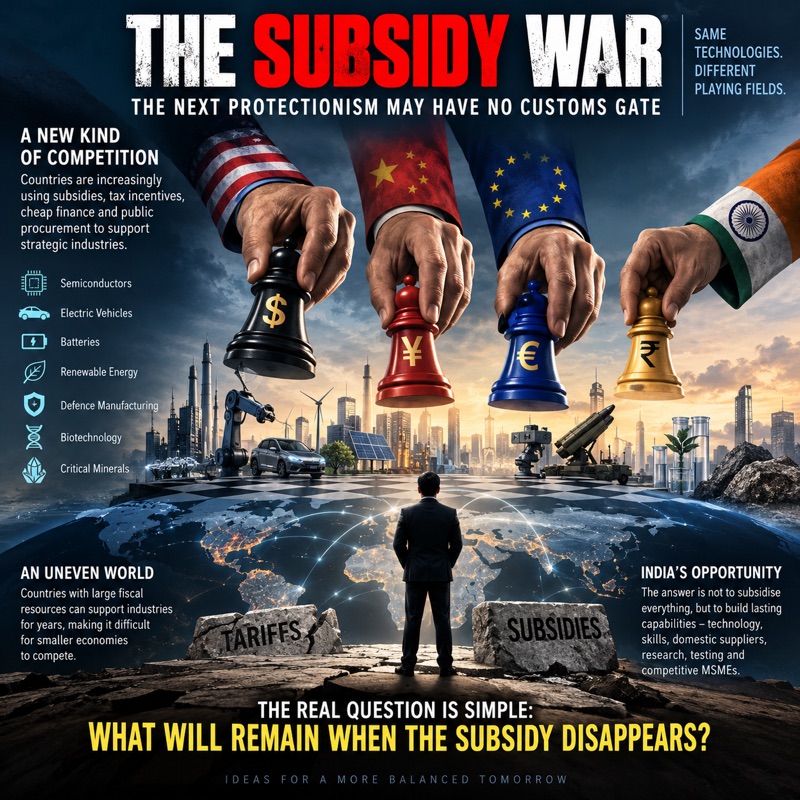
The Subsidy War: When Governments Become Competitors

For much of the last three decades, the visible face of protectionism was the tariff. Governments raised duties, imposed quotas or restricte...